Italy Guide  |
|---|
|
| | Top Italian Cities |
|---|
|
| | Italian Regions |
|---|
|
| | Europe Guide |
|---|
|
| | Travel Tools |
|---|
|
|
|
|
 Sassi di Matera, Basilicata. Sassi di Matera, Basilicata.
Introduction

Basilicata is the third least populous Italian region, with 591,000, and the second least densely populated (59 inhab./km²) after Aosta Valley. The region can be thought of as the "instep" of Italy, with Calabria functioning as the "toe" and Apulia the "heel". Basilicata is the most mountainous region of Southern Italy, with 47% of its area covered by mountains and 45% by hills.
The most compelling attraction in Basilicata is Matera, an ancient town of ochre stones lying inside a small canyon. Its Sassi are cave dwellings thought to be among the earliest human settlements in Italy (possibly 9,000 years old), and still in use today.
At the region's other extremity, the Pollino National Park is one of the few places in Italy where one can spot Egyptian vultures. There are also golden eagles, peregrine falcons, red kites, as well as otters, deer and wolves. It is the second largest national park in the country.
Attractions
| Matera ※ |
|---|

 Matera is one of the world's oldest continuously inhabited cities, with evidence of human settlements dating back to 7000 BCE. The city is renowned for its unique Sassi districts, ancient cave dwellings carved into limestone rock, which were declared a UNESCO World Heritage Site in 1993. Matera's history is a remarkable tale of transformation. Once dubbed the "shame of Italy" due to its extreme poverty and poor living conditions in the 1950s, the city has undergone a dramatic rebirth. It was named a European Capital of Culture in 2019, showcasing its cultural significance and successful urban regeneration. The Sassi were once considered symbols of poverty but have since been restored and transformed into boutique hotels, restaurants, and cultural spaces. Matera gained international fame as a filming location, including for movies like The Passion of the Christ and No Time to Die. |
| Pollino National Park
|
|---|
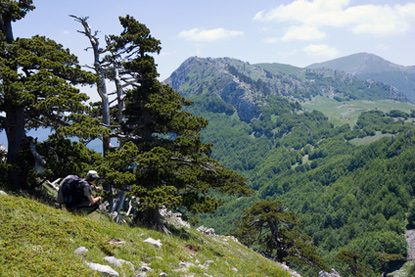
 Pollino National Park, established in 1992, is Italy's largest national park, covering 1,925 square kilometers across the regions of Basilicata and Calabria. It's home to Europe's oldest tree, a 1,230-year-old Heldreich's pine, and became a UNESCO World Heritage Site in 2015. The park boasts impressive biodiversity, including golden eagles, Italian wolves, and the rare Bosnian pine, which is the symbol of the park. From its highest peaks, which exceed 2,000 meters above sea level, visitors can see both the Tyrrhenian and Ionian coasts on clear days. The park also features several Albanian-speaking communities, adding cultural diversity to its natural wonders. Pollino National Park is a haven for outdoor enthusiasts, offering activities like hiking, rafting, and rock climbing. Its cultural richness adds another layer, with charming villages, historic monasteries, and local culinary delights, such as pasta made with the region’s famous chili peppers. |
| Castelmezzano & Pietrapertosa |
|---|

 Castelmezzano and Pietrapertosa are two picturesque hilltop towns, both recognized as among "The most beautiful villages of Italy". These towns are uniquely situated in the Lucanian Dolomites, a mountainous area that provides a stunning backdrop. One of the most thrilling attractions connecting these towns is the Volo dell'Angelo (Angel's Flight), a high-speed zipline that spans the valley between them, offering breathtaking views at over 400 meters above ground. Castelmezzano's history dates back to ancient Greek settlers, and its name derives from a Norman castle built between the 11th and 13th centuries. Pietrapertosa, on the other hand, features an old quarter called Arabata, named after the Arabs who lived there for nearly 50 years, creating a labyrinth of uphill alleys and steps. It is the highest village in Basilicata (1,088 meters above sea level). Both towns are known for their traditional crafts, with Pietrapertosa particularly famous for its woodworking and furniture creation. The area is a paradise for outdoor enthusiasts, with numerous hiking trails that wind through the rugged peaks and forests of the Lucanian Dolomites. The Sentiero delle Sette Pietre ("Path of the Seven Stones") is a notable route, blending nature and local legends. |
| Craco |
|---|

 Craco is a fascinating ghost town perched atop a 400-meter-high cliff. Founded by Greeks in the 8th century BCE, it grew into a thriving medieval village with a rich history. In 1276, a university was established in Craco, and by the 15th century, it boasted four large plazas and several noble residences. However, the town faced numerous challenges over the centuries, including plagues, famines, and earthquakes. The final blow came in the 1960s when landslides, likely caused by faulty infrastructure work, forced the evacuation of the last 1,800 residents in 1963. Today, Craco has become a popular tourist attraction and filming location, featured in movies such as "The Passion of the Christ" and "Quantum of Solace". Visitors can now explore the haunting ruins on guided tours, wearing protective helmets as they walk through the abandoned streets and buildings frozen in time. |
Other attractions
 Avigliano
Maratea
Potenza
|


 : Local interest
 : Moderately interesting
 : Outstanding place
 : Must-see in the country
 : Top cities in Europe