


| Contents |
|---|

Introduction
Overlooking the Adriatic Sea, Molfetta is located approximately 30 minutes north from Bari. Dating back to Neolithic times, Molfetta began as a small fishing port in the 4th century BCE and developed significant importance as a trading centre during Byzantine rule and the Crusades. The ancient port, which has Roman origins, remains active with local fishermen today. The historic centre features impressive architecture, including the 11th-century Cathedral of San Corrado with its distinctive bell towers, the Cathedral of the Holy Assumption, and the Basilica of the Madonna of the Martyrs. Visitors can explore the charming cobblestone streets, enjoy the picturesque seafront promenade, and sample local specialities including fresh seafood and traditional orecchiette pasta.
Interesting Facts about Molfetta
- Molfetta is home to Il Pulo, one of the most important Neolithic sites in southern Italy, which is a karst doline located just 2 km from the town.
- The city has strong Greek roots, with two temples in honour of Neptune and Diana said to have existed there in ancient times.
- Molfetta's Old Cathedral (Duomo Vecchio) was built in the 12th-13th centuries in Romanesque-Pugliese style, featuring three distinctive cupolas and two slender towers.
- The medieval centre of Molfetta was originally located on a peninsula known as Sant'Andrea, named after an ancient church first mentioned in documents from 1126.
- During the Middle Ages, Molfetta was an important trading port that had commercial relations with major cities like Venice, Alexandria, Constantinople, Syria, Amalfi and Ragusa.
- The city was sacked by the French on 18-19 July 1529, an event that stalled the economic rebirth of the city.
- Molfetta has two cathedrals: the old Romanesque Duomo dating from the 11th century, and the newer Baroque Santa Maria Assunta, which became the cathedral in 1775.
- The Basilica of the Madonna of the Martyrs, the oldest church in town, contains a sculpture of the Holy Sepulchre carved from stone transported from the Holy Land.
- The narrow, winding streets of Molfetta Vecchia (Old Molfetta) were designed in a confusing pattern to disorient invaders, who would be attacked from the rooftops when they entered the city.
- In 2006, Molfetta hosted the International Youth Parliament, an event that had taken place the previous year in Canterbury.
- The city was once ruled by a feisty Norman knight named Jocelyn, who acquired Molfetta as payment for services rendered to Robert Guiscard but later changed loyalties to the Greeks.
- Molfetta's historic centre features streets designed in a "fish skeleton" pattern, appropriate for a town with a long fishing tradition.

History
Molfetta’s origins trace back to the early medieval period, with documented references emerging by the 10th and 11th centuries as a fortified village encircled by protective walls and a seaside palace structure. Strategically positioned along the Adriatic coast, the town flourished under successive rulers, including the Swabians, Aragonese, and Angevins, who capitalised on its harbour for commercial prosperity. Frederick II of Swabia elevated Molfetta to a "royal city" in the 13th century, recognising its geopolitical value during the Crusades as a vital stopover for pilgrims en route to the Holy Land. This era cemented Molfetta’s role as a maritime hub, with its port facilitating trade across the Mediterranean and fostering economic growth that funded the construction of enduring landmarks like the Romanesque Duomo Vecchio, begun in the 11th century.
The town’s medieval fabric, concentrated on the Sant’Andrea peninsula, reflects a blend of defensive and sacred architecture. The Centro Antico, once a derelict quarter, now showcases restored 16th-century palazzi and labyrinthine streets radiating from Piazza Municipio, the site of a razed 15th-century castle. Despite suffering devastation during the French Sack of 1529, which obliterated swathes of its architectural heritage, remnants like Torrione Passari—a circular artillery tower erected in 1512—testify to Molfetta’s adaptive fortifications. Ecclesiastical landmarks punctuate the skyline, including the Baroque Santa Maria Assunta Cathedral, which supplanted the older Duomo as the episcopal seat in 1775, and the Basilica of the Madonna dei Martiri, housing relics from the Holy Land.
Molfetta’s maritime identity deepened in the 19th century with port expansions to accommodate burgeoning mercantile and fishing industries, culminating in the construction of the lighthouse and outer piers by 1890. This nautical legacy intertwines with cultural contributions from native artists like Baroque painter Corrado Giaquinto, whose works adorn local churches and Madrid’s Prado Museum. Today, the regenerated harbour and historic core, with their interplay of medieval stonework and modern revitalisation, invite exploration of a town where the Adriatic’s rhythms have shaped centuries of resilience and reinvention.

Main Attractions
Duomo di San Corrado
The Duomo di San Corrado stands as a magnificent example of Romanesque architecture in Puglia, constructed during the 11th century and dedicated to Molfetta's patron saint, San Corrado di Baviera. This cathedral's distinctive silhouette is defined by two imposing towers that serve different purposes—one functions as a traditional bell tower while the other was designed as a watchtower to alert the town of approaching dangers from the sea. The building's most remarkable feature is its trio of uniquely shaped domed cupolas that create an unmistakable profile against the Adriatic skyline. These domes, unusual for Romanesque architecture in the region, represent a fascinating architectural solution that draws visitors' attention.
The cathedral's interior presents an austere and solemn atmosphere typical of Romanesque design, featuring three naves separated by stone columns that support the weight of the structure above. The side chapels, added during the 15th and 16th centuries, showcase the evolution of artistic styles over the centuries, with decorative elements reflecting both Gothic and Renaissance influences. The stone altar, carved with intricate biblical scenes, serves as the focal point of the main nave. Particularly noteworthy is the crypt, which houses relics of San Corrado and features columns salvaged from earlier structures, possibly dating to the Roman period. The cathedral's strategic position overlooking the sea not only provides spectacular views of the old port area but also speaks to its historical role as both a religious centre and a landmark for sailors returning to Molfetta.

Basilica della Madonna dei Martiri
The Basilica della Madonna dei Martiri represents one of Molfetta's most significant religious landmarks, with foundations dating back to 1162, making it the oldest church in the city. The basilica's façade combines elements from various architectural periods, reflecting the numerous renovations and expansions it has undergone throughout its long history. The structure's relationship with maritime traditions is evident in the numerous ex-votos displayed inside—offerings from sailors and fishermen who attributed their survival at sea to the Madonna's intervention.
Within its walls, the basilica houses an impressive collection of religious artworks, including the notable Madonna del Rosario painted in 1574, which exemplifies the late Renaissance style that influenced sacred art in southern Italy. Perhaps the most unique feature is the meticulously crafted replica of the Holy Sepulchre, constructed using stones specifically brought from the Holy Land by pilgrims and crusaders. Adjacent to the main basilica stands the "Ospedale dei Crociati" (Hospital of the Crusaders), which originally served as a resting place and infirmary for pilgrims on their journey to Jerusalem. The building complex includes a courtyard with a well that has provided water continuously since medieval times. The basilica's bell tower offers views across the city and sea, while the annual September festival dedicated to the Madonna transforms the surrounding area into a vibrant celebration of religious and maritime traditions that has continued uninterrupted for centuries.
Historic Centre
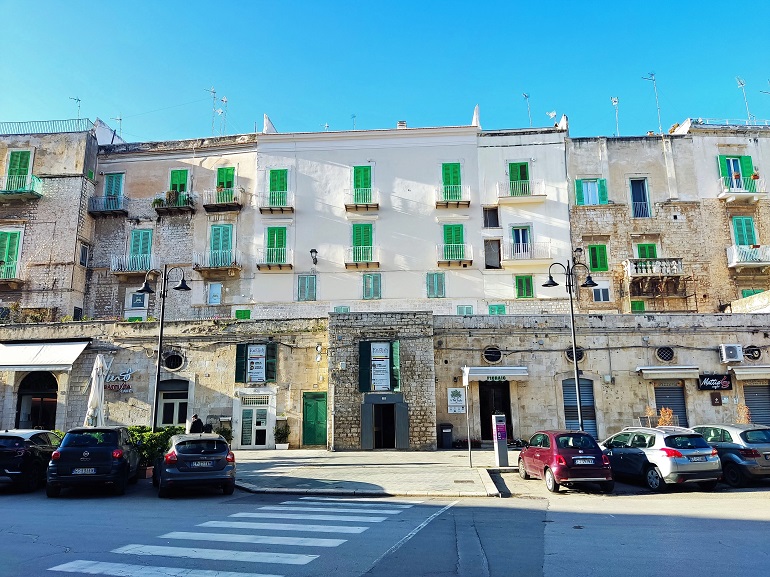
Molfetta's historic centre presents a captivating labyrinth of narrow medieval streets and intimate squares that have retained their original layout since the 12th century. This area, known locally as "Borgo Antico," is enclosed within the remnants of ancient defensive walls that once protected the settlement from coastal raiders. The network of streets follows an organic pattern typical of medieval urban development, with winding pathways that occasionally open into small piazzas where community life has centred for centuries. The buildings throughout this district feature the distinctive white limestone construction typical of Pugliese architecture, their façades weathered to subtle cream and grey tones that create a harmonious visual ensemble.
Throughout the historic centre, visitors encounter numerous religious buildings beyond the main cathedral, including the Church of Santo Stefano with its ornate Baroque interior that contrasts with the simplicity of its exterior, and the Church of San Pietro with its remarkable 13th-century frescoes depicting biblical scenes executed in the Byzantine-influenced style common in southern Italy during this period. The residential architecture displays fascinating details that reveal the area's history, from Norman-influenced arched doorways to decorative balconies added during the 18th century. Many buildings feature external staircases known as "scale scoperte" that served practical purposes in the dense urban environment while creating distinctive architectural rhythms along the narrow streets. Small shrines dedicated to the Madonna and various saints are embedded into street corners and building walls, many still maintained by local residents who place fresh flowers and light candles at these centuries-old devotional sites. The historic centre also contains several ancient courtyards hidden behind unassuming entrances, where communal wells and cisterns reflect the ingenious water management systems developed during periods when fresh water was a precious resource in this coastal community.
Torrione Passari
Torrione Passari represents a remarkable example of 16th-century military architecture, constructed in 1512 as a crucial component of Molfetta's coastal defence system against Ottoman raids. This imposing circular watchtower features massive walls that measure up to five metres thick at the base and gradually taper as they rise, employing an architectural technique designed to withstand cannon fire while providing stability. The tower's strategic position allowed sentinels to monitor the coastline and communicate with other defensive structures through a system of fire signals, creating an early warning network along the Adriatic coast.
The interior of Torrione Passari reveals the practical aspects of defensive architecture, with its spiral staircase built into the thickness of the walls and designed to disadvantage right-handed attackers who might breach the tower. The observation platform at the top provides breathtaking 360-degree panoramic views of the Adriatic coastline and Molfetta's urban landscape. The tower's stonework displays the skilled craftsmanship of the period, with precisely cut blocks that have withstood centuries of coastal weathering. Historical records indicate that the tower was named after the Passari family, who contributed significantly to its construction and initial maintenance. Archaeological investigations have uncovered evidence of earlier structures beneath the tower, suggesting that this strategic position has been valued for defensive purposes since ancient times. Today, the restored interior houses informational displays about the tower's role in the broader context of Mediterranean maritime conflicts and coastal defence strategies employed throughout the region.

Old Port
The old port of Molfetta represents the heart of the city's maritime identity, having served as the centre of fishing activities and trade for many centuries. Unlike more modernized harbours, Molfetta's old port retains much of its traditional character, with fishing vessels still dominating the waterfront rather than pleasure craft. The port basin is protected by two extending arms that create a natural harbour, with the eastern mole dating back to the 15th century and expanded over subsequent periods as maritime traffic increased. The distinctive blue and red wooden fishing boats known as "gozzi" that line the quayside follow designs that have changed little over generations, their sturdy construction specifically adapted to local fishing methods and Adriatic conditions.
The waterfront surrounding the old port features buildings that directly relate to maritime activities, including former warehouses with wide arched entrances that allowed goods to be moved efficiently between ships and storage. The fish market building, though modernized internally to meet contemporary standards, retains its historical façade and continues to serve its original purpose as the place where the day's catch is sold each morning in a lively auction that begins when the fishing fleet returns. Fishermen can often be observed along the quayside mending their nets using traditional techniques passed down through families, creating a living connection to practices that have sustained the community for centuries. The lighthouse at the harbour entrance, though not ancient, has become an iconic landmark that guides vessels safely into port while providing a popular photography subject, particularly when illuminated against evening skies. The area surrounding the old port contains numerous small restaurants specializing in seafood dishes prepared according to local traditions, where the proximity to the fishing fleet ensures exceptional freshness. During religious festivals, particularly that of the Madonna dei Martiri in September, the port becomes the focal point for maritime processions where the statue of the Madonna is carried on boats decorated with flowers and lights, continuing a tradition that has linked Molfetta's religious and maritime heritage for over eight centuries.
Lungomare Europa
Lungomare Europa serves as Molfetta's primary seafront promenade, stretching for several kilometres along the Adriatic coastline and providing residents and visitors alike with a scenic route for walking, jogging, or cycling. The promenade was developed in the late 20th century as part of urban renewal efforts but incorporates elements of the city's historical relationship with the sea. The walkway is paved with local stone that reflects the traditional building materials of the region, while modern design elements create comfortable seating areas and viewing platforms at regular intervals.
The Lungomare offers constantly changing vistas of the Adriatic Sea, from tranquil morning scenes with fishing boats heading out for the day's catch to dramatic sunset panoramas that transform the water into a canvas of vibrant colours. Along certain stretches, the promenade is lined with palm trees and native Mediterranean plants that provide shade during summer months and add to the coastal atmosphere. The route connects various parts of Molfetta's coastline, from the historic port area to more modern sections of the city, effectively serving as a timeline of the city's development. Numerous small coves and access points to the water can be discovered along the way, some offering steps down to small pebble beaches where locals swim during warmer months. The Lungomare also features several monuments and sculptures that reference Molfetta's maritime heritage, including tributes to fishermen lost at sea and the city's historical role in Adriatic trade networks. During summer evenings, the promenade transforms into a social hub where families stroll, street performers entertain, and the cooling sea breeze provides relief from the Pugliese heat.
Beaches
Molfetta's coastline features distinctive pebble beaches nestled at the base of limestone cliffs, offering a different experience from the sandy shores found elsewhere in Puglia. These beaches are characterized by exceptionally clear waters that range from turquoise in the shallows to deep azure further from shore, providing excellent visibility for swimming and snorkelling. The pebble composition of the beaches—primarily smooth, white stones polished by centuries of wave action—creates a striking visual contrast with the blue waters and contributes to the remarkable clarity of the sea by reducing sediment.
Lido Bahia Beach represents one of the more developed beach areas, offering a combination of free access and serviced sections where visitors can rent loungers and umbrellas. The beach is framed by natural rock formations that create small, sheltered coves ideal for swimming. Near Torrione Passari, several smaller beaches combine natural beauty with historical context, as bathers can enjoy views of the 16th-century watchtower while relaxing by the water. These beaches feature interesting geological formations, including natural arches and caves carved by wave action that can be explored during low tide. The underwater environment near these beaches is equally impressive, with rocky reefs supporting diverse marine ecosystems that attract snorkellers. During quieter seasons, particularly spring and autumn, the beaches become perfect spots for contemplation, with the rhythmic sound of waves washing over the pebbles creating a naturally meditative atmosphere. Local fishermen still launch their small boats from certain sections of these beaches, continuing traditions that have remained largely unchanged for generations and adding an authentic cultural dimension to the seaside experience.
Pulo di Molfetta
The Pulo di Molfetta presents a fascinating geological formation located just 1.5 kilometres southwest of the city centre. This karst doline—a large depression formed by the collapse of an underground cave system—reaches approximately 30 metres in depth and 170 metres in diameter, creating a dramatic landscape feature unusual for the relatively flat Puglia region. The formation began millions of years ago through the slow dissolution of limestone by rainwater, eventually creating the impressive depression visible today. The microclimate within the Pulo supports unique vegetation that differs from the surrounding area, including rare plant species that have adapted to the specific conditions of this sheltered environment.
The walls of the Pulo contain numerous caves that bear evidence of human occupation dating back to the Bronze Age, with archaeological investigations revealing that these natural shelters were used for both habitation and burial purposes. Only one cave has been properly secured for public access, containing a Neolithic tomb with replicas of the archaeological finds discovered during excavations. These findings included pottery, stone tools, and evidence of early agricultural practices that provide valuable insights into prehistoric life in the region. Geological studies of the Pulo have contributed significantly to understanding the karst processes that shaped much of Puglia's landscape. The site also features evidence of historical quarrying activities, as the depression's stone was extracted for construction purposes in Molfetta during medieval and early modern periods. The rim of the Pulo offers spectacular views of the entire formation, while paths allow visitors to descend partially into the depression to experience its unique atmosphere and observe the geological features up close.
Top Museums
Diocesan Museum of Molfetta
The Museum of the Diocese of Molfetta, Ruvo, Giovinazzo and Terlizzi is elegantly housed in the seventeenth-century Jesuit College (now used as an Episcopal Seminary). This impressive museum spans three levels and contains works of great historic, artistic, archaeological and liturgical value.
The museum journey begins with a rich archaeological section featuring prehistoric and pre-Roman artefacts, many discovered during excavation campaigns at the Pulo di Molfetta and surrounding archaeological sites. The ground floor also houses the fascinating Lapidarium room, containing architectural fragments and sculptures from Molfetta's ancient Duomo and other churches.
A highlight of the collection is the display of antique wooden statues used in Molfetta's Holy Week processions, commissioned by the Confraternity of Death. These statues bring to life the Mystery of Easter as they're arranged to reflect their traditional processional route through the town.
The first floor features the monumental Library of the Episcopal Seminary, housing approximately 47,000 volumes including manuscripts, incunables, graduals, and numerous other volumes dating from the sixteenth and seventeenth centuries. The picture gallery on the second floor illustrates the development of local painting over the centuries, with works spanning from the fifteenth century to modern day.
Ethnographic Museum of the Sea
Located in the premises of the Fabbrica di San Domenico, the Ethnographic Museum of the Sea (Museo Etnografico del Mare) has been curated by the Molfetta Archeoclub since 2005. This museum celebrates Molfetta's unbreakable link with the sea and is considered one of the town's cultural treasures.
The exhibition meticulously documents all phases of the development of the city's port activities and shipbuilding industry. Most of the displayed materials have been donated by local sea artisans, carefully restored by Archeoclub members, and presented with technical information, educational panels, and detailed iconography.
The museum is divided into several sections. The first is dedicated to Vincenzo Estere Uva, an important Molfettese shipwright, and his creations. The second section houses an extensive display of fishing nets, rope-maker productions, navigation instruments, and exhibits on the history of anchorage points and the development of Molfetta's port. The third section focuses on ancient and current techniques of wooden boat construction, while the fourth contains collections of tools used by master caulkers from the first half of the twentieth century. The fifth and final section comprises numerous historical documents, including original antique fishing registration booklets, health patents, and nationality certificates.
Archaeological Museum of Pulo
The Civic Archaeological Museum (Museo Civico Archeologico del Pulo) houses artefacts from various excavation campaigns carried out in the Pulo di Molfetta and other surrounding archaeological sites. The collection includes ceramics and stone artefacts found in the Molfetta countryside between 1908 and 1910. This museum offers valuable insights into the prehistoric settlements that once thrived in the area.
Contemporary Art Collection
The Civic Collection of Contemporary Art (Raccolta Civica d'Arte Contemporanea), located in the Town Hall, comprises approximately 60 artworks produced by numerous artists. This collection showcases modern artistic expressions and provides a contrast to the historical artefacts found in the town's other museums.
Other Museums
Molfetta's museum landscape also includes the Civica Siloteca del Centro Studi Molfettesi, which further enriches the cultural offerings of this historic coastal town.
Local Cuisine
Molfetta's cuisine beautifully blends seafood from the Adriatic with produce from the fertile countryside. The local gastronomy centres around simple, high-quality ingredients transformed into flavourful dishes. Orecchiette, cavatieddi and lagane pastas are often served with seasonal vegetables, while seafood specialities include cembotte (fisherman's soup) and past cu pesce (pasta with fish). Don't miss the unique Molfetta style stuffed calzone with fish and olives, hearty brasciole (stuffed meat rolls), or traditional pegnéte (slow-cooked broad beans). Sweet treats like carteddate pastries and zeppole of Saint Joseph round out the experience, all enhanced by the region's exceptional extra virgin olive oil from local Bitonto and Coratina olives.
Getting There & Around
From Bari, the nearest major city, regular trains depart every half hour, reaching Molfetta in just 25 minutes for €3-28, whilst coaches take slightly longer at 35 minutes for €12-17. Budget travellers may consider ridesharing for as little as €1-3, whilst taxis offer direct service for €50-65. Once in Molfetta, the compact historic centre is perfect for exploring on foot, with affordable local buses (€1 per journey) connecting key areas of interest. The Moovit app is highly recommended for navigating public transport, offering real-time schedules and route planning to help visitors make the most of their stay in this charming Italian destination.