


| Contents |
|---|
Introduction
Mérida (pop. 60,000), the capital of Extremadura, stands as one of the country's most significant archaeological sites, housing the most extensive collection of Roman ruins on the Iberian Peninsula. Founded in 25 BCE as Augusta Emerita by Emperor Augustus, the city served as the capital of the Roman province of Lusitania and remains remarkably well-preserved today. The UNESCO World Heritage site features an impressive Roman theatre, amphitheatre, circus, and numerous temples, bridges, and aqueducts that demonstrate the city's former importance within the Roman Empire. Mérida sits along the Guadiana River, near the Portuguese border. The city successfully balances its role as a modern provincial capital with its status as an open-air museum, where ancient Roman structures integrate into contemporary urban life, making it an essential destination for those interested in Roman history and archaeology.
Interesting Facts about Mérida
- Mérida was founded in 25 BCE by Emperor Augustus as Emerita Augusta to provide a retirement settlement for discharged Roman soldiers from the V Alaudae and X Gemina legions.
- The city preserves more major Roman monuments than any other city in Spain, making it a veritable open-air museum of ancient Roman architecture.
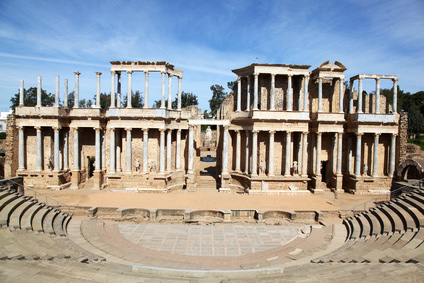
- Mérida's Roman theatre, built in the 1st century BCE, has remained in continuous operation for over 2,000 years and still hosts performances today during the annual Classical Theatre Festival.
- The Roman circus in Mérida was one of the largest in the Roman Empire, with a capacity of 30,000 spectators who gathered to watch thrilling chariot races.
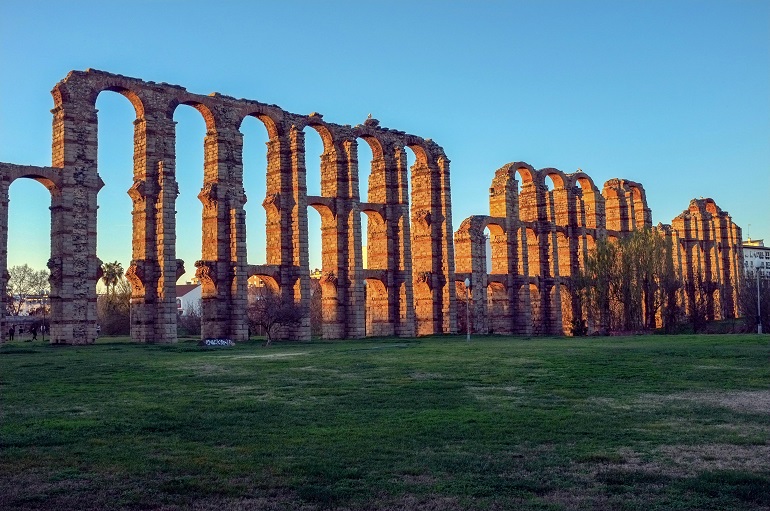
- The spectacular Aqueducto de los Milagros (Aqueduct of Miracles) features dramatic arches reaching up to 25 metres high and now serves as nesting sites for storks.
- A prestigious hoard of prehistoric gold jewellery excavated from a girl's grave in Mérida in 1870 is now preserved at the British Museum in London.
- The Roman bridge spanning the Guadiana River is one of the longest Roman bridges in the world and remains a vital pedestrian walkway today.
- Mérida served as the capital of Lusitania, the westernmost province of the Roman Empire, and later became the capital of the Diocese of Hispania.
- The Temple of Diana, despite its name, was actually an imperial cult temple that was later incorporated into a Renaissance palace.
- Under Arabic rule from 713 to 1230, Mérida became one of the three border capitals of Al-Andalus, alongside Toledo and Zaragoza.
- The Alcazaba fortress, built in 835 during Moorish occupation, is recognised as the most ancient fortress in the Iberian Peninsula.
- Mérida's archaeological ensemble was designated a UNESCO World Heritage Site in 1993, acknowledging its exceptional preservation of Roman urban planning.
- The National Museum of Roman Art is housed in a striking building designed to mimic a Roman basilica, complete with colossal brick and concrete arches.
- The city became the capital of the autonomous community of Extremadura in 1983, cementing its modern political importance.
- Mérida lies along the ancient Vía de la Plata (Silver Way), a crucial Roman route that connected the gold mines near Asturica Augusta with southern Iberia.
History
Roman Foundation and Imperial Grandeur
Mérida's remarkable history began in 25 BCE when Emperor Augustus founded the colony of Augusta Emerita to settle discharged soldiers from the V Alaudae and X Gemina legions following the Cantabrian Wars. The city was strategically positioned to guard a vital pass and the Guadiana river bridge, quickly becoming one of the most important cities in Roman Hispania and the capital of Lusitania province. At its peak, Augusta Emerita boasted a population of approximately 60,000 inhabitants and was large enough to contain a garrison of 90,000 men. The Romans constructed an impressive array of monuments that still define the city today, including a magnificent theatre built between 16-15 BCE with capacity for 6,000 spectators, an amphitheatre inaugurated in 8 BCE that could accommodate 15,000 people, and a colossal granite bridge over the Guadiana comprising 81 arches and measuring 2,575 feet (785 metres) in length. The city also served as a terminus of the Vía de la Plata (Silver Way), the crucial Roman route connecting northern gold mines with southern Iberia.
Medieval Transformations and Religious Significance
Following the collapse of the Western Roman Empire, Mérida experienced several dramatic transitions under different rulers whilst maintaining its strategic importance. In 409 CE, the city briefly became the capital of the short-lived Kingdom of the Alans under King Attaces, before falling to the Visigoths in 469. The Visigoths preserved much of the city's Roman heritage, even restoring the famous bridge in 686. However, the most significant medieval transformation occurred in 713 when Musa ibn Nusayr conquered Mérida for the Umayyad Caliphate, making it the capital of the Cora of Mérida and one of three border capitals of Al-Andalus alongside Toledo and Zaragoza. The Arabs expanded many Roman buildings, notably constructing the impressive Alcazaba fortress on the site of the original Roman fort. After over 500 years of Muslim rule, the city was finally reconquered in 1230 by Alfonso IX of León during the Reconquest, who granted it to the Knights of Santiago.
Modern Renaissance and UNESCO Recognition
The modern era brought both challenges and renewed recognition to Mérida's extraordinary heritage. During the Napoleonic Wars, many historic monuments suffered damage, with 17 arches of the Roman bridge destroyed during the 1812 siege of Badajoz by French forces. However, the city subsequently developed as a railway hub and underwent significant industrialisation. A major milestone came in 1983 when Mérida was designated the capital of the autonomous community of Extremadura. The city's archaeological significance received international recognition in 1993 when UNESCO declared the Archaeological Ensemble of Mérida a World Heritage Site, acknowledging its status as an exceptional example of a provincial Roman capital. Today, Mérida preserves more major Roman monuments than any other city in Spain, with its ancient theatre continuing to host performances through the Festival de Mérida, the oldest classical theatre festival in the country, which began in the 1930s. The city successfully balances its role as a living museum with modern urban life, serving as both the ecclesiastical seat of the Archdiocese of Mérida-Badajoz and a vibrant regional capital.
Main Attractions
Roman Theatre (Teatro Romano)
Constructed primarily in 16–15 BCE under the patronage of Marcus Vipsanius Agrippa, the son-in-law of Emperor Augustus, the Roman Theatre is one of Mérida's most significant landmarks. The structure could seat approximately 6,000 people in its three-tiered seating area, or cavea, which is divided according to social rank. The most striking feature is the restored stage front (scaenae frons), a two-storey colonnade of Corinthian marble columns adorned with sculptures of gods and imperial figures. After being buried for centuries, the theatre was excavated in the early 20th century and is now a principal venue for the annual Mérida International Classical Theatre Festival, bringing the ancient stage back to life.
Roman Amphitheatre (Anfiteatro Romano)
Inaugurated in 8 BCE and situated adjacent to the theatre, the Roman Amphitheatre was a venue for public spectacles, most notably gladiatorial combat and staged wild beast hunts (venationes). The elliptical arena has a large central pit, which would have been covered with a wooden floor and used to house scenery or cages for the animals. With a capacity for around 14,000 spectators, its grandstands (cavea) were, like the theatre's, divided into three sections for different social classes. The remnants of the main entrance gates and the rooms where gladiators and animals were held before contests are still visible today.
Temple of Diana (Templo de Diana)
Located in what was once the city's Roman forum, this temple dates from the late 1st century BCE during the reign of Augustus. Despite its name, which was assigned in the 17th century, evidence suggests it was dedicated to the Imperial Cult, a practice of worshipping the emperor. The temple's rectangular plan and surrounding Corinthian columns, crafted from local granite, are remarkably well-preserved. Its survival is largely thanks to its later incorporation into the Renaissance palace of the Conde de los Corbos, the remains of which are still built around and within the ancient structure.
Roman Bridge (Puente Romano)
Spanning the Guadiana River, the Roman Bridge is one of the longest surviving bridges from the Roman era, measuring 792 metres with 60 arches. Its construction began at the founding of the city to provide a vital crossing for the Vía de la Plata, a major Roman road connecting northern and southern Spain. Built with granite ashlars, the bridge features robust cutwaters to protect its piers from the river's current. Although it has undergone several reconstructions over the centuries, particularly after floods, its core structure remains Roman. Today, it is a pedestrian-only bridge, offering excellent views of the city and the Alcazaba.
Alcazaba of Mérida
This Moorish fortress was built in 835 CE by the Emir of Córdoba, Abd ar-Rahman II, at the head of the Roman Bridge. Its primary purpose was to control the city, which had frequently rebelled against Moorish rule, and to defend the strategic river crossing. The fortress is a formidable square enclosure with thick walls and defensive towers. Inside, visitors can explore the remains of various structures and ascend the ramparts. A notable feature is the aljibe, a deep cistern that drew water directly from the river through a filtration system, ensuring a water supply during a siege. The structure incorporates many reused Roman and Visigothic stones.
Acueducto de los Milagros
The "Aqueduct of the Miracles" is a testament to Roman engineering, built to supply the city with water from the Proserpina reservoir, located 5 kilometres away. Dating from the 1st century CE, its surviving section stretches over 800 metres and reaches a height of 27 metres, composed of striking arched piers made from a combination of granite ashlars and red brick. Its name was given by later inhabitants who were in awe of its scale and design. During spring, the tops of the arches are famously occupied by large stork nests, adding a unique natural element to the ancient monument.
Circo Romano (Roman Circus)
The Roman Circus of Mérida was one of the largest in the Roman Empire, built for chariot racing and capable of holding up to 30,000 spectators. Located outside the main city walls, the vast arena measures over 400 metres in length and 100 metres in width. Key features that remain visible include the outline of the track, the starting gates (carceres), and the long central barrier (spina) around which the chariots would race. Although much of the original seating has disappeared, its sheer size gives a clear impression of the scale of Roman public entertainment. An interpretation centre at the site helps visitors visualise the original structure and the events held there.
Casa del Mitreo
This ancient Roman villa, situated outside the old city walls, provides insight into the domestic life of Mérida's elite. The structure was built around two courtyards and featured numerous rooms, including thermal baths and bedrooms, many of which were decorated with high-quality frescoes and mosaics. The most famous discovery is the "Cosmological Mosaic," a complex artwork that depicts human figures, the sky, the sea, and the earth, representing the creation of the world. The villa's name derives from the discovery of remains related to the cult of the god Mithras in an adjacent building, suggesting a place of worship was located nearby.
Pórtico del Foro (Forum Portico)
The Portico del Foro comprises the surviving remains of one side of Mérida's municipal forum, the civic and commercial centre of the Roman city. Built in the 1st century CE, the structure features a high wall with niches that would have held statues of gods, goddesses, and members of the imperial family. The surviving section, decorated with Medusa heads and classical motifs, showcases the high-quality marble work that would have adorned the city's most important public square, serving as a powerful symbol of Roman authority and culture.
Basilica of Santa Eulalia
Considered the oldest site of continuous Christian worship in Mérida, the current basilica was constructed in the 13th century over the ruins of a previous Visigothic church. The site is historically significant as the supposed burial place of Saint Eulalia, a young Christian martyr who died in the 4th century. A small chapel known as the "Hornito," located outside the basilica, was built in the 17th century using the remains of a Roman temple dedicated to the god Mars. Below the church lies a crypt containing Roman and Visigothic tombs and mosaics, which can be visited via a subterranean walkway.
Trajan Arch (Arco de Trajano)
Despite its common name, this monumental arch was not a triumphal arch dedicated to Emperor Trajan but rather a grand entranceway to the provincial forum. Standing at approximately 15 metres high, its unadorned granite structure would have originally been clad in marble, creating a far more imposing spectacle. It is one of the few surviving Roman arches in Spain that still serves as a public thoroughfare, with a modern street passing through its rounded archway.
Zona Arqueológica de Morería
This archaeological site, located near the banks of the Guadiana River, reveals the layered history of Mérida's urban development. Excavations have uncovered a long stretch of the Roman city wall, the foundations of Roman houses, a Visigothic cemetery, and a large section of a Moorish neighbourhood (Morería) with preserved houses and streets. It provides a unique opportunity to see the evolution of the city from its Roman origins through to the Middle Ages in a single location.
Plaza de España
The Plaza de España is the central square of modern Mérida and serves as the city's social and administrative hub. It is surrounded by a diverse collection of buildings from various periods, including the 16th-century Concatedral de Santa María la Mayor and the baroque Palacio de la China. With its central fountain, outdoor cafés, and vibrant atmosphere, the square provides a lively contrast to the ancient ruins found elsewhere in the city and is a popular gathering place for both locals and visitors.
Top Museums
Museo Nacional de Arte Romano
Housed in Rafael Moneo’s acclaimed 1986 design, the National Museum of Roman Art presents Augusta Emerita’s archaeological splendour under a modern reinterpretation of Roman basilica form. Visitors traverse vast, vaulted galleries where colossal brick arches frame exhibitions of life-size statuary, richly patterned mosaics, inscriptions and everyday artefacts. A central atrium flooded by zenithal light evokes Roman thermae; adjacent wings display household ceramics, funerary monuments and a scale model of ancient Mérida, offering a comprehensive narrative of provincial capital and its role in the western empire.
Museo del Arte y la Cultura Visigoda (Visigoth Collection)
Located in the 17th-century former convent and church of Santa Clara, the Visigoth Collection occupies a Latin-cross nave where shafts of daylight illuminate sculpted capitals, altar furnishings, epigraphic slabs and liturgical fittings dating from the 4th to 8th centuries. The constant-flow layout guides visitors past carved pilasters and intricately ornamented altarpieces, enabling comparison of reused Roman architectural fragments and original Visigothic craftsmanship. Its intimate scale contrasts with the monumental Roman museum, emphasising early medieval cultural synthesis.
Museo Abierto de Mérida (MAM)
The Open Museum of Mérida transforms the former Cuartel Hernán Cortés barracks into an interactive archaeological and sensory centre. Under one roof, themed spaces reconstruct Roman daily life: a “pleasures of Augusta Emerita” gallery invites visitors to smell period perfumes and spices; a gladiatorial room displays replica armour and weapons; a gastronomic corner evokes Apicius’s recipes through multimedia narration. A rooftop promenade affords panoramic views of the adjacent amphitheatre and Teatro Romano, blurring the line between museum and urban ruins.
Museo de la Ciudad de Mérida (El Costurero)
Known colloquially as El Costurero, Mérida’s municipal museum occupies a charming 19th-century sewing workshop in the historic core. Its permanent displays include Juan de Ávalos’s modernist bronzes alongside local archaeological finds donated by emeritenses. Period rooms evoke Mérida’s social history, while rotating temporary exhibitions celebrate contemporary Extremaduran art and heritage. A central courtyard hosts cultural events, integrating community life with the museum’s evolving narrative.
Casa del Mitreo
This late 1st–early 2nd century domus unfolds around three colonnaded courtyards. Once the home of a prominent Roman family, its frescoed walls and geometric mosaics—most notably the “Cosmic” mosaic depicting terrestrial, marine and celestial spheres orbiting the figure of Eternitas—attest to elite taste and cosmological knowledge. Subterranean chambers reveal summer retreats, while surviving hypocaust arched corridors hint at private baths. Its compact layout offers an intimate glimpse of patrician domesticity on the fringes of Augusta Emerita.
Centro de Interpretación del Circo Romano
Perched alongside the city’s vast, oval-plan Circus, the Interpretation Centre brings chariot-race spectacle to life. Exhibits reconstruct the ancient spina and crowded carceres (starting gates) through scale models, augmented-reality animations and salvaged architectural fragments. From a raised viewing platform, visitors survey the full 400 m length of the arena below, imagining the thunder of quadrigae as they circled the central barrier decorated with obelisks and statuary.
Local Cuisine
Mérida’s rich local cuisine captures the flavours of Extremadura, focusing on hearty, rustic dishes made from local produce. Diners can savour jamón ibérico, a prized local cured ham, often paired with Torta del Casar or sheep’s cheese. The region is celebrated for its variety of Spanish tapas, particularly those made with acorn-fed pork such as chorizo, morcón, and lomo. Refreshing cold dishes like gazpacho extremeño and ajoblanco are popular choices during warmer months, while specialties such as caldereta de cordero (lamb stew) and migas (fried breadcrumbs mixed with meats) are traditional local favourites. Meals are commonly accompanied by a glass of Ribera del Guadiana wine, offering a true taste of the area. To finish, local pastry shops tempt with sweet treats like perrunillas and bollos de aceite, ensuring Mérida’s culinary heritage leaves a lasting impression.
Getting There & Around
By train, visitors can reach Mérida from major Spanish cities, with services from Madrid departing from Atocha Station taking between 3.5 to 7 hours depending on the service type, whilst trains from Seville operate twice daily with journey times of around 3.5 hours. The train station is centrally located, just a 10-minute walk from the Roman Theatre. By coach, regular services connect Mérida to key destinations including Madrid (4-5 hours via Avanza from Estación Sur de Autobuses), Seville (2-3 hours via Alsa and Leda), and Barcelona (approximately 12 hours with FlixBus), with the bus station situated about 15 minutes' walk from the city centre. By car, Mérida is easily accessible via well-maintained motorways, with driving times of approximately 3.5 hours from Madrid (359km), 2 hours from Seville (192km), and just under 10 hours from Barcelona (934km), offering the flexibility to explore the surrounding Extremadura region at your own pace.