


| Contents |
|---|
Introduction
Astorga, the historic capital of the Maragatería region in León province, stands at the intersection of the Pilgrim's Road to Santiago de Compostela and the ancient Silver Road. Founded by Romans in 14 BCE as Asturica Augusta, this compact city offers remarkable architectural diversity, including Antoni Gaudí's 19th-century Episcopal Palace, a Gothic cathedral with Renaissance and Baroque elements, preserved Roman walls dating to the 3rd century, and museums dedicated to Roman history and chocolate production. As a significant stop on the Camino de Santiago pilgrimage route, Astorga welcomes visitors with its distinctive regional cuisine and rich cultural heritage spanning over two millennia.
Interesting Facts about Astorga
- Astorga is considered the European birthplace of chocolate, after Hernán Cortés brought the cacao bean back from Mexico in 1528, and by 1914, the town had an impressive 49 chocolate manufacturers.
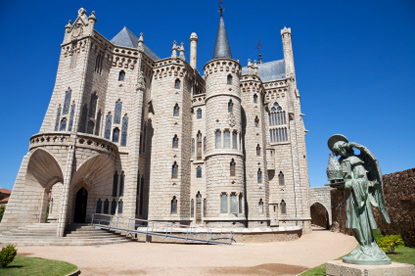
- The town features the magnificent Episcopal Palace, one of only three buildings outside of Catalonia designed by the famous modernist architect Antoni Gaudí.
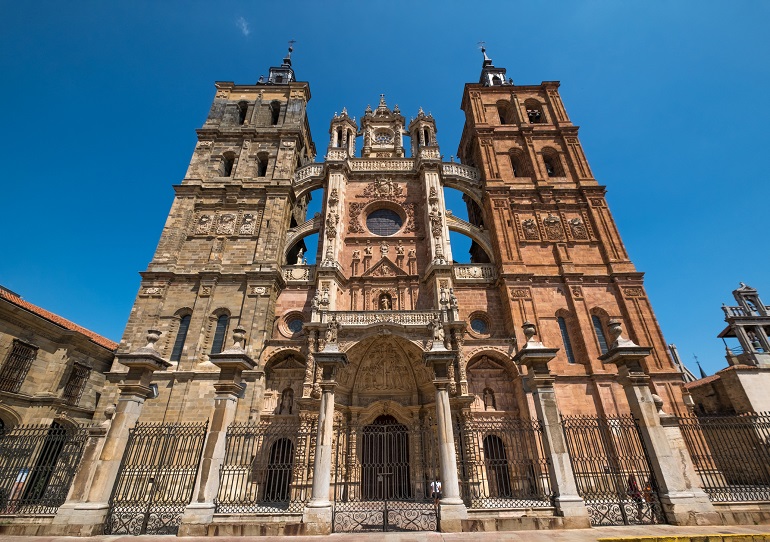
- Astorga Cathedral, built between the 15th and 18th centuries, showcases a fascinating blend of Gothic, Baroque, Renaissance, and Plateresque architectural styles.
- Astorga is the capital of the traditional comarca of Maragatería, a district inhabited by the unique Maragato tribe who have historically interbred among themselves and are possibly of Germanic origin.
- The town is famous for its local gastronomy, particularly cocido maragato (a traditional stew with chickpeas and cabbage), cecina (cured smoked beef), and botillo (smoked pork sausage).
- Astorga's 17th-century Baroque Town Hall features twin towers and a central bronze bell that strikes each hour, making it the focal point of the Plaza Mayor in the Old Town.
- Two important Camino de Santiago routes converge in Astorga: the East-West Camino Frances and the North-South Via de la Plata, which follows an ancient Roman commercial road.
History
Astorga's history dates back to ancient times when it was initially settled by the Celts before becoming the Roman city of Asturica Augusta in the 1st century BCE. Referred to as a "magnificent city" by the Roman philosopher Pliny the Elder, it flourished as an important administrative and military centre within the Roman Empire. The city's prosperity was largely due to its strategic location and connection to nearby gold mines of Las Médulas (now a UNESCO World Heritage Site) and copper mines of Rio Tinto. Evidence of this Roman heritage remains visible today through the partially preserved Roman walls, archaeological remains, and the Roman Museum that houses mosaics and artefacts from this era.
Following periods of decline during Muslim invasions, Astorga experienced a significant revival in the Middle Ages. The city's fortunes improved markedly with the establishment of the Camino de Santiago (Way of St. James) pilgrimage route in the 11th century, which brought countless pilgrims through the town. The creation of the Marquisate of Astorga in the 14th century, governed by the Osorio family, further contributed to the city's resurgence. This period of prosperity saw the commencement of construction on the present Gothic cathedral in the 15th century, as well as the building of numerous churches, convents and hospitals that catered to pilgrims traversing this sacred route.
By the early modern era, Astorga had established itself as Europe's birthplace of chocolate after Spanish conquistador Hernán Cortés brought cacao beans to Spain from Mexico in 1528. The chocolate industry flourished over subsequent centuries, reaching its zenith in 1914 with 49 chocolate manufacturers operating within the city. The 18th and 19th centuries witnessed Astorga's expansion beyond its medieval walls, accelerated by the arrival of railway connections. Among the architectural treasures from this period is the remarkable Bishop's Palace, designed by the celebrated architect Antoni Gaudí in the late 19th century, which exemplifies his distinctive Modernist style. Today, Astorga remains renowned for its historical significance, architectural splendour, and culinary traditions, particularly its famous chocolates and biscuits.
Main Attractions
Palacio de Gaudí (Episcopal Palace)
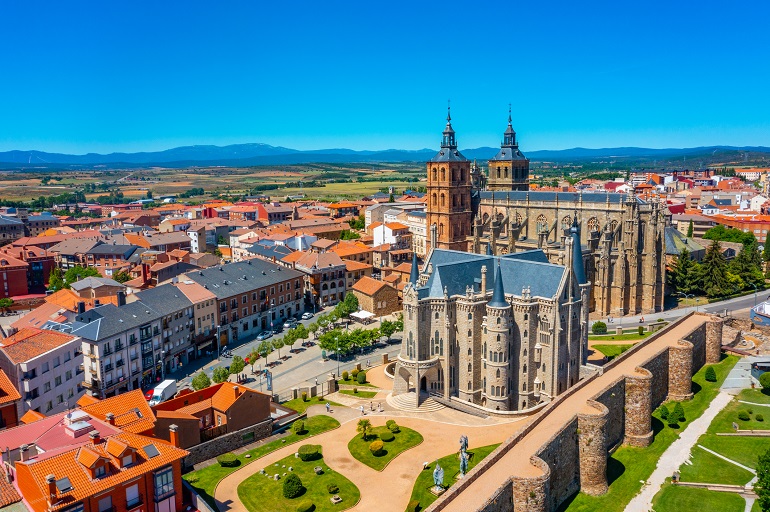
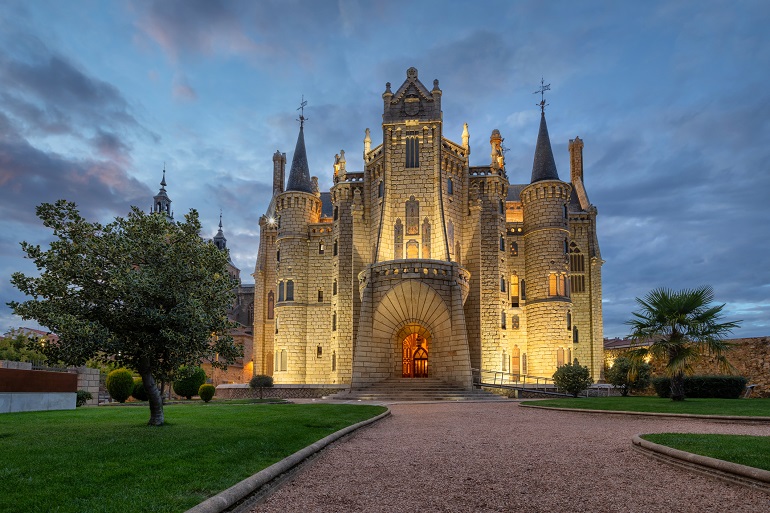
The Palacio de Gaudí, also known as the Episcopal Palace, stands as a testament to the genius of Antoni Gaudí, one of Spain's most celebrated architects. Constructed in the late 19th century, this palace is a rare gem, being one of only three Gaudí buildings located outside of Catalonia. The structure embodies the Neogothic architectural style, with Gaudí's distinctive flair evident in every detail. Its fairy tale-like appearance captivates visitors, featuring intricate stonework, ornate spires, and whimsical design elements that seem to dance between fantasy and reality. The palace's exterior is adorned with beautiful stained glass windows that cast colourful patterns inside when struck by sunlight. Situated atop the old city walls, the palace grounds offer a peaceful retreat and panoramic views of the surrounding landscape, allowing visitors to appreciate both the architectural marvel and its picturesque setting.
Astorga Cathedral
The Astorga Cathedral, a monumental edifice built between the 15th and 18th centuries, showcases a harmonious blend of architectural styles that reflect its long construction period. The cathedral's exterior is dominated by its ornate Baroque façade, which features a striking figure of St James, the patron saint of Spain. This grand entrance serves as a prelude to the artistic treasures housed within. As visitors step inside, they are greeted by an interior that seamlessly combines Gothic, Renaissance, and Baroque elements. The cathedral's most prized possession is a Baroque carving of La Inmaculada, crafted by the renowned sculptor Gregorio Fernandez. This masterpiece exemplifies the intricate craftsmanship of the era. Another notable artefact within the cathedral is a silver chest that once belonged to Alfonso III, also known as Alfonso the Great, a 9th-century king of Asturias. This historical relic provides a tangible link to the region's royal past.
Ancient Roman Walls
The ancient Roman walls of Astorga stand as enduring reminders of the city's significant role during the Roman occupation of the Iberian Peninsula. These well-preserved fortifications encircle parts of the old city, offering visitors a glimpse into Astorga's strategic importance in ancient times. The walls, constructed with robust stone masonry, have withstood the test of time, bearing witness to centuries of history. Walking along these fortifications, one can almost imagine the Roman sentries patrolling the ramparts, keeping watch over the surrounding countryside. The Puerta del Sol, or Sun Gate, serves as the main entrance to the old part of the city. This imposing structure, with its thick stone archway, once controlled access to the Roman settlement. Today, it acts as a portal through which visitors can step back in time, entering the historic heart of Astorga.

Plaza Mayor
The Plaza Mayor of Astorga, constructed in the 17th century, occupies the site of the ancient Roman forum, emphasising the city's continuous importance throughout history. This expansive square forms the beating heart of Astorga, surrounded by an ensemble of historic buildings that showcase various architectural styles. The most prominent of these is the aforementioned Town Hall, whose Baroque façade dominates one side of the plaza. The square's cobblestone paving and traditional buildings create an atmosphere that transports visitors back in time. Throughout the year, the Plaza Mayor serves as the focal point for local life, hosting markets, festivals, and cultural events that bring the community together. It's a place where history and contemporary life intertwine, offering a vibrant snapshot of Astorga's enduring spirit.
Ayuntamiento de Astorga (Town Hall)
The Ayuntamiento de Astorga, or Town Hall, stands proudly in the Plaza Mayor, embodying the grandeur of 17th-century Baroque architecture. This civic building is renowned for its distinctive clock tower, which has become an iconic symbol of the city. The tower's most famous feature is its pair of Maragato figures, mechanical statues dressed in traditional local costumes, which emerge to strike the hours. This charming spectacle has delighted residents and visitors alike for generations. The Town Hall's façade is a masterpiece of Baroque design, with intricate stonework, elegant balconies, and ornate decorations that reflect the prosperity and artistic sensibilities of Astorga during that era. Considered one of the most important civil Baroque structures in the region, the Ayuntamiento serves not only as the seat of local government but also as a testament to Astorga's rich architectural heritage.

Casa Granell
The Casa Granell, situated near the Episcopal Palace, is a striking example of early 20th-century architecture in Astorga. Designed by Antonio Palacios, an architect renowned for his work on Madrid's iconic Palacio de Comunicaciones (now the City Hall), the building showcases a unique blend of modernist and regional influences. The most notable feature of Casa Granell is its distinctive tower, which has become an important symbol of Astorga's skyline. The tower's design incorporates elements that echo the region's architectural traditions while embracing the innovative spirit of the modernist movement. The building's façade is adorned with intricate stonework and decorative elements that reflect Palacios' attention to detail and his ability to create structures that are both functional and aesthetically pleasing. Casa Granell stands as a testament to Astorga's embrace of architectural innovation at the turn of the 20th century, providing an interesting counterpoint to the city's more ancient monuments.
Top Museums
Mantecadas Velasco Chocolate Museum
This unique museum celebrates Astorga's reputation as the European birthplace of chocolate, which began when cacao beans were brought to Spain by Hernán Cortés. The museum displays a fascinating collection of chocolate memorabilia and includes sections on both the history of chocolate and chocolate-making processes. Visitors can enjoy chocolate tastings and have the opportunity to purchase some of Astorga's famous chocolate. Although the museum's information and documentary are primarily in Spanish, it remains a worthwhile cultural experience that highlights an important aspect of the city's heritage.
Roman Museum of Astorga
Located in the southern part of the city, the Roman Museum occupies the ancient Ergastula, a vaulted portico that was once part of the Roman forum of Astúrica Augusta. The museum houses artefacts discovered during various archaeological excavations throughout the city. It features a modest but interesting collection of Roman items and an enjoyable big-screen slide show about Roman Astorga. This museum provides valuable insights into Astorga's importance as a Roman administrative and military centre, which Pliny once called a "magnificent city".
Episcopal Palace Museum (Museum of the Roads)
Housed in Antoni Gaudí's magnificent Episcopal Palace, this museum is dedicated to the pilgrimage routes that pass through Astorga. The building itself is a masterpiece that resembles a cross between "Snow White's palace and a medieval castle", featuring architectural elements that seem to defy gravity. Inside, you'll find various exhibits displaying pieces related to the pilgrimage tradition while wandering through rooms that were originally designed as a residence but never fulfilled that purpose. This is one of only three Gaudí buildings outside of Catalonia and offers excellent value compared to his more expensive Barcelona works.
Local Cuisine
The city is renowned for its cocido maragato, a hearty stew served in reverse order, starting with meat and ending with soup. Another local delicacy is cecina, a cured meat traditionally made from beef or horse, though other meats are now used. Astorga's sweet tooth is satisfied by mantecadas, fluffy sponge cakes, and the city's famous chocolate, both of which can be savoured at local bakeries and the Chocolate Museum. For a true taste of the region, try the Alubias de la Bañeza-León, flavourful local beans, or pair your meal with wines from nearby Bierzo or Tierra de León. Don't miss the opportunity to sample merles, a pastry filled with cream and covered in brown sugar, for a truly indulgent experience.
Getting There & Around
Travellers can reach Astorga by train from Madrid-Chamartín station, with journey times around 3 hours and fares starting from €40. Buses offer a more economical option, with ALSA operating services from Madrid Airport and Estación Sur, taking 4-5 hours and costing approximately €28. For those driving, Astorga is about 332 km northwest of Madrid via the A6 motorway. Once in Astorga, the compact town centre is best explored on foot, allowing visitors to easily navigate between key attractions such as the Episcopal Palace, Cathedral, and Roman Museum. The bus station is conveniently located 100 metres north of the cathedral, while the railway station is situated 1 km northeast of the town centre.