


| Contents |
|---|

Introduction
León's origins date back to the 1st century BCE as a Roman military encampment of the Legio VI Victrix. It later became the permanent settlement of the Legio VII Gemina in 74 CE. The city rose to prominence in the 10th century when it became the capital of the Kingdom of Asturias and León after García I moved his court from Oviedo. León is renowned for its rich architectural heritage, featuring the Gothic Cathedral of Santa María de Regla, the Romanesque Basilica of San Isidoro, and the Renaissance-style Monastery of San Marcos. The city hosted the first Parliament in European history in 1188, earning it recognition as the "cradle of Parliamentarism". With a population of about 124,000, León offers visitors a harmonious blend of historical monuments and modern amenities, set amidst tree-lined plazas, parks and broad avenues. Its location on the French Way of the Camino de Santiago, combined with its vibrant cultural scene and renowned gastronomy in the Barrio Húmedo district, makes it a significant destination for cultural tourism.
Interesting Facts about León
- León's name is derived from the Latin word "legio," honouring the Roman legions that founded the city over 2,000 years ago as a military encampment.
- The stunning Gothic cathedral of Santa María de León, known as "The House of Light," features one of the most extensive and best-preserved collections of medieval stained glass in Europe, covering an area of at least 1,764 square metres.
- León hosted the first Parliament in European history in 1188 under the reign of Alfonso IX, earning UNESCO recognition as the "cradle of Parliamentarism".
- The city became the capital of the Kingdom of Asturias and León in the 10th century when García I transferred his court there from Oviedo.
- León's Barrio Húmedo (Wet Quarter) is famous for its vibrant tapas culture and narrow streets teeming with bars and restaurants.
- The Romanesque collegiate church of San Isidoro, built in the 11th century, contains ceiling paintings often referred to as the "Sistine Chapel of Romanism".
- León was the first city in Spain to implement an all-electric urban bus system, demonstrating its commitment to sustainable urban development.
- The city's Holy Week processions are renowned for their solemn beauty and have been declared of International Tourist Interest.
- León boasts exquisite examples of Mudéjar architecture, a style unique to Spain that blends Muslim and Christian artistic traditions.
- The Renaissance-style Convento de San Marcos, originally built in the 16th century, has served many functions throughout history and now houses a luxury Parador hotel.
- León serves as a key stop on the Camino de Santiago (Way of St. James), the famous pilgrimage route to Santiago de Compostela.
- The city features more than a million square metres of green spaces in the form of parks and gardens, reflecting its commitment to quality of life.

History
León's history begins with the Romans, who conquered the area around 29 BCE and established a military camp called Legio. The settlement evolved into a garrison town from 74 CE when the Legio VII Gemina settled in a permanent camp, which became the origin of the city. After the fall of the Roman Empire, León changed hands several times between Muslim and Christian rulers until 910 CE, when an autonomous Kingdom of León emerged.
The city's history is deeply intertwined with the Reconquest. In 914, as Christians moved southward from Asturias, King Ordoño II transferred his capital from Oviedo to León. Despite being sacked by al-Mansur in 996, the new capital flourished rapidly. For the next two centuries, León and Castile jointly led the war against the Moors, and this period marked León's greatest power, during which most of its finest buildings were constructed. From the Kingdom of León emerged the counties of Castile and Portugal, which eventually became independent kingdoms.
By the 13th century, Castile had come to dominate León, and from 1217, the kingdoms of León and Castile were united under a single crown, the Kingdom of Castile. In the Middle Ages, power and wealth gradually shifted to Madrid, but the pilgrimage route to Santiago de Compostela gained importance, leading to the embellishment of fine buildings such as the cathedral. The city experienced relatively little later industrial development, which helped preserve its old centre. In more recent times, León saw significant urban expansion in the late 19th and 20th centuries, becoming an important communications hub in northwest Spain due to coal mining and the arrival of the railroad.
Main Attractions
León Cathedral (Catedral de Santa María de León)
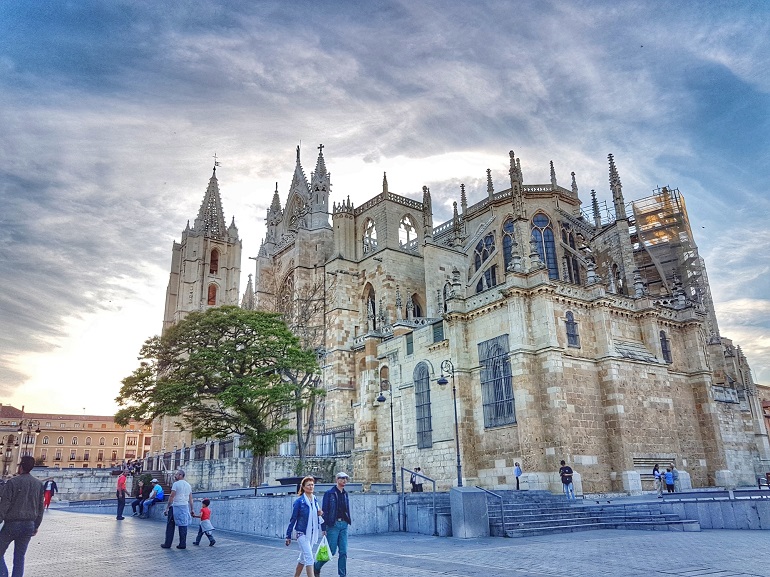
The León Cathedral, affectionately known as the "Pulchra Leonina" (Beautiful Leonese), stands as one of Spain's most impressive Gothic cathedrals. Construction began in the early 13th century under the direction of Master Enrique, who was influenced by the great French cathedrals of Reims and Chartres. The cathedral's most remarkable feature is undoubtedly its collection of stained glass windows, which cover more than 1,800 square metres and date primarily from the 13th to 15th centuries. These windows transform the interior into a kaleidoscope of coloured light, earning the cathedral its nickname "The House of Light." The western façade features three elaborately decorated portals depicting scenes from the Last Judgment, the Virgin Mary, and various biblical narratives. Inside, visitors will find an impressive choir with intricately carved wooden stalls, a magnificent high altar, and numerous chapels housing important religious artworks. The cathedral's flying buttresses, elegant spires, and rose windows exemplify the height of Gothic architectural achievement. The building underwent significant restoration in the 19th century under the direction of Juan Madrazo and Demetrio de los Ríos, who saved the structure from potential collapse.
Basilica of San Isidoro
The Basilica of San Isidoro represents one of the most important Romanesque buildings in Spain. Founded in 1063 by Fernando I and Queen Sancha to house the remains of Saint Isidore of Seville, the basilica showcases the transition from Romanesque to early Gothic styles. The building's exterior features the ornate "Puerta del Cordero" (Door of the Lamb), decorated with detailed biblical reliefs. The basilica's greatest treasure lies beneath in the Royal Pantheon, known as the "Sistine Chapel of Romanesque Art." This burial place of the kings of León contains remarkably well-preserved 12th-century frescoes depicting biblical scenes and the zodiac in vibrant colours that have retained their brilliance over the centuries. The basilica's main altar is covered with a silver frontal, and the church houses numerous Romanesque sculptures and architectural elements. The adjacent cloister, though rebuilt in the 16th century, contains remnants of the original Romanesque structure. The basilica's bell tower, with its distinctive silhouette, has become one of León's recognisable landmarks. Throughout its history, San Isidoro has served not only as a religious centre but also as a site of royal coronations and important historical events in the Kingdom of León.
Church of San Salvador de Palat del Rey
The Church of San Salvador de Palat del Rey holds the distinction of being León's oldest church, with origins dating to the 10th century when King Ramiro II ordered its construction. Though little remains of the original Pre-Romanesque structure, the church represents an important historical link to León's early medieval past. Archaeological excavations have revealed foundations of the original building and evidence of its importance in the early development of the city. The church underwent significant modifications in the 16th and 18th centuries, giving it a blend of architectural styles. Despite these changes, elements of its ancient origins can still be discerned in certain architectural details and in the layout of the building. The church's name, "Palat del Rey" (Palace of the King), references its original connection to the royal palace that once stood nearby, highlighting León's importance as a royal capital in the early medieval period.
Convent of San Marcos
The imposing Convent of San Marcos represents one of Spain's most magnificent examples of Renaissance architecture. Originally built in the 12th century as a hospice for pilgrims travelling the Camino de Santiago, the current structure dates primarily from the 16th century. The building's most striking feature is its extraordinarily elaborate plateresque façade, stretching over 100 metres and adorned with intricate sculptural decoration including medallions, coats of arms, and religious figures. Master sculptor Juan de Juni contributed significantly to the decorative elements. The convent has served various functions throughout its history, including as headquarters for the Military Order of Santiago, a prison where Francisco de Quevedo was once incarcerated, and now as a luxury Parador hotel. The building's church features an impressive choir with carved stalls by Juan de Juni and a sacristy with remarkable ceiling work. The two-storey cloister showcases elegant Renaissance proportions with delicate stonework. The convent's strategic location along the Bernesga River provides picturesque views and marks the western entrance to the historic city.
Casa Botines
Casa Botines stands as a remarkable example of Antoni Gaudí's architectural genius outside his usual Catalonian context. Commissioned by textile merchants Simón Fernández and Mariano Andrés, the building was constructed between 1891 and 1892 during Gaudí's early career. This neo-Gothic structure with modernist elements features distinctive pointed arches, corner turrets, and a steep slate roof typical of northern Spanish architecture. The building's façade incorporates symbolic elements, including a statue of Saint George slaying the dragon above the main entrance, created by sculptor Mateo Inurria. Gaudí designed the building to serve multiple purposes: commercial space on the ground floor, offices on the first floor, and residential apartments on the upper levels. The architect incorporated innovative structural solutions, including a basement with slender cast-iron columns and natural lighting through a moat surrounding the building. After careful restoration, Casa Botines now houses the Gaudí Museum, allowing visitors to explore its unique architectural features, including the original wooden staircases, decorative elements, and some of Gaudí's furniture designs. The building's name derives from the nickname of one of the earlier owners of the plot, Joan Homs i Botinàs.
Palacio de los Guzmanes
The Palacio de los Guzmanes, an impressive Renaissance palace, serves as the headquarters of the Provincial Council of León. Construction began in 1560 under the direction of Rodrigo Gil de Hontañón for the powerful Guzmán family. The palace features a square floor plan with a central courtyard surrounded by elegant arcaded galleries on three levels. The building's façade displays classical Renaissance elements with perfectly proportioned windows and doorways adorned with the coat of arms of the Guzmán family. The corner balcony, supported by an impressive stone column, is particularly noteworthy for its craftsmanship. The palace's main entrance features a monumental doorway framed by Doric columns and topped with a classical pediment. Inside, the central courtyard showcases the plateresque style with intricate decorative elements on the columns and arches. The building underwent significant restoration in the late 19th century when it was converted for administrative use. The palace's grand staircase, with its ornate balustrade, exemplifies the grandeur that the Guzmán family sought to project through their urban residence. The building's location near the cathedral places it at the heart of León's historic district.
Roman Walls
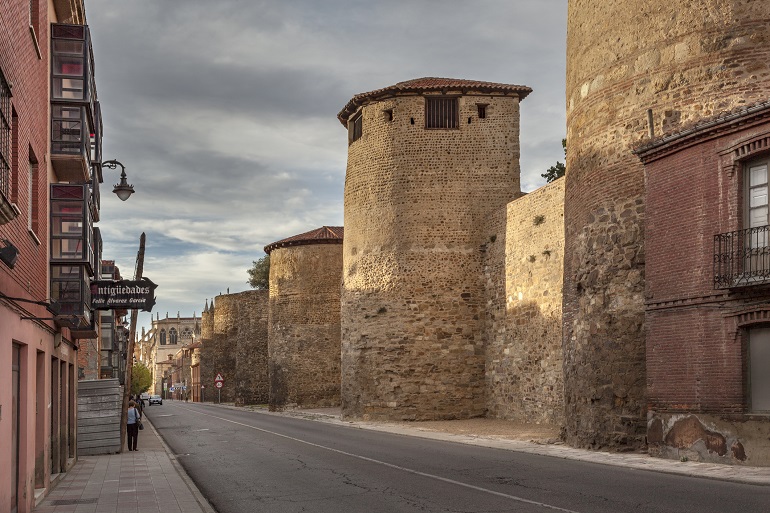
León's Roman walls stand as a testament to the city's ancient origins as a Roman military encampment. Founded in the 1st century BCE as the permanent camp of the Legio VI Victrix and later the Legio VII Gemina, León (derived from "legion") was fortified with impressive stone walls. The original Roman enclosure formed a rectangle of approximately 570 by 350 metres, following the classic layout of Roman military camps. While many sections were dismantled over the centuries to accommodate urban expansion, substantial portions remain visible today, particularly along the eastern and northern sides of the old city. The walls were constructed using a technique of two parallel stone facings filled with a mixture of mortar, stone, and rubble, creating a structure approximately 5.5 metres thick. The original walls featured towers at regular intervals, some of which have survived. The most impressive remaining section can be seen near the Puerta Castillo, where the walls reach a height of nearly 8 metres. Archaeological excavations have revealed that the walls were reinforced and heightened during the 3rd and 4th centuries CE in response to increasing threats to the Roman Empire. These ancient fortifications have been declared a National Monument and provide visitors with a tangible connection to León's Roman heritage.
Plaza Mayor
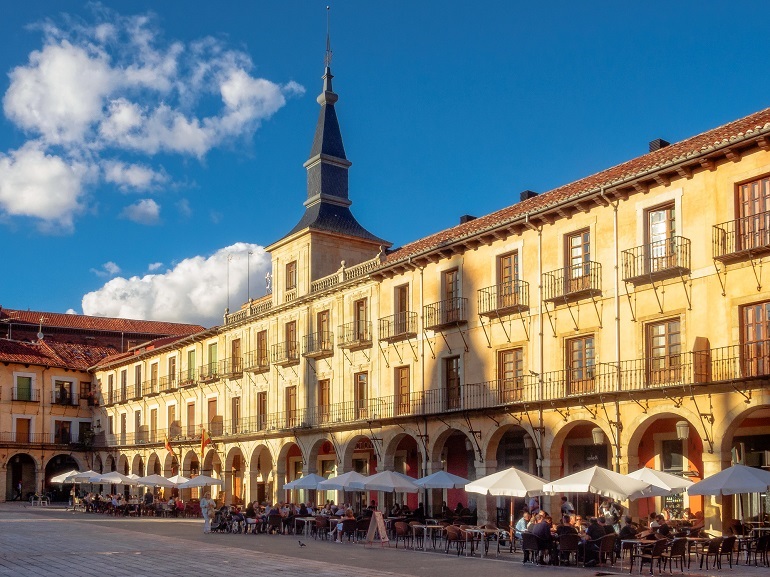
Plaza Mayor forms the heart of León's civic life and has done so for centuries. This rectangular square was designed in the 17th century following the typical Spanish model of a central plaza surrounded by consistent architecture with arcaded ground levels. The most prominent building is the Old Town Hall (Antiguo Consistorio), constructed between 1677 and 1683, which dominates the western side of the square with its balanced façade featuring two symmetrical towers. The building displays the coat of arms of the city and the Spanish monarchy. The plaza is surrounded by colonnaded walkways known as "los soportales," which house numerous cafés, restaurants, and shops, providing shelter from rain or sun. Traditionally, the plaza served as the city's main marketplace, and this tradition continues with a weekly market held on Wednesdays and Saturdays, where local producers sell regional products, particularly fresh fruits and vegetables. The square has witnessed numerous historical events throughout León's history and continues to serve as the venue for public celebrations, festivals, and gatherings. During important festivities such as Easter week or the feast of San Froilán (León's patron saint), the plaza becomes the focal point of celebrations. The consistent architectural style of the buildings surrounding the plaza creates a harmonious urban space that exemplifies traditional Spanish urban planning.
Barrio Húmedo
The Barrio Húmedo (Wet District) constitutes León's atmospheric old quarter and derives its name from the abundance of taverns and bars where wine and other beverages flow freely. This labyrinthine neighbourhood of narrow medieval streets is centred around Plaza San Martín and extends through a network of interconnected alleyways including Calle Plegaria, Calle Azabachería, and Calle Cardiles. The district preserves much of its medieval urban layout, with buildings dating primarily from the 16th to 19th centuries. The Barrio Húmedo is renowned throughout Spain for its tapas culture, where establishments serve complimentary small plates of food with each drink ordered—a tradition maintained more faithfully here than in many other Spanish cities. The area contains numerous historic buildings, including the Casa de las Carnicerías, a 16th-century building that once served as the city's meat market. The Church of San Martín, with origins dating to the 11th century though largely rebuilt in the 16th century, provides a spiritual anchor for the neighbourhood. The district's vibrant atmosphere intensifies in the evening hours when locals and visitors engage in the traditional "tapeo"—moving from bar to bar sampling different specialities. The area represents the social heart of León and offers visitors an authentic experience of Spanish social customs and gastronomy.
Camino de Santiago
The Camino de Santiago (Way of St. James) has profoundly shaped León's development and continues to influence its character today. As one of the most important stops on the French Way (Camino Francés), the most popular route of this ancient pilgrimage, León has welcomed pilgrims for over a thousand years. The city marks an important psychological milestone for pilgrims, being one of the last major urban centres before the final stretch to Santiago de Compostela. The pilgrim's route enters León from the east along Calle San Pedro and proceeds through the historic centre past the cathedral before exiting westward toward Astorga. Throughout the city, bronze scallop shells embedded in the pavement mark the official route. León developed numerous facilities to support pilgrims throughout history, including the Hospital de San Marcos (now the Parador hotel) and various pilgrim hostels that continue to operate today. The influence of the Camino is visible in much of the city's religious architecture, particularly in the iconography related to St. James found in the cathedral and other churches. The constant flow of international pilgrims gives parts of León a cosmopolitan atmosphere despite its provincial location. UNESCO recognised the cultural significance of the Camino de Santiago by designating it a World Heritage Site in 1993, acknowledging its role in European cultural exchange throughout history.
Top Museums
Museo de León
The Museo de León, housed in the Pallarés Building, is the oldest and largest museum in the province. Founded in the 19th century, it offers visitors a comprehensive journey through the region's history. The museum's permanent collection is divided into seven areas of knowledge:
- Prehistory
- Romanisation
- The end of the ancient world
- The Middle Ages
- The Modern Age
- The Modern World
- A panoramic view of the city
The museum showcases an exceptional collection of artefacts, including Roman mosaics, medieval crosses, and an extensive numismatic collection. Visitors can explore exhibits ranging from the Palaeolithic era to the 20th century, providing a thorough insight into León's cultural achievements.
MUSAC (Museo de Arte Contemporáneo de Castilla y León)
The MUSAC is one of the most important contemporary art museums in Castilla y León. Inaugurated in 2005, this striking building is covered in hundreds of sheets of rainbow-coloured glass, mimicking the cathedral's stained glass windows. The museum houses over 1,650 works by approximately 400 Spanish, Leonese, and international artists, with a particular focus on 21st-century art.
Basílica de San Isidoro Museum
Located within the magnificent Basílica de San Isidoro, this museum comprises a Royal Pantheon adorned with stunning colourful frescoes, an Oriental and Biblical Museum, and a collegiate library. The museum offers a glimpse into the religious and royal history of León.
Casa Botines
Designed by the famous architect Antoni Gaudí, Casa Botines opened to the public in 2017. While not strictly a museum, this architectural marvel offers visitors a unique opportunity to explore Gaudí's work outside of Barcelona.
Sierra-Pambley Museum
Inaugurated in 2006, the Sierra-Pambley Museum is housed in a 19th-century building. It offers visitors a glimpse into the life of the Leonese bourgeois elite, featuring original furnishings and fittings from the period.
Archaeological Museum at San Marcos
Situated in the stunning San Marcos convent, this museum houses a fascinating collection of archaeological artefacts. The building itself, considered one of the most important Spanish Renaissance structures in the country, adds to the museum experience.
Local Cuisine
When visiting León, prepare to be delighted by its rich gastronomic offerings. The city is renowned for its exceptional cold meats, particularly cecina, a distinctive cured beef that accounts for 95% of all cecina consumed in Spain. This local delicacy may have a strong flavour for some, but can also be enjoyed in scrambled eggs or croquettes. No culinary journey through León would be complete without experiencing the famous tapas culture, where ordering a drink rewards you with a complimentary tapa—not merely olives or crisps, but substantial offerings like garlic soup, squid sandwiches, or chorizo al infierno. Other regional specialties include Maragato stew, Valdeón cheese, and botillo from El Bierzo. The province also produces excellent local wines that perfectly complement these hearty dishes. For the ultimate León experience, order a cold meat platter featuring the area's celebrated ham, cheese, and chorizo whilst bar-hopping through the romantic and atmospheric neighbourhoods of this gastronomic paradise.
Getting There & Around
León is easily accessible via multiple transport options, with most international travellers arriving through Madrid-Barajas Airport before continuing their journey. Regular ALSA buses run from Madrid (€20-40 return, 3½ hours) from Estación Sur, whilst Renfe trains depart from Madrid-Chamartin (approximately 2 hours). FlixBus offers economical routes from €7.98. The city has a small airport with limited connections to Barcelona. Once in León, the comprehensive public transport network operated by Autobuses Urbanos de León (ALESA-ALSA) makes exploring effortless. The conveniently located bus and railway stations sit approximately half a mile from the city centre. Travellers can use the Moovit app for real-time schedules and routes to navigate León's attractions seamlessly.