


| Contents |
|---|
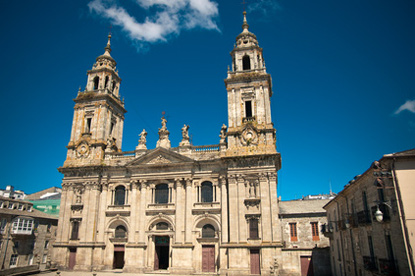
Introduction
Lugo (pop. 99,500) has the unique distinction of being the only city in the world to be completely surrounded by intact Roman walls, which were built between 263 and 276 CE and designated a UNESCO World Heritage Site in 2000. These impressive fortifications extend for over 2 kilometres, reach heights of 10 to 15 metres, and feature 71 towers and 10 gates. Founded as Lucus Augusti by the Romans in 13 BCE, the city sits on the banks of the Miño River and boasts significant historical landmarks including the 12th-century Cathedral of Santa María, the Church of St. Francis, and Roman Baths. Lugo serves as a stop on the Camino Primitivo path of the Camino de Santiago and offers visitors a blend of rich history, architectural heritage, natural beauty and Galician culture.
Interesting Facts about Lugo
- Lugo is the only city in the world to be completely surrounded by intact Roman walls, which reach heights of 10 to 15 metres and stretch for 2,117 metres.
- The Roman walls of Lugo, dating from the 3rd century CE, were declared a UNESCO World Heritage Site in 2000.
- The city's Roman walls feature 85 external towers and 10 gates, with a continuous walkway along the top that visitors can stroll around.
- Lugo originated as the Roman colony of Lucus Augusti, with some sources suggesting the name derives from "Lucus" meaning "sacred grove" or "sacred forest".
- The city's cathedral, dedicated to St Mary, was built around 1129 but its main façade and towers date only from 1769.
- Lugo Cathedral has the unique privilege of having the Blessed Sacrament perpetually exposed, a fact commemorated in the town's armorial bearings.
- The city celebrates its Roman heritage annually with a popular festival called "Arde Lucus", featuring gladiator fights and chariot racing.
- In 2007, the Roman walls of Lugo were symbolically twinned with the Great Wall of China during a ceremony attended by China's then-ambassador to Spain.
- Lugo is renowned throughout Galicia for its exceptional cuisine, reflected in the popular saying "Y para comer, Lugo" (And to eat, Lugo).
- The city houses the "Casa de los Mosaicos" (House of Mosaics), an ancient Roman house from the late 3rd century with remarkable geometric floor mosaics.
- During the Middle Ages, pilgrims on their way to Santiago de Compostela passed through the gates of Lugo's walls, particularly Porta Miña.
- The former prison of Lugo, "O Vello Cárcere", which has over 130 years of history, has been transformed into a cultural centre whilst retaining its original semicircular structure.

History
Lugo's illustrious history began with the Romans, when Emperor Augustus founded the city as Lucus Augusti around 13 BCE. It quickly developed into a significant administrative and military hub in northwestern Hispania. The city's most remarkable feature, its impressive Roman walls, was constructed between 263 and 276 CE to defend against local tribes and Germanic invasions. These magnificent fortifications, reaching heights of 10 to 15 metres and stretching over 2.1 kilometres in a complete circuit, are the only fully intact Roman walls in the world today, adorned with 71 towers and ten gates.
Following the decline of the Roman Empire, Lugo experienced centuries of turmoil, changing hands numerous times. The Suevi conquered the city in the 5th century, followed by the Visigoths, before it was sacked by the Moors in 714. King Alfonso I recaptured Lugo for Christendom in the mid-8th century, though it would later be ravaged again by the Normans in 968. Throughout the Middle Ages, the city evolved from a Roman military outpost into an important ecclesiastical centre. The Cathedral of Santa María, consecrated in 1129, became a significant pilgrimage site due to its unique privilege of displaying the Blessed Sacrament 24 hours a day—a tradition that continues to this day.
The modern history of Lugo began to take shape in 1833 when Spain was divided into provinces and Lugo was designated as a provincial capital, elevating its status significantly. The arrival of the railway in 1875 marked another pivotal moment, transforming the city into a major cattle trading centre on the Iberian Peninsula. The famous San Froilán fairs further strengthened the local economy. During the Spanish Civil War, Lugo quickly fell under Nationalist control. In more recent decades, the city has focused on preserving its remarkable heritage, culminating in the UNESCO World Heritage designation of its Roman walls in 2000. Today, Lugo stands as a living museum, where visitors can walk the entire circuit of the ancient walls while enjoying views of both the medieval centre and the modern city that surrounds it.
Main Attractions
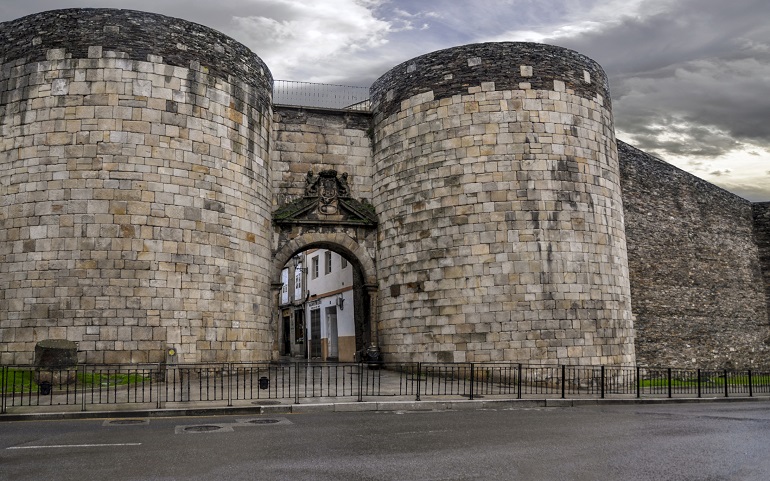
Roman Walls
Lugo's Roman walls are the city's most recognisable and historically significant feature. Constructed in the late 3rd century to defend the Roman settlement of Lucus Augusti, they are remarkably well-preserved and have been designated a UNESCO World Heritage Site. The walls form an oblong rectangle, stretching 2,117 metres in length, with a height ranging from 8 to 10 metres and a width of 4.2 to 7 metres. They are punctuated by 85 external towers and 10 gates, five of which are original Roman structures, while the others were added in more recent centuries to accommodate urban growth. Visitors can walk along the entire circuit of the walls, which offer excellent views of both Lugo's old town and its surrounding areas. The walls also feature several access points, including four staircases and two ramps, making it easy for visitors to explore this ancient fortification.
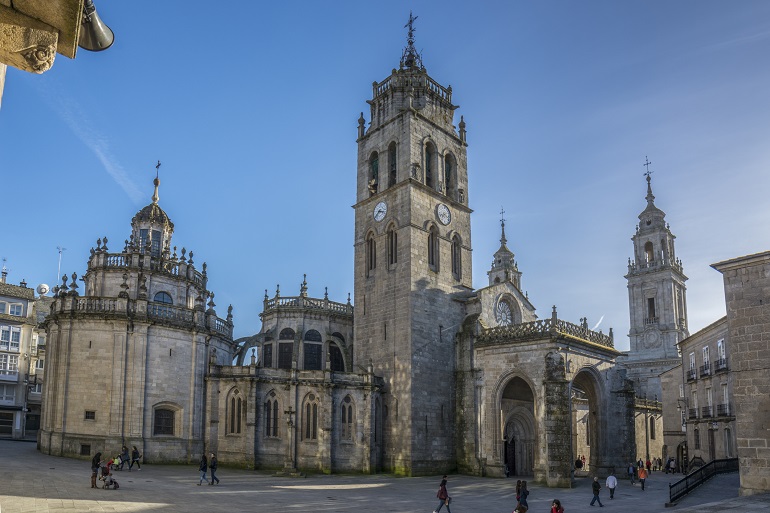
Cathedral of Santa Maria
The Cathedral of Santa Maria is one of Lugo's most important landmarks and a testament to its long-standing religious significance. Construction began in 1129, and the building showcases a mix of architectural styles due to modifications over the centuries. The cathedral's Romanesque origins are evident in its layout and some interior elements, while later additions include Gothic chapels and a Neoclassical façade completed in 1769. The cathedral is unique for its continuous exposition of the Blessed Sacrament, a privilege granted by Pope Innocent III in the early 13th century. Inside, visitors can admire the intricately carved choir stalls created by Francisco Mouro in 1624, as well as various chapels adorned with religious art. The cathedral is located in Lugo's historic centre and serves as a focal point for both religious ceremonies and cultural events.
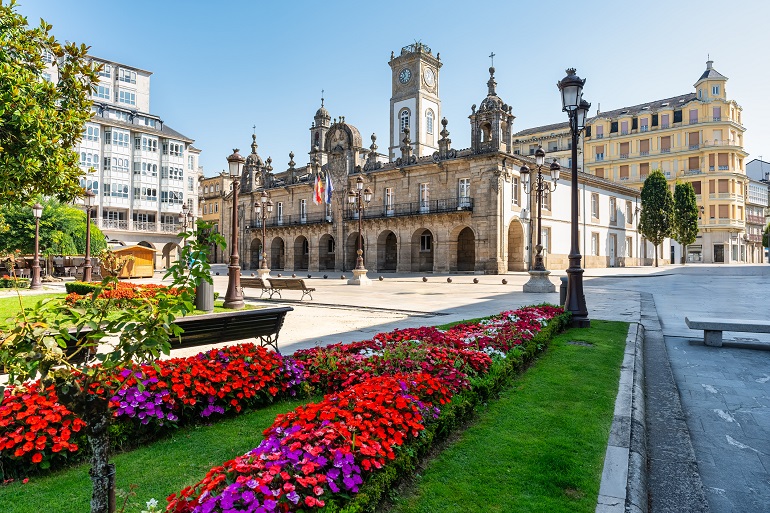
Plaza Mayor
The Plaza Mayor is Lugo's central square and serves as a hub for social activity in the city. Surrounded by historic buildings and lively cafés, it is an ideal place for visitors to relax or take in the city's atmosphere. One of the square's most prominent structures is the City Hall (Casa do Concello), a Baroque building with an ornate façade dating back to the mid-18th century. Adjacent to it stands the Clock Tower, originally built in the 16th century but later reconstructed. The plaza often hosts public events, markets, and festivals, making it a vibrant part of Lugo's cultural life.
Roman Bridge
The Roman Bridge over the Miño River is another reminder of Lugo's ancient past. Although it has undergone numerous repairs and modifications over time, much of its original Roman structure remains intact. The bridge was an essential part of Lugo's infrastructure during Roman times, connecting the city with other parts of Galicia. Today, it serves as a pedestrian walkway and offers picturesque views of the river and surrounding countryside.
Rosalía de Castro Park
Rosalía de Castro Park is Lugo's largest green space and provides a peaceful retreat from the city's historic streets. Covering 23 hectares, the park features well-maintained walking paths, lush vegetation, and a small pond that attracts local wildlife. It is named after Rosalía de Castro, one of Galicia's most celebrated poets. Among its many trees are three towering sequoias that stand out for their impressive size. The park is popular with both locals and visitors looking for a quiet place to relax or enjoy outdoor activities.
Church of St Francis
The Church of St Francis is a Gothic-style building that dates back to Lugo's medieval period. Although much of its original structure has been altered or lost over time, parts of its cloister remain intact and provide insight into its historical significance. The church is located near Rosalía de Castro Park and offers visitors another glimpse into Lugo's rich ecclesiastical heritage.
Church of St Dominic
The Church of St Dominic is an 18th-century structure located within Lugo's old town. While less ornate than some of Lugo's other religious buildings, it holds historical importance as part of the city's network of churches that have served its community over centuries.
Festivals
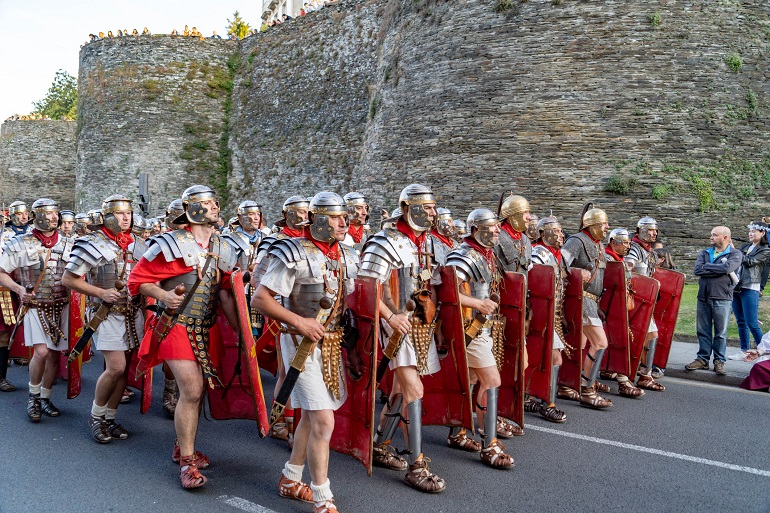
Lugo is known for its vibrant festivals that celebrate both its Roman heritage and Galician traditions. The Arde Lucus festival takes place in late June and transforms the city into a living history museum that recreates life during Roman times. Locals dress in period costumes, participate in re-enactments, and host markets that mimic those from ancient Rome. Another major event is the Saint Froilán Festivity, held annually from 4–12 October. This festival honours Lugo's patron saint with music performances, traditional Galician food stalls (notably offering "pulpo á feira," or fair-style octopus), parades, and cultural events throughout the city centre.
Top Museums
Provincial Museum of Lugo
The Provincial Museum of Lugo, established in 1932 by the Provincial Council of Lugo, was created to collect and protect the patrimony of the province that was previously scattered across individual collections and public institutions. Initially housed in the Palacio Provincial de San Marcos, the museum moved to its current location in 1957, occupying the rooms of the old San Francisco Convent alongside a new building designed by architect Manuel Gómez Román.
The museum offers a chronological journey through history, with the first floor housing a collection of tiles from the 3rd century found in Armañá Street, as well as sacred art collections featuring stone imagery, Gothic Mannerist and Baroque pieces, processional silver crosses, and other religious objects. The cloister displays epigraphy, heraldry, and stone collections, while the convent kitchen showcases ethnographic funds.
The upper part of the cloister is dedicated to Prehistory and Archaeology, presenting a timeline from the Palaeolithic era to the end of Romanisation, complemented by ceramics, glass, numismatic and medals collections. The second floor features Galician art collections, focusing on 19th and 20th century painting and sculpture, with dedicated halls for artists such as Antonio Fernández, Julia Minguillón, and Corredoira, alongside the renowned Sargadelos ceramic collection.
Interactive Museum of the History of Lugo (MIHL)
The Interactive Museum of the History of Lugo (MIHL) offers a modern and dynamic approach to exploring the city's rich history. Located in Milagrosa Park in the northern part of the city, this cultural space emphasises new technologies to provide an interactive visitor experience.
The museum provides a comprehensive overview of Lugo's history from prehistoric times to the present day, situated within proximity to the well-preserved Roman walls. Facilities include space for temporary exhibitions, a performance stage, library, cafeteria, and shops. Notably, the museum demonstrates environmental consciousness through its use of biomass energy for heating and hot water.
Museum of the History of Lugo
Designed by Nieto Sobejano Arquitectos, this innovative museum is conceived as a fusion between a museum and a park. The building is largely buried underground with a green roof creating a prairie-like surface punctuated by cylindrical lanterns that bring natural light and ventilation to the spaces below.
The museum's objective is to present Lugo's history through audiovisual means. Its distinctive cylindrical volumes make references to the bastions of Lugo's Roman walls and archetypal industrial silos, creating a sculptural and abstract space enhanced by the cor-ten steel mesh covering the cylinders. The design includes a dissuasive parking area to reduce traffic in the city centre.
Other Notable Museums
Lugo also offers several other cultural spaces worth visiting, including:
- House of Mosaics: A specialised museum showcasing the mosaic heritage of the region.
- Vieja Cárcel: The old prison converted into a cultural space.
- Sala de Exposicións Porta Miñá: An exhibition hall featuring rotating displays of art and cultural artefacts.
Local Cuisine
Lugo, often hailed as the gastronomic capital of Galicia, offers a rich culinary tradition that showcases the region's finest ingredients and flavours. One of the most iconic dishes is pulpo á feira, a tender boiled octopus garnished with olive oil, paprika, and coarse salt, often served with boiled potatoes. Another must-try is lacón con grelos, a hearty dish of salted pork shoulder, turnip greens, and potatoes. Seafood lovers will delight in soggy rice with lobster and empanada gallega, a savoury pie filled with meat, fish, or vegetables. For dessert, indulge in filloas, delicate crêpes often paired with honey or cream, or Cebreiro cheese with honey, a local delicacy. Pair these dishes with a glass of Albariño or Ribeiro, two celebrated Galician wines, for an authentic Lugo dining experience.
Getting There & Around
Lugo is well-connected by bus services, with ALSA and Arriva operating regular routes from major Spanish cities including Madrid (6h 45m, €55), Vigo (3h, €25), and A Coruña (1h 10m, €7-11). For international travellers, flying to a nearby airport and taking a connecting bus is the most practical option. Once in Lugo, the compact city centre is easily explored on foot, with the historic Roman-walled old town being particularly pedestrian-friendly. Local urban bus services operate to the outskirts of the city, with lines 10, 12, 7, 9, 14 and 14A serving the bus station. Taxis are readily available, with a stand located just outside the main bus station for convenient transfers. The city's layout, with the impressive UNESCO World Heritage Roman walls forming a 2km loop around the old town, makes orientation simple for visitors.