


 Belgium Guide
 Luxembourg Guide
|
|
Introduction
Gouda, a charming city in the western Netherlands, is renowned for its eponymous cheese and rich history dating back to the 13th century. Located at the confluence of the Gouwe and IJssel rivers, this medieval city boasts a picturesque centre with canals, historic facades, and notable landmarks. The Gothic town hall, built in 1449, and the Sint-Janskerk (St. John's Church), famous for its 72 stained-glass windows, are key attractions. Gouda's weekly cheese market, held from April to September, offers visitors a glimpse into traditional Dutch culture. Beyond its cheese heritage, the city is also known for its stroopwafels, clay pipes, and pottery. With a population of around 70,000, Gouda provides a perfect blend of history, culture, and culinary experiences, making it an ideal destination for travellers seeking an authentic Dutch experience.
History
In medieval times, Gouda was situated in a swampy area covered with a peat forest and crossed by small creeks such as the Gouwe. Peat harvesting began in the 11th and 12th centuries. In the 13th century, the Gouwe was connected to the Old Rhine by a canal, and a harbour developed at its mouth. The van der Goude family built a fortified castle alongside the banks of the Gouwe River, which gave its name to the town and the family.
Gouda was granted city rights in 1272 by Floris V, Count of Holland. The city was destroyed by fires in 1361 and 1438. It was occupied and damaged by the Sea Beggars (rebels from noble families opposing the Spanish regime) in 1572. The castle was demolished in 1577.
In 1574, 1625, 1636, and 1673, Gouda suffered from deadly Plague epidemics, the last of which killing 2995 people, or 20% of the population at the time. This caused alternate economic upheavals, further worsened by the Eighty Years' War (1568-1648). The situation improved between 1700 and 1730. Afterwards, other recessions led to a long period of decline lasting until the middle of the 19th century. During that period, Gouda had become so poor that the terms "Goudaner" and "beggar" were considered synonymous.
The city walls were pulled down between 1830 and 1854. In 1855, the railway linking Gouda to Utrecht began to operate. New companies, such as the Stearine Kaarsenfabriek (Stearine Candle Factory) and the Machinale Garenspinerij (Mechanized Yarn Spinnery), acted as the impetus to the local economy. Large-scale development started beyond the city walls at the beginning of the 20th century. In the 1940's, parts of the canals were filled up in spite of protests from the local population.
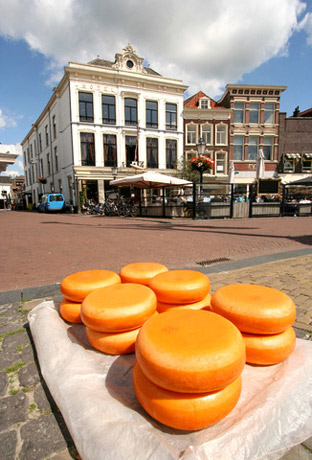
Nowadays, Gouda is first and foremost renowed for its cheese, still sold on the market every Thursday, but also for its candles, smoking pipes, and syrup waffles.
Attractions
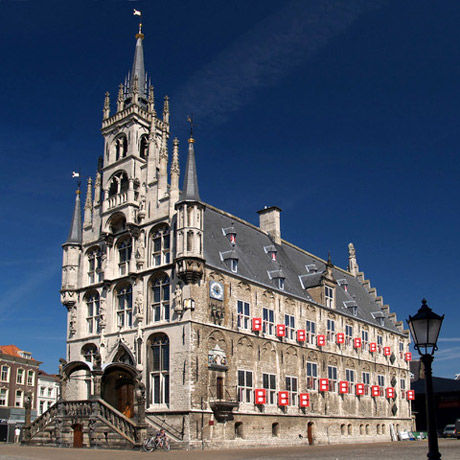
The Market Square (Markt) is the heart of the city's activity. The main shopping street passes through the north-western side of the square, and market is still held several days per week. The square is dominated by the splendid Gothic town hall (stadhuis), built between 1448 and 1450.
Just behind the town hall, the so-called Waag (scale house), dating from 1667, was formerly used for weighing goods (especially cheese) to levy taxes. It now houses a museum retracing the history of cheese trade.
South of the Markt is the 16th-century Great St. John's Church (Grote Sint Janskerk), the largest cross-shaped church in the Netherlands. The main reason to visit the church (and pay the admission fee) is to see its famed stained glass windows, created between 1530 and 1603, an which are considered to be among the finest in the world. The works were sponsored by rich noble families from the whole of the Habsburgian Netherlands (modern Belgium included), as testify the coat of arms at the bottom of each window. The most significant windows were designed by Dirick (Theodore) and Wouter (Walter) Crabeth, as well as Lambert van Noort, between 1550 and 1570.

|

|

|

|
Other attractions in town include the Waaiersluis (historic lock on the Hollandse IJssel), the Harbour Museum Gouda (Museumhaven Gouda), the Gouda Museum (local history), De Verborgen Tijd Museum (modern art), the De Moriaan Museum (national pharmaceutical museum), and the Verzets Museum (about Dutch resistance during WWII).
How to get there
Gouda is well-connected to major Dutch cities by train, making it an excellent day trip destination. From Amsterdam, the journey takes under an hour, while Rotterdam and Utrecht are just 20 minutes away with trains running every 15 minutes. The main station is a mere 5-minute walk to the Markt (central square). For €7-18, you can travel by train from Rotterdam to Gouda. If you prefer driving, the city is accessible via the A12 and A20 motorways, with affordable parking at Klein Amerika, Schouwburgplein and Vossenburchkade (approximately €1.40-1.80 per hour, maximum €8-10 daily). Once in Gouda, the compact city centre is easily explored on foot, with most historic sights located within the circular canal. Cycling is ideal for venturing beyond the centre, with bikes available for hire at NS Rijwielshop and Rep.26. The Tourist Day Ticket (€14,50) offers unlimited travel on buses, trams, metro and waterbus throughout South Holland, though it's not valid on trains. For a unique perspective, consider a canal tour with Rederij de IJsel to see the city from the water.