


 Belgium Guide
 Luxembourg Guide
Introduction
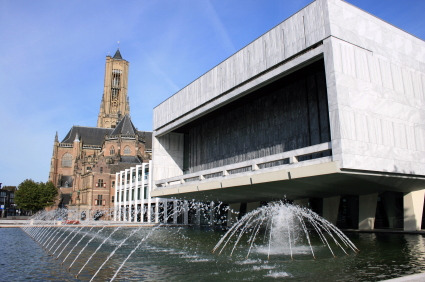
Arnhem, the capital city of Gelderland province in the eastern Netherlands, offers a unique blend of urban amenities and natural beauty. With a population of over 150,000, this vibrant hub is known for its rich history, particularly its role in World War II's Operation Market Garden. Arnhem boasts a thriving art and culture scene, influenced by its renowned fashion and art school, ArtEZ. The city is surrounded by lush green spaces, including the Veluwezoom National Park and Hoge Veluwe National Park, earning it the title of 'greenest city in Europe'. Visitors can explore historical sites such as the St. Eusebius Church and the Devils' House, enjoy the Netherlands Open Air Museum, or relax in the picturesque Sonsbeek Park. Arnhem's excellent transport links, including its modern train and bus station, make it an ideal base for exploring both the city and the surrounding natural landscapes.
Arnhem Land, in the north-eastern corner of the Northern Territory of Australia, was named after the Dutch ship Arnhem - itself named after the city - which explored the coast in 1623.
The Anglo-Dutch actress Audrey Hepburn attended Arnhem Conservatory during the war years (1939-1945).
History
Neanderthals inhabited the region at least 70,000 years ago. The first traces of modern human presence date from 5000 BCE. 12 graves from 2400 BCE were found in a nearby hill, in Schaarsbergen. The earliest permanent settlement in Arnhem, on the Hoogkamp, dates from 1500 BCE.
When the Romans arrived in the region around 50 BCE, the area around the city was called Oppidium Arnoldi Villa, while the settlement itself was called Arenacum, from which the city name is derived. The meaning of the name is "home of the eagle", and stems from the many eagles that used to inhabit the hills and the woods of Arnhem.
First mentioned on paper in 893, the early town belonged to the abbey of Prüm, near Luxembourg. Arnhem did not obtained city rights until 1233, after which it became a residence of the Dukes of Guelders. The city joined the Hanseatic League in 1443.
In 1473, Arnold of Egmond sold the duchy of Guelders to Charles the Bold, Duke of Burgundy, who was recognized by the Holy Roman Emperor as Duke of Guelders. In 1492, Charles of Egmond, fought to restore the independence of Guelders, with the support of the King of France. Proclaimed Duke of Guelders, he took the duchy back from the Dukes of Burgundy. In 1543, Emperor Charles V of Habsburg, heir of the Dukes of Burgundy, reclaimed his rights in the duchy and took it back by force, thus permanently annexing Guelders (and the neighbouring County of Zutphen) to the Habsburgian Netherlands.
As capital of the so-called Kwartier van Veluwe, Arnhem joined the Union of Utrecht in 1579 and became part of the newly independent Republic of the Seven United Provinces of the Netherlands in 1585.
The French occupied the town from 1672 to 1674 under Louis XIV, and again from 1795 to 1813, during the French Revolution.
In the early 19th century, the former fortifications were almost completely dismantled, to give space for town expansion. The Sabelspoort ("Sabres' Gate") is the only remaining part of the medieval walls.
In the 19th century, Arnhem was a genteel resort town famous for its picturesque beauty. It was known as het Haagje van het oosten ("The Little Hague of the East"), mainly because a number of rich sugar planters who returned from the Indies to settle there, as they did in The Hague. Even now the city is famous for its parks and greenery. The urbanization on hilly terrain, in the northern part of the city, is also quite unusual for the Netherlands.
In September 1944, British and Polish units were parachuted around Arnhem as part of the Operation Market Garden. The Allied attempted to take the city from the Germans, but encountered stiff resistance and failed. The events served for the plot of the 1977 film A Bridge Too Far. A second battle of Arnhem took place in April 1945 when the city was liberated by the First Canadian Army.
Attractions
The only prominent building in town is the heavily reconstructed Groote Kerk (a.k.a. St. Eusebius Church), originally built between 1452 and 1560. Interestingly, the tower is not officially part of the church as it is owned by the municipality.
The best reason to visit Arnhem is for the National Heritage Open Air Museum (Nederlands Openluchtmuseum) is a park with reconstructed traditional houses, farms, windmills, and workshops from different regions of the Netherlands. Volunteers in traditional clothes show visitors how daily life was in the countryside in past centuries. Th park is very similar to the Bokrijk Domain in Hasselt, Belgium.
The other main attraction is the Burgers' Zoo, the biggest and most-visited zoo in the Netherlands.
If you are into modern art, the Museum voor Moderne Kunst has a collection mostly by Dutch artists. The museum has a policy that half of the works on display at any given time must be by female artists.
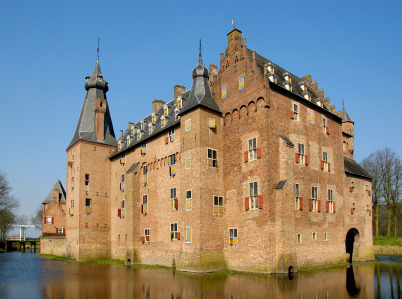
Around ArnhemAbout 10 km west of central Arnhem, along the Waal River, is Doorwerth Castle. This medieval castle originated in the late 13th century. Expanded several times in the following centuries, the castle as it stands today hasn't changed since 1637. The castle suffered heavily in 1944 during the confrontation between German and Allied troops, and was only restored from 1983. Doorwerth was featured on the British paranormal television show Most Haunted in 2004. The castle is open from 10 am (11 am on Sunday, 1 pm on Saturday) to 5 pm. It is closed on Mondays. Admission is €8 (€4.50 for children until 12). |
|
How to get there
Arnhem is well-connected by various transport options. By car, you can reach the city via the A12 (connecting The Hague to the German border), A50 (north-south route), or A325 (linking Arnhem and Nijmegen). The city has four train stations, with Arnhem Centraal being the main hub offering intercity connections to Amsterdam, Utrecht, and even international services to Frankfurt and Düsseldorf. From Amsterdam's Schiphol Airport (110km away), the train journey takes approximately 75 minutes and costs about €20.60 one-way. Once in Arnhem, you can explore the city using its unique trolleybus network—the only one in the Netherlands—with the central bus station conveniently located next to the train station. For more flexibility, hire a bicycle from the station for €5.20 per day or €21 per week (requiring a €25 deposit). Taxis are available at the station or can be booked via Taxi Arnhem (☏ +31 26 260 26 26). If driving within the city centre, be aware that paid parking applies throughout and there's a strict environmental zone prohibiting diesel cars registered before January 2005.