


 Bulgaria Guide
 Greece Guide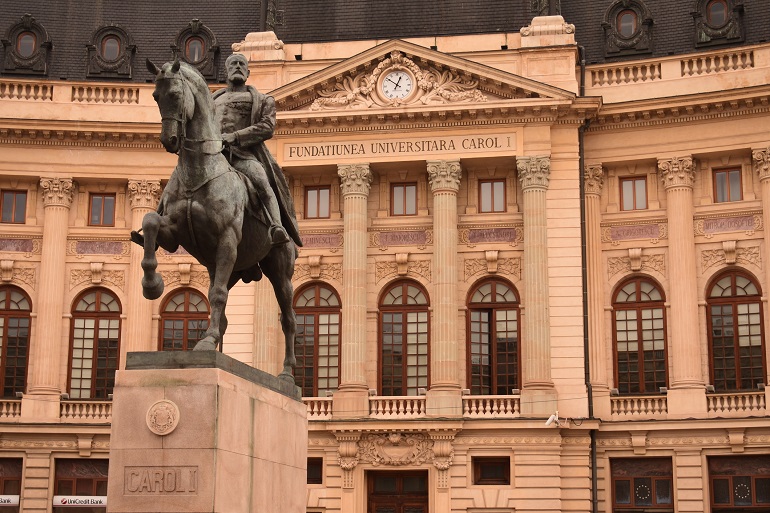
Prehistoric Era and Ancient Civilisations
Romania's history begins in the distant past, with evidence of human habitation dating back to the Palaeolithic period. The 2002 discovery of human remains in the Peștera cu Oase ("Cave with Bones") in southwestern Romania revealed the oldest known Homo sapiens in Europe, dating to approximately 34,950 years ago. These fossils, known as "Oase 1," display a mixture of modern human and Neanderthal characteristics, suggesting interbreeding between the two species.
The Neolithic period (c. 6500-3500 BCE) saw the development of sophisticated agricultural societies across Romania. The Starčevo-Criș culture, one of the earliest Neolithic cultures in Europe, flourished in the region around 6200-5500 BCE, introducing farming, pottery, and permanent settlements.
Perhaps the most remarkable prehistoric culture to develop in Romania was the Cucuteni-Trypillia civilisation (5500-2750 BCE), which created some of Europe's largest settlements of the time. Archaeological excavations have uncovered Cucuteni settlements containing up to 1,500 buildings, housing perhaps 20,000-30,000 people—remarkably large for Neolithic Europe. The culture is particularly known for its intricate polychrome pottery, featuring spirals, meandering lines, and stylised animal and human figures. Curiously, evidence suggests that Cucuteni settlements were deliberately burned every 60-80 years, possibly as part of a ritual practice of renewal.
By the Bronze Age (3500-1700 BCE), metallurgy was well-established in the Carpathian Basin. The Wietenberg culture in Transylvania produced sophisticated bronze weapons and ornaments, while the Monteoru culture in eastern Romania created distinctive pottery and bronze objects.
The Dacians and Romans
The Iron Age saw the rise of the Dacians, a Thracian people who established a powerful kingdom in the Carpathian Mountains. By the 1st century BCE, under King Burebista (82-44 BCE), the Dacian kingdom had expanded to its greatest extent, stretching from the Black Sea to the Tisza River and from the Balkan Mountains to present-day Slovakia. Burebista unified various Dacian tribes and posed such a threat to Rome that Julius Caesar reportedly planned a campaign against him before his assassination.
The Dacian capital, Sarmizegetusa Regia, located in the Orăștie Mountains of Transylvania, was a sophisticated urban centre with an advanced water supply system, stone temples, and an astronomical observatory. Recent archaeological work has revealed that Dacian craftsmen were skilled metalworkers, producing high-quality iron tools and weapons.
The Dacians' conflict with Rome intensified under King Decebalus (87-106 CE). After Decebalus defeated Emperor Domitian's forces in 87 CE, Rome was forced to pay annual tribute to the Dacian kingdom—a humiliation that Emperor Trajan sought to avenge. Trajan's Dacian Wars (101-102 and 105-106 CE) ended with the conquest of Dacia and Decebalus's suicide rather than face capture.
The Roman conquest of Dacia was commemorated on Trajan's Column in Rome, which depicts the war in a 200-metre spiral relief. The Romans exploited Dacia's gold mines in the Apuseni Mountains, extracting an estimated 700 tonnes of gold and 4,000 tonnes of silver over 166 years—wealth that helped finance the Roman Empire's expansion elsewhere.
Roman Dacia became a prosperous province with urban centres like Ulpia Traiana Sarmizegetusa (not to be confused with the earlier Dacian capital), Apulum (modern Alba Iulia), and Napoca (Cluj-Napoca). The Romans built extensive road networks, baths, temples, and amphitheatres. At Germisara (modern Geoagiu Băi), they developed thermal spas that are still in use today.
The Roman withdrawal from Dacia in 271-275 CE under Emperor Aurelian, due to mounting pressure from migratory peoples, marked the end of direct Roman rule. However, the Latin language and Roman customs had taken root among the local population, forming the basis of Romanian culture and language.
The Migration Period and Early Middle Ages
Following the Roman withdrawal, Romania entered a turbulent period known as the Migration Era. Successive waves of nomadic peoples—Goths, Huns, Gepids, Avars, Slavs, Bulgars, and others—crossed the territory. Despite these migrations, archaeological and linguistic evidence suggests continuity of the Romanised Dacian population, particularly in the mountainous regions.
The Slavic migrations of the 6th-7th centuries CE had a significant impact on the region's demography and language. While Romanian remained fundamentally a Romance language, it absorbed substantial Slavic vocabulary and some grammatical features, making it distinct from other Romance languages.
Christianity spread gradually throughout the region, with archaeological evidence of Christian communities dating to the 4th-5th centuries. By the 9th century, most of the population had adopted Eastern Orthodox Christianity, which would remain the predominant religion of Romanians.
The First Bulgarian Empire (681-1018) extended its control over much of present-day Romania south of the Carpathians. Bulgarian rule brought Slavonic liturgy and the Cyrillic alphabet, which would be used in Romanian church writings and official documents until the 19th century.
The Formation of the Romanian Principalities
The 13th and 14th centuries saw the emergence of the first Romanian states. Transylvania developed as an autonomous voivodeship within the Kingdom of Hungary, with a significant Romanian population but primarily Hungarian and German (Saxon) nobility and urban classes.
Wallachia emerged as an independent principality in the early 14th century when Basarab I (c. 1310-1352) defeated the Hungarian King Charles Robert at the Battle of Posada in 1330. This victory, in which Basarab's forces ambushed the Hungarian army in a narrow mountain pass, secured Wallachian independence and established the Basarab dynasty.
Moldavia coalesced as a state under Bogdan I, who rebelled against Hungarian authority around 1359. The principality reached its zenith under Stephen the Great (Ștefan cel Mare, r. 1457-1504), who successfully defended Moldavia against Ottoman, Hungarian, and Polish incursions. During his 47-year reign, Stephen fought 36 battles, winning 34 of them, and built a church after each victory. He was canonised by the Romanian Orthodox Church in 1992.
These medieval Romanian states developed distinctive political institutions, including the boyar nobility and the institution of the hospodar (prince). A unique feature was the absence of feudalism in its Western European form; instead, Romanian peasants typically lived in self-governing village communities (obști) that collectively owned the land.
Ottoman Influence and Resistance
By the mid-15th century, the Ottoman Empire had become the dominant power in the Balkans. Rather than directly annexing the Romanian principalities, the Ottomans established a system of suzerainty. Wallachia became a tributary state in 1417, followed by Moldavia in 1455. The principalities maintained internal autonomy but paid annual tribute, provided troops when required, and had their foreign policy controlled by the Porte (Ottoman government).
Several Romanian rulers gained renown for their resistance against Ottoman power:
- Vlad III Dracula (Vlad Țepeș, "the Impaler") of Wallachia (r. 1448, 1456-1462, 1476) is infamous for his brutal punishments, particularly impalement. In 1462, he conducted a scorched-earth campaign against an invading Ottoman army led by Sultan Mehmed II, the conqueror of Constantinople. Vlad's night attack on the Ottoman camp nearly succeeded in assassinating the Sultan. Though later romanticised and fictionalised as the inspiration for Bram Stoker's "Dracula," historical records show Vlad as a harsh but effective ruler who temporarily halted Ottoman expansion.
- John Hunyadi (Iancu de Hunedoara), a Transylvanian nobleman of Romanian origin who became regent of Hungary, led several campaigns against the Ottomans. His victory at Belgrade in 1456 halted Ottoman advance into Central Europe for decades.
- Michael the Brave (Mihai Viteazul) achieved a remarkable, if brief, unification of Wallachia (1593), Transylvania (1599), and Moldavia (1600) under his rule. Though primarily motivated by political expediency rather than national consciousness, his achievement later became a powerful symbol for Romanian nationalists. Michael's assassination in 1601 by Habsburg general Giorgio Basta ended this first unification of Romanian lands.
The Phanariot Era
The 18th century brought a new phase in Ottoman-Romanian relations. After the failed anti-Ottoman campaign of Dimitrie Cantemir of Moldavia, who allied with Peter the Great of Russia in 1711, the Ottomans instituted a system of appointing Greek administrators from the Phanar district of Constantinople as princes of Moldavia and Wallachia.
These Phanariot rulers (1711-1821) were typically wealthy Greek families who purchased their positions from the Ottoman court. The frequent rotation of princes—47 reigns in Moldavia and 40 in Wallachia during this period—led to fiscal exploitation as each ruler sought to recoup his investment. However, the Phanariot era also brought Enlightenment influences, administrative reforms, and the first modern legal codes (the Calimachi Code in Moldavia and the Caragea Law in Wallachia).
Transylvania Under Habsburg Rule
While Moldavia and Wallachia experienced Ottoman suzerainty, Transylvania followed a different historical path. After the Battle of Mohács in 1526 and the collapse of the medieval Hungarian kingdom, Transylvania emerged as an autonomous principality under Ottoman suzerainty but ruled by Hungarian princes.
The 16th-17th centuries were a golden age for Transylvanian culture, particularly under princes Gabriel Bethlen and György Rákóczi I. The principality became known for its religious tolerance at a time when religious wars ravaged much of Europe. The Edict of Turda (1568) was one of the first legal guarantees of religious freedom in Europe, recognising four "received" religions: Catholicism, Lutheranism, Calvinism, and Unitarianism. However, Romanian Orthodox Christians, who constituted the majority of the population, were merely "tolerated" rather than having equal rights.
Following the defeat of the Ottomans at Vienna in 1683, the Habsburg Empire gradually extended its control over Transylvania. The Diploma Leopoldinum of 1691 formalised Habsburg rule while preserving Transylvania's autonomy and the privileges of its three "nations" (Hungarians, Székelys, and Saxons) and four "received" religions.
Under Habsburg rule, significant demographic changes occurred in Transylvania. The Habsburgs encouraged German colonisation, particularly in the Banat region after its recovery from the Ottomans in 1718. These German settlers, known as Swabians, brought advanced agricultural techniques and contributed to the region's economic development.
The late 18th century saw growing Romanian national consciousness in Transylvania, stimulated by the Transylvanian School (Școala Ardeleană), a cultural movement led by Greek Catholic intellectuals like Samuil Micu, Gheorghe Șincai, and Petru Maior. These scholars emphasised the Latin origins of the Romanian language and people, challenging Hungarian claims to historical precedence in Transylvania.
The Road to Modern Romania
The early 19th century brought significant changes to the Romanian principalities. The Treaty of Adrianople (1829), concluding the Russo-Turkish War, granted Moldavia and Wallachia increased autonomy, abolished the Ottoman trade monopoly, and established Russian protectorate. The Organic Regulations, introduced under Russian supervision in 1831-1832, provided the first constitutional framework for the principalities, modernising their administration and creating the foundations for unified state institutions.
The 1848 revolutions swept through the Romanian lands as they did across Europe. In Moldavia, the revolution was quickly suppressed, but in Wallachia, revolutionaries briefly took power and issued the Islaz Proclamation calling for independence, civil liberties, and land reform. In Transylvania, Romanian national demands clashed with Hungarian revolutionary aims, leading to inter-ethnic conflict.
Though the revolutions were ultimately defeated, they crystallised national aspirations and brought a new generation of leaders to prominence, including Mihail Kogălniceanu, C.A. Rosetti, and Ion C. Brătianu.
A crucial step toward unification came after the Crimean War (1853-1856). The Treaty of Paris placed the principalities under the collective guarantee of the Great Powers rather than under Russian protection. When Moldavians and Wallachians both elected the same man—Alexandru Ioan Cuza—as their prince in 1859, the foundation for a unified Romanian state was laid.
Cuza's reign (1859-1866) brought sweeping reforms: secularisation of monastery lands, agrarian reform, establishment of universities in Iași and Bucharest, and the introduction of a modern legal code based on the Napoleonic model. However, his authoritarian tendencies and personal scandals led to his forced abdication in 1866.
Cuza was replaced by Prince Carol of Hohenzollern-Sigmaringen, who would rule as Carol I until 1914. Under his leadership, Romania declared independence during the Russo-Turkish War of 1877-1878, with Romanian troops playing a crucial role in the siege of Plevna. The Treaty of Berlin formally recognised Romanian independence, though at the cost of ceding southern Bessarabia to Russia in exchange for the Dobruja region.
In 1881, Romania was proclaimed a kingdom, with Carol I as its first king. The late 19th century saw Romania developing modern infrastructure, including railways and the magnificent bridge over the Danube at Cernavodă, designed by Anghel Saligny. The discovery of oil fields around Ploiești laid the foundation for Romania's petroleum industry, which would become strategically important in the 20th century.
The World Wars and Greater Romania
Romania initially declared neutrality when World War I broke out in 1914. After two years of diplomatic manoeuvring, Romania entered the war on the Allied side in August 1916, hoping to gain Transylvania from Austria-Hungary. The campaign began promisingly but quickly turned disastrous. By December 1916, Central Powers forces had occupied Bucharest and most of southern Romania, forcing the government, royal family, and remnants of the army to retreat to Moldavia.
In 1917, the Romanian army, reorganised with French assistance, successfully defended Moldavia against German-Austrian offensives at Mărăști, Mărășești, and Oituz. However, Russia's withdrawal from the war after the Bolshevik Revolution left Romania isolated, forcing it to sign the harsh Treaty of Bucharest with the Central Powers in May 1918.
Romania re-entered the war on November 10, 1918, just one day before the Armistice on the Western Front. The collapse of Austria-Hungary and revolutionary turmoil in Russia created an opportunity for Romanian national aspirations. The provinces of Bessarabia, Bukovina, and Transylvania each declared union with Romania in 1918, creating "Greater Romania" (România Mare).
The 1919 Paris Peace Conference and subsequent treaties (Versailles, Saint-Germain, Trianon, and Neuilly) confirmed these territorial changes. Romania emerged from World War I with its territory doubled and its population increased from 7.5 to 16 million.
The interwar period brought significant challenges of integration and modernisation. The 1923 Constitution established a liberal democratic framework, while the agrarian reform—one of the most extensive in Eastern Europe—redistributed approximately 6 million hectares to peasants. However, the global economic crisis of 1929-1933 hit Romania severely, exacerbating social tensions and fuelling political extremism.
King Ferdinand I (r. 1914-1927) and Queen Marie played important roles in achieving national unity. Their son, Carol II (r. 1930-1940), initially enjoyed popularity but gradually established a royal dictatorship in 1938, suppressing political parties and promulgating a new authoritarian constitution.
The rise of Nazi Germany and the Soviet Union placed Romania in an increasingly precarious international position. The Molotov-Ribbentrop Pact of August 1939 assigned Bessarabia to the Soviet "sphere of influence." In June 1940, Romania was forced to cede Bessarabia and Northern Bukovina to the USSR. Two months later, under the Second Vienna Award imposed by Germany and Italy, Northern Transylvania was transferred to Hungary. Southern Dobruja was also ceded to Bulgaria in the Treaty of Craiova.
These territorial losses discredited Carol II's regime. In September 1940, General Ion Antonescu, with the support of the fascist Iron Guard movement, forced Carol to abdicate in favour of his 19-year-old son, Michael I. Antonescu established a military dictatorship, initially sharing power with the Iron Guard but then suppressing them after their rebellion in January 1941.
Seeking to recover the territories lost to the Soviet Union, Antonescu allied Romania with Nazi Germany. Romanian forces participated in the invasion of the USSR in June 1941, recovering Bessarabia and Northern Bukovina and continuing eastward to participate in the siege of Odessa and the Battle of Stalingrad. On the Eastern Front, Romania contributed the largest forces among Germany's allies, suffering approximately 500,000 casualties.
The Romanian administration of Transnistria (the territory between the Dniester and Bug rivers) was marked by atrocities against Jews and Roma. Within Romania proper, despite initial anti-Semitic measures, most Jews survived, particularly in the Old Kingdom regions of Wallachia and Moldavia.
As the war turned against the Axis, King Michael I led a coup d'état on August 23, 1944, arresting Antonescu and announcing Romania's switch to the Allied side. Romanian forces then fought alongside the Soviet Army against Germany, contributing significantly to the liberation of Transylvania, Hungary, Czechoslovakia, and Austria. Despite this contribution, the 1947 Paris Peace Treaty treated Romania as a defeated nation, though it did restore Northern Transylvania to Romanian control.
Communist Romania
The presence of Soviet troops in Romania after the war facilitated the gradual Communist takeover. The Romanian Communist Party, which had been marginal before the war with fewer than 1,000 members, grew rapidly under Soviet protection. Rigged elections in 1946 brought a Communist-dominated government to power.
King Michael I was forced to abdicate on December 30, 1947, and Romania was proclaimed a People's Republic. The new regime, led initially by Gheorghe Gheorghiu-Dej, implemented Soviet-style policies: nationalisation of industry, collectivisation of agriculture, and political repression through the Securitate secret police.
The 1950s saw harsh Stalinist policies, including the notorious Pitești experiment—a brutal "re-education" programme in which political prisoners were forced to torture each other. The Danube-Black Sea Canal, begun as a massive labour project using political prisoners, resulted in thousands of deaths before being temporarily abandoned in 1953.
After Stalin's death, Gheorghiu-Dej gradually distanced Romania from Moscow, seeking greater autonomy within the Eastern Bloc. This "national Communist" approach was continued and expanded by Nicolae Ceaușescu, who succeeded Gheorghiu-Dej in 1965.
Ceaușescu's early years (1965-1971) were marked by relative liberalisation and opening to the West. Romania established diplomatic relations with West Germany, maintained relations with Israel after the Six-Day War (unlike other Eastern Bloc countries), and Ceaușescu publicly condemned the 1968 Warsaw Pact invasion of Czechoslovakia. These independent foreign policy stances earned him popularity at home and respect abroad.
However, after a visit to China and North Korea in 1971, Ceaușescu launched his "July Theses," initiating a "mini-cultural revolution" that tightened ideological control and developed an extreme personality cult around himself and his wife, Elena. The 1970s-1980s saw increasingly erratic economic policies, including massive industrialisation projects and the construction of the enormous "People's House" (now the Palace of Parliament)—the second-largest administrative building in the world after the Pentagon.
The 1980s brought severe austerity as Ceaușescu became obsessed with paying off Romania's foreign debt. Food, electricity, and heating were severely rationed, creating immense hardship for ordinary Romanians. Meanwhile, the Securitate expanded its surveillance network, with an estimated one in three Romanians serving as informants.
The Romanian Revolution and Post-Communist Era
The Romanian Revolution began in Timișoara on December 16, 1989, when authorities attempted to evict Hungarian Reformed Church pastor László Tőkés, who had spoken out against the regime. Protests spread rapidly, and despite initial violent repression that left dozens dead, the revolutionary movement gained momentum.
On December 21, Ceaușescu's attempt to address a mass rally in Bucharest backfired when the crowd began booing and chanting anti-government slogans. The next day, Defence Minister Vasile Milea committed suicide (or was murdered, according to some accounts), and the army began to side with the protesters. Ceaușescu and his wife Elena fled Bucharest by helicopter but were captured, subjected to a hasty trial, and executed on December 25.
The National Salvation Front (FSN), led by Ion Iliescu, took control during the revolution and formed an interim government. However, suspicions that many FSN leaders were former Communist officials led to ongoing protests and unrest, including the violent miners' riots (mineriads) of 1990-1991.
Romania's transition to democracy and a market economy was challenging. The 1990s saw economic hardship as state industries were privatised and restructured. However, Romania also began to reorient itself towards the West, joining NATO in 2004 and the European Union in 2007.
Since the turn of the millennium, Romania has experienced significant economic growth, becoming one of the fastest-growing economies in the EU. The country has also made strides in combating corruption, though this remains an ongoing challenge.
Cultural and Scientific Contributions
Throughout its history, Romania has made significant contributions to world culture and science:
- Literature: Mihai Eminescu is considered the national poet of Romania. Other notable writers include Ion Creangă, I.L. Caragiale, Mircea Eliade, Emil Cioran, and Nobel Prize winner Herta Müller.
- Music: George Enescu was a renowned composer, violinist, and conductor. The international music festival bearing his name is held annually in Bucharest.
- Art: Constantin Brâncuși was a pioneer of modernism and one of the most influential sculptors of the 20th century.
- Science: Henri Coandă discovered the Coandă effect in fluid dynamics. Nicolae Paulescu was a pioneer in the discovery of insulin. Gheorghe Marinescu was a founder of Romanian neurology.
- Sports: Nadia Comăneci achieved the first perfect 10 in Olympic gymnastics history at the 1976 Montreal Olympics.
Contemporary Romania
Today, Romania is a parliamentary republic with a multi-party system. It is a member of the European Union, NATO, and various other international organisations. The country continues to grapple with issues such as corruption, political instability, and economic inequality, but has also made significant progress in areas like technology and environmental protection.
Romania's rich history, from its ancient Dacian roots through Roman colonisation, medieval principalities, communist era, and modern democracy, has shaped a unique national identity. As it moves forward in the 21st century, Romania continues to balance its historical legacy with its aspirations for the future.
History of European Countries
| Concise Histories of European Countries |
|---|

