


 England Guide
 Scotland Guide
 Wales Guide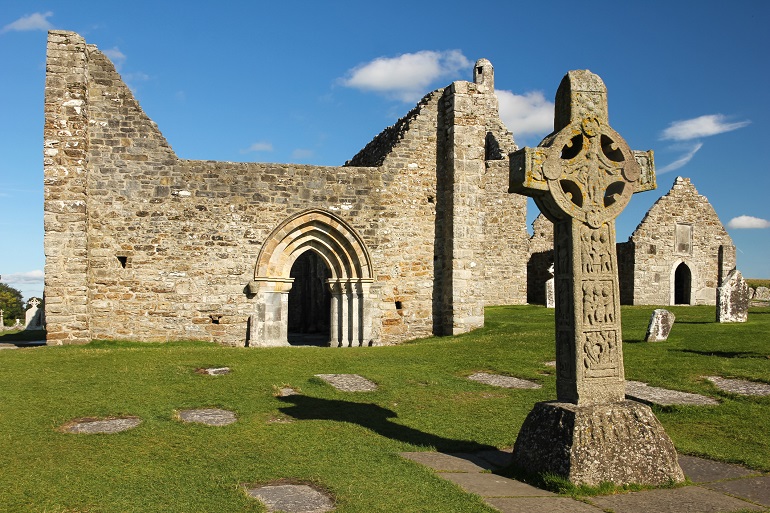
Prehistoric Ireland
Earliest Inhabitants
Ireland's story begins long before written records. The earliest evidence of human presence dates to approximately 10,500 BCE, during the Mesolithic period, when hunter-gatherers first arrived on the island. Archaeological findings at Mount Sandel in County Derry reveal Ireland's oldest known human settlement, where these early inhabitants lived in huts, hunted wild boar and birds, and fished in rivers and coastal waters.
Around 6000 BCE, Ireland's landscape was dramatically different from today, with dense woodlands covering much of the island. These early settlers used stone tools, particularly microliths—small flint blades—for hunting and food preparation. They also created dugout canoes from large tree trunks to navigate Ireland's numerous waterways.
Neolithic Revolution
The Neolithic period, beginning around 4000 BCE, brought transformative changes to Ireland with the arrival of farming communities. These settlers introduced domesticated animals including cattle, sheep, and goats, as well as cereal crops such as wheat and barley. This agricultural revolution fundamentally altered the Irish landscape as forests were cleared to create fields.
The Neolithic people of Ireland constructed impressive megalithic monuments, many of which still stand today. Newgrange, built around 3200 BCE, predates both Stonehenge and the Egyptian pyramids. This passage tomb in the Boyne Valley is precisely aligned so that at dawn on the winter solstice, a beam of sunlight illuminates its inner chamber—demonstrating the sophisticated astronomical knowledge of its builders.
Other remarkable Neolithic sites include the Céide Fields in County Mayo, the world's oldest known field system, dating back nearly 6,000 years. The stone walls that divided these ancient fields remain preserved beneath the bog, offering a remarkable window into prehistoric farming practices.
Bronze and Iron Ages
The Bronze Age arrived in Ireland around 2000 BCE, bringing metalworking technology that revolutionised tools and weaponry. Irish craftsmen became particularly skilled at creating gold ornaments, with over 2,000 gold artefacts from this period discovered across the island. The Broighter Hoard, found in County Derry, exemplifies the exquisite craftsmanship of this era, featuring a gold boat complete with oars and mast.
Around 700-500 BCE, Celtic peoples began arriving in Ireland, bringing Iron Age technology and distinctive cultural practices. These Celtic arrivals were not a single invasion but rather a series of migrations over centuries. They introduced a new language—the precursor to Irish Gaelic—and established a complex social hierarchy dominated by warrior elites.
The Celts organised Irish society into approximately 150 small kingdoms or tuatha, each ruled by a king. Above these local rulers were provincial kings, with a High King supposedly ruling from the Hill of Tara in County Meath, though historians debate whether this position held real power or was largely ceremonial.
Celtic Ireland had a sophisticated legal system known as Brehon Law, which remained in use until the 17th century. This system addressed issues ranging from land ownership to marriage and included provisions for divorce and women's property rights that were progressive for their time.
Early Christian Ireland (5th-8th Centuries)
Arrival of Christianity
Christianity's arrival in the 5th century CE profoundly transformed Irish society and culture. While Saint Patrick is traditionally credited with bringing Christianity to Ireland around 432 CE, historical evidence suggests Christian communities existed in Ireland before his mission, particularly in the southeast.
Patrick, born in Roman Britain and captured by Irish raiders as a youth, returned to Ireland as a missionary after escaping slavery. His autobiography, the "Confession," provides rare first-hand insights into 5th-century Ireland. Patrick focused his conversion efforts on local kings and nobles, recognising that their subjects would likely follow their example.
The transition from paganism to Christianity in Ireland was relatively peaceful compared to other European regions. Rather than eradicating pre-Christian traditions, Irish Christianity often incorporated and adapted them. Many holy wells and sacred sites associated with Celtic deities were rededicated to Christian saints, and the Celtic festival of Imbolc evolved into Saint Brigid's Day.
Monastic Golden Age
The 6th to 9th centuries marked Ireland's "Golden Age," when Irish monasteries became centres of learning, artistic achievement, and missionary activity. Unlike continental Europe, where Roman urban centres formed the basis for ecclesiastical organisation, Irish Christianity developed a distinctive monastic character.
Monasteries such as Clonmacnoise, Glendalough, and Durrow grew into substantial settlements with schools, scriptoria (writing rooms), workshops, and farms. These institutions preserved classical learning during Europe's Dark Ages, with monks copying not only religious texts but also classical Greek and Roman works.
Irish monasticism had unique features, including a particularly austere tradition of asceticism. Some monks became "green martyrs," seeking isolated locations for spiritual contemplation. The beehive huts on Skellig Michael, a remote rocky island off the Kerry coast, exemplify this tradition of extreme isolation.
Irish monks developed a distinctive artistic tradition, creating illuminated manuscripts of extraordinary beauty. The Book of Kells (c. 800 CE), with its intricate illustrations and ornate calligraphy, represents the pinnacle of this art form. Irish craftsmen also excelled in metalwork, producing elaborate reliquaries, chalices, and processional crosses that combined Christian symbolism with Celtic artistic motifs.
Irish Missionaries Abroad
Irish monks played a crucial role in the re-Christianisation of Europe following the collapse of the Western Roman Empire. Columba (Colmcille) established the influential monastery of Iona off Scotland's coast in 563 CE, which became a base for converting the Picts. Columbanus founded monasteries across continental Europe, including Luxeuil in France and Bobbio in Italy, while Aidan established Lindisfarne in Northumbria.
These Irish missionaries brought not only Christianity but also scholarship and artistic traditions to regions where classical learning had declined. Their monasteries became important cultural centres, preserving and transmitting knowledge that might otherwise have been lost during this turbulent period in European history.
Viking Age and Its Impact (9th-11th Centuries)
Viking Raids and Settlements
The first recorded Viking raid on Ireland occurred in 795 CE when Norse warriors attacked Lambay Island near Dublin. Over the following decades, Viking longships targeted Ireland's wealthy monasteries, which were vulnerable, unfortified repositories of precious metalwork and manuscripts.
Initially, Vikings conducted seasonal raids, returning to Scandinavia with their plunder. By the 840s, however, they began establishing permanent settlements, particularly along Ireland's eastern and southern coasts. Dublin (Dyflin) was founded in 841 as a Norse trading post and became the centre of a Viking kingdom. Other Viking settlements included Waterford (Veðrafjǫrðr), Wexford (Veisafjǫrðr), Cork (Corcaigh), and Limerick (Hlymrekr).
These Viking towns became Ireland's first true urban centres, introducing a commercial economy based on trade and crafts that contrasted with the predominantly rural, agricultural Gaelic society. Archaeological excavations in Dublin have revealed extensive evidence of Viking craftwork, including woodcarving, leatherworking, and jewellery-making.
Cultural Exchange and Integration
Despite the violence of their initial raids, the Vikings gradually integrated into Irish society. Intermarriage between Norse settlers and the native Irish population created a hybrid Hiberno-Norse culture, particularly in coastal towns. By the 10th century, many Viking leaders had adopted Christianity and formed political alliances with Irish kings.
The Vikings contributed significantly to Ireland's economic development, establishing trade networks that connected the island to a commercial system spanning from the Arctic to the Mediterranean. Dublin became a major slave-trading centre and an important port for the export of Irish goods including wool, hides, and timber.
Linguistically, the Norse influence on Irish is evident in loanwords related to shipping and commerce. The modern Irish words for things like "market" (margadh) and "money" (pinginn) derive from Norse. Many coastal place names, particularly in eastern Ireland, also reflect Viking heritage.
Brian Boru and the Battle of Clontarf
The most famous figure of this era was Brian Boru, who rose from minor nobility to become High King of Ireland. Born around 941 CE in County Clare, Brian first became King of Munster before extending his authority across much of Ireland through a combination of military campaigns and strategic alliances.
In 1014, Brian faced a coalition of his enemies at the Battle of Clontarf near Dublin. This pivotal conflict pitted Brian's forces against an alliance of the Dublin Vikings, the King of Leinster, and Norse mercenaries from Orkney and the Isle of Man. Although Brian's army was victorious, the 73-year-old king was killed in his tent after the battle.
The Battle of Clontarf has often been mythologised as a straightforward conflict between Irish and Vikings, but historical reality was more complex—Irish fought on both sides, as did Norse warriors. Nevertheless, the battle marked the beginning of the decline of Viking power in Ireland, though Norse influence remained significant in Dublin and other coastal towns for generations.
Norman Ireland (12th-15th Centuries)
The Norman Invasion
The Norman invasion of 1169 CE fundamentally altered Ireland's political landscape. This invasion originated in a succession dispute among the Irish themselves. Dermot MacMurrough, the deposed King of Leinster, sought help from King Henry II of England to regain his kingdom. Henry authorised MacMurrough to recruit Norman knights from Wales for this purpose.
The first Norman force, led by Robert FitzStephen, landed at Bannow Bay, County Wexford, in May 1169. A larger contingent arrived in 1170 under Richard de Clare, Earl of Pembroke (known as "Strongbow"), who married MacMurrough's daughter Aoife, positioning himself as heir to Leinster.
Alarmed by Strongbow's growing power, Henry II personally led a large army to Ireland in 1171, becoming the first English monarch to set foot on Irish soil. Most Irish kings submitted to Henry, recognising him as their overlord but maintaining their local authority. The Pope, Adrian IV (the only English pope), had earlier issued the bull Laudabiliter, supposedly granting Ireland to Henry II to bring the Irish church into closer conformity with Rome.
Norman Colonisation and Castle Building
The Normans introduced feudalism to Ireland, granting large territories to noble families including the FitzGeralds (Kildare and Desmond), Butlers (Ormond), and de Burghs (Connacht). These Norman lords built impressive stone castles to secure their territories—a military technology previously unknown in Ireland, where fortifications had typically been earthwork ringforts.
Trim Castle in County Meath, the largest Norman castle in Ireland, exemplifies their architectural and military sophistication. Other significant Norman structures include King John's Castle in Limerick and Carrickfergus Castle in County Antrim. The Normans also established planned towns with distinctive grid layouts, chartered markets, and stone churches.
The Normans transformed Ireland's ecclesiastical organisation, replacing the monastic system with a diocesan structure modelled on continental practices. They founded new religious houses, particularly for recently established orders like the Cistercians and Augustinians. Mellifont Abbey, Ireland's first Cistercian foundation, introduced continental architectural styles including the Gothic arch.
Gaelicisation of the Norman Lords
Over generations, many Norman families became increasingly integrated into Gaelic society—a process historians call "gaelicisation." By the 14th century, Norman lords often spoke Irish, adopted Irish customs, employed Irish bards and lawyers, and intermarried with Gaelic families. The contemporary phrase "more Irish than the Irish themselves" (Hiberniores Hibernis ipsis) described these assimilated Normans.
Several factors contributed to this cultural assimilation. The Black Death (1348-1349) disproportionately affected coastal towns where English influence was strongest. The Statute of Kilkenny (1366) attempted to reverse gaelicisation by forbidding the English in Ireland from speaking Irish, wearing Irish clothes, or intermarrying with the Irish, but these prohibitions proved largely unenforceable outside the area around Dublin known as the Pale.
By the late 15th century, direct English authority had shrunk to this small region around Dublin. The rest of the island was controlled by either gaelicised Norman lords or resurgent Gaelic chieftains who had reclaimed territories previously lost to the Normans.
Tudor Conquest and Plantation (16th-17th Centuries)
Tudor Reconquest
The Tudor dynasty, beginning with Henry VII in 1485, initiated a more assertive policy toward Ireland. The English crown was concerned about Ireland potentially becoming a base for continental enemies, particularly after the break with Rome under Henry VIII.
In 1541, Henry VIII upgraded Ireland from a lordship to a kingdom, declaring himself King of Ireland with the approval of the Irish Parliament. This change in status aimed to establish that Henry's authority in Ireland derived from his position as king rather than from papal grant, which had become problematic after his break with Rome.
The Tudor reconquest intensified under Elizabeth I, who faced challenges including the Desmond Rebellions in Munster (1569-1573 and 1579-1583) and the Nine Years' War (1593-1603) led by Hugh O'Neill, Earl of Tyrone, and Hugh Roe O'Donnell of Ulster. The latter conflict culminated in the Battle of Kinsale (1601), where Spanish forces allied with the Irish were defeated, marking a decisive English victory.
Plantation Policies
The Tudor and early Stuart monarchs implemented "plantation" schemes, confiscating lands from rebellious Irish lords and redistributing them to loyal English and Scottish settlers. The Plantation of Munster followed the Desmond Rebellions, while the most extensive scheme, the Plantation of Ulster, began in 1609 after the Flight of the Earls—when O'Neill, O'Donnell, and other Gaelic nobles fled to continental Europe.
The Ulster Plantation brought thousands of Protestant settlers, primarily from Scotland and northern England, fundamentally altering the region's demographic and cultural character. These settlers established new towns with distinctive architecture and street layouts that remain visible today in places like Derry/Londonderry.
The plantations created a new landowning class loyal to the Crown and established Protestant communities in predominantly Catholic Ireland. This policy laid the foundation for centuries of sectarian division, particularly in Ulster, where the descendants of planters maintained a distinct identity and strong connections to Britain.
Religious Conflict and the Confederate Wars
Religious tensions intensified as the Reformation took hold in England but made little headway among the native Irish population. Penal laws increasingly restricted Catholics' rights to education, property ownership, and political participation.
In 1641, Catholic landowners and dispossessed Gaelic Irish launched a rebellion that began with attacks on Protestant settlers in Ulster. Exaggerated accounts of these attacks spread fear throughout Protestant communities and hardened sectarian attitudes.
The 1641 Rebellion evolved into the Confederate Wars, part of the broader Wars of the Three Kingdoms that engulfed Britain and Ireland. The Catholic Confederation of Kilkenny established a parallel government that controlled much of Ireland between 1642 and 1649, minting its own coins and conducting diplomatic relations with Catholic powers in Europe.
This period ended brutally with Oliver Cromwell's campaign in Ireland (1649-1653). His forces captured Drogheda and Wexford, massacring the garrisons and many civilians. Cromwell's conquest was followed by the most extensive land confiscation yet, with Catholic ownership of land falling from approximately 60% before the wars to just 22% by the 1650s.
The Williamite Wars and Penal Laws (Late 17th-18th Centuries)
Jacobite Ireland and the Williamite War
The accession of the Catholic James II to the English throne in 1685 briefly improved the position of Irish Catholics. Richard Talbot, Earl of Tyrconnell, was appointed Lord Deputy of Ireland and began replacing Protestants with Catholics in the army and administration.
When James was deposed in the Glorious Revolution of 1688, Ireland became a battleground in the wider struggle between James and his Protestant son-in-law, William of Orange. James landed in Ireland in March 1689 with French support, and an Irish Parliament dominated by Catholics (known as the "Patriot Parliament") passed legislation restoring Catholic lands and repealing anti-Catholic measures.
The Williamite War in Ireland (1689-1691) included several significant engagements. Protestant apprentice boys closed the gates of Derry against Jacobite forces, leading to a 105-day siege that became a defining event in Ulster Protestant identity. The war's decisive battle came at the Boyne in July 1690, where William's multinational army defeated James's forces. James fled to France, earning him the derisive nickname "Séamus an Chaca" (James the Shit) in Irish folklore.
The war concluded with the Treaty of Limerick in October 1691, which promised religious tolerance for Catholics and protection of property for Jacobite soldiers who swore allegiance to William. However, these terms were quickly violated by the Protestant-dominated Irish Parliament.
The Penal Laws
The decades following the Williamite War saw the implementation of comprehensive Penal Laws designed to marginalise the Catholic majority and consolidate Protestant control. These laws:
- Barred Catholics from parliament, voting, public office, the legal profession, and military commissions
- Prohibited Catholics from owning weapons or a horse worth more than £5
- Restricted Catholic education, forbidding Catholics from attending university or establishing schools
- Implemented complex inheritance laws designed to fragment Catholic estates, requiring division among all sons unless the eldest converted to Protestantism
- Banned Catholic bishops and regular clergy from the country and placed parish priests under strict regulation
The Penal Laws also targeted Presbyterians and other Protestant dissenters, who faced restrictions on holding public office and were required to pay tithes to the established Anglican Church of Ireland, despite representing only about 10% of the population.
Economic Developments and Trade Restrictions
The 18th century saw significant economic changes in Ireland. The linen industry flourished, particularly in Ulster, becoming Ireland's most valuable export. Commercial beef production expanded to supply provisions for transatlantic shipping and Caribbean plantations.
However, Ireland's economic development was constrained by restrictive legislation. The Cattle Acts of 1663 and 1667 prohibited the export of Irish livestock to England, while the Woollen Act of 1699 effectively destroyed Ireland's woollen industry by prohibiting the export of Irish wool products to protect English manufacturers.
Ireland's subordinate economic position was further reinforced by the Navigation Acts, which prevented direct Irish trade with colonies and required goods to pass through English ports, where they were subject to duties. These restrictions fuelled growing resentment among the Protestant Ascendancy (the landowning Anglican elite), who began developing a distinct Anglo-Irish identity and advocating for greater autonomy within the British Empire.
The Age of Revolution (Late 18th-Early 19th Centuries)
The Volunteers and Legislative Independence
The American Revolution significantly influenced Irish politics. When British troops were withdrawn from Ireland to fight in America, Protestant landowners formed volunteer militia units for local defence. These Volunteers, numbering around 80,000 by 1782, became a powerful political force advocating for free trade and legislative independence.
Led by figures like Henry Grattan, the "Patriot Parliament" movement achieved significant concessions. The British Parliament repealed restrictive trade legislation and passed the Constitution of 1782, which granted the Irish Parliament greater autonomy by removing the British Privy Council's power to veto Irish legislation.
However, this "legislative independence" had significant limitations. The Irish Parliament remained unrepresentative, with Catholics and Protestant dissenters excluded, and the British government maintained control through patronage and the royal veto. The Lord Lieutenant, appointed by London, continued to manage Irish affairs.
The United Irishmen and 1798 Rebellion
Inspired by the French Revolution, a more radical movement emerged in the 1790s. The Society of United Irishmen, founded in Belfast in 1791 by Presbyterians including Theobald Wolfe Tone, initially advocated peaceful reform but evolved into a revolutionary republican organisation seeking complete independence from Britain and the establishment of a non-sectarian republic.
The United Irishmen attracted support across religious divides, with Catholic, Protestant, and Presbyterian members. Their newspaper, The Northern Star, promoted democratic ideals and religious equality. As government repression intensified, the United Irishmen formed a military structure and sought French assistance.
The 1798 Rebellion began in May with risings in counties Kildare, Meath, and Dublin, followed by major outbreaks in Wexford and Antrim. The rebellion was marked by sectarian atrocities on both sides, particularly in Wexford, where massacres occurred at Scullabogue and Wexford Bridge. Government forces suppressed the rebellion with brutal efficiency—an estimated 30,000 people died in just three months of fighting.
A small French force under General Humbert landed in Mayo in August 1798, too late to affect the outcome. Wolfe Tone was captured aboard a French ship in October and committed suicide while awaiting execution. The rebellion's failure led directly to the Act of Union, which abolished the Irish Parliament and incorporated Ireland fully into the United Kingdom.
The Act of Union and Catholic Emancipation
The Act of Union took effect on January 1, 1801, creating the United Kingdom of Great Britain and Ireland. Ireland was allocated 100 seats in the House of Commons and 32 Irish peers in the House of Lords. The Anglican Churches of England and Ireland were united, and free trade was established between the two islands.
Prime Minister William Pitt had intended Catholic Emancipation—the right of Catholics to sit in parliament and hold public office—to accompany the Act of Union. However, King George III's opposition and Pitt's subsequent resignation delayed this reform for nearly three decades.
The campaign for Catholic Emancipation was led by Daniel O'Connell, known as "The Liberator." O'Connell founded the Catholic Association in 1823, which used mass mobilisation techniques including "Catholic rent"—a subscription of a penny a month from supporters—to fund its activities. In 1828, O'Connell won election to the House of Commons but, as a Catholic, was unable to take his seat.
Faced with the threat of widespread civil unrest, the British government finally passed the Catholic Relief Act in 1829, granting Catholics the right to sit in parliament and hold most public offices. This victory for O'Connell's constitutional nationalism set the template for future Irish political movements.
The Great Famine and Its Aftermath (1845-1852)
Causes and Impact of the Famine
The Great Famine, also known as the Irish Potato Famine, was a period of mass starvation, disease, and emigration in Ireland between 1845 and 1852. It was caused by a potato blight that destroyed the staple food source for much of the Irish population, particularly the rural poor.
The impact of the Famine was catastrophic. Approximately one million people died from starvation and disease, while another million emigrated, primarily to North America, Britain, and Australia. Ireland's population fell from more than 8 million in 1841 to 6.6 million in 1851 and continued to decline in subsequent decades due to ongoing emigration.
British Response and Controversies
The British government's response to the Famine has been a subject of historical debate and controversy. Initial relief efforts, including the importation of maize and the establishment of public works programmes, proved inadequate to the scale of the crisis. The government's adherence to laissez-faire economic principles limited intervention, while the continuation of food exports from Ireland during the Famine remains a contentious issue.
The Famine had profound long-term consequences for Irish society, economy, and politics. It accelerated the decline of the Irish language, as many Irish-speaking areas were disproportionately affected. The Famine also contributed to the consolidation of landholdings and the shift from tillage to pasture in Irish agriculture.
Land War and Home Rule Movement (Late 19th Century)
The Land War
The Land War of 1879-1882 was a period of agrarian agitation in Ireland, focusing on tenants' rights and land ownership. The Irish National Land League, founded by Michael Davitt and supported by Charles Stewart Parnell, organised resistance to evictions and campaigned for the "Three Fs": fair rent, fixity of tenure, and free sale of improvements.
Tactics employed during the Land War included rent strikes and social ostracism of land agents and tenants who took over farms of evicted tenants (a practice that gave rise to the term "boycott"). The British government responded with coercion but also with reform, passing a series of Land Acts that gradually improved tenants' rights and facilitated land purchase.
The Home Rule Movement
The campaign for Home Rule—self-government for Ireland within the United Kingdom—dominated Irish politics in the late 19th century. Charles Stewart Parnell's Irish Parliamentary Party held the balance of power in the British House of Commons and allied with William Gladstone's Liberals to advance the cause of Home Rule.
Gladstone introduced Home Rule bills in 1886 and 1893, both of which were defeated. The prospect of Home Rule alarmed many Ulster Protestants, who feared becoming a minority in a Catholic-dominated Ireland. This opposition led to the formation of the Ulster Unionist Party and the signing of the Ulster Covenant in 1912, pledging resistance to Home Rule.
The Road to Independence (Early 20th Century)
The Easter Rising and Its Aftermath
The Easter Rising of 1916 was a watershed moment in Irish history. A small group of Irish republicans, including Padraig Pearse and James Connolly, staged an armed insurrection in Dublin during Easter week, proclaiming an Irish Republic. Although the Rising was quickly suppressed by British forces, the execution of its leaders transformed public opinion and galvanised support for the independence movement.
War of Independence and Partition
In the 1918 general election, the republican Sinn Féin party won a majority of Irish seats. Its MPs refused to take their seats in Westminster and instead established an Irish parliament, Dáil Éireann, in Dublin. This led to the Irish War of Independence (1919-1921), a guerrilla conflict between the Irish Republican Army (IRA) and British forces.
The war ended with the Anglo-Irish Treaty of 1921, which established the Irish Free State as a self-governing dominion within the British Empire. However, the treaty also confirmed the partition of Ireland, with six counties in the northeast remaining part of the United Kingdom as Northern Ireland. Disagreement over the treaty led to the Irish Civil War (1922-1923) between pro-treaty forces and republican opponents.
Independent Ireland and Northern Ireland (20th-21st Centuries)
Development of the Irish State
Under Eamon de Valera's leadership, Ireland (renamed Éire in 1937) gradually dismantled its constitutional links with Britain, declaring itself a republic in 1949. Ireland pursued a policy of neutrality during World War II, referring to the conflict as "The Emergency."
Economic protectionism in the post-independence decades gave way to a policy of openness from the 1960s onward. Ireland joined the European Economic Community (now the European Union) in 1973, which had a transformative effect on the country's economy and society.
The Troubles in Northern Ireland
Northern Ireland experienced decades of sectarian conflict known as "The Troubles" from the late 1960s to the 1990s. This period saw violence between republican and loyalist paramilitary groups, as well as the deployment of British troops. Key events included Bloody Sunday in 1972, the hunger strikes of 1981, and numerous bombings and assassinations.
Peace Process and Contemporary Developments
The Good Friday Agreement of 1998 established a power-sharing government in Northern Ireland and set out a framework for peaceful resolution of the conflict. While challenges remain, the agreement has largely succeeded in ending large-scale violence.
In the Republic of Ireland, the late 20th and early 21st centuries saw rapid economic growth (the "Celtic Tiger" era), followed by a severe recession in 2008-2013. Ireland has since recovered and continues to be one of Europe's fastest-growing economies. Social changes have included the legalisation of same-sex marriage in 2015 and the repeal of the constitutional ban on abortion in 2018.
As of 2025, both parts of Ireland face ongoing challenges and opportunities, including the implications of Brexit for the island's economy and the constitutional status of Northern Ireland, as well as issues of economic inequality, housing, and environmental sustainability.
History of European Countries
| Concise Histories of European Countries |
|---|


