Hahah the shameless liar Bruzmi is already attempting to spin his webs yet again, now trying to claim the Triballi were not one of the main people mentioned in Moesia.
He even tries to use Appian, who didn't know the difference between the Paeonians and Pannonians, as a credible source.
He lies outright that "the
only actual information for them in antiquity concerns their location in northern Bulgaria."
Just like his attempts to fabricate a world in which the Brnjica culture doesn't exist, his lies are here for all to see. He claims there is no ancient information for Triballians location in antiquity except in northern Bulgaria. A claim that is beyond false.
Here I will list countless ancient authors that reference the Triballi, that obviously demonstrate he is a pathological liar not to be trusted:
1.
"
From the Illyrians the river Angros flows northwards and runs out into the Triballian plain and into the river Brongos, and the Brongos flows into the Ister; thus the Ister receives both these, being great rivers. From the region which is above the Ombricans, the river Carpis and another river, the Alpis, flow also towards the North Wind and run into it; for the Ister flows in fact through the whole of Europe, beginning in the land of the Keltoi, who after the Kynesians dwell furthest towards the sun-setting of all the peoples of Europe; and thus flowing through all Europe it falls into the sea by the side of Scythia"
(Herodotus, Histories, 4.49 - ca. 430 BCE )
2.
"The Agrianes and Laeaeans, and the rest of the Paeonian tribes in his empire, at the confines of which these lay, extending up to the Laeaean Paeonians and the river Strymon, which flows from Mount Scombrus through the country of the Agrianes and Laeaeans; there the empire of Sitalces ends and the territory of the independent Paeonians begins. 4
Bordering on the Triballi, also independent, were the Treres and Tilataeans, who dwell to the north of Mount Scombrus and extend towards the setting sun as far as the river Oskius"
(Thucydides, Peloponnesian War, 2.96 - ca. 395 BCE )
3.
"At one time when the Autariatae had subdued the
Triballi, whose territory extended from that of the Agrianes as far as the Ister, a journey of fifteen days, they held sway also over the rest of the Thracians and the Illyrians; but they were overpowered, at first by the Scordisci, and later on by the Romans, who also subdued the Scordisci themselves, after these had been in power for a long time"
(Strabo, Geography, 7.5.11 - ca. 24 CE )
4.
"whereas the Little Scordisci lived on the far side of this river, and their territory bordered on that of the
Triballi and the Mysi. The Scordisci also held some of the islands; and they increased to such an extent that they advanced as far as the Illyrian, Paeonian, and Thracian mountains; accordingly, they also took possession of most of the islands in the Ister"
(Strabo, Geography, 7.5.12 - ca. 24 CE )
5.
"Joining up to Pannonia is the province called
Moesia, which runs, with the course of the Danube, as far as the Euxine. It commences at the confluence previously mentioned. In it are the Dardani, the Celegeri,
the Triballi, the Timachi, the Moesi, the Thracians, and the Scythians who border on the Euxine. The more famous among its rivers are the Margis, which rises in the territory of the Dardani,
(Pliny the Elder, Natural History 1-11, 3.29.1 - ca. 77 CE )
6.
"
On the left hand, before the Dardani are extended the Triballi and the nations of Moesia, while in front of them the Medi and the Denselatae join, and next to them the Thracians, who stretch away as far as the Euxine: in such a manner is a rampart raised around the lofty heights of Rhodope, and then of Haemus
(Pliny the Elder, Natural History 1-11, 4.1.3 - ca. 77 CE )
7.
"
Paeonia and Pelagonia protect its northern parts from the Triballi. Its towns are Aegiae, at which place its kings were usually buried, Beroea, and, in the country called Pieria from the grove of that name, Aiginium."
(Pliny the Elder, Natural History 1-11, 4.17.1 - ca. 77 CE )
8.
" simply repelling the attacks of the
nations on our frontiers, the Thracians, Illyrians, and Triballians, or even those Greeks who were unfriendly to our interests?
(Arrian, Anabasis of Alexander, 5.26 - ca. 150 CE )
9.
"The Triballoi occupy the western parts of Lower Moesia;
(Ptolemaeus, Geography (II-VI), 3.10.4 - ca. 160 CE )
10.
"those of the latter, however, who live
on this side of the river near the country of the Triballi are reckoned in with the district of Moesia and are called Moesians, except by those living in the immediate neighbourhood, while those on the other side are called Dacians and are either a branch of the Getae are Thracians belonging to the Dacian race that once inhabited Rhodope
(Dio Cassius, Histories, 51.22.7 - ca. 230 CE )"
11.
"subdued the Triballi who adjoin this district and the Dardani who inhabit the Triballian country. And as long as they were thus engaged, they had no trouble with the Romans; 4 but when they crossed Haemus and overran the part of Thrace belonging to the Dentheleti, which was under treaty with the Romans, then Crassus, partly to defend Sitas, king of the Dentheleti, who was blind, but chiefly out of fear for Macedonia, went out to meet them
(Dio Cassius, Histories, 51.23.2 - ca. 230 CE )"
12.
"Two of the many tribes found among them are those formerly
called the Triballi, and the Dardani, who still retain their old name
(Dio Cassius, Histories, 51.27.2 - ca. 230 CE )
13.
"In the north, Macedonia is beaten by the cold north winds cast down from the mountainous borders.
Here Pelagonia and Paeonia protect the country from the Triballi (Solinus, Polyhistor, 9.1 - ca. 300 CE )
14.
"Living in the
west of Moesia The tribes of Triballi. Two islands of Moesia Are situated by that sea flow, The Island of Achilles, Leuke, is one. Borysthenes is the second island. Beyond the Danube is the nation of the Goths,
(, 11.930 - ca. 1150 CE )
These are not even all the mentions, these are just enough to demonstrate ad infinitum that Bruzmi is a pathnological liar and chronic serial offender, spin doctor extraordinaire.
As you can see, there are mentions of Triballi still after Appian, Bruzmi has no clue what he is talking about.
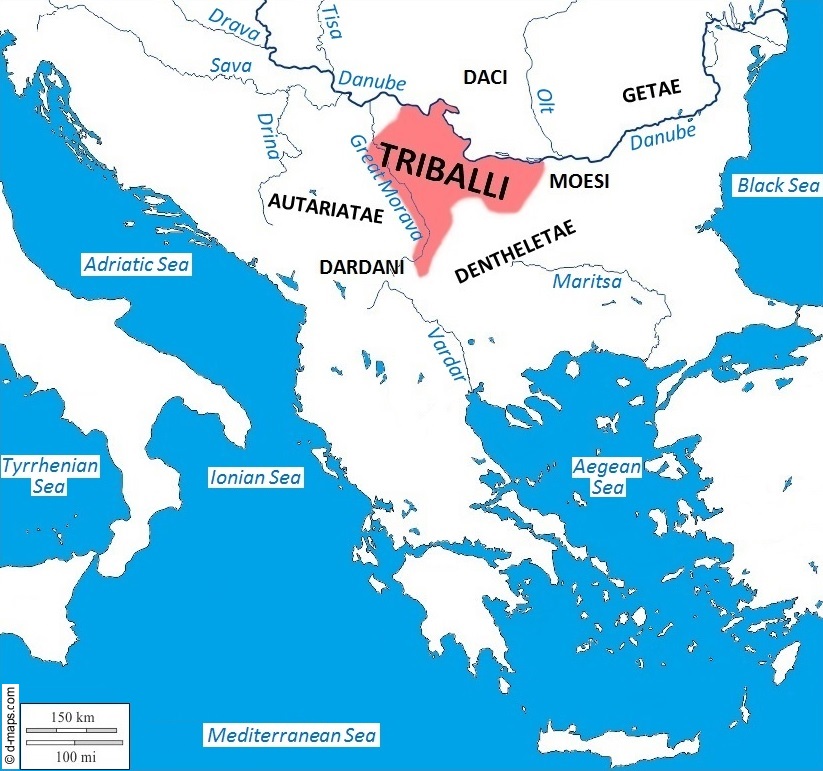
Here is the map of the regions where Triballi appear in ancient sourced made by Fanula Papazoglu.