• Don't want to see ads? Install an adblocker like uBlock Origin or use a Europe-based privacy-friendly browser like Vivaldi or Mullvad.

Where does the Albanian language come from? [VIDEO]

On initial point i do agree, R1b-Z2103 might even be the mediator of all Indo-European languages, since it's formation and TMRCA goes in line with linguistic thinking of Proto Indo-European which hypothetically formed during 3500 B.C to 2500 B.C, to add the archaeogenetic evidence to this so far.

If that's true then yes, because otherwise i see people classifying Illyrian as Bell-Beaker derived and Thracian as CWC derived either from Nitra/Kostany or Noua-Sabatinovska-Coslogeni.

Otherwise within Balkanic IE so far we probably have: Greco-Armenian, Phrygian, Messapian and Albanoid?. The last one is still disputed especially by linguists like John Basset Trumper who essentially believes Albanian came from somewhere from Southern Central Europe somewhere during Iron Age.

Or, we might perhaps agree that R1b-Z2103 was initially who brought Thraco-Illyrian before they split in their adequate separate cultures/separate influences in Early Bronze Age and Albanoid is like a relic split from both of them in the middle, probably a Central Balkan language. Who knows.

Thinking about it, its highly likely Thracians will have a good amount of Z2103. One of my pet peeves, what made me antipathic to the 80% of Thracian samples will be E-V13 from earlier debates. I think we are paying to little attention to R1b in general, and how important it was for IE in the Balkans, Thracians, Illyrians and what have you.
 
Are you mentally ill or that stupid? This is a daco-mysian name, it's not even attested in Illyria.
Here is another Dacian "Baedari",
Nothing to do with "Illyrian" peregrines.
Dacia
et vindicata.
Ulcudius Baedari
et Sutta Epicadi
D(is) I(nferis) M(anibus). Ulcudius
Baedari vixit an(nis) L.
https://edh.ub.uni-heidelberg.de/edh/inschrift/HD044377

1) From page 24 of 'The Reflection of Personal and Collective Tragedies in Ancient Sources: 1. Personal Tragedies in Roman Epigraphy' published in the Journal of Ancient History and Archaeology (2019):


Only two monuments mention explicit revenge, probably a social necessity, as well as a ritual step towards the pacification of the Di Manes. Both come from Dacia Inferior, one from Băile Herculane and one from Zegaia. The latter is more deteriorated, but unmistakably different from a social history point of view. The name of the deceased is not readable. What we do know is that we are dealing with a girl, murdered (interfecta) by latrones and revenged (vindicata). We can assume that the avengers were her parents, Ulcudius Bedari and Sutta Epicadi, who also erect the monument. Noticeably, in this case we are dealing with a peregrine family, with an Illyrian background, as Sutta and Bedarus are common names for the Illyrians. While Ulcudius seems to be an Illyrian name as well, the woman's patronymic is Greek, but it is hard to tell if it indicates real Greek roots or is just the object of an onomastic accidental occurrence.

2) From pages 114 and 115 of 'The Barbarians Within: Illyrian Colonists in Roman Dacia' published in Stvdica Historica (2010):


Inscriptions in Roman Dacia mention a considerable number of people who can be identified as Illyrians due to their name, relatives or origin. Most of them were located in the mining center of Alburnus Maior, others lived in cities such as Apulum, Ampelum, Sarmizegetusa, Potaissa, Napoca, Drobeta, Romula, Tibiscum... This group of people show, through the names they bear, a certain level of romanization. Thus, one can distinguish between four main categories of among people of Illyrian origin attested in inscription from Dacia... 1. The first category consists of Illyrians who did not adopt the Roman onomastic system. They only feature in inscriptions with their personal names of Illyrian origin or, according to the barbarian onomastic system, a personal name and patronym of Illyrian origin. Names such as Bato, Batonianus, Bedarus... fall in this first subcategory.

Epicadus is also an Illyrian name despite the classification given to it by the source.


Didn't Johane Derite/Albanian History know that these are Illyrians? Of course he knew it and it's impossible that he had never encountered sources about Illyrian Baedarus.


It's just that they don't fit his agenda and propaganda. It's obvious at this point that the Albanian History twitter account is promoting a very specific propaganda and it's consciously misinforming its readers.
 
Concur with the above. Of all Y-s, Z2103 has the strongest connection to Yamnaya/ and both east and west IE all the way to central Asia.
If one has kept up with the recent symposia, they would understand how important the branch is, if who is who in anthrogenetics are about to rewrite the whole IE story, placing it east of Anatolia due to likely Z2103, Yamnaya-Armenian-Greek-Albanian connection comes to mind.
E-V13 and J2b were both Yamnaya too but they exclusively cremated so we’ll find only R1b ;)
 
Thinking about it, its highly likely Thracians will have a good amount of Z2103. One of my pet peeves, what made me antipathic to the 80% of Thracian samples will be E-V13 from earlier debates. I think we are paying to little attention to R1b in general, and how important it was for IE in the Balkans, Thracians, Illyrians and what have you.

Perhaps there was, not denying it. Today frequency in Serbia, Macedonia, Bulgaria, Romania can give a light to it as well, how much R1b-Z2103 there is (without downstream Albanian subclade).

But, i still do think they were predominantly E-V13. Since it looks E-V13 has separate Bronze Age story from J2b2-L283 and R1b-Z2103, they meet quite late in Balkans, Bronze to Iron Age transition. I guess, the E-V13-Z5017 Albanians (cousins of Huban) will start crying all over the place.
 
1) From page 24 of 'The Reflection of Personal and Collective Tragedies in Ancient Sources: 1. Personal Tragedies in Roman Epigraphy' published in the Journal of Ancient History and Archaeology (2019):


Only two monuments mention explicit revenge, probably a social necessity, as well as a ritual step towards the pacification of the Di Manes. Both come from Dacia Inferior, one from Băile Herculane and one from Zegaia. The latter is more deteriorated, but unmistakably different from a social history point of view. The name of the deceased is not readable. What we do know is that we are dealing with a girl, murdered (interfecta) by latrones and revenged (vindicata). We can assume that the avengers were her parents, Ulcudius Bedari and Sutta Epicadi, who also erect the monument. Noticeably, in this case we are dealing with a peregrine family, with an Illyrian background, as Sutta and Bedarus are common names for the Illyrians. While Ulcudius seems to be an Illyrian name as well, the woman's patronymic is Greek, but it is hard to tell if it indicates real Greek roots or is just the object of an onomastic accidental occurrence.

2) From pages 114 and 115 of 'The Barbarians Within: Illyrian Colonists in Roman Dacia' published in Stvdica Historica (2010):


Inscriptions in Roman Dacia mention a considerable number of people who can be identified as Illyrians due to their name, relatives or origin. Most of them were located in the mining center of Alburnus Maior, others lived in cities such as Apulum, Ampelum, Sarmizegetusa, Potaissa, Napoca, Drobeta, Romula, Tibiscum... This group of people show, through the names they bear, a certain level of romanization. Thus, one can distinguish between four main categories of among people of Illyrian origin attested in inscription from Dacia... 1. The first category consists of Illyrians who did not adopt the Roman onomastic system. They only feature in inscriptions with their personal names of Illyrian origin or, according to the barbarian onomastic system, a personal name and patronym of Illyrian origin. Names such as Bato, Batonianus, Bedarus... fall in this first subcategory.

Epicadus is also an Illyrian name despite the classification given to it by the source.


Didn't Johane Derite/Albanian History know that these are Illyrians? Of course he knew it and it's impossible that he had never encountered sources about Illyrian Baedarus.


It's just that they don't fit his agenda and propaganda. It's obvious at this point that the Albanian History twitter account is promoting a very specific propaganda and it's consciously misinforming its readers.
But bro, they were not truly Illyrian because they had Brnjica influence in their clothing style.
 
On initial point i do agree, R1b-Z2103 might even be the mediator of all Indo-European languages, since it's formation and TMRCA goes in line with linguistic thinking of Proto Indo-European which hypothetically formed during 3500 B.C to 2500 B.C, to add the archaeogenetic evidence to this so far.

If that's true then yes, because otherwise i see people classifying Illyrian as Bell-Beaker derived and Thracian as CWC derived either from Nitra/Kostany or Noua-Sabatinovska-Coslogeni.

Otherwise within Balkanic IE so far we probably have: Greco-Armenian, Phrygian, Messapian and Albanoid?. The last one is still disputed especially by linguists like John Basset Trumper who essentially believes Albanian came from somewhere from Southern Central Europe somewhere during Iron Age.

Or, we might perhaps agree that R1b-Z2103 was initially who brought Thraco-Illyrian before they split in their adequate separate cultures/separate influences in Early Bronze Age and Albanoid is like a relic split from both of them in the middle, probably a Central Balkan language. Who knows.

I agree with the last statement for the most part, except the central Balkans part. I am not so sure that will be the case. We could have been more south, in transitional territories like southern Serbia, Kosove North Albania or even Macedonia.
 
I agree with the last statement for the most part, except the central Balkans part. I am not so sure that will be the case. We could have been more south, in transitional territories like southern Serbia, Kosove North Albania or even Macedonia.

To rephrase better, by Central Balkans i meant exactly those countries/territories except North Albania.
 
Not that i care about Baedarus/Bedri, but that name classification as Illyrian or Daco-Mysian is not convincing by either sources. No one gives additional details.
 
R-Z2103 possibly being the source of all IE languages seems quite exaggerated in my opinion. Either way IE would not have been a thing with its source being solely EHG, which in itself is also made up of other autosomal components lol, and I do not really find an „argument“ such as the postulation of 28200 years of continuity for a language realistic, since that is what I am seeing from certain enthusiasts quite often. If one might want to think it started that way with a basal R guy from Irkutsk Siberia 28200 years ago, then that’s fine with me, but it is understandably not really convincing.

As for the Balkans and the spread of IE languages in the Bronze Age, graphs per an upcoming Balkan study which focuses more on the Central and Western Balkans:


D0RC6ri.png


Either way there are Copper Age steppe samples on their way and the location of J2b-L283 presence will be very interesting, also in regards to its IE arrival in the Balkans.
 
All Paleo Balkan languages were initially mediated by Z2103 linages, including Illyrian.

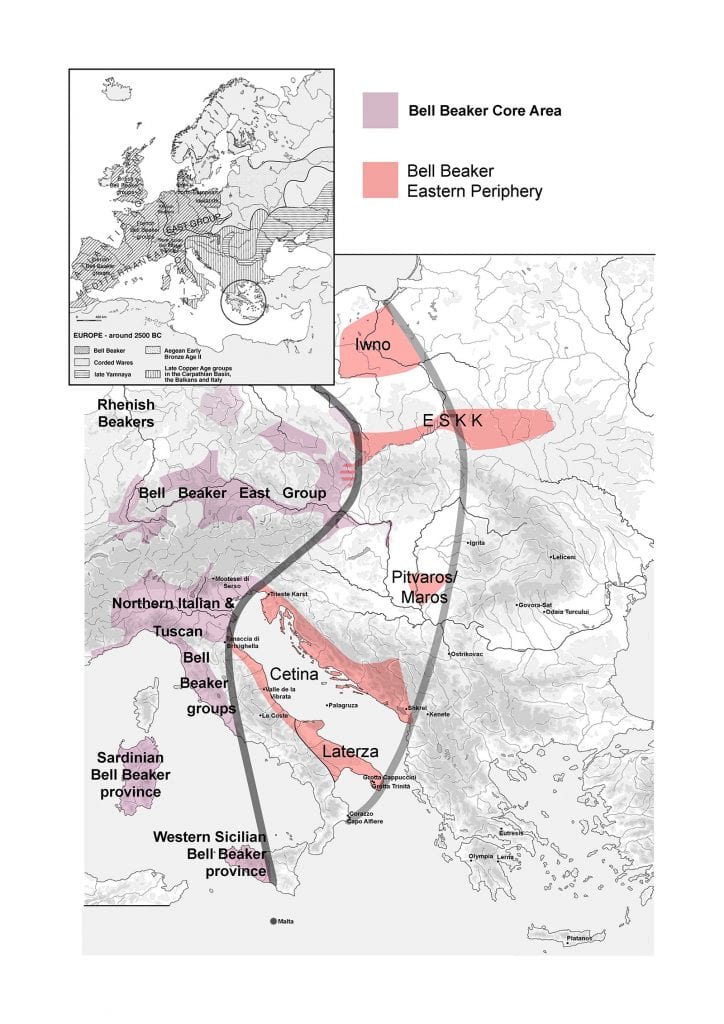
That's not for sure, because the J-L283 Illyrians came form the Bell Beaker sphere, which is true for both Cetina (basically a peripheral-mixed Bell Beaker culture) and Posusje-Dinaric, which came under strong Tumulus culture influence.

Thracians seem to have been constantly under the influence from Epi-Corded groups (Unetice, Kostany-Mierzanowice/F?zesabony-Otomani, even the Lusatian-G?va connection).

Actually the direct evidence for R-Z2103 surviving IE languages is very thin, practically all descend from Corded decorated groups from the Western steppe, which came from Sredny Stog, instead of Yamnaya itself.

The best chances do have Greco-Armenian, which might include Phrygian, which seem to have descend from Catacomb/MCW. However, even those were under Epi-Corded/Sintashta influence before, but that's the best case we got. Illyrian and Thracian are much, much weaker and seem to belong to the Bell Beaker and Epi-Corded sphere, respectively.

The connection of R-Z2103 to E-V13 seems to be somewhat closer in the LBA than to J-L283, so wouldn't wonder about some overlap, especially in the Southern-Central Balkans, like Brnjica. But for the North and the Thracian core, I don't expect a lot of R-Z2103, while it could very well have been present.

I think the Thracians will have more J2a, possibly, than R-Z2103, even in the North. But we really don't know as of yet. Kyjatice had J2a, which makes it the only highly likely Channelled Ware lineage we know from ancient DNA. Kyjatice is the Western sister group of G?va, with more F?zesabony and Tumulus culture influence, so more mixed with non-locals.
 
R-Z2103 possibly being the source of all IE languages seems quite exaggerated in my opinion. Either way IE would not have been a thing with its source being solely EHG, which in itself is also made up of other autosomal components lol, and I do not really find an „argument“ such as the postulation of 28200 years of continuity for a language realistic, since that is what I am seeing from certain enthusiasts quite often. If one might want to think it started that way with a basal R guy from Irkutsk Siberia 28200 years ago, then that’s fine with me, but it is understandably not really convincing.

As for the Balkans and the spread of IE languages in the Bronze Age, graphs per an upcoming Balkan study which focuses more on the Central and Western Balkans:


D0RC6ri.png


Either way there are Copper Age steppe samples on their way and the location of J2b-L283 presence will be very interesting, also in regards to its IE arrival in the Balkans.


The Neolithic ydna markers are also the same markers from Germany and Czechia lands
 
The Neolithic ydna markers are also the same markers from Germany and Czechia lands

Culture and ethnicity beats geography all the time.

By the way, an interesting video:

Don't have to agree with every detail, especially the earliest periods, but still a nice job and good visualisation.
 
Culture and ethnicity beats geography all the time.

By the way, an interesting video:

Don't have to agree with every detail, especially the earliest periods, but still a nice job and good visualisation.

not accurate ............had Apulia Italy starting before croatia and slovenia.....where we know L283 came from

illyrian was in port of Vienna circa 1600BC ..........archeological fact ....link I provided already
 
That's not for sure, because the J-L283 Illyrians came form the Bell Beaker sphere, which is true for both Cetina (basically a peripheral-mixed Bell Beaker culture) and Posusje-Dinaric, which came under strong Tumulus culture influence.
Well yeah, because Beakers were famous for spreading L283.
 
not accurate ............had Apulia Italy starting before croatia and slovenia.....where we know L283 came from
illyrian was in port of Vienna circa 1600BC ..........archeological fact ....link I provided already

I think his logic was that the Venetic languages with Venetic, Liburnian and Histrian in particular, as well as some of the Pannonians, aren't really Illyrian, or not close enough to Proto-Illyrian. That's a good debate actually.

Well yeah, because Beakers were famous for spreading L283.

Corded Ware wasn't famous for spreading R-L51 either, yet somehow, someway, a specific branch might have developed which was dominated by it. Something similar seems to have happened with J-L283. Note that both Maros, Cetina and Posusje-Dinaric had Western relations.

aegeobalkanprhistory_west-meets-east_2-724x1024.jpg


https://aegeobalkanprehistory.kreas.ff.cuni.cz/2008/03/06/when-the-west-meets-the-east/

Note that the Beaker periphery, Cetina in particular, doesn't mean full Beaker package, but a large scale connection, communication, influence. And its not by chance that the Illyrian core groups around HRV_MBA-IA score pretty Beaker/Tumulus culture like autosomally. That was kind of an allied clan, tribe, under heavy, really heavy influence of the Beakers and later Tumulus culture.

It is not by chance that J-L283 was found in Maros and Posusje, might be found, eventually, in Cetina too. Fact is also that from the EBA onwards, the later North Western lllyrian core became constantly more Beaker like. So there was steady and significant gene flow, while J-L283 spread. This might mean that there was a marriage exchange network with the Italian Apennine and Southern Beaker/later Tumulus culture group. Something along those lines, but big scale influence came from the West.
 
So everyone is a kind of Thracian, despite the -dava and -para differences in city naming. Channelled Ware Thracians from the Carpathians down to Thessaly and Asia Minor, not to forget Pannonia, Veneti, Liburni, Rhaetians, Noricans, who’re half Thracian. How can I forget Cimmerians also?

But in Illyricum? Nobody is truly Illyrian. There’s the Venetic ones in the North, there’s proprie dicti who’re not really Proto-Illyrians, there’s Brygians who’re not Illyrian (super proven because of Phrygians), there’s the Dardani who were not Illyrian AT ALL, the NOT Illyrian Paeonians, the not Illyrian Channelled Ware Taulanti, Dessaretae, Atintani, etc., not Illyrian Messapi, who were even different from Daunians.

All of the aforementioned tribes are alien to each other. If you look closely, the Ardiaei and Autariatae were not really similar. If you look even more closely, the Delmatae are very different too because of a supposed matriarchal system as well as being seafarers.

Riverman, I’m convinced you’re an E-V13 Serb from Austria. If yes, don’t worry, I prefer you over Trojan-Kosovars any day.
 
If you look at the Illyrian core territory, its fairly big and expands in the Iron Age. No reason to get ironic.

Also, I do have a wider definition of Illyrian. The main problem is really how far the Pannonian relatives of the Illyrians reached, like into Austria, Hungary and Czechia.

As for the Thracians/Channelled Ware: They had a huge influence on the development of Early Hallstatt, but that doesn't mean that all people affected by them became actually Thracian. Rather admixed and culturally influenced at the most.

The unity of Thracian, Moesian, Getae and Dacian is pretty much a given. There might be splitters around which want to break it down, but going back in time, the common root and similarities are pretty obvious. That was one cultural and ethnic koine.

Take the core cultures of Basarabi and Psenichevo, they are clearly connected along the Danube, both in origin (Channelled Ware), as well as with their later developments and exchange.
 
So everyone is a kind of Thracian, despite the -dava and -para differences in city naming. Channelled Ware Thracians from the Carpathians down to Thessaly and Asia Minor, not to forget Pannonia, Veneti, Liburni, Rhaetians, Noricans, who’re half Thracian. How can I forget Cimmerians also?

But in Illyricum? Nobody is truly Illyrian. There’s the Venetic ones in the North, there’s proprie dicti who’re not really Proto-Illyrians, there’s Brygians who’re not Illyrian (super proven because of Phrygians), there’s the Dardani who were not Illyrian AT ALL, the NOT Illyrian Paeonians, the not Illyrian Channelled Ware Taulanti, Dessaretae, Atintani, etc., not Illyrian Messapi, who were even different from Daunians.

All of the aforementioned tribes are alien to each other. If you look closely, the Ardiaei and Autariatae were not really similar. If you look even more closely, the Delmatae are very different too because of a supposed matriarchal system as well as being seafarers.

Riverman, I’m convinced you’re an E-V13 Serb from Austria. If yes, don’t worry, I prefer you over Trojan-Kosovars any day.


Pretty sure he's Bosnian. Would explain the stubborn kumpir head spouting stupid theories for years despite being proven wrong over and over again.

Riverman would be more toreable if he contained himself in a single thread. Seeing him just vomit all over Albanian threads on multiple forums, every single day for years, is extremely tiresome. We get it dude. E-V13 = Daco-Thracian. Every single person in SE Europe is a Thracian. Very cool my guy.
 
The links of our past are in Dacia Meditarranea. Just west of the Bulgarian capital there is a valley called Burel, seems to be related to the Albanian word berryl(elbow), the valley has a 90 degree angle turn, thus shaped like an elbow. At the heart of medieval Albania, in the Mat valley is the village/town of Burrel.
There many toponyms in this area of Bulgaria and on the Serbian side of the border that seem to stem from Albanian, and borrowed by the Slavs as shown by Slavic pronouncation. This is my finding by simply scanning the areas west of Sofia: Kambelevtsi (from Alb. kumbulla, plum), two villages named Dreatin (related to Albanian Drite(light), there are settlements in Albania named Drite),Bukorovtsi (from Albanian bukur), Arzan (same as Albanian villages named arrez, from the word arre (farm land)), Buzovitsa from Albanain buze(many such toponym derivates in Albania), Lyalintsi from Albanian lala(this toponym existed even in Peloponnese where Albanians settled near Patras), on the Serbian-Bulgarian border there is the Ruy mountain which can be related to the Albanian word for safety/protection ruj. Village of Giginitsi (gheg). Village of Oresha (similar to Orosh in Mirdite). Village of Bilintsi, could derive from blini. Village of Gintsi (probably from Gjin, which would equate to Ivan).

On the Serbian side of the border is the village Grapa (Gropa in Albania from the word for hole/depression in the land), village of Postalica from Albanian posht(lower), there are also two settlement with similar name Petrilje and Petrlas which reminds me of the Albanian fort and settlement of Petrela near Tirana where the first Albanian principality appears. Village of Dumbija(from the word tooth dhemb? like dhembel mountain), village of Lalinice again from lala just has a Serbian pronounciation. The village of Gaginice (gheg). Village of Resen (same as Reshen in Mirdita).

I am sure there can be more toponyms. But I more interested to look into any census data from the Middle Ages from these villages and nearby area. A proto-Albanian people clearly stayed behind and got assimilated over time but the Albanian heritage and names would have lingered for some time and would be easy to detect if we can get our hands such documents. I don't know if the Bulgarian empire(s) took any population census, if there isn't any, we should try to look into Byzantine records of the area and early Ottoman, because the Ottomans took over in the late 1300s and took defters right away.

Those are some really interesting possible Albanian connections. We should start mapping these out.
 
Actually the direct evidence for R-Z2103 surviving IE languages is very thin, practically all descend from Corded decorated groups from the Western steppe, which came from Sredny Stog, instead of Yamnaya itself.

The best chances do have Greco-Armenian, which might include Phrygian, which seem to have descend from Catacomb/MCW. However, even those were under Epi-Corded/Sintashta influence before, but that's the best case we got. Illyrian and Thracian are much, much weaker and seem to belong to the Bell Beaker and Epi-Corded sphere, respectively.

The connection of R-Z2103 to E-V13 seems to be somewhat closer in the LBA than to J-L283, so wouldn't wonder about some overlap, especially in the Southern-Central Balkans, like Brnjica. But for the North and the Thracian core, I don't expect a lot of R-Z2103, while it could very well have been present.

I think the Thracians will have more J2a, possibly, than R-Z2103, even in the North. But we really don't know as of yet. Kyjatice had J2a, which makes it the only highly likely Channelled Ware lineage we know from ancient DNA. Kyjatice is the Western sister group of Gva, with more Fzesabony and Tumulus culture influence, so more mixed with non-locals.
Guess where J2b-L283 presence will be, exactly, the Western Steppe!

Also, knowingly from all of the many samples we have and are going to get, Proto-Illyrians were heavy J2b-L283. There is also no correlation between J2b-L283 and R-Z2103 whatsoever.
 
Back
Top