• Don't want to see ads? Install an adblocker like uBlock Origin or use a Europe-based privacy-friendly browser like Vivaldi or Mullvad.

Anatolian Hypothesis: Lord Renfrew still a partial holdout

I think that the proto proto IE were widespread across europe miles earlier then what the mainstream says.
its clear germany to central russia was full of r1 from the word go. all the 8000bc sites across europe seem similar to each other with strong fishing and trapping cultures. These groups must all ready be ancient and they were spread far and wide in the north at least.
The younger dryas most probably caused a massive influx of northern people to flood down into and over the caucasus mountains and into persia around 10k/11kbc these are you proto indo europeans. they repopulated the world again from the new base.
There success was firstly down to the fact they had boats and navigated the water ways for fertile lands to grow crops and forage.
The key to farming was the fact these peoples ancestors had been to the artic circle and had seen the suns movements and so understood the seasons and how it all worked. round earth etc etc.
The horse was food and You cant drive chariots over mountains, they had Boats.
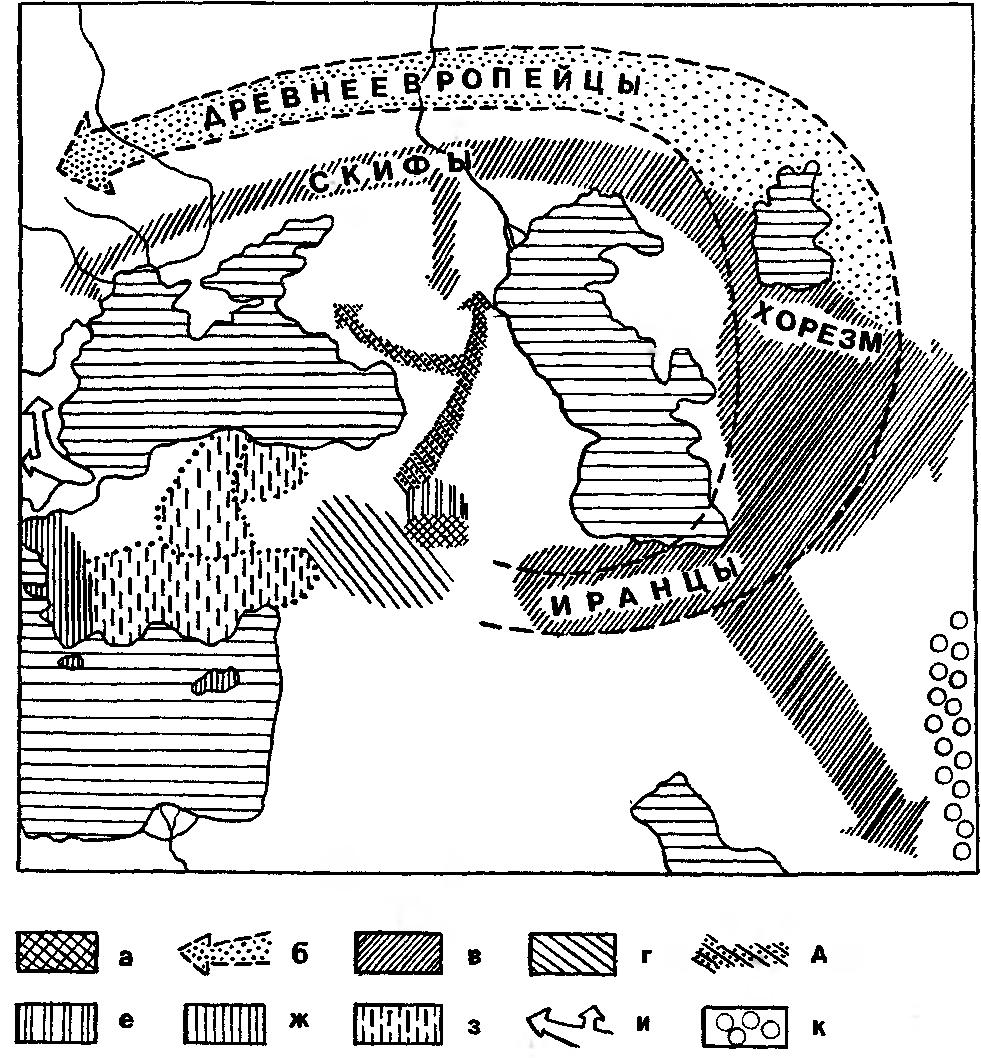
 
Well also Yamnayan R1b-Z103 could come from Armenia or that area somewhere it is most common there, "Armenian" like population to be the source of CHG ancestry in Yamna.

Armenian hypothesis of Ivanov and Gamkrelidze

ivanov.jpg


The big arrow called "Old- Europeans" that go arround Caspian sea are copromising of Balto-Slavic,Germanic and Italo-Celtic,Tocharian.Others signs represent the Anatolian languages,Armenian,small arrows crossing Bosphorus migrating Greeks,Anatolian west coast Achiyawo (Greeks) perhaps.
To him the arrows going into Yamnaya from Armenia represent perhaps Indo-Iranians or others from that language group.
I can search for better maps.


It is Cyrillic again maybe not better representation but still is color and can be seen better.

3-19.jpg


1-Original IE homeland
2-Hittite
3-Pallaic
4-Luwian
5-Achiyawa?
6-Mycenaean
7-Colchis?
8-Proto-Armenian
9-Mittani,Aryan

Others are non IE languages.

The arrows are "Old European" or Baltic-Slavic,Germanic,Italo-Celtic,Tocharian and some Indo-Aryan languages across their territory.
 
Last edited:
Well also Yamnayan R1b-Z103 could come from Armenia or that area somewhere it is most common there, "Armenian" like population to be the source of CHG ancestry in Yamna.

Armenian hypothesis of Ivanov and Gamkrelidze


The big arrow called "Old- Europeans" that go arround Caspian sea are copromising of Balto-Slavic,Germanic and Italo-Celtic,Tocharian.Others signs represent the Anatolian languages,Armenian,small arrows crossing Bosphorus migrating Greeks,Anatolian west coast Achiyawo (Greeks) perhaps
Others are Greek,Hittite,Armenian and Indo-Iranian languages.
To him the arrows going into Yamnaya from Armenia represent perhaps Indo-Iranians or others from that language group.
I can search for better maps.


It is Cyrillic again maybe not better representation but still is color and can be seen better.


1-Original IE homeland
2-Hittite
3-Pallaic
4-Luwian
5-Achiyawa?
6-Mycenaean
7-Colchis?
8-Proto-Armenian
9-Mittani,Aryan

Others are non IE languages.

The arrows are "Old European" or Baltic-Slavic,Germanic,Italo-Celtic,Tocharian and some Indo-Aryan languages across their territory.

Milan...here its safe, but say these in "some other places" and be ready for a storm.
 
Well also Yamnayan R1b-Z103 could come from Armenia or that area somewhere it is most common there, "Armenian" like population to be the source of CHG ancestry in Yamna.

Armenian hypothesis of Ivanov and Gamkrelidze

ivanov.jpg


The big arrow called "Old- Europeans" that go arround Caspian sea are copromising of Balto-Slavic,Germanic and Italo-Celtic,Tocharian.Others signs represent the Anatolian languages,Armenian,small arrows crossing Bosphorus migrating Greeks,Anatolian west coast Achiyawo (Greeks) perhaps
Others are Greek,Hittite,Armenian and Indo-Iranian languages.
To him the arrows going into Yamnaya from Armenia represent perhaps Indo-Iranians or others from that language group.
I can search for better maps.


It is Cyrillic again maybe not better representation but still is color and can be seen better.

3-19.jpg


1-Original IE homeland
2-Hittite
3-Pallaic
4-Luwian
5-Achiyawa?
6-Mycenaean
7-Colchis?
8-Proto-Armenian
9-Mittani,Aryan

Others are non IE languages.

The arrows are "Old European" or Baltic-Slavic,Germanic,Italo-Celtic,Tocharian and some Indo-Aryan languages across their territory.

From what I gathered over the years , the #1 on the coloured map IMO should be on the east side of the Caspian sea basically where Iran borders Turkmenistan on modern maps
 
From what I gathered over the years , the #1 on the coloured map IMO should be on the east side of the Caspian sea basically where Iran borders Turkmenistan on modern maps

Sile,
I don’t (obvious reasons) recommend Eurogenes. However the latest post is precisely related to this. And plays to my believes. I am all about the centrality of Shulaveri-Shomu In the history of PIE, and future admixes, inclusively Yamnaya. Its fascinating how they run away from the the word Shulaveri…because it would bring the PIE issue .

It is all about http://r1b2westerneurope.blogs.sapo.pt/from-shulaveri-shomu-to-kubans-3429

So, to keep it short- The paper they are talking about Is the fact that Mesokho, as well as earlier Svobodnoe , was build by south Caucasus peoples (who else on those dates, but Shulaveri, like I have always said) but later there was a less “developed” local people that took over.
I think that that local people could be very much CHG, if not pure CHG, and they add much CHG to the “shulaveri” arriving to places like samara…

So, migration went mostly not by eastern Caspian, but by east black sea. Story is 6200-4900bc Shulaveri, 4800bc became "Kubans" and crosses to north caucasus and went on...
 
Good #95 post Ygorcs, I agree for the most -
BTW, I think vowels are less robust in evolution than consonnants (occlusives), or at least, leave less traces of their original state. It's due maybe to their absence of frontiers between them?
 
Sile,
I don’t (obvious reasons) recommend Eurogenes. However the latest post is precisely related to this. And plays to my believes. I am all about the centrality of Shulaveri-Shomu In the history of PIE, and future admixes, inclusively Yamnaya. Its fascinating how they run away from the the word Shulaveri…because it would bring the PIE issue .

It is all about http://r1b2westerneurope.blogs.sapo.pt/from-shulaveri-shomu-to-kubans-3429

So, to keep it short- The paper they are talking about Is the fact that Mesokho, as well as earlier Svobodnoe , was build by south Caucasus peoples (who else on those dates, but Shulaveri, like I have always said) but later there was a less “developed” local people that took over.
I think that that local people could be very much CHG, if not pure CHG, and they add much CHG to the “shulaveri” arriving to places like samara…

So, migration went mostly not by eastern Caspian, but by east black sea. Story is 6200-4900bc Shulaveri, 4800bc became "Kubans" and crosses to north caucasus and went on...

Something intrigue me more than anything else, why a portuguese guy hate the Yamnaya culture and love the Shulaveri Shomu so much. I mean at the end, we dont rewright history, so what have you to win, for being so obsessive with PIE coming from Transcaucasus ? Edit: I just read your blog and... is it some kind of a reptilian invasion theory ? What are those Ophidians you are talking about exactly ?
 
Something intrigue me more than anything else, why a portuguese guy hate the Yamnaya culture and love the Shulaveri Shomu so much. I mean at the end, we dont rewright history, so what have you to win, for being so obsessive with PIE coming from Transcaucasus ? Edit: I just read your blog and... is it some kind of a reptilian invasion theory ? What are those Ophidians you are talking about exactly ?


Halfalp…
Let me start by the end. I will not regard as a tongue in cheek the “reptilian thing”. Was it?
Anyway, it all about premises:

  1. The Portuguese call themselves LUSITANIANS, because of the tribe that fought the romans. However the Greeks, earlier, 700BC call them the OPHIUSSA, SEFES, Serpents. But the reason why that was, is because when Periplus, the Greek Mariner passed in what is Lisbon and asked who they were, he writes that the Ostrimini (Potugal) were a people that lived in there for a very long time, and were a people that had to flee their far way homeland a long time ago because of an attack of serpents. Actually the ophiusa is the place where lusitanians also lived…. And funny enough lusitanian is an PIE unclassified language with archaism older than Celtic or Italic.
  2. I believe myths, in ancient times where very robust, almost perpetual transmitted over generation. That is why you have the old testament. If arriving to Iberia 3500-3300BC population was and ancestral Shulaveri shomu (which is basically my hypothesis) then the best candidate to having pushing the Shulaveri away from south Caucasus, and spread all over, was the Ubaid, turning Uruk , Turning Mesopotamians.. – Both Ubaid and Uruk, were the… SERPENT PEOPLE. Its strange, but they even deformed crania to look like serpents.


  1. If, just if, thousands of years later they tried to explain to someone where their origin was… not better than what they explain to periplus…. Correct?


  1. Remember that even the Turdetanos, on south Portugal, explained to STRABO (20 ac) that they spoke Roman, but they had their own language, laws and history that went back 6000 years.
 
Something intrigue me more than anything else, why a portuguese guy hate the Yamnaya culture and love the Shulaveri Shomu so much. I mean at the end, we dont rewright history, so what have you to win, for being so obsessive with PIE coming from Transcaucasus ? Edit: I just read your blog and... is it some kind of a reptilian invasion theory ? What are those Ophidians you are talking about exactly ?

Then,
I don’t hate Yamnaya. If I am right, then Yamnaya is nothing else than Shulaveri moving by Mesokho, Yasenova Polyana, Svobodnoe (maybe admixing in North caucasus) into the steppe.

What I hate is a mind trick very common in today’s world, which is called ..”Pretend not to” see.
In this case, the fact that the Shulaveri-Shomu have all the traits and way of live needed to be PIE and clearly a good candidate to be it. If it’s not a coincidence that people talk about neolithic South Caucasus without mentioning it (Shulaveri) but immediately talk about Kura-araxas, Leylatepe, etc,
it’s not a coincidence that a community so keen on registering new ancient DNA completely ignores the ones (mtdna) from Shulaveri -Shomu, even if those were good enough, quality enough to make it to Ian logans database. AncestralJourneys last time I check hasn’t even added them. Do you know why?

Because mtdna H2+152, H15a1 and I1 is not seen in Anatolia/south Caucasus with any other population, but sure is seen later in steppe… isn’t it? and is mostly found in Bell beakers, Corded ware and Unetice.
 
In my amateur opinion for now i think that the intrusion people might be or maybe not be related to the people that formed the Maykop culture and came probably from Western Iran,Armenia,Kurdistan (that area) this is where the CHG admixture appeared in Yamna likely from this area,and this population was source of IE languages.
The Greek and Armenian language and perhaps the Anatolian languages never went north of the Caucasus.

That's not possible because Greek and Armenian share a lot more vocabulary and grammar with the "northern" groups of IE languages than the Anatolian languages, and they actually look like more related with such "later" and innovative branches as Indo-Iranian and Balto-Slavic than other "northern" groups like Italic or Celtic. That suggests that Greek, Armenian, Indo-Iranian and other "northern" groups lived very close to each other until really late in the history of PIE.

Not always the most technically advanced culture is the one that imposes its language. It's rather the language that manages to conquer the region politically and, particularly, militarily. Turks were not more advanced than Anatolian Byzantines, Magyars were not more advanced than Slavs and Romanized Pannonians, Arabs were not more advanced than Egyptians and Assyrians - except perhaps in military skills, but that has to do as much with training and an effective warrior culture as with technology.

I wouldn't be so sure that Proto-Indo-European couldn't have been, as one very plausible hypothesis in my opinion argues, an EHG language under heavy lexical and partly grammatical influence of a very influential and more "civilized" CHG language, much like the medieval relationship between English and French, or Chinese and Vietnamese.
 
Well also Yamnayan R1b-Z103 could come from Armenia or that area somewhere it is most common there, "Armenian" like population to be the source of CHG ancestry in Yamna.

Armenian hypothesis of Ivanov and Gamkrelidze

ivanov.jpg


The big arrow called "Old- Europeans" that go arround Caspian sea are copromising of Balto-Slavic,Germanic and Italo-Celtic,Tocharian.Others signs represent the Anatolian languages,Armenian,small arrows crossing Bosphorus migrating Greeks,Anatolian west coast Achiyawo (Greeks) perhaps.
To him the arrows going into Yamnaya from Armenia represent perhaps Indo-Iranians or others from that language group.
I can search for better maps.


It is Cyrillic again maybe not better representation but still is color and can be seen better.

3-19.jpg


1-Original IE homeland
2-Hittite
3-Pallaic
4-Luwian
5-Achiyawa?
6-Mycenaean
7-Colchis?
8-Proto-Armenian
9-Mittani,Aryan

Others are non IE languages.

The arrows are "Old European" or Baltic-Slavic,Germanic,Italo-Celtic,Tocharian and some Indo-Aryan languages across their territory.

If this scenario is supposed to have happened not in the Early Neolithic, but in the Late Neolithic bordering on the Chalcolithic, then we had to find a lot more Levant_Neolithic admixture in the peoples derived from IE expansions. By the Late Neolithic, the 3 "ancient farmers" lineages had spread and mixed a lot in the Middle East, and we'd expect that people coming from present-day Kurdistan/Armenia/Iran/Southeastern Anatolia would have not only Anatolian and Iranian-like admixtures, but also a lot of Levantine-like ancestry - which we can't see in very significant % anywhere in the progressively Indo-Europeanized Europe/North Asia.
 
That's not possible because Greek and Armenian share a lot more vocabulary and grammar with the "northern" groups of IE languages than the Anatolian languages, and they actually look like more related with such "later" and innovative branches as Indo-Iranian and Balto-Slavic than other "northern" groups like Italic or Celtic. That suggests that Greek, Armenian, Indo-Iranian and other "northern" groups lived very close to each other until really late in the history of PIE.

Not always the most technically advanced culture is the one that imposes its language. It's rather the language that manages to conquer the region politically and, particularly, militarily. Turks were not more advanced than Anatolian Byzantines, Magyars were not more advanced than Slavs and Romanized Pannonians, Arabs were not more advanced than Egyptians and Assyrians - except perhaps in military skills, but that has to do as much with training and an effective warrior culture as with technology.

I wouldn't be so sure that Proto-Indo-European couldn't have been, as one very plausible hypothesis in my opinion argues, an EHG language under heavy lexical and partly grammatical influence of a very influential and more "civilized" CHG language, much like the medieval relationship between English and French, or Chinese and Vietnamese.


but is also the result of Gray Atkinson Greenhill 2011.
and the Greco-Aryan aproach,
these languages were nearby before they split.

so no matter it seems or sound today,
at most earlier forms Hittites Anatolians were nearby, Greek Armenians were nearby, and Albanians and Iranians were nearby,

and that send us back to somewhere Caucasus,
no matter the Anatolian Hypothesis as first expreesed by Renfrew
were we have the Thettalo-Danubians mostly G2a2 populations, which seems not to be well based/document.
 
I think that that local people could be very much CHG, if not pure CHG, and they add much CHG to the “shulaveri” arriving to places like samara…

So, migration went mostly not by eastern Caspian, but by east black sea. Story is 6200-4900bc Shulaveri, 4800bc became "Kubans" and crosses to north caucasus and went on...

Let me see if I get your point better... do you mean that the local steppe/North Caucasus people were mainly CHG already, so what do you think was the main autosomal makeup of the Shulaveri-Shomu migrating northward?
 
And funny enough lusitanian is an PIE unclassified language with archaism older than Celtic or Italic.

What's an example of archaism in Lusitanin not found in Celtic or Italic? I know that like Italic Lusitanian preserved initial *p and the like, but that vocabulary wise it's much more closely connected with Celtic, making some scholars suggest that it's the remnant of another [Pre-?)Proto-Celtic branch. Also, Lusitanian looks an awful lot related to Celtic and Italic to be only distantly related to them, so the breakup time of those 3 branches was probably not that long before the Roman era, perhaps on the order of 1,500 years.
 
but is also the result of Gray Atkinson Greenhill 2011.
and the Greco-Aryan aproach,
these languages were nearby before they split.

so no matter it seems or sound today,
at most earlier forms Hittites Anatolians were nearby, Greek Armenians were nearby, and Albanians and Iranians were nearby,

Then how do we explain the many isoglosses (much more than with Anatolian or even Armenian branches) of Indo-Iranian with Balto-Slavic and Albanian with both Balto-Slavic and Germanic? If we keep expanding more and more the branches that were supposed to be nearby in Anatolia with the very archaic Anatolian branch, soon we'll have to argue that all IE branches, with the possible exception of Italo-Celtic, developed in the South Caucasus/Anatolia, and, since we have so many evidences of ancient DNA from as early as the Chalcolithic, that would have to have happened firmly in the Neolithic. Unlikely to say the least.
 
Then how do we explain the many isoglosses (much more than with Anatolian or even Armenian branches) of Indo-Iranian with Balto-Slavic and Albanian with both Balto-Slavic and Germanic? If we keep expanding more and more the branches that were supposed to be nearby in Anatolia with the very archaic Anatolian branch, soon we'll have to argue that all IE branches, with the possible exception of Italo-Celtic, developed in the South Caucasus/Anatolia, and, since we have so many evidences of ancient DNA from as early as the Chalcolithic, that would have to have happened firmly in the Neolithic. Unlikely to say the least.

it is easy and very very simple,
the road of Scythians was taken millenium before by previous.
 
it is easy and very very simple,
the road of Scythians was taken millenium before by previous.

We'd see a lot less EHG and a lot more Levantine_Neolithic and Anatolian_Neolithic if that was the case, all IE groups already fully formed migrating to the north and west. Unless we suggest that the PIE expansion to the steppes happened way before still in the beginning of the Neolithic when the Near East was still a mostly unmixed place (so that that region of Anatolia would still be overwhelmingly CHG only), which is very unlikely.
 
Indo-European languages expansion is clearly linked with Yamnaya both genetically and archeologically. For exemple, Lusitanians and Celts for exemple have exactly, exactly the same anthropomorphic stelae as Yamnaya and this cultural tradition was already in Sredny Stog. Also we found some mtdna DNA from transcaucasus in steppe yes, but we also found some steppe mtdna in the same time range in transcaucasus some U4a, as far as North Mesopotamia, so it's clear that at this time, mobility, in case of mtdna was solid.
 
What's an example of archaism in Lusitanin not found in Celtic or Italic? I know that like Italic Lusitanian preserved initial *p and the like, but that vocabulary wise it's much more closely connected with Celtic, making some scholars suggest that it's the remnant of another [Pre-?)Proto-Celtic branch. Also, Lusitanian looks an awful lot related to Celtic and Italic to be only distantly related to them, so the breakup time of those 3 branches was probably not that long before the Roman era, perhaps on the order of 1,500 years.

Ygorcs,
Can't argue on linguistics. However taking from experts, from Blanca Prosper to Witczak or even Vaclav Blazek they all seem to agree that some of the archaisms predate by long Celtic or Italic.
"Many archaisms of lusitanian are actually related to IndoAryan/Iranian. Sure many other do. But Lusitanian seem to, apart from still have very old PIE “–P” , actually many archaism follow related to IA/I. then others are trying to link it to…. Anatolian branch of PIE. Or words such as PIE pālakˆu (Iron) linking so directly lusitanian to Sanskrit, Old persian, Hittite, Tocharian" -Just a summary I made some time ago.

It may mean nothing. The point in my hypothesis is that Iberian Bell beakers spoke IE so Lusitanian is a remnant of Bell beakers language, hence the similarities with Celtic and Italic because these would derive from the same language. -- Or not. Maybe time will tel.
 
Back
Top