• Don't want to see ads? Install an adblocker like uBlock Origin or use a Europe-based privacy-friendly browser like Vivaldi or Mullvad.

Anatolian Hypothesis: Lord Renfrew still a partial holdout

Because I have mentioned something wrong about Lazaridis, he had modeled Steppe EMBA as 0.568% EHG+0.432 Iran_ChL,
and in turn Iran_ChL was 0.167 Iran_N + 0.631 CHG + 0.202 Levant_N
(Levant_N was 2/3 Natufian, 1/3 Anatolian_N)
 
We know somewhat well the story of migrating Anatolian into Europe as Neolithic farming dispersal.
We do not know nearly enough about:

  1. Why agriculture Jumped over (both people & culture) over North Anatolia, Thrace and most of Balkans. To me it’s obvious that someone lived there and was not Agricultural/ Farmers friendly (in the beginning, Anatolia Farmers clearly preferred to avoid them).
  2. What admix as lurking in several parts of Balkans. It looks like pastoral WHG(+) and EHG (-) but by middle Neolithic it was very heterogenous, hence surprises we now have with EHG in there, hotbed R1b in Iron Gates, etc. and some more in the future for sure.
  3. But most important, what is missing is the understanding of the migration by beginning of 6th millennia from the Balkans into Anatolia and Caucasus, like a High pastoral/High Agricultural now diferent population. ImO:
    1. Balkan admix went into Fikertepe (which does not mean Fikertepe is Balkan), into maybe Halaf, or Hogosthim (north Israel) and most definitely, most definitely into SHulvaveri-Shomu in South Caucasus and Armenia.
    2. So, when people find EMBA in Armenia with EHG it does not mean it was steppe. It could be the same guys at Lepenski Vir or Malak Preslavets, or many other settlements in Bulgaria, Romania, etc, that the Farmers totally avoided that had varying WHG and EHG components or even parts of CHG already. These is a late migration into Anatolia/Caucasus.
    3. These population arriving around the Kura and Araxes Rivers in South caucasus only saw their CHG component spike even mixing a bit with Iran Neolithic
    4. The disappearing of the Shulaveri-Shomu was the dispersal of a vast amount of people. If some went to Steppe…. It genetically fit the bill! As it does to those staying.
  4. If by any chance that migration was full of R1b and that migration meant the birth of PIE in south Caucasus (Shulaveri) then it even makes sense to have the Armenian PIE, South Ossetia PIE, etc. Or, AFAIK, the only R1b-L23 without any other mutation is in Erzurum, Anatolia, near armenia – which is known as a place to were south ossetians (High on R1b) migrated. Or never forgetting that its the same place with highest diversity of R1b haplotypes.
 
Last edited:
No one said it makes more sense. I said it is theoretically possible. And it is, especially if Yamnaya is just EHG+CHG.

Alan, I think talked about 3 scenarios and considered a movement from Armenia to be more likely.

Concerning Greece Neolithic, I don't know what has been published apart from those from Peloponnese, so I may miss something.

Concerning Yamnaya ancestry in Balkans, the source is just Mathieson?


I said that if the 'Yamnaya' ancestry in some Peloponnese Neolithic samples is something 'CHG-related' (Davidski's opinion) how do I know that the same isn't true about the rest that appear to have some in that paper?


Greek Neolithic is Peloponnese, but there are other samples from northern Greece from the late Neolithic (Klei10 and Pal7) that don't have CHG affinity. Also I'm not sure what Davidski's opinions are on the Peloponnese neolithic, nor do I care and I also question your motives for bringing it up and his relevance to the conversation.

I think the better question is who does believe there is actual Yamnaya ancestry in the Greek Peloponnese, because it is not the opinion of the authors of the paper. They mentioned if anything Peloponnese Neolithic actually have less HG ancestry than other farmers. They only appear to have some yamnaya admixture in the supervised admixture plot. If you look at the supplementary material you can see that they are best modeled as having around 7 percent admixture from an unknown basal population somewhat related to CHGs. You can also clearly see this in the PCA map with a few Greek Peloponnese samples being pulled northeast toward CHGs, none are being pulled toward EHGs or Yamnaya.

A more valid concern you bring up is whether a component of the yamnaya admixture in the chalcolithic balkans could be CHG like ancestry that entered from Anatolia. In this situation you would have to suppose which is a more coherent belief: That some Yamnaya ancestry was present among a few individuals in the early chalcolithic in the balkans, perhaps coming from Ukraine or that CHG like ancestry had somehow made its way sporadically to the balkans around the same time we start to see Iranian Chalcolithic ancestry in eastern Anatolia and when it was not even evident in Greece. You would have to take into consideration that there was no J2 in these balkan populations yet the Smyadovo sample with yamnaya ancestry had haplogroup R and although the sample with the most yamnaya ancestry in Varna was a female we know a male in Varna with minute yamnaya ancestry also carried haplogroup R as well. You would also wonder why the authors mentioned that the yamnaya ancestry in the chalcolithic balkans was not enough for a steppe migration into Anatolia, but they failed to mention the possibility that this wasn't even yamnaya ancestry but a misinterpreted mix of EHG and CHG like ancestry. Whatever the answer the consequence of this is minimal since yamnaya ancestry in the Balkans continued to increase into the late bronze age when the Mycenaeans finally appear, what happened earlier on in the chalcolithic is less consequential.

I agree with you that the Armenian model does look the most promising, but also along with the Europe_LNBA model. I think we can both agree the theory that EHG trickled into Greece without yamnaya ancestry through an unknown migration or source along with a migration of CHG like ancestry masked as yamnaya into the balkans from Anatolia as early as 4700bc has less legs to stand on than the other two models and is more of a distraction than anything prescient.


I believe the blue component is WHG ancestry, EEF is gray, yamnaya is orange and EHG is red, it was a supervised admixture plot that didn't include CHG ancestry. Also Trypillia had some EHG ancestry so G2a mingled with them as well.
 
I think this article about the current state of the genetic evidence might be helpful, especially for people still confused or for newbies to population genetics. I don't agree with him in every particular, as in his statement that the Armenians don't have at any point steppe ancestry, but it's a good, general review.

I'll also put in the papers for newbies thread.

See:

http://armchairprehistory.com/
 
I think this article about the current state of the genetic evidence might be helpful, especially for people still confused or for newbies to population genetics. I don't agree with him in every particular, as in his statement that the Armenians don't have at any point steppe ancestry, but it's a good, general review.

I'll also put in the papers for newbies thread.

See:

http://armchairprehistory.com/
So, basically i am right! :)
The shulaveri-shomu , so complex in terms of pastoral and agricultural traits, showing craft specialization and even transumamce almost type of pastoral are origin of PiE.

*So Kum6 girl was the first speaker of proper PIE.
*those shulaveri, on their 4900bc dispersal and scatter, took to steppe PIE where late pie emerged. And yamanya were R1b.
*Those staying put, made south ossetian and Armenian PIE....and awkwardly both are the highest r1b populations in the region.
....
Right? :)
 
So, basically i am right! :)
The shulaveri-shomu , so complex in terms of pastoral and agricultural traits, showing craft specialization and even transumamce almost type of pastoral are origin of PiE.

*So Kum6 girl was the first speaker of proper PIE.
*those shulaveri, on their 4900bc dispersal and scatter, took to steppe PIE where late pie emerged. And yamanya were R1b.
*Those staying put, made south ossetian and Armenian PIE....and awkwardly both are the highest r1b populations in the region.
....
Right? :)

Well, they may even have made the population that milennia later would become speakers of Armenian and South Ossetian, but let us not presume that their language came directly from that ancient population. They certainly shifted to later waves of IE expanding languages. The Shulaveri tongues that stayed in the South Caucasus may even perhaps have developed into the Anatolian IE languages, but not into Armenian and much less into Ossetian, both of which are too connected with Indo-Iranian (clearly a very northern branch originally) to be that ancient and that apart from the Yamnaya-derived LPIE.
 
Well, they may even have made the population that milennia later would become speakers of Armenian and South Ossetian, but let us not presume that their language came directly from that ancient population. They certainly shifted to later waves of IE expanding languages. The Shulaveri tongues that stayed in the South Caucasus may even perhaps have developed into the Anatolian IE languages, but not into Armenian and much less into Ossetian, both of which are too connected with Indo-Iranian (clearly a very northern branch originally) to be that ancient and that apart from the Yamnaya-derived LPIE.

Shulaveri disapeared by 4900bc. What we are talking about is PIE Original speakers. Having said that, Linguistics are so full of it as geneticists or any other. They infer, make connections and postulate things that they have no way of "knowing". If there is something as Lpie, and between Original Pie, Lpie and those languages (including Indo-arian) there are less than 500KM in geography and thousands of years of time. Loans must have been immense. Specially between people that spoke the same substratum.

And reading the link Angela is providing,

"[FONT=&quot]However, Greek for various reasons is generally bundled by linguists with Armenian (and to a lesser extent Indo-Iranian). If the ancestors of Armenian really have been stuck in NW Anatolia since the 5th millennium BC and there is a connection between Greek and Armenian, doesn’t that suggest that the precursors of Greek might have been there with them? This would favour a Caucasus/NW Anatolian origin for Greek."
[/FONT]
 
^^You neglect his other statements about the pros for the steppe origin of Greek and a migration through the Balkans, and therefore you are misrepresenting what he concluded.

I don't appreciate that kind of selective reading and posting. It can misinform other people who haven't taken the time to read the article.
 
I think this article about the current state of the genetic evidence might be helpful, especially for people still confused or for newbies to population genetics. I don't agree with him in every particular, as in his statement that the Armenians don't have at any point steppe ancestry, but it's a good, general review.I'll also put in the papers for newbies thread. See:http://armchairprehistory.com/

Τhanks
although he is conviced for steppe,
his dilema as a scientific report seems ok


too much analysis for wheel
but forgeting that except Κυκλος
Ελιξ Helix
κοχλιας kohlias (screw Vida)
AND
Κοχλιας (snail)
lat cochlea
Irish Seilid
Spanish caracole
(Slavic Hlem Sleim?)

helix
Z

%25CE%25B3%25CE%25B4%25CF%2583.jpg


Kohlias

200px-Common_snail.jpg


9k=
So could word be from snail and Agriculture to Wheel?
or the wheel gave the name to snail?
more simple question than this can not be asked
to all steppe ancestry faithfull of IE language.
I mean what a human baptise first?
the smail? or the wheel?

notice
the graphical of the snail shell is called κλω-θοειδης (kloo)

PS
is the difference of πολος polos and *kwelh1-, “to turn”
same to N and S Slavic?snail
N Slavic Hlem Sleim (satemization?)
S Slavic Polz Pulz Puz *kwel- to pol-
wouldn't that mean another origin?


question on the theory of the wheel as steppe language
 
^^You neglect his other statements about the pros for the steppe origin of Greek and a migration through the Balkans, and therefore you are misrepresenting what he concluded.

I don't appreciate that kind of selective reading and posting. It can misinform other people who haven't taken the time to read the article.

...Good for you, I suppose.
 
Up until very recently PIE into pre-greek from Balkans as a proxy of steppe PIE was very well accepted. – Having Myceneans as mostly Minoans (full of CHG) and minor EHG from neighboring northern areas (especially because they were mostly all y-dna J2 Caucasus and highest Steppe was even a girl) must be a fact to change the narratives - Hence the strength of a linkage of Greek-Armenian as early population linkage from Caucasus/Anatolia.

We can never at this point establish facts…. But probabilities sure increased for a PIE origin in south Caucasus.
 
Shulaveri disapeared by 4900bc. What we are talking about is PIE Original speakers. Having said that, Linguistics are so full of it as geneticists or any other. They infer, make connections and postulate things that they have no way of "knowing". If there is something as Lpie, and between Original Pie, Lpie and those languages (including Indo-arian) there are less than 500KM in geography and thousands of years of time. Loans must have been immense. Specially between people that spoke the same substratum.

Honestly I did not get what you really wanted to say. I just meant that Armenian and Ossetian DEFINITELY come from a branch very close or even identical (in the case of Ossetian), to the northern group of Indo-Iranian languages after the breakup of LPIE. Thus they can't possibly be descendants of Shulaveri that stuck south of the Caucasus in an entirely different environment, culture, and with a huge mountain range separating them from the first Indo-Iranians who probably came at least partly from a more northern IE group like the Corded Ware, given their predominant R1a. This is not about loanwords or similar vocabulary, but about genetic origin of the languages, with common sound and grammar innovations. Armenians and Ossetians may genetically have a lot to do with Shulaveri, but just like the British people shifted their IE language to another IE language many times in history (even present Celtic is certainly not the first Celtic or Pre-Celtic branch to arrive that island) the same shift from one IE to another IE language must have happened in Armenia and Ossetia. That is, of course, assuming that the people who are now Armenians and Ossetians really spoke any IE language in the past, because they could easily have lost their lanuage to Hurro-Urartian.
 
too much analysis for wheel
but forgeting that except Κυκλος
Ελιξ Helix
κοχλιας kohlias (screw Vida)
AND
Κοχλιας (snail)
lat cochlea
Irish Seilid
Spanish caracole
(Slavic Hlem Sleim?)

helix
Z

%25CE%25B3%25CE%25B4%25CF%2583.jpg


Kohlias

200px-Common_snail.jpg


9k=
So could word be from snail and Agriculture to Wheel?
or the wheel gave the name to snail?
more simple question than this can not be asked
to all steppe ancestry faithfull of IE language.
I mean what a human baptise first?
the smail? or the wheel?

notice
the graphical of the snail shell is called κλω-θοειδης (kloo)

PS
is the difference of πολος polos and *kwelh1-, “to turn”
same to N and S Slavic?snail
N Slavic Hlem Sleim (satemization?)
S Slavic Polz Pulz Puz *kwel- to pol-
wouldn't that mean another origin?


question on the theory of the wheel as steppe language

I really did not understand what you're suggesting or asking, but I must firstly point out that Latin "cochlea" is definitely a loanword from Greek "kokhlias". That can be deduced not only from the very similar form, but also from the fact that all Latin [x] sound (written "ch") is used to represent words of foreign origin even if introduced early into Latin. Latin sound rules did not derive any [x] from Proto-Italic or PIE.

Also, I'm not sure that you can presume that the words for "wheel" and "snail" were very similar or even related to each other in PIE only because they sound similar in Greek, which is forgetting at least 2,000 years of phonetic evolution since PIE.
 
I agree with you that the Armenian model does look the most promising, but also along with the Europe_LNBA model. I think we can both agree the theory that EHG trickled into Greece without yamnaya ancestry through an unknown migration or source along with a migration of CHG like ancestry masked as yamnaya into the balkans from Anatolia as early as 4700bc has less legs to stand on than the other two models and is more of a distraction than anything prescient.

To clarify, I didn't say that. I said that Alan considered it more likely. (I consider more than 3 scenarios to be possible).

Other than that, concerning the possibility of two sources, Balkans Chalolithic samples have some 'EHG' or 'Ukraine Mesolithic' (Figure 1 & Extended Data Figure 2 in Mathieson et al. 2017) admixture. Could that, together with the CHG-related admixture that arrives from the East (through Anatolia) appear as 'steppe' admixture? I think yes.

-----

About Smyadovo, the Y-DNA of the sample you mention is reported as just 'R' while there is also one 'R1b1a [L754]' there and only the first one appears to have 'Yamnaya' admixture in that study.
 
Other than that, concerning the possibility of two sources, Balkans Chalolithic samples have some 'EHG' or 'Ukraine Mesolithic' (Figure 1 & Extended Data Figure 2 in Mathieson et al. 2017) admixture. Could that, together with the CHG-related admixture that arrives from the East (through Anatolia) appear as 'steppe' admixture? I think yes.

Wasn't Ukraine Mesolithic, apart from too old to be directly related to Bronze Age movements, more WHG-shifted than Bronze Age Steppe admixture? I'm really asking, I don't know, but I'd presume not only EHG to be a lot more present, but also more WHG, while Bronze Age Steppe was an entirely different beast with EHG much reduced in favor of CHG, and also increasingly, in western areas bordering the Balkans, more EEF.
 
@ Ygors

ok with Latin ch greek x
what about Irish Spanish Francais Bulgarian etc,

and why S Slavic have simmilar evolution with Greek in the term of *kwelh
with po-pu instead of N Slavic? were kepts the suggested form for PIE with satemization? Hlem Sleim

I think you do understand. but you can not explain

simply

*kwékwlo gives Helix Kuklos kohlias
*kwelh[SUB]1 the same

[/SUB]
[SUB]
so the wheel is and an invasion
is it possble to give an aniimal the name of an invasion?
or an invation can take the name of a thing?
[/SUB][SUB]


[/SUB]
[SUB]
That is electron (amber) gave name to electricity

[/SUB]
kexrimpari.jpg


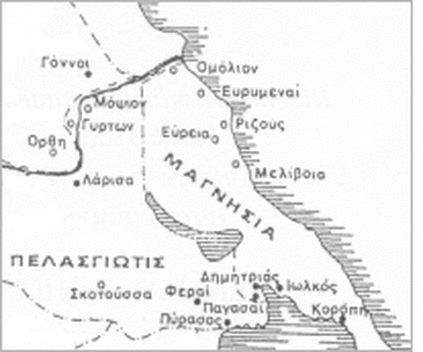
that is ancient Magnesia
_2459119.gif


Where Plinny the elder mention of a good quality stone Magnetas Lithos (Mαγνητας Λιθος)

small.jpg


that gave name to Magnetism


So my question is this

the term round, circle turn in PIE
was derived from wheel? or fron snail?

I mean ok-ro means rock and βραχος ραχη, peδρα,
but the subject we take the root,

so from where PIE kwelh[SUB]1[/SUB] *kwékwlo
may entered to vocabulary meaning round turn?
from wheel?
or from snail?

And the most stupid in the theory of Wheel and chariot is this?

Greek κυκλος from IE kwukwlos

Is Just the most stupid I have ever heard
why?
cause If the word in IE was *kwékwlo
Then in Greek should be teklos or peklos (aeolian dialect)
compare all greek Slavic etc word for #4 τετταρα cetiri ctyri (c=τσ) etc

so why in the word wheel for Greek the linguistic rules of IE languages make exception? (kyklos instead of teklos?)
the answer is simple, cause the PIE form prexisted in other form of a thing or an animal etc etc.

understanding that,
as also the names of plants etc etc,
Steppe is innapropriate place for creation of IE.

its ok
you may can explain kastanea
or cochlea
but non Linguist can explain πτελεα φιλλυρα πευκη etc etc
and non notice the snail before the wheel
as non notice or avoid to notice, even the great Duridanov, who was so sure about Baltic origin of Thracian
the S Slavic Polz Puz that is the same aspiration that happens to Greek comparing πολος or τεσσαρα (4)
and the yodization.
and and and
 
Last edited:
@ Moesan

It is simple

some believe that IE ment Horse wheel chariot
but is it?

lets see
Cappadokia in Iranic languages Cappadaka from Cappadawa or Cappatussa etc
means land of Horses,
so lets see
OCS Kobyla
Celtic Latin Equus-Hepphew Godess Eppona
Mycenean ikkos Greek Ippos
Germanic horse Ars Marc
Illyrian mandos
Getto-Thracian God Menzanas

same with word wheel
same with word chariot

on contradictory
lets find the words for metal
Ka-ko cypros copper etc etc
same with trees and flowers and other animal like goat
Aiwa Goat Aiga getta

if IE was trully a steppe language
and based on Kumis from Phorbas (female horse) milk
why we see so many word for horse
but not for metal or trees etc etc

just this from the forum
https://www.eupedia.com/forum/threa...an-PIE-word-for-Nobility-or-Free-Men-Assembly

I think IE language was a S Caucasian language and not a steppe

Yetos
1- a too common and unique word for a precise and limited meanings field with few phonetic changes is rather the proof of « recent » borrowing, I think (see the words for ‘wine’ concerning meaning) – as a relatively recent discovery and trade matter, metals had more chances to keep relatively homogenous even if I believe it’s not the case for every metal – BTW a society where horse is common tends naturally to have more than a term for gender, age, function and so on… for metals it’s not the same case ?
2- ‘horse’ : *marc is Celtic too (maybe more for stallions?) – the root *ekw- (old spelling) seems having been common from Ireland to Indo-Iranic – kobyla has the same root as capal/ceffyll/cabal (Gaël/Welsh/Lat) - ‘horse’ is from *hros- ← *kurs- ;
3- ‘wheel’ : I see only two roots : *roth-H2- (Sanskrit ràthah : ‘charriot’, Gaulish reda : -id-, Britt- r(h)od : ‘wheel’, Latin rota : -id-, Britt- red- : ‘race’, ‘to run’, maybe Scot.Gaël rathad : ‘road’) and something like *kʷékʷlo- / *kʷol-o- (semantically, there are bridges between ‘wheel’ and ‘cart’ and between ‘car(t)’ and ‘road’ or ‘car(t)’ and ‘race’, don’t wait too much strictness and stability concerning meanings) -
If we search only strict meanings strictly linked to one form among modern langages we are sure to find a great heterogeneity – but if we search on a larger scale, we see the great malleability, and we can fill up the « holes » in the series of words : Breton jaw, surely a recent romance loanwords for every kind of mount, today for ‘horse’ ; marc’h rather for ‘stallion’ today ; ebeul (*ep-) for ‘foal’, ‘colt’ ; ‘mare’ is translated ‘kaseg’, so the root *kapal/kabal seems definetely lost but we have kefelleg/kevelleg : ‘woodcock’ (!) based upon *kefel – so we have to be cautious when we state « holes » in the PIE chains of words (same words are the same for a fish and a bird today!!!) ; that said even well spred words among the IE langages can be of not-PIE origin ; it needs very deep studies in ancient and modern langages AND small dialects too ! Genuine PIE words could have disappeared very soon in some langages...

concerning localization of PIE I 'll post later, just to express my doubts rather than to affirm something
 
@ Ygors

ok with Latin ch greek x
what about Irish Spanish Francais Bulgarian etc,

and why S Slavic have simmilar evolution with Greek in the term of *kwelh
with po-pu instead of N Slavic? were kepts the suggested form for PIE with satemization? Hlem Sleim

I think you do understand. but you can not explain

simply

*kwékwlo gives Helix Kuklos kohlias
*kwelh[SUB]1 the same

[/SUB]
[SUB]
so the wheel is and an invasion
is it possble to give an aniimal the name of an invasion?
or an invation can take the name of a thing?
[/SUB][SUB]


[/SUB]
[SUB]
That is electron (amber) gave name to electricity

[/SUB]
kexrimpari.jpg


that is ancient Magnesia
_2459119.gif


Where Plinny the elder mention of a good quality stone Magnetas Lithos (Mαγνητας Λιθος)

small.jpg


that gave name to Magnetism


So my question is this

the term round, circle turn in PIE
was derived from wheel? or fron snail?

I mean ok-ro means rock and βραχος ραχη, peδρα,
but the subject we take the root,

so from where PIE kwelh[SUB]1[/SUB] *kwékwlo
may entered to vocabulary meaning round turn?
from wheel?
or from snail?

And the most stupid in the theory of Wheel and chariot is this?

Greek κυκλος from IE kwukwlos

Is Just the most stupid I have ever heard
why?
cause If the word in IE was *kwékwlo
Then in Greek should be teklos or peklos (aeolian dialect)
compare all greek Slavic etc word for #4 τετταρα cetiri ctyri (c=τσ) etc

so why in the word wheel for Greek the linguistic rules of IE languages make exception? (kyklos instead of teklos?)
the answer is simple, cause the PIE form prexisted in other form of a thing or an animal etc etc.

understanding that,
as also the names of plants etc etc,
Steppe is innapropriate place for creation of IE.

its ok
you may can explain kastanea
or cochlea
but non Linguist can explain πτελεα φιλλυρα πευκη etc etc
and non notice the snail before the wheel
as non notice or avoid to notice, even the great Duridanov, who was so sure about Baltic origin of Thracian
the S Slavic Polz Puz that is the same aspiration that happens to Greek comparing πολος or τεσσαρα (4)
and the yodization.
and and and

I avow you score a point at first sight concerning kyklos <- *kwe-kwlo- - by the way, genuine "children" of this root would be Greek pelô: "to move" + polos : 'pivot' + poleô : 'to turn ground up' - so kyklos would be a later loan to a not-P dialect of IE ??? - I confess I don't know, but more than a exception exists in languages phonetic rules, and they do'nt distruct the theory but have simple historial explanation.
 
Back
Top