
Yetos
Regular Member
- Messages
- 5,954
- Reaction score
- 520
- Points
- 113
- Location
- Makedonia
- Ethnic group
- Makedonian original
- Y-DNA haplogroup
- G2a3a
- mtDNA haplogroup
- X2b
Yetos 1- a too common and unique word for a precise and limited meanings field with few phonetic changes is rather the proof of « recent » borrowing, I think (see the words for ‘wine’ concerning meaning) – as a relatively recent discovery and trade matter, metals had more chances to keep relatively homogenous even if I believe it’s not the case for every metal – BTW a society where horse is common tends naturally to have more than a term for gender, age, function and so on… for metals it’s not the same case ? 2- ‘horse’ : *marc is Celtic too (maybe more for stallions?) – the root *ekw- (old spelling) seems having been common from Ireland to Indo-Iranic – kobyla has the same root as capal/ceffyll/cabal (Gaël/Welsh/Lat) - ‘horse’ is from *hros- ← *kurs- ; 3- ‘wheel’ : I see only two roots : *roth-H2- (Sanskrit ràthah : ‘charriot’, Gaulish reda : -id-, Britt- r(h)od : ‘wheel’, Latin rota : -id-, Britt- red- : ‘race’, ‘to run’, maybe Scot.Gaël rathad : ‘road’) and something like *kʷékʷlo- / *kʷol-o- (semantically, there are bridges between ‘wheel’ and ‘cart’ and between ‘car(t)’ and ‘road’ or ‘car(t)’ and ‘race’, don’t wait too much strictness and stability concerning meanings) - If we search only strict meanings strictly linked to one form among modern langages we are sure to find a great heterogeneity – but if we search on a larger scale, we see the great malleability, and we can fill up the « holes » in the series of words : Breton jaw, surely a recent romance loanwords for every kind of mount, today for ‘horse’ ; marc’h rather for ‘stallion’ today ; ebeul (*ep-) for ‘foal’, ‘colt’ ; ‘mare’ is translated ‘kaseg’, so the root *kapal/kabal seems definetely lost but we have kefelleg/kevelleg : ‘woodcock’ (!) based upon *kefel – so we have to be cautious when we state « holes » in the PIE chains of words (same words are the same for a fish and a bird today!!!) ; that said even well spred words among the IE langages can be of not-PIE origin ; it needs very deep studies in ancient and modern langages AND small dialects too ! Genuine PIE words could have disappeared very soon in some langages...concerning localization of PIE I 'll post later, just to express my doubts rather than to affirm something
my friend
wheel
except the strange word kuklos of Greek
there is also the Tocharian kukale.
chariot and horse
strange all the analysis ofrom ekwos to *hros
but what about Tocharian warkant.
there is a strange connection among what the as I call old languages (Greek Anatolian Armenian Aryan)
a strange connectivity, that has nothing to do with steppe
the other strange is celtic,which I accept the more possible Yamnaa origin due to Taranis=Thor
but what about the Nemeton // to Nemesis?
I do not think word kuklos is imported to Greek
cause then Helix and Kohlias has no meaning
as also the Tocharian Ko(ku)kale might be different
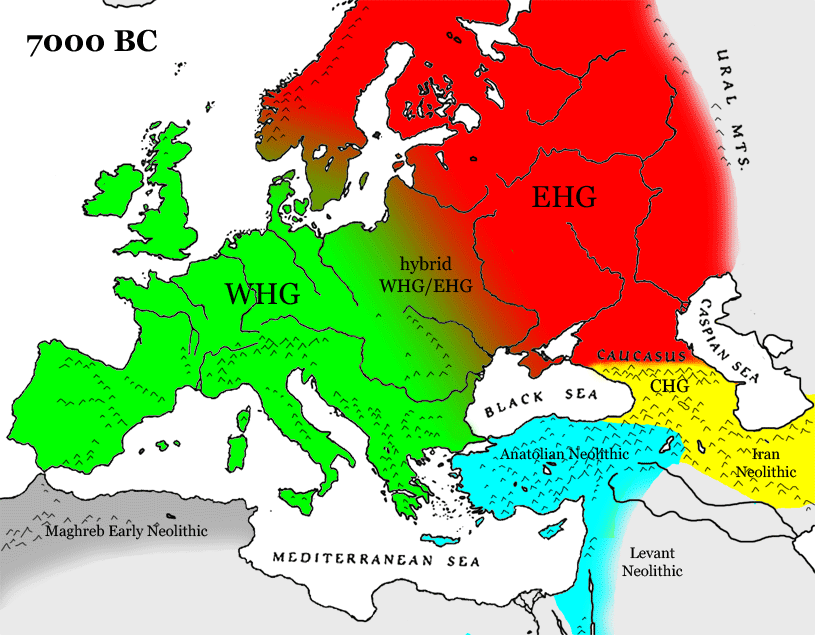
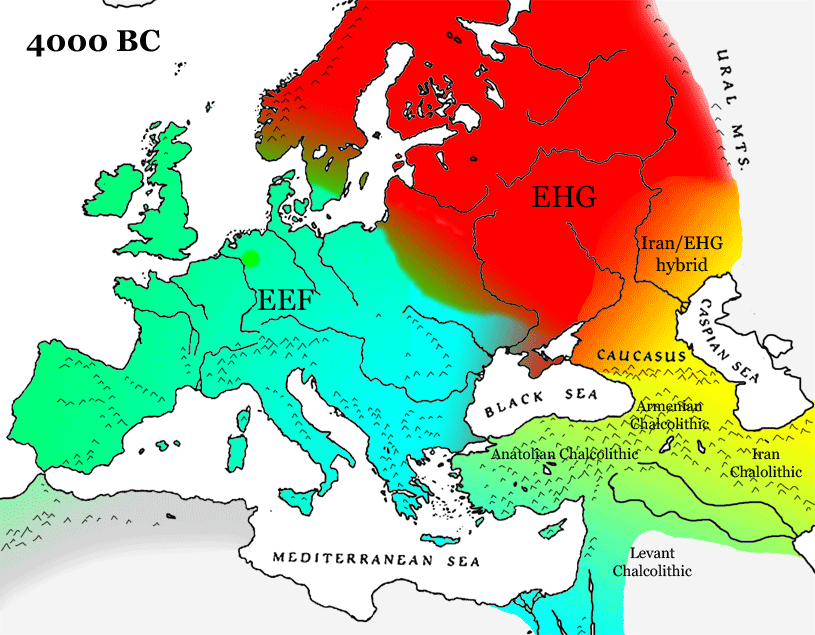
from all this I think we must reconsider the thesis that IE was a steppe origin language
and not tie our hands, with a sterile thesis,
yes steppe people spread IE to most of Europe's surface.
but I do not think IE was a steppe language
just search the word kumis,in IE languages, where?
it is a complicated puzzle,
Renfrew theory explain very well the agicultural part
but can not explain the metals etc etcthat is why is rejected,
steppe people and expand can explain well the metal expansion (except gold and silver)
but not the vocabulary of 'old' languages
besides the lack of gedrosian in some as the lack of Caucasus to other makes things much complicated.
PSIE
*roteh
Greek τροχος trohos wheel
τρεχω treho I run
 )
)