• Don't want to see ads? Install an adblocker like uBlock Origin or use a Europe-based privacy-friendly browser like Vivaldi or Mullvad.

Where does the Albanian language come from? [VIDEO]

If E-V13 would have showed up all around and G�va would have used inhumation, with us getting dozens of samples from regular burials, of course one E-V13 sample would be ridiculous. But as things are, any E-V13 find is huge and finding it even close to G�va will be a game changer. Fact is, the locals did cremate from Nyirseg EBA in some regions up to the Avar or even Christian period! I means seriously, cremation being a real and very big thing, especially for the EBA-EIA in the Upper Tisza/Eastern Carpathian region.
And the date for E-V13 based on the modern DNA sampling and phylogeny is absolutely clear: A big scale explosion of lineages and new branches happened in the Transitional Period, right when Channelled Ware expanded. That's just a fact.
Many of these new lineages had to live together by that time, but haven't seen each other afterwards, because they expanded in different directions.


For that to happen we would need another Tollense battle site. No other way, because regulars in G�va being, as a rule, always cremated. We can only go for earlier finds and groups which got under foreign influence and adopted inhumation, iike Basarabi and Babadag. Or the Psenichevo finds we already got. They were Channelled Ware descendants.


It seems they did trade, intermarry and fight, throughout their existence. Illyrians pushed them East and took Srem, at the same time we find Basarabi influences deep in Illyrian territory. So kind of neighbours which did exchange, trade or fight, depending on the current situation. That's why by that time, but even earlier, when Channelled Ware expanded, E-V13 can pop up in Illyrians and J-L283 in Thracians, occasionally. Because there was exchange and migration on a smaller scale.

But looking at the bigger picture, its about the ratio and diversity. Like if looking at the E-V13 : J-L283 ratio, its very clear that Basarabi should be E-V13 dominated, and Glasinac-Mati J-L283 dominated.
Just like Slavs could have Germanic R1b and I1, but Germanics had more of it and being the source of these lineages among Slavs.

Did Basarabi make use of tumuli at all? Or did they just cremate? Since I have seen you before wish that Serbian archeologists test the site. What makes you think E-V13 will be there? I hope its not some cyclical reasoning stemming from the conclusion itself.


As for the highlighted part, where did you get that from? I mean it could be likelier as a relative measure, but far from clear.

Right now not trying to throw crap at anything, more so wanna understand the line of thinking.
 
I think his logic was that the Venetic languages with Venetic, Liburnian and Histrian in particular, as well as some of the Pannonians, aren't really Illyrian, or not close enough to Proto-Illyrian. That's a good debate actually.


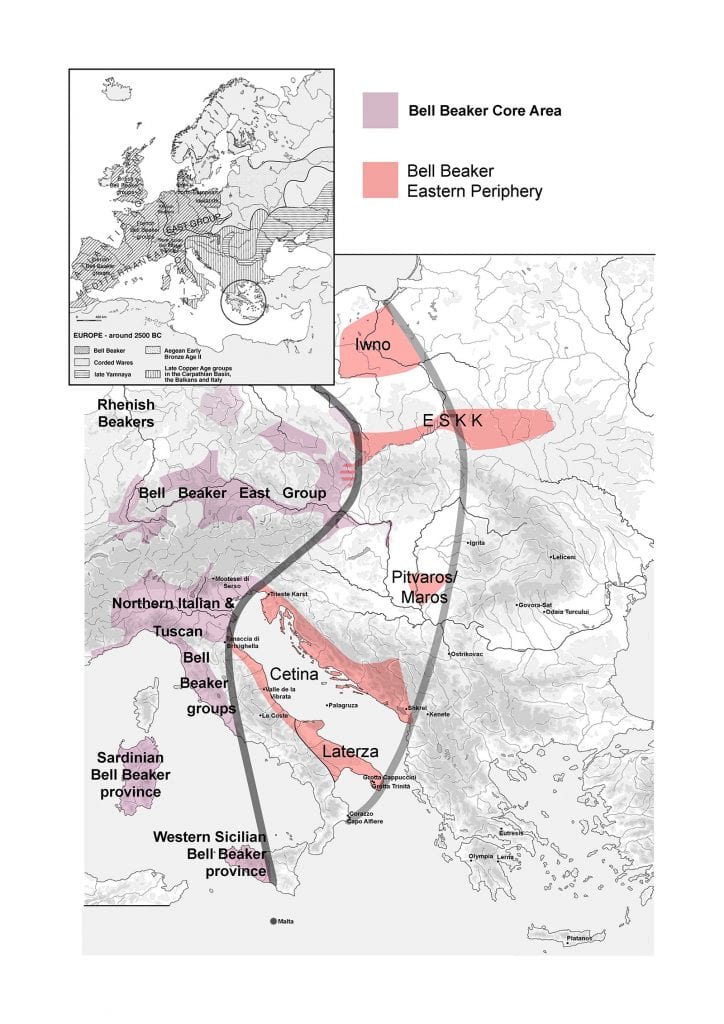
Corded Ware wasn't famous for spreading R-L51 either, yet somehow, someway, a specific branch might have developed which was dominated by it. Something similar seems to have happened with J-L283. Note that both Maros, Cetina and Posusje-Dinaric had Western relations.

aegeobalkanprhistory_west-meets-east_2-724x1024.jpg


https://aegeobalkanprehistory.kreas.ff.cuni.cz/2008/03/06/when-the-west-meets-the-east/

Note that the Beaker periphery, Cetina in particular, doesn't mean full Beaker package, but a large scale connection, communication, influence. And its not by chance that the Illyrian core groups around HRV_MBA-IA score pretty Beaker/Tumulus culture like autosomally. That was kind of an allied clan, tribe, under heavy, really heavy influence of the Beakers and later Tumulus culture.

It is not by chance that J-L283 was found in Maros and Posusje, might be found, eventually, in Cetina too. Fact is also that from the EBA onwards, the later North Western lllyrian core became constantly more Beaker like. So there was steady and significant gene flow, while J-L283 spread. This might mean that there was a marriage exchange network with the Italian Apennine and Southern Beaker/later Tumulus culture group. Something along those lines, but big scale influence came from the West.

he is claiming that Venetic was in Noricum ...............when archeological evidence studying Noricum and the Port of Vienna ( not the town which was a celtic creation much later ) was a Illyrian trade centre from at least 1600BC ( most likely the amber trade passage from the baltic to the adriatic sea )............there is only evidence of Venetic in modern slovenia , but not before 1000BC

when Illyric split off from its ling with Celtic-italic around 2200BC it was around East-Austria -Czechia ..........it started going southward down the western Balkans ...............Italic split off and went into Italy via the North-East passage ..........and celtic went into South and central Germany

we already know that the bulk of L283 was found in modern Slovenia, Croatia and northern Dalmatia
 
"Since there are two fundamentally different phoneme systems between Illyrian and Proto-Albanian, there are also two different languages.

On basis of these facts, it is possible, even inevitable, to reject the hypothesis that Albanian has a linear origin from ancient Illyrian."

Whereas Illyrian had /ó/, Early Proto-Albanian lacked this vowel entirely.

Whereas Illyrian had the IE /sk/, Early Proto-Albanian had instead /x/.


FAcYMFiXsAYaPxB


FAcYNHAXMAMD8Ad
 
I think his logic was that the Venetic languages with Venetic, Liburnian and Histrian in particular, as well as some of the Pannonians, aren't really Illyrian, or not close enough to Proto-Illyrian. That's a good debate actually.


Corded Ware wasn't famous for spreading R-L51 either, yet somehow, someway, a specific branch might have developed which was dominated by it. Something similar seems to have happened with J-L283. Note that both Maros, Cetina and Posusje-Dinaric had Western relations.

aegeobalkanprhistory_west-meets-east_2-724x1024.jpg


https://aegeobalkanprehistory.kreas.ff.cuni.cz/2008/03/06/when-the-west-meets-the-east/

Note that the Beaker periphery, Cetina in particular, doesn't mean full Beaker package, but a large scale connection, communication, influence. And its not by chance that the Illyrian core groups around HRV_MBA-IA score pretty Beaker/Tumulus culture like autosomally. That was kind of an allied clan, tribe, under heavy, really heavy influence of the Beakers and later Tumulus culture.

It is not by chance that J-L283 was found in Maros and Posusje, might be found, eventually, in Cetina too. Fact is also that from the EBA onwards, the later North Western lllyrian core became constantly more Beaker like. So there was steady and significant gene flow, while J-L283 spread. This might mean that there was a marriage exchange network with the Italian Apennine and Southern Beaker/later Tumulus culture group. Something along those lines, but big scale influence came from the West.
Cetina will end up being predominantly L283, as is obvious by the samples we already have. Bell Beaker influence among them was just that, mostly cultural influence. Genetically obviously they didn’t carry the Beaker package.
 
"In Albanian, on the other hand, there was a completely different change in sound, since indo european *r. an *l. resulted in Alb. ri and li [not ur and ul like in Illyrian]...
These developments are a clear indication that two different languages are present here."

FHSPfWYX0AIfFYq


FHSHu9eXwAAnWdf
 
Did Basarabi make use of tumuli at all? Or did they just cremate? Since I have seen you before wish that Serbian archeologists test the site. What makes you think E-V13 will be there? I hope its not some cyclical reasoning stemming from the conclusion itself.

Because of Belegis II-G?va -> Gornea-Kalakaca -> Basarabi showing a large scale continuity. The biggest impact on the whole region was by far with Belegis II-G?va before the Celts and Slavs. Therefore, even though other influences being visible and influential, it is reasonable to assume that the majority of the population from Basarabi core sites will be descendants of Belegis II-G?va, which was itself just an iteration with local influences from G?va.

We also have the samples from areas of Basarabi, from later periods, where E-V13 appeared e.g. around Szeged and Viminacium. Not all Viminacium samples must be local, but a good fraction likely was from the wider region and therefore both Daco-Thracian, as well as Basarabi derived.

We have a lot of less sure irregular burials, of which some look like bodies being just disposed. Just like the G?va context female from Hungary in heap. That's no regulars, which creates doubt.

But in Basarabi existed also regular inhumation burials, in later Bosut and Channelled Ware, also among the local La Tene Celtic influenced people, cremation became more common again, which causes the fact that in the Roman era a lot of the locals still cremated and being in a transition towards inhumation, like being written in the paper on Viminacium.

So we have:
- Regional cultural and population continuity, not fully, but largely, since Belegis II-G?va into Basarabi
- Later a lot of E-V13 finds from regions which being dominated by Belegis II-G?va and Basarabi

Basarabi has a base on earlier Belegis II-G?va, with Eastern influences, related to those from Psenichevo as well, like we see in their stamped pottery. Compare:

The-Geography-of-Serbia-Nature-People-Economy-p16.jpg


Source, page 16:
https://books.google.de/books?id=BPJQEAAAQBAJ&printsec=frontcover&hl=de#v=onepage&q&f=false

Another summary:

It describes the genesis of individual cultures, their styles, typological features and interrelationships. Danubian Serbia is seen as a contact zone reflecting influences of the Central European Urnenfelder culture on the one hand, and those of the Gornea-Kalakača and the Bosut-Basarabi complex on the other. The latter?s penetration into the central Balkans south of the Sava and Danube rivers has been registered in the Morava valley, eastern Serbia, north-western Bulgaria and as far south as northern Macedonia. The terminal Early Iron Age is marked by the occurrence of Scythian finds in the southern Banat, Bačka or around the confluence of the Sava and the Danube (e.g. Ritopek), and by representative finds of the Srem group in Srem and around the confluence of the Tisa and Danube rivers. The powerful penetration of Celtic tribes from Central Europe into the southern Pannonian Plain marked the end of the Early Iron Age.

https://www.balkaninstitut.com/pdf/izdanja/balcanica/balcanica%2035/01%20Tasic.pdf

The excavators dated the Vajuga ? Pesak ne-
cropolis between Ha B3 stage, the very end of the
Kalakača phase, and the beginning of the Basara-
bi phase.23 In this necropolis, the deceases were
buried on platforms made of river pebbles. The
eastern part contained the oldest burial of the
necropolis (No 17). In its surroundings, several
groups of pottery characteristic of the Kalakača
phase (Figure 6, b) were discovered, while the
rest of the pottery in and around the graves ex-
clusively belonged to the Basarabi complex (Fig-
ure 6, c).24 It should be stressed that the all metal
finds from these graves have been dated to the
Basarabi phase.25 This closely related co-occur-
rence of two culturally and chronologically dif-
ferent pottery styles correlates with the change in
burial rites as there is a shift from flexed inhuma-
tion, which prevailed during the Kalakača phase,
to inhumation in extended position, characteris-
tic of the Basarabi culture.

https://www.anubih.ba/godisnjak/god47/5-Aleksandar Kapuran.pdf

Therefore it would be a huge disappointment if from a Serbian centred study no Basarabi finds would have been analysed. Because Basarabi really should have E-V13 in its ranks.
 
Last edited:
It's increasingly obvious that Johane Derite / Alb History (the one who cried wolf on anthrogenica) is throwing yet again another emotional tantrum. Why? Who knows, could be a personal thing he's dealing with and thus the rollercoaster of insults he's hurling to everyone. My key advice is to ignore the fella until he calms down, he's not in the right state of mind to be discussed with.
 
Cetina will end up being predominantly L283, as is obvious by the samples we already have. Bell Beaker influence among them was just that, mostly cultural influence. Genetically obviously they didn’t carry the Beaker package.

But if you compare the CA - EBA - MBA - EIA samples, you see a constant pull North/North West, so clearly in the direction of Beakers. Even if that would be due to female exogamy with BB populations, it clearly points towards connections in the West, the Italian Apennine and Tumulus culture of the Alpine zone for example.
 
It's increasingly obvious that Johane Derite / Alb History (the one who cried wolf on anthrogenica) is throwing yet again another emotional tantrum. Why? Who knows, could be a personal thing he's dealing with and thus the rollercoaster of insults he's hurling to everyone. My key advice is to ignore the fella until he calms down, he's not in the right state of mind to be discussed with.

Mental illness is what happens when you take Homer's Iliad too seriously and try to project your ancestors into it.
 
"In Albanian, on the other hand, there was a completely different change in sound, since indo european *r. an *l. resulted in Alb. ri and li [not ur and ul like in Illyrian]...
These developments are a clear indication that two different languages are present here."
FHSPfWYX0AIfFYq

FHSHu9eXwAAnWdf

This East Alpin Block group that Illyrian belongs to that Matzinger mentions (its not his finding, but that of linguist Peter Anreiter) seems to line up well with the bell beaker influence of the north west balkans.
 
"Since there are two fundamentally different phoneme systems between Illyrian and Proto-Albanian, there are also two different languages.
On basis of these facts, it is possible, even inevitable, to reject the hypothesis that Albanian has a linear origin from ancient Illyrian."
Whereas Illyrian had /ó/, Early Proto-Albanian lacked this vowel entirely.
Whereas Illyrian had the IE /sk/, Early Proto-Albanian had instead /x/.
FAcYMFiXsAYaPxB

FAcYNHAXMAMD8Ad

Kind of odd though that Bruzmi is posting Matzinger's dating for Albanian in the origins of Albanians thread, meanwhile totally supressing his explicit statements about Albanian and Illyrian being two different languages.
 
I totally agree, that's why I wanted to point out that while I have reservations for the Balkan Limes modern pops autosomal models, where they modeled Albanian as ~50% Slavic; on the other hand I think the section about ancient samples, including the one about E-V13, is totally valid and expected IMO. I meant in no way to discredit it, in fact its in line with my worldview. Just wanted to stress that we should be aware of what standards we use, and to what they relate, as I see conflicting sides all the time use the same standard for different conclusions, when I think in both cases its inconclusive at best.

As you might have noticed I take your comments way more seriously as from the vibe I think there is no baggage behind them. So what do you think of the leaked PCA with IA Albania. How does that factor in the calculus? Myself I am still weary about PCAs, even if it really slots well in my worldview.

On another note, as for BG IA, how sure are we that this is going to be representative of IA Bulgaria? Its one sample IIRC and quite different from BA samples from the region. But when I revisit the leaked PCA it seems to be representative. Meaning if its representative we have quite different profiles in the Balkans for the period.

It will be very interesting to see what formal stats come up with, too many variables to keep in mind.

I am not good at analyzing PCA (someone better than me might have better insight), or autosomal, i would take my bet when we have G25 coordinates, we can separate EEF, Yamnaya/Bell-Beaker/CWC regionally to check what percentags they get, IMO we should get different snapshots from different perspectives to make sense of them. General overview might trick us.
 
What I'm curious about, is did anyone peer review Matzinger's work? Like which academic in their right mind, unironically thinks, Illyrians ended their names in "ium"? (Literally if you check the Greek names of these places, they end in -on, which shows it's just a Latin addendum).

Maybe Plutonium is Illyrian? It ends in "ium" like Delminium. What about Vibranium? Maybe Wakanda is Illyrian too.

The most important Illyrian word though by far is "Copium" though, which is what all these Illyrian-Albanian deniers are inhaling.
 
Many of those like Delminium are not accepted by current linguists as being related to Albanian dele, while some like Taulanti are ethnically and linguistically mixed regions.


Why do you ignore linguistic examples from the east though which are far more numerous?:


Dacian. Amalusta [camomile]
Albanian. Ambël [sweet]

Dacian. Drubetis [placename]
Albanian. Dru [wood]

Dacian. Zermisirga [placename]
Albanian. Zjerm [fire]

Dacian. Karpates [Placename of Mountain]
Albanian. Karpë [rocky hill]

Dacian. Mantia [blackberry]
Albanian. Man [blackberry]

Dacian. Polondova, later Pelendova [placename]
Albanian. Pelë [mare] from proto-Albanian *pōl-nā,

Dacian. Patavissa [placename]
Albanian. Vis [locality, place]

Dacian. Maluensis [placename]
Albanian. Mal [mountain]

"Daco-Mysian." Ouendenis/Vindenis [placename in Eastern Dardania]
Albanian. vend [place, location]

Daco-Mysian. Vetespios/Ouetespios [epithet of a god]
Albanian. Vetë [self, person]

Dacian. Diegis [personal name of King]
Albanian. Djeg [burn]

Thracian. Diegulis [personal name of King]
Albanian. Djeg [burn]

Dacian. Burebista [personal name of King]
Albanian. Burrë [man]

Thracian. Mezenai (horseman)
Albanian. Mëz (foal)

Thracian. Dreneos [personal name]
Albanian. Dren [deer]

Dacian. Buri [Tribe name]
Albanian. Burrë [man]

Delminium is literally related to Delvine in Albania you dolt. The people who named "Delvine" hundreds/thousands of years ago, had no idea about the modern concepts of "Illyrians".

"The name of the Dalmatian/Delmata Illyrian tribe, Dalmatia/Delmatia area, the Illyrian city Delminium/Dalmion, and the name of the present-day Delvinë and Delvinaqi geographical units are related to the Albanian words dele (plural delme) 'sheep', delmer 'shepherd'. Strabo adds the epithet "...πεδιον μελωβοτον..." to the name of the Illyrian city Delmion, i.e. "sheep-feeding plain""

And as for tribe names, they have to be related to animals/plants. Not just random ******* words. There has to be a theme. You can nitpick any language like that, and find fake etymologies.
 
Delminium is literally related to Delvine in Albania you dolt. The people who named "Delvine" hundreds/thousands of years ago, had no idea about the modern concepts of "Illyrians".

"The name of the Dalmatian/Delmata Illyrian tribe, Dalmatia/Delmatia area, the Illyrian city Delminium/Dalmion, and the name of the present-day Delvinë and Delvinaqi geographical units are related to the Albanian words dele (plural delme) 'sheep', delmer 'shepherd'. Strabo adds the epithet "...πεδιον μελωβοτον..." to the name of the Illyrian city Delmion, i.e. "sheep-feeding plain""

And as for tribe names, they have to be related to animals/plants. Not just random ******* words. There has to be a theme. You can nitpick any language like that, and find fake etymologies.

O Gashjan, why you are so persistent and picking fights for trivial things, random words? Matzinger might be pretty much right, but even if he is wrong that doesn't make him the words you attribute to him. He is respected linguist, and the guy who did the archaeological part in the book is one of the best in his field.
 
"In Albanian, on the other hand, there was a completely different change in sound, since indo european *r. an *l. resulted in Alb. ri and li [not ur and ul like in Illyrian]...
These developments are a clear indication that two different languages are present here."
FHSPfWYX0AIfFYq

FHSHu9eXwAAnWdf


Eastern Alpine block = ancient Noricum which is Eastern Austria and Slovenia
 
Delminium is literally related to Delvine in Albania you dolt. The people who named "Delvine" hundreds/thousands of years ago, had no idea about the modern concepts of "Illyrians".

"The name of the Dalmatian/Delmata Illyrian tribe, Dalmatia/Delmatia area, the Illyrian city Delminium/Dalmion, and the name of the present-day Delvinë and Delvinaqi geographical units are related to the Albanian words dele (plural delme) 'sheep', delmer 'shepherd'. Strabo adds the epithet "...πεδιον μελωβοτον..." to the name of the Illyrian city Delmion, i.e. "sheep-feeding plain""

And as for tribe names, they have to be related to animals/plants. Not just random ******* words. There has to be a theme. You can nitpick any language like that, and find fake etymologies.


where did you find info on Delminium

I could not find it in the 2020 paper

https://www.academia.edu/49053037/Reviewing_the_question_of_Delminium
 
Delminium is literally related to Delvine in Albania you dolt. The people who named "Delvine" hundreds/thousands of years ago, had no idea about the modern concepts of "Illyrians".

"The name of the Dalmatian/Delmata Illyrian tribe, Dalmatia/Delmatia area, the Illyrian city Delminium/Dalmion, and the name of the present-day Delvinë and Delvinaqi geographical units are related to the Albanian words dele (plural delme) 'sheep', delmer 'shepherd'. Strabo adds the epithet "...πεδιον μελωβοτον..." to the name of the Illyrian city Delmion, i.e. "sheep-feeding plain""

And as for tribe names, they have to be related to animals/plants. Not just random ******* words. There has to be a theme. You can nitpick any language like that, and find fake etymologies.

This is the millionth time that you get duped by BS wiki entries that go nowhere. Always check the primary sources, otherwise you end up making a fool of yourself as you did with claiming that all scholars support an Albano-Germanic clade.

Show me the page where Strabo says the "sheep feeding plain". I'll wait.

Meanwhile, here you have linguist Smerdaleos giving a basic rundown on why Dele has nothing to do with Dalmatia.

https://smerdaleos.wordpress.com/2018/10/29/μυθοθρυψίες-η-δήθεν-αλβανική-ετυμολο/
 
This is the millionth time that you get duped by BS wiki entries that go nowhere. Always check the primary sources, otherwise you end up making a fool of yourself as you did with claiming that all scholars support an Albano-Germanic clade.

Show me the page where Strabo says the "sheep feeding plain". I'll wait.

Meanwhile, here you have linguist Smerdaleos giving a basic rundown on why Dele has nothing to do with Dalmatia.
And who is this smerdaleos? How do you know that he is a linguist?
 
What I'm curious about, is did anyone peer review Matzinger's work? Like which academic in their right mind, unironically thinks, Illyrians ended their names in "ium"? (Literally if you check the Greek names of these places, they end in -on, which shows it's just a Latin addendum).

Maybe Plutonium is Illyrian? It ends in "ium" like Delminium. What about Vibranium? Maybe Wakanda is Illyrian too.

The most important Illyrian word though by far is "Copium" though, which is what all these Illyrian-Albanian deniers are inhaling.
Thanks for pointing it out. People studying the Illyrian language are like people studying Atlantis and their language.

Like I said before, good luck finding the etymology of Xerxes and reconstructing the language that uses such a name. Or Artaxerxes the golden Xerxes for that matter xD

Protothyes, the name of a 7th century BC Scythian king. The reconstructed name seems to have been Bartatua. Who would bother reconstructing Protothyes if he were a Paeonian king? Everyone would be: oh this is easy, it means Paeonians spoke a language close to Phrygo-Hellenic.
 
Back
Top