• Don't want to see ads? Install an adblocker like uBlock Origin or use a Europe-based privacy-friendly browser like Vivaldi or Mullvad.

Reasons For R1b Dominance In Western Europe?

Of course I'm no expert, Angela, but in my reasoning there is no need of a complex and relevant explanation for that imbalance, though this conclusion doesn't lead us to think that the Indo-Europeanization of large areas happened peacefully, through mere gradual "difusion". But see: the pool of male and female population decreased equally... but on the other hand the pool of the incoming IE-speaking peoples was already very male-biased.

To put it into clearer terms, let's say we had 1,000 male conquerors and 100 female companions of them, coming into the territory of a native population of ~10,000 people (roughly half male, half female). If the plague killed 50% of them and didn't affect the incomers much, you'd soon have 3,500 men, IE immigrants being 29% of them, and 2,600 women.

This extreme sex imbalance would only reinforce (as it happens even nowadays in countries like India and China) what was already very expected in a situation of a polygamous and unequal society where one specific group acquired much more dominance and social prestige than the defeated ones: lots and lots of men wouldn't have been able to procreate, and that's not even counting those that were killed or became invalid, probably losing much of their attractiveness as husbands.

We don't even need to draw a dramatic fate for these defeated men. Even if they managed to have 2 children on average, while the IE men could father as many as 5 or 6 children each, in just 3 generations (~ 75 years) they the indigenous male "blood" could be reduced from the previous post-plague 71% to just 14%.

I've said it repeatedly because this is what I firmly believe: we don't need any apocalyptical scenario of genocides, ethnic cleansing and massive harems to explain the Neolithic European Y-DNA being replaced mostly by steppe-derived Y-DNA.

yes, but if the local population holds only 5000 males, 1000 males are already a serious invasion, especially if they come from some marginal plague-infested country
maybe the plague travelled faster and was there ahead of these R1-invaders, and the locals were already thinned out before their arrival
but then again there would already have grown some local immunity before arival of the R1b and the replacement mechanism would be less strong in the subsequent generations
 
Of course I'm no expert, Angela, but in my reasoning there is no need of a complex and relevant explanation for that imbalance, though this conclusion doesn't lead us to think that the Indo-Europeanization of large areas happened peacefully, through mere gradual "difusion". But see: the pool of male and female population decreased equally... but on the other hand the pool of the incoming IE-speaking peoples was already very male-biased.

To put it into clearer terms, let's say we had 1,000 male conquerors and 100 female companions of them, coming into the territory of a native population of ~10,000 people (roughly half male, half female). If the plague killed 50% of them and didn't affect the incomers much, you'd soon have 3,500 men, IE immigrants being 29% of them, and 2,600 women.

This extreme sex imbalance would only reinforce (as it happens even nowadays in countries like India and China) what was already very expected in a situation of a polygamous and unequal society where one specific group acquired much more dominance and social prestige than the defeated ones: lots and lots of men wouldn't have been able to procreate, and that's not even counting those that were killed or became invalid, probably losing much of their attractiveness as husbands.

We don't even need to draw a dramatic fate for these defeated men. Even if they managed to have 2 children on average, while the IE men could father as many as 5 or 6 children each, in just 3 generations (~ 75 years) they the indigenous male "blood" could be reduced from the previous post-plague 71% to just 14%.

I've said it repeatedly because this is what I firmly believe: we don't need any apocalyptical scenario of genocides, ethnic cleansing and massive harems to explain the Neolithic European Y-DNA being replaced mostly by steppe-derived Y-DNA.

I don't believe I ever mentioned a scenario of genocides, ethnic cleansing and massive harems. Those are the beloved fantasies of the internet Nordicist warriors like Davidski and his ilk. I certainly hope that isn't what happened. I think it would be naive to believe it couldn't have happened, however. Heck, we had an attempt at ethnic cleansing and genocide and the use of rape as a weapon of war in the Balkans a generation ago, between peoples who are almost indistinguishable and for marginal gain, not to mention what went on three or four generations ago with Nazi Germany. Thanks to their mania for record keeping, we have a record of their plan to exterminate the Slavs, probably in triplicate.

To think that all of these genetic changes occurred during the Bronze Age without violence, therefore, is, I think, highly unlikely given what we know of every other large folk migration in history, and especially given what we know of Indo-European culture in terms of polygamy, the raiding culture by groups of young men, and the glorification of the "warrior".

I certainly agree that the population they encountered in Central Europe may have been thinned out and weakened by malnutrition due to climate change and the resulting problems with their food supply, (although there were repeated crashes, and the dates for the final one don't precisely coincide to the best of my recollection) and, as Bicicleur mentioned, the plague may have traveled ahead of the actual invasion. I once posted a study which showed that this is precisely what happened in the Pacific Northwest. That would explain why the steppe people were able to prevail without, in the early stages, any superiority of weapons, although that changed by the time they got to places like Britain.

Then, of course, there is the fact that parts of the northeast were empty at the time, and other parts of the north were sparsely populated, and then by remaining foragers, the farmers being able to penetrate only so far, and then permanently stalling or retreating with worsening climatic conditions. Much of the land even in Central Europe, given the large areas of very heavy soil, could be efficiently farmed only in the Middle Ages with the invention of better agricultural technology.

What precisely happened we don't know, and perhaps will never know, although future archaeological discoveries and ancient dna may fill in some of the blanks.

@Silesian,
I'm unsure what to make of your post. Are you trying to imply that R1b men are more brutal and prone to genocide and ethnic cleansing than R1a men? Really?
 
Angela@
I'm unsure what to make of your post. Are you trying to imply that R1b men are more brutal and prone to genocide and ethnic cleansing than R1a men? Really?

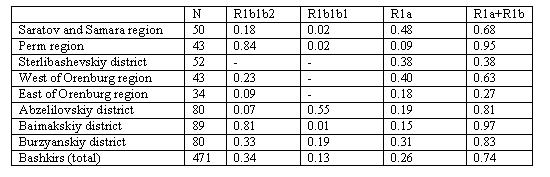
Sintashta-Arkaim complex and the roughly 10+/- settlements in the region, fall roughly into the region of modern day Burzyanskiy in the sample set shown below. All Sintashta tested have been R1a. Even with war chariots and fortified defenses modern day demographics show high numbers of R1b in the region. The same R1b that has been in the region for thousands of years prior to the building of these defense structures and spoked war chariots.

Inter-group competition and warfare[edit]

The first Sintashta settlements appeared around 2100 BCE, during a period of climatic change that saw the already arid Kazakh steppe region become even more cold and dry. The marshy lowlands around the Ural and upper Tobol rivers, previously favoured as winter refuges, became increasingly important for survival. Under these pressures both Poltavka and Abashevo herders settled permanently in river valley strongholds, eschewing more defensible hill-top locations.[8]
The Abashevo culture was already marked by endemic intertribal warfare;[9] intensified by ecological stress and competition for resources in the Sintashta period, this drove the construction of fortifications on an unprecedented scale and innovations in military technique such as the invention of the war chariot. Increased competition between tribal groups may also explain the extravagant sacrifices seen in Sintashta burials, as rivals sought to outdo one another in acts of conspicuous consumption analogous to the North American potlatch tradition.[8] Sintashta artefact types such as spearheads, trilobed arrowheads, chisels, and large shaft-hole axes were taken east.[10] Many Sintashta graves are furnished with weapons, although the composite bowassociated later with chariotry does not appear. Sintashta sites have produced finds of horn and bone, interpreted as furniture (grips, arrow rests, bow ends, string loops) of bows; there is no indication that the bending parts of these bows included anything other than wood.[11] Arrowheads are also found, made of stone or bone rather than metal. These arrows are short, 50–70 cm long, and the bows themselves may have been correspondingly short
lobov-bashkir-freqs.jpg
 
Sintashta-Arkaim complex and the roughly 10+/- settlements in the region, fall roughly into the region of modern day Burzyanskiy in the sample set shown below. All Sintashta tested have been R1a. Even with war chariots and fortified defenses modern day demographics show high numbers of R1b in the region. The same R1b that has been in the region for thousands of years prior to the building of these defense structures and spoked war chariots.


lobov-bashkir-freqs.jpg

Okay, and? Could you please spell out your point with reference to how and why R1b rose to dominance in western Europe?
 
Okay, and? Could you please spell out your point with reference to how and why R1b rose to dominance in western Europe?

Yamnaya/culture kurgans have been predominately R1b-Z2103. It's males were not displaced/genocide by R1a Sintashta males-culture and or Mongol invasion and or Turkic invasion. The R1b descendants of Yamnya/culture in- Bashkortostan do not share their branch of Ynda with Mongols and or Turks elites that settled in distant areas like Turkey for example. Mongol and Turkic ydna is very rare among dominating R1b and R1a lineages in Bashkortostan.

https://bmcgenet.biomedcentral.com/t...medcentral.com
Tatar share moderate amount of IBD (3.55–7.35 cM per pair) with all neighbouring populations, while Bashkir share most of their ancient blocks (on average 8.62 cM per pair) with Khanty, a group of Uralic speakers from Western Siberia.


Further analyses (ADMIXTURE and recent IBD) pointed to proximity of Bashkir to Turkic-speaking Tatar and Chuvash as well as to Finno-Ugric Udmurt and Khanty. In addition, results of f3 outgroup analysis indicate that Bashkir, in contrary to other Turkic speakers, were strongly influenced by Ancient Northern Eurasians, highlighting a mismatch of their cultural background and genetic ancestry and an intricacy of the historic interface between Turkic and Uralic populations.

As shown by by the history of the Bashkirs. There may be more involved, beside conquest, and eliminating competing males. As I pointed out Western R1b is dominated by L51+ plague or the ability to resist -may have been a factor; only more data on Yamnaya and it's offshoots may hold the answer. We might not be asking the right questions. Off record if I were to speculate[highly speculative] I would say it has to do with their immune system and maybe blood type.
 
Yamnaya/culture kurgans have been predominately R1b-Z2103. It's males were not displaced/genocide by R1a Sintashta males-culture and or Mongol invasion and or Turkic invasion. The R1b descendants of Yamnya/culture in- Bashkortostan do not share their branch of Ynda with Mongols and or Turks elites that settled in distant areas like Turkey for example. Mongol and Turkic ydna is very rare among dominating R1b and R1a lineages in Bashkortostan.

https://bmcgenet.biomedcentral.com/t...medcentral.com


As shown by by the history of the Bashkirs. There may be more involved, beside conquest, and eliminating competing males. As I pointed out Western R1b is dominated by L51+ plague or the ability to resist -may have been a factor; only more data on Yamnaya and it's offshoots may hold the answer. We might not be asking the right questions. Off record if I were to speculate[highly speculative] I would say it has to do with their immune system and maybe blood type.

First of all, the R1a Corded Ware people were autosomally quite similar to Yamnaya (75%, wasn't it?). Perhaps that was because of bride exchange. I don't know. They may, as a result, have had a different relationship than they would have had with the MN/LN type people in Central Europe and the Balkans. It's one thing when two relatively mobile groups both inhabit a wide open and relatively sparsely population steppe compared to encountering settled populations and proposing to take over their lands.

In addition, I would say that this particular R1b was indeed displaced from certain areas of the steppe. We may never know the precise mechanisms that were involved.

As for the plague, I would have to go back and check the lineages of the samples, but my recollection is that it was present in far northern Corded Ware. Why are you proposing that it was a particularly R1b phenomenon?
 
It seems to be quite widely admitted that pre-BA people in western Europe lived in more egalitarian (matriachal?) societies than the people who came next. There's nothing derogatory about stating such a fact. No need for grunts or neo-cortex deficiencies to explain the fact that you can be more easily submerged by a wave of heavily trained warriors when you yourself don't make war your tip top priority.
I read this as well, matriachal societies dominated europe and with this you see an equal % of different haplogroups.
R1b brought "dynastic breeding system" into europe, where chiefs had first pick of all the women in the village .............very similar to the 19th century Zulu scenario under shaka, 3 generations of this system is enough to shift the difference in a haplogroup dominating .
The Zulu scenario is interesting , zero breeding until a certain level of military glory by the "regiment" of warriors.......so , some men where never allowed to breed for sake of death.
The book, washing of the spears describes the scenario
...................
The only other scenario is that , haplogroup R is one of the youngest Haplogroups and it had developed a better sperm system, getting rid of most defects, although R-M222 has still an issue with a mutation of slow moving sperm
 
Or killing/enslaving a lot of the men.

However, as to this idea that there was an actual matriarchy in Europe before the arrival of the Indo-Europeans, this is the most disputed part of Gimbutas' theory, and doesn't seem to have much actual archaeological support.

It may very well be true, however, that their society was more equal than that of the steppe people in terms of gender, and their religion might have been fertility, Mater Dea based, although we have to be careful not to project backwards from later periods in the Near East.

The idea that the people of "Old Europe" were a particularly peaceful lot has been pretty much falsified. As resources got scarce because of climate change there was actually a lot of violence.

See:

"David Anthony has praised Gimbutas' insights regarding the Indo-European Urheimat, but also disputed Gimbutas' assertion that there was a widespread peaceful society before the Kurgan incursion, noting that Europe had hillforts and weapons, and presumably warfare, long before the Kurgan.[17] A standard textbook of European prehistory corroborates this point, stating that warfare existed in neolithic Europe and that adult males were given preferential treatment in burial rites.[21]Peter Ucko and Andrew Fleming were two early critics of the "Goddess" theory, with which later Gimbutas came to be associated. Ucko, in his 1968 monograph Anthropomorphic figurines of predynastic Egypt warned against unwarranted inferences about the meanings of statues. Ucko, for example, notes that early Egyptian figurines of women holding their breasts had been taken as "obviously" significant of maternity or fertility, but the Pyramid Texts revealed that in Egypt this was the female sign of grief.[22]
Fleming, in his 1969 paper "The Myth of the Mother Goddess", questioned the practice of identifying neolithic figures as female when they weren't clearly distinguished as male and took issue with other aspects of the "Goddess" interpretation of Neolithic stone carvings and burial practices.[23]
The 2009 book Knossos and the Prophets of Modernism by Cathy Gere examines the political influence on archaeology more generally. Through the example of Knossos on the island of Crete, which had been misrepresented as the paradigm of a pacifist, matriarchal and sexually free society, Gere claims that archaeology can easily slip into reflecting what people want to see, rather than teaching people about an unfamiliar past.[24] [25]"

https://en.wikipedia.org/wiki/Marija_Gimbutas
 
In addition, I would say that this particular R1b was indeed displaced from certain areas of the steppe. We may never know the precise mechanisms that were involved.


Snapshots of samples showing Sintashta-Arkaim 10+/- settlements in the region- Burzyanskiy. All Sintashta were R1a.
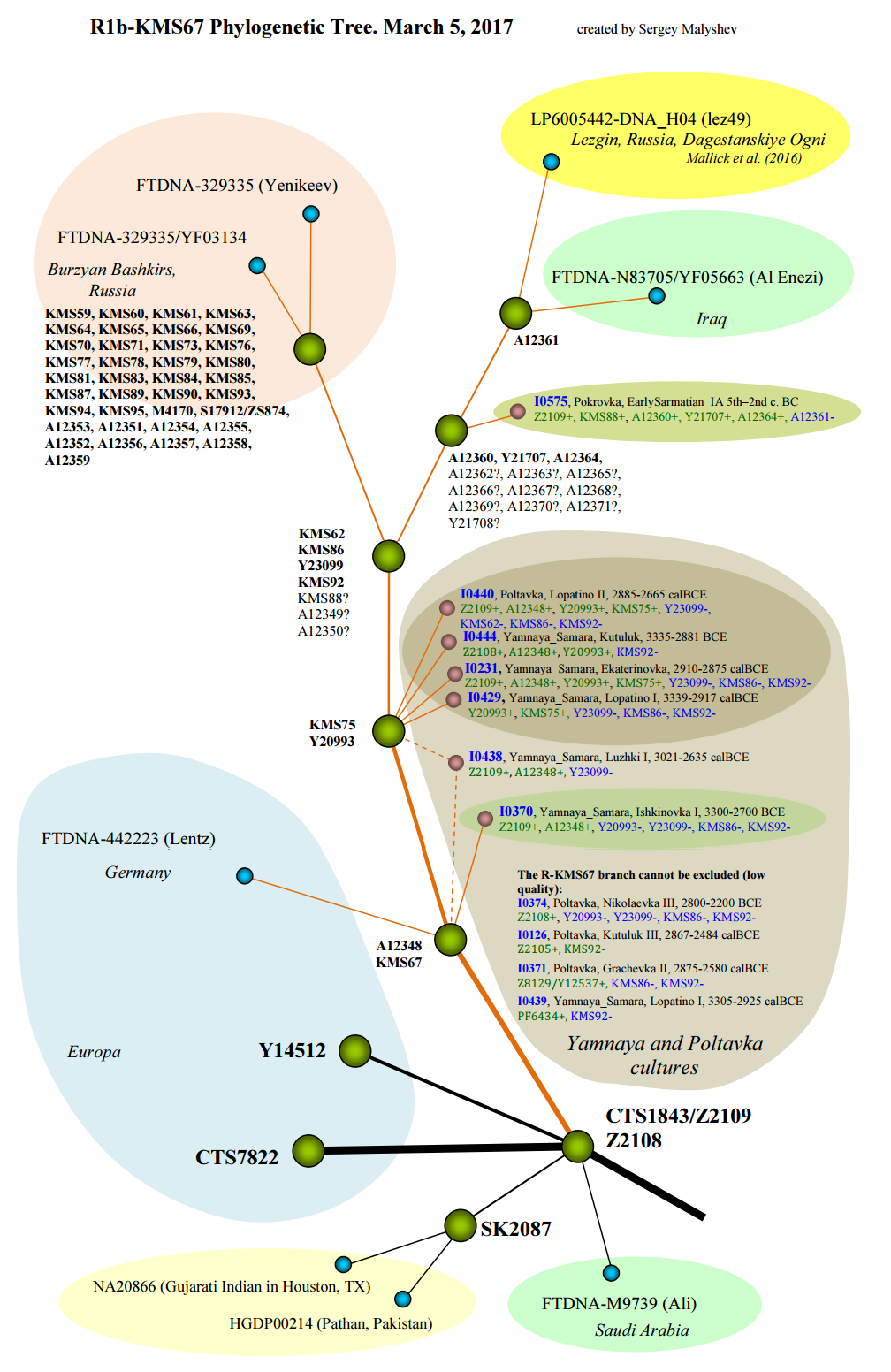
Snapshots of samples below R1b-Burzyanskiy and ancient
R1b-Yamnaya KMS-67+[Ishkanovka] and Early-Sarmatian -all belonging to same branch, in the same area for the past 5000 years+/-

z2103_r1b_paleo_dna.png


hbjhptAE17V8S1Zi-Region.png


vE5L0232OCLbobBW-Region.png


G2iOzCwme89XFDCa-Region.png


ictAaWvEMcRfpltQ-Region.png


R1a-Z93 higher frequency presence in Asia than Sintashta region.
Underhill_Z93.png


R1b-Sintashta region-
attachment.php
 
Back
Top