• Don't want to see ads? Install an adblocker like uBlock Origin or use a Europe-based privacy-friendly browser like Vivaldi or Mullvad.

Italian HO populations Divided by Province (SmartPCA)

Jovialis

Advisor
Messages
9,888
Reaction score
6,794
Points
113
Ethnic group
Italian
Y-DNA haplogroup
R1b-PF7566>Y227216
mtDNA haplogroup
H6a1b7
Update with all HO samples:
1771346762077.png

1771342752221.png


//

1771126542026.png


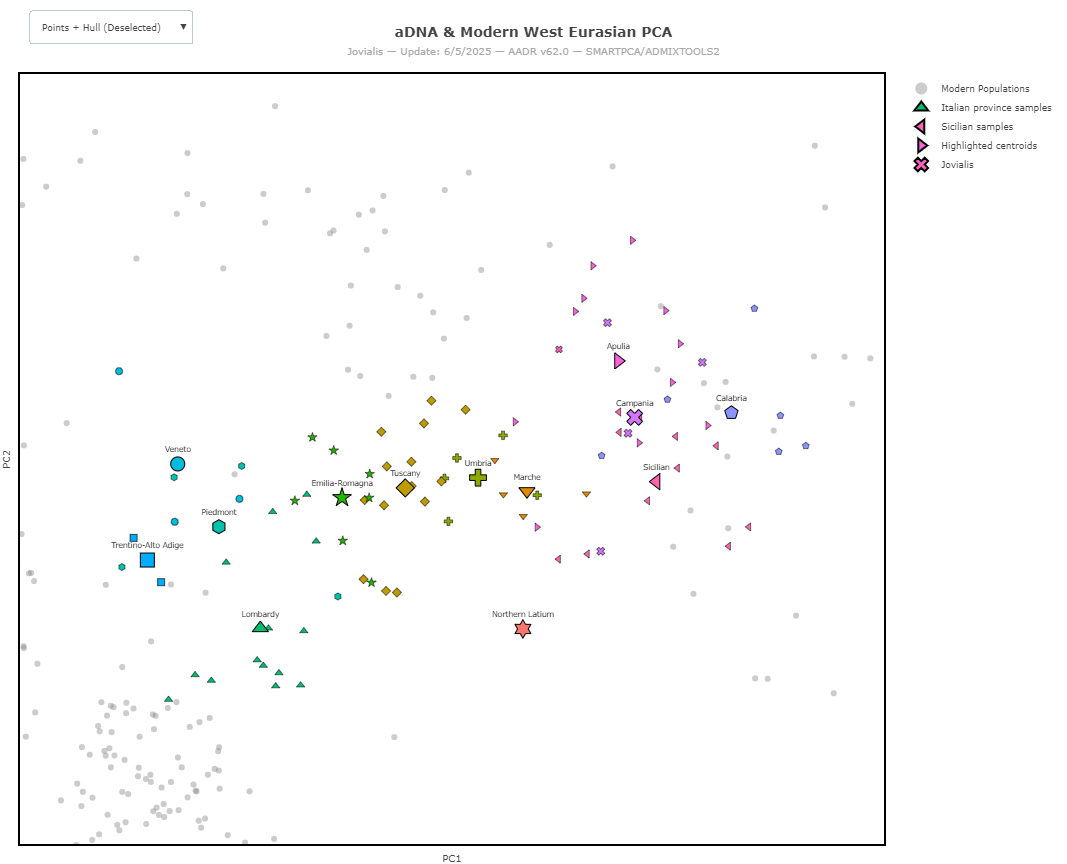
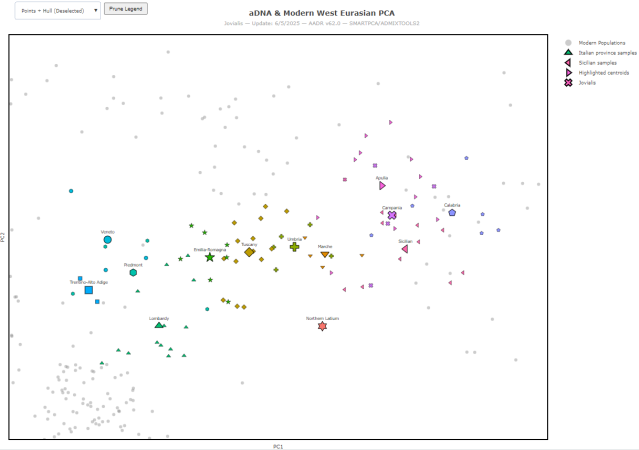
I was inspired by @Elrele 's use of aggregates to create this PCA with centroids for each respective Italian population from AADR's HO Italian populations.
 

Attachments

  • 1771342490931.png
    1771342490931.png
    68.2 KB · Views: 110
  • 1771342637023.png
    1771342637023.png
    81 KB · Views: 126
  • 1771346631529.png
    1771346631529.png
    99.1 KB · Views: 132
Last edited:
View attachment 19209

I was inspired by @Elrele 's use of aggregates to create this PCA with centroids for each respective Italian population from AADR's HO Italian populations.
Do you have any thoughts as to why the Northern Latium sample has such a strong EEF pull relative to the rest of Central Italy? Perhaps someone with recent Sardinian ancestry?
 
Seems like I made a little mistake, but this is still serviceable and comprehensive! This is only the HO samples directly listed in Reitsema et al. 2022, The diverse genetic origins of a Classical period Greek army. I just copy and pasted the list from the excel in the supplement, and had AI sort it for me. There are other HO samples from modern Italians populations within the HO. At any rate, that will just inspire me to provide an update eventually.
 
Nice work! I only viewed briefly the PCA, but I think your results seem similar to mines. Just out of curiosity @Alessio , I've seen in some of your older posts that you do have the Picenes data converted for SmartPCA use. Have you tried to compare them with modern Italian populations at this PCA? Do they also overlap with most of North Italians in SmartPCA?
 
Nice work! I only viewed briefly the PCA, but I think your results seem similar to mines. Just out of curiosity @Alessio , I've seen in some of your older posts that you do have the Picenes data converted for SmartPCA use. Have you tried to compare them with modern Italian populations at this PCA? Do they also overlap with most of North Italians in SmartPCA?
Thanks!

Here is it is, when I used to be on X I was in communication with one of the main authors. I asked her about the discrepancy, and it just has to do with a different methodology. This is what the samples would look like using the method outlined by Christian Huber, which recreates Lazaridis et al. 2016, and is employed by the Reich Lab: https://christianhuber.github.io/smartsnp/articles/aDNA_smartpca_analysis.html

1771294951866.png
 
Last edited:
Just as an aside, looking at this PCA of Iron Age Italics, Etruscans, and Greeks; both Iron Age and the Classical era of Himera and Iapygians; I have to ask: does the ethnogenesis of modern Italians really require the narrative of mass immigration from Imperial Roman era Anatolia? It seems like these Iron Age and Classical era populations do a sufficient job of explaining the modern population on their own.

Part of this narrative was initially promoted by the authors of Antonio et al. 2019, focusing heavily on exotic inputs which they themselves admit essentially disappear by the end of the Western Roman Empire. Of course, this was used as fodder for Northern European and Middle Eastern ethnonationalists who incorrectly read the data by assuming "C7" was autosomal Central European. Then come the journalists who emphasize a sensationalist and inaccurate interpretation, seemingly based on misunderstanding the data and relying entirely on the conclusion and abstract. It is already openly admitted by leading individuals like Thomas Booth that they intentionally try to suppress "nationalistic" narratives in favor of inclusive ones.

All of these views hold fast to the narrative of mass immigration from both a pro- and anti-immigration agenda. Mass immigration did happen, but based on the evidence of subsequent eras, we see it didn't necessarily leave a lasting impact due to many reasons that I have discussed on this website ad nauseam.

I know PCA is a single tool and others like qpAdm are needed to help resolve such claims, but I cannot help but notice that Rome, and by extension Italians, are constantly used as a political football. We are not being studied; I sense we are being used to advance narratives tied to the history of Rome in relation to the modern world.

1771296040327.png
 
Last edited:
Thanks!

Here is it is, when I used to be on X I was in communication with one of the main authors. I asked her about the discrepancy, and it just has to do with a different methodology. This is what the samples would look like using the method outlined by Christian Huber, which recreates Lazaridis et al. 2016, and is employed by the Reich Lab: https://christianhuber.github.io/smartsnp/articles/aDNA_smartpca_analysis.html

View attachment 19222
Northern Lazio and Lombardy seem to be right on the edge of the Picene lozenge.
 
Northern Lazio and Lombardy seem to be right on the edge of the Picene lozenge.
Indeed, and perhaps centuries of genetic drift could help explain the "eastern" drift away from the west. Or perhaps more samples as well, as R1 Proto-Villanovan, as well as recent acknowledgement of trans-Adriatic inputs in Apulia demonstrate. I understand that professionals want to be accurate according to the data they have, but at the same time, they create this hyperfocus on their limited data, and create these possibly/likely inaccurate and obtuse deviations of history. Even my grandfather who was born in a cherry tree field in the 1920s ,and had limited education already knew Magna Graecia had a lasting impact on Italians. Moreover, even people like Gabriele D'Annunzio, of who Italian Fascism is downstream of, considered himself to be of both Roman and Ancient Greek heritage. Contrary to this strawman canard, that both Leftists, and foreign-Nationalists accuse Italians of believing they are "100% Romans". Then turn around with data that in a big way, indirectly vindicates the theories of a glorious and prestigious past, that even the progenitor of Fascism believed in, as if it is some kind of own against Italians. The old adage is true, there is no poverty like ignorance!
 
Last edited:

Thank you.

The position of northern Lazio continues to be strange, as if there had been a shift towards Sardinia. However, as far as I know, the sample consists of only one individual from Lake Bolsena, Viterbo, not far from the border with the southern tip of Tuscany. In fact, that is an area full of Sardinian migrants. We would need a few more samples from northern Lazio to understand. But I don't think they are available, right?

The private results I have seen for the province of Viterbo, northern Lazio, are generally similar to those from Umbria and Marche.
 
Lombardy also has a bit of an EEF pull compared to the rest of Northern Italy.

Yes, exactly. And this is particularly evident in individuals generally from the Lombardy Alps and Prealps (see, for example, Bergamo HGDP, which seems to be samples from Val Seriana in the Orobic Alps). Those from the Po Valley areas of Lombardy, such as the provinces of Cremona, Mantua, and Pavia, tend to lean toward western Emilia.

It should be noted that in some academic samples, such as those from Veneto, the northern areas of the region are more represented than the southern areas, which seem to be absent from academic studies. I have seen the results of individuals from the province of Rovigo who were closer to the Emilian people than to those from the more Alpine provinces of Veneto. This also applies to some Venetians and some Paduans. For example, in the HO samples, Veneto is represented by an individual from Bassano del Grappa (VI) ALP202, one from Treviso (TV) ALP108, and one from Sappada (BL) ALP481. This could explain the distance between Veneto and Emilia-Romagna, for example. Furthmore, Sappada is a German-speaking community, and since 2017 it has been part of the Friuli-Venezia Giulia region.
 
Thank you.

The position of northern Lazio continues to be strange, as if there had been a shift towards Sardinia. However, as far as I know, the sample consists of only one individual from Lake Bolsena, Viterbo, not far from the border with the southern tip of Tuscany. In fact, that is an area full of Sardinian migrants. We would need a few more samples from northern Lazio to understand. But I don't think they are available, right?

The private results I have seen for the province of Viterbo, northern Lazio, are generally similar to those from Umbria and Marche.
Your interesting note about the presence of modern Sardinian migrants around Lake Bolsena and most Viterbo samples being close to Umbria/Marche reminds us that modern samples need to be vetted for authenticity.
 
Your interesting note about the presence of modern Sardinian migrants around Lake Bolsena and most Viterbo samples being close to Umbria/Marche reminds us that modern samples need to be vetted for authenticity.

Agreed. In any case, a single individual is not enough to get an accurate regional average. See also the case of Liguria in the G25, which is based on a single individual.
 
Thank you.

The position of northern Lazio continues to be strange, as if there had been a shift towards Sardinia. However, as far as I know, the sample consists of only one individual from Lake Bolsena, Viterbo, not far from the border with the southern tip of Tuscany. In fact, that is an area full of Sardinian migrants. We would need a few more samples from northern Lazio to understand. But I don't think they are available, right?

The private results I have seen for the province of Viterbo, northern Lazio, are generally similar to those from Umbria and Marche.
Yeah, this is the only sample for Lazio AADR has. I wish it was more substantive. Adding new samples would be pretty straight forward if the FASTQ or preferably the HG19-aligned BAMs were available. As FASTQ takes several days and massive computational demands to facilitate.
 
Thanks for showing the PCA with Picenes! Its cool to see that also in your PCA the Bergamo samples (which you added as Lombardy) seems generally more shifted to Early Europeans Farmes (EEF) than the rest of North Italy (including the non-Bergamo samples from Lombardy). As mentioned above, this could be due to the fact that they are more isolated and closer to the Alps.

I think your questioning of the "mass immigration from Imperial Roman era Anatolia" is valid, I can see from the PCAs that Greek populations seem indeed more shifted to the right-side of your PC1 (along the x-axis), the same shift that Italians (specially southerns) show after the Imperial period. So, I agree that it makes sense for you to question the extent of which this shift that Italians show after the imperial period can be actually caused by Greeks, rather than other populations. The Greeks samples that I've seen do not fully overlap with modern-day Southern Italy populations (or any other Italian region), they're close to them. So, although, I think Greeks can be an important component of modern-day Italians, I think it's unlikely that they represent 100% (or almost 100%) of their ancestry. We also do not have many Greek IA samples (you showed some, but most are from the BA), so we'll need to wait to see if they differ from the known samples.

As you mentioned, the PCA alone cannot solve this issue, so it would be good to analyze it via qpAdm and other methods. I haven't look much at this issue as you did, to be honest, but I agree that Greeks are a possible source, which is being underlooked.
 
Last edited:
Now, about the Picenes, given your PCAs, it seems unlikely to me that the Picenes sample can fully explain modern-day Northern Italians, as previously suggested. They look more shifted to EEF and Etruscans than Northern Italians, so I think that Northern Italians still require another population with higher Steppe admixture. Of course, this admixture can have arrived at any time, but I do not think that any currently known Italian IA samples match modern-day Northern Italians.

In your PCA some IA populations do seem to overlap with modern-day North Italians (if you consider the full region that they cover), but it seems to me that this is only caused by the use of some outliers. The Italy_Tarquinia_Etruscan.SG have 1/6 outlier with more Central-Euro admixture (ITTQ11.SG), and the Italy_TarquiniaMonterozzi_IA.SG have at least 2/11 outliers (R10339.SG, which plots close to Germanics, and R10342.SG which plots close to Central Euros), as I will show in the PCA below. From your PCA, it's not clear to me whether you included them. At least 7-11% of historical individuals are ancestry outliers (post Bronze-Age Europe) according to "Stable population structure in Europe since the Iron Age, despite high mobility". There are some other individuals from Sicily plotting close to North Italians, but I believe that they are also outliers, and it's unlikely due to the geographical distances that this actually represent the IA North Italian profile.

Here's a PCA that I build, I tried to separate some outliers as: Italy_TarquiniaMonterozzi_IA_o.SG and Italy_Tarquinia_Etruscan_o.SG. I drew a red-line to divide all used Italian populations that were from the Late Antiquity or previously (mostly from IA), from other populations. I focused on populations which I believed might be important to Northern/Central Italians. I also added arrows explaining the EEF x Steppe cline and the Extra-CHG cline (which as discussed earlier can be possibly impacted by Greeks). Although with a few exceptions, it seems to me that in general modern-day Northern/Central Italians (mostly below the red line) are shifted when compared to older Italy IA populations (above the red line) in the direction of a higher steppe component present in Central Euro pops:

PCA_Separating_Pre_IA_ITA_pops_2.png


Then, if I am not missing anything from your PCA, the only other IA samples which are closer to modern-day North/Central Italians are the ones from the IA Apulia (as Italy_Ordona_Daunian.SG and Italy_SanGiovanni_IA.SG). As you mentioned, they represent a trans-Adriatic influence of the Balkans, so I also think their influency was mostly local. I have attempted earlier to use them for modeling modern-day Apulians in qpAdm with very simple models, and I think that their use drastically improved the p-value with a high % contribution. This could mean that they are an important source for modern-day Apulians. Using the same logic, Picenes might have an effect on modern-day March. So, these eastern Italy populations might indeed have this IA Balkan shift. But those migrations might have come via Adriatic as archeologists long suggested and not via a massive North Italy replacement in IA.

Verona_LIA and samples from Emilia IA seem to be more shifted to EEF than North Italians, and there was that pre-print which claimed to have analysed more samples of IA North Italians and concluded that they were similar to Etruscans (although, I've never seen this data published). So, although we still lack a high quantity of IA North Italians, I think current evidence does not support that they are simply equal to modern-day North Italians.

Another possibility, is that the reason for this shift in modern-day Northern/Central Italians in comparison to the core of IA Italian populations torward Central/North Euros is not necessarily entirely due to massive migrations (as Gaulish and Germanic), but also due natural gene flow between centuries. E.g. if Italy received ~1% gene flow per 50 years, this could translate in a 10% admixture in 500 years. These flows are quite common and can be bidirectional (with Italians also migrating to neighbor regions). These flows are also one of the main reasons for which many PCA shows continuity between neighbor regions and they do not require mass-replacements. Due to their small scale, these flows are unlikely to be present in the historical records, which makes them harder to prove or disprove. They are also quite hard to distinguish from mass-migrations via qpAdm.

 
Back
Top