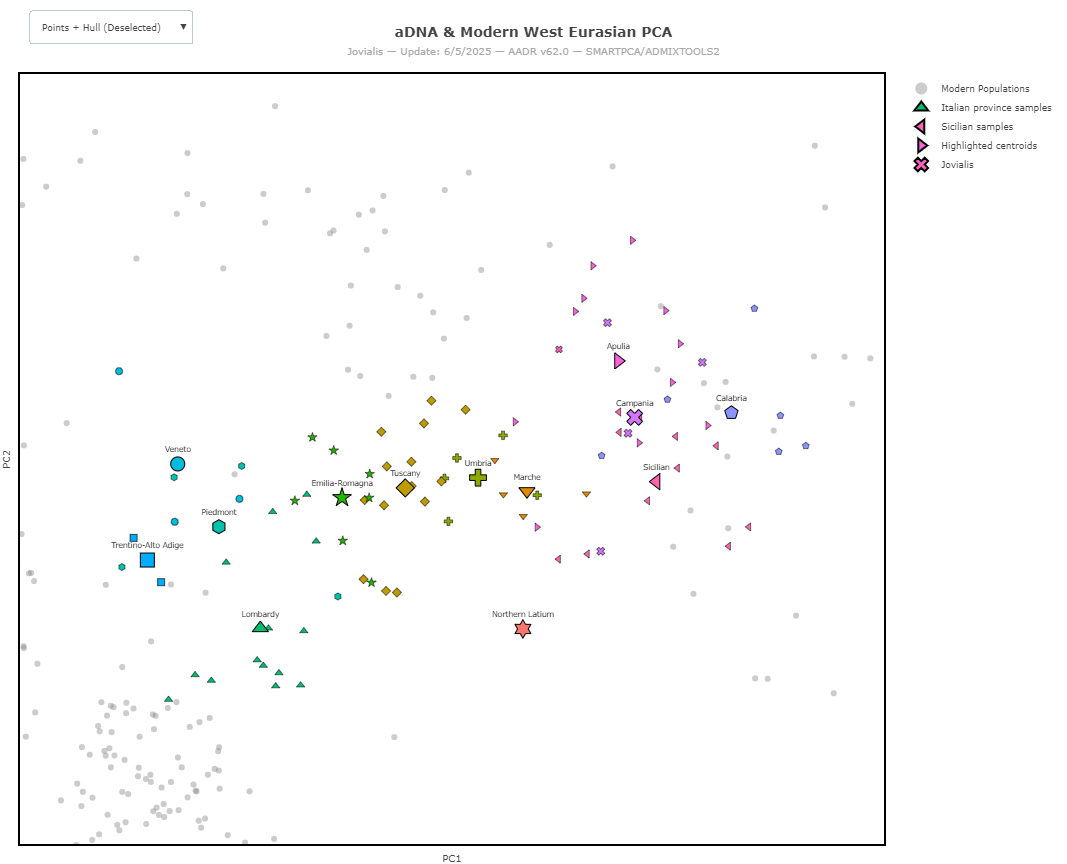
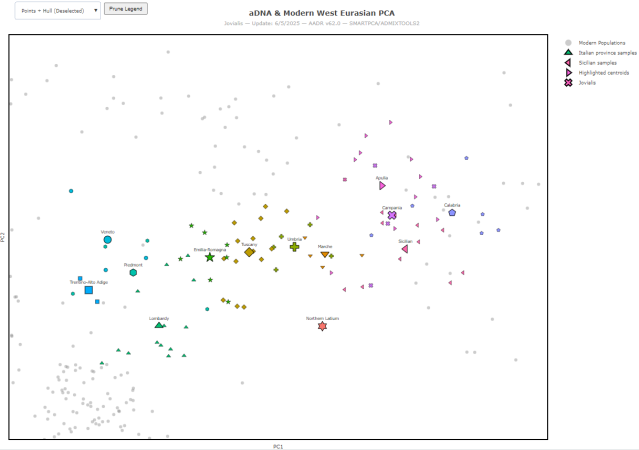
Now, about the Picenes, given your PCAs, it seems unlikely to me that the Picenes sample can fully explain modern-day Northern Italians, as previously suggested. They look more shifted to EEF and Etruscans than Northern Italians, so I think that Northern Italians still require another population with higher Steppe admixture. Of course, this admixture can have arrived at any time, but I do not think that any currently known Italian IA samples match modern-day Northern Italians.
In your PCA some IA populations do seem to overlap with modern-day North Italians (if you consider the full region that they cover), but it seems to me that this is only caused by the use of some outliers. The Italy_Tarquinia_Etruscan.SG have 1/6 outlier with more Central-Euro admixture (ITTQ11.SG), and the Italy_TarquiniaMonterozzi_IA.SG have at least 2/11 outliers (R10339.SG, which plots close to Germanics, and R10342.SG which plots close to Central Euros), as I will show in the PCA below. From your PCA, it's not clear to me whether you included them. At least 7-11% of historical individuals are ancestry outliers (post Bronze-Age Europe) according to "Stable population structure in Europe since the Iron Age, despite high mobility". There are some other individuals from Sicily plotting close to North Italians, but I believe that they are also outliers, and it's unlikely due to the geographical distances that this actually represent the IA North Italian profile.
Here's a PCA that I build, I tried to separate some outliers as: Italy_TarquiniaMonterozzi_IA_o.SG and Italy_Tarquinia_Etruscan_o.SG. I drew a red-line to divide all used Italian populations that were from the Late Antiquity or previously (mostly from IA), from other populations. I focused on populations which I believed might be important to Northern/Central Italians. I also added arrows explaining the EEF x Steppe cline and the Extra-CHG cline (which as discussed earlier can be possibly impacted by Greeks). Although with a few exceptions, it seems to me that in general modern-day Northern/Central Italians (mostly below the red line) are shifted when compared to older Italy IA populations (above the red line) in the direction of a higher steppe component present in Central Euro pops:

Then, if I am not missing anything from your PCA, the only other IA samples which are closer to modern-day North/Central Italians are the ones from the IA Apulia (as Italy_Ordona_Daunian.SG and Italy_SanGiovanni_IA.SG). As you mentioned, they represent a trans-Adriatic influence of the Balkans, so I also think their influency was mostly local. I have attempted earlier to use them for modeling modern-day Apulians in qpAdm with very simple models, and I think that their use drastically improved the p-value with a high % contribution. This could mean that they are an important source for modern-day Apulians. Using the same logic, Picenes might have an effect on modern-day March. So, these eastern Italy populations might indeed have this IA Balkan shift. But those migrations might have come via Adriatic as archeologists long suggested and not via a massive North Italy replacement in IA.
Verona_LIA and samples from Emilia IA seem to be more shifted to EEF than North Italians, and there was that pre-print which claimed to have analysed more samples of IA North Italians and concluded that they were similar to Etruscans (although, I've never seen this data published). So, although we still lack a high quantity of IA North Italians, I think current evidence does not support that they are simply equal to modern-day North Italians.
Another possibility, is that the reason for this shift in modern-day Northern/Central Italians in comparison to the core of IA Italian populations torward Central/North Euros is not necessarily entirely due to massive migrations (as Gaulish and Germanic), but also due natural gene flow between centuries. E.g. if Italy received ~1% gene flow per 50 years, this could translate in a 10% admixture in 500 years. These flows are quite common and can be bidirectional (with Italians also migrating to neighbor regions). These flows are also one of the main reasons for which many PCA shows continuity between neighbor regions and they do not require mass-replacements. Due to their small scale, these flows are unlikely to be present in the historical records, which makes them harder to prove or disprove. They are also quite hard to distinguish from mass-migrations via qpAdm.