• Don't want to see ads? Install an adblocker like uBlock Origin or use a Europe-based privacy-friendly browser like Vivaldi or Mullvad.

Where does the Albanian language come from? [VIDEO]

Some argue that Albanian is closer to Dacian and Dacian itself has strong Illyrian influences or being a close relative. You can read a lot of theories floating around. Honestly I think ancient will solve more for the linguistic debate than the linguistic debate can still add to the quest, at this point and level of the discourse. Because the data base is just too small to draw any definite conclusions from the few written sources. If it would be more clear how the relationship of Illyrian, Albanian, Dacian and Thracian is, there wouldn't be so many different opinions among linguists.

From my point of view there can be no doubt Dacians and Thracians are closer related, but we'll see what the data says. Hopefully they also test some Romanised Dacians abroad, because those at home did cremate until they were gone as a clearly recognisable entity. Like the Dacian graves from Britain would be great source material.

This is from 1927 so its pretty old, but I thought it was interesting as few know it. Well, yeah, there is a camp that argues that Albanian is Daco-Moesian pure and simple. I agree that dna will help, but I thnk all the disciplines complement each other. Obviously there is something going on with E-V13, but most just want to put their heads in the sand and keep hoping their denial will make it disappear...
 
Phillipide argued that the proto-Albanian homeland was a narrow strip between the Vrbas and Drina rivers in Bosnia.


He argued the proto-Albanians were neither Illyrians nor Thracians, but Pannonians, who he considered related but distinct to the Illyrians.


Among the tribes he listed specifically were the Maezaei, Ditiones, Daesitiatae, and the Breuci. |


He also made a comparison between the traditional Albanian. "Tirq" clothing constructed out of composite parts stitched together, and an account from Dio Cassius about the Pannonian's costumes.

He argued for this region between Vrbas and Drina due to the relatively low signs of Romanisation in this region, which he argued made it possible for the proto-Albanians to escape assimilation.

Fz3nbRLXgAAcdLf


Fz3ncZUWYAE6xlV

Fz3orcCXoAEqVQk


more likely is Paeonians instead of Pannonians
 
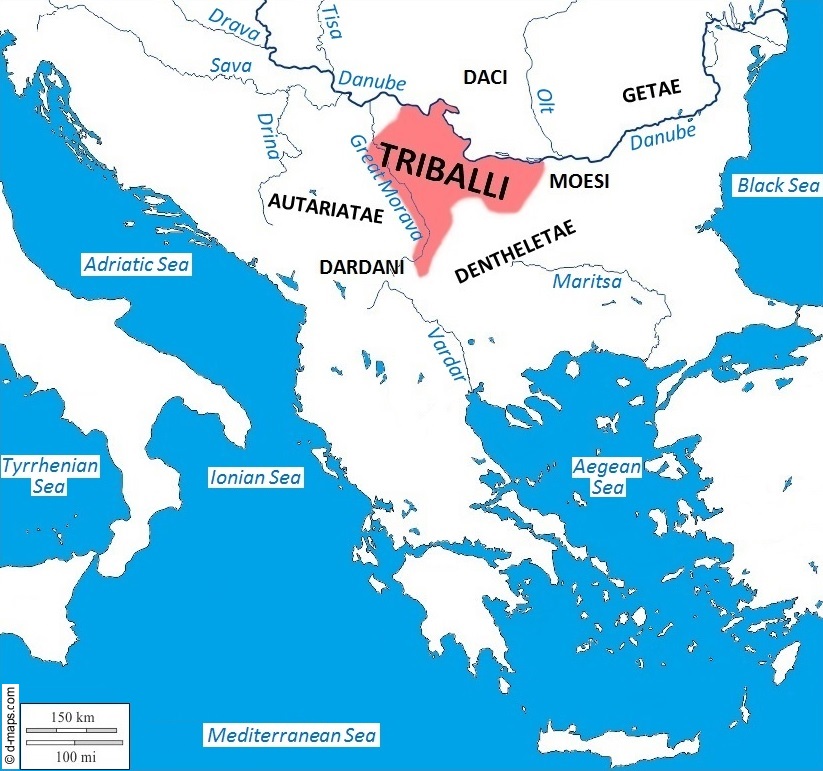
Hahah the shameless liar Bruzmi is already attempting to spin his webs yet again, now trying to claim the Triballi were not one of the main people mentioned in Moesia.

He even tries to use Appian, who didn't know the difference between the Paeonians and Pannonians, as a credible source.

He lies outright that "the only actual information for them in antiquity concerns their location in northern Bulgaria."

Just like his attempts to fabricate a world in which the Brnjica culture doesn't exist, his lies are here for all to see. He claims there is no ancient information for Triballians location in antiquity except in northern Bulgaria. A claim that is beyond false.


Here I will list countless ancient authors that reference the Triballi, that obviously demonstrate he is a pathological liar not to be trusted:


1.

"From the Illyrians the river Angros flows northwards and runs out into the Triballian plain and into the river Brongos, and the Brongos flows into the Ister; thus the Ister receives both these, being great rivers. From the region which is above the Ombricans, the river Carpis and another river, the Alpis, flow also towards the North Wind and run into it; for the Ister flows in fact through the whole of Europe, beginning in the land of the Keltoi, who after the Kynesians dwell furthest towards the sun-setting of all the peoples of Europe; and thus flowing through all Europe it falls into the sea by the side of Scythia" (Herodotus, Histories, 4.49 - ca. 430 BCE )


2.


"The Agrianes and Laeaeans, and the rest of the Paeonian tribes in his empire, at the confines of which these lay, extending up to the Laeaean Paeonians and the river Strymon, which flows from Mount Scombrus through the country of the Agrianes and Laeaeans; there the empire of Sitalces ends and the territory of the independent Paeonians begins. 4 Bordering on the Triballi, also independent, were the Treres and Tilataeans, who dwell to the north of Mount Scombrus and extend towards the setting sun as far as the river Oskius" (Thucydides, Peloponnesian War, 2.96 - ca. 395 BCE )


3.

"At one time when the Autariatae had subdued the Triballi, whose territory extended from that of the Agrianes as far as the Ister, a journey of fifteen days, they held sway also over the rest of the Thracians and the Illyrians; but they were overpowered, at first by the Scordisci, and later on by the Romans, who also subdued the Scordisci themselves, after these had been in power for a long time" (Strabo, Geography, 7.5.11 - ca. 24 CE )


4.

"
whereas the Little Scordisci lived on the far side of this river, and their territory bordered on that of the Triballi and the Mysi. The Scordisci also held some of the islands; and they increased to such an extent that they advanced as far as the Illyrian, Paeonian, and Thracian mountains; accordingly, they also took possession of most of the islands in the Ister" (Strabo, Geography, 7.5.12 - ca. 24 CE )


5.

"Joining up to Pannonia is the province called Moesia, which runs, with the course of the Danube, as far as the Euxine. It commences at the confluence previously mentioned. In it are the Dardani, the Celegeri, the Triballi, the Timachi, the Moesi, the Thracians, and the Scythians who border on the Euxine. The more famous among its rivers are the Margis, which rises in the territory of the Dardani, (Pliny the Elder, Natural History 1-11, 3.29.1 - ca. 77 CE )


6.

"On the left hand, before the Dardani are extended the Triballi and the nations of Moesia, while in front of them the Medi and the Denselatae join, and next to them the Thracians, who stretch away as far as the Euxine: in such a manner is a rampart raised around the lofty heights of Rhodope, and then of Haemus (Pliny the Elder, Natural History 1-11, 4.1.3 - ca. 77 CE )


7.

" Paeonia and Pelagonia protect its northern parts from the Triballi. Its towns are Aegiae, at which place its kings were usually buried, Beroea, and, in the country called Pieria from the grove of that name, Aiginium." (Pliny the Elder, Natural History 1-11, 4.17.1 - ca. 77 CE )


8.


" simply repelling the attacks of the nations on our frontiers, the Thracians, Illyrians, and Triballians, or even those Greeks who were unfriendly to our interests? (Arrian, Anabasis of Alexander, 5.26 - ca. 150 CE )


9.

"
The Triballoi occupy the western parts of Lower Moesia; (Ptolemaeus, Geography (II-VI), 3.10.4 - ca. 160 CE )


10.

"
those of the latter, however, who live on this side of the river near the country of the Triballi are reckoned in with the district of Moesia and are called Moesians, except by those living in the immediate neighbourhood, while those on the other side are called Dacians and are either a branch of the Getae are Thracians belonging to the Dacian race that once inhabited Rhodope (Dio Cassius, Histories, 51.22.7 - ca. 230 CE )"


11.

"subdued the Triballi who adjoin this district and the Dardani who inhabit the Triballian country.
And as long as they were thus engaged, they had no trouble with the Romans; 4 but when they crossed Haemus and overran the part of Thrace belonging to the Dentheleti, which was under treaty with the Romans, then Crassus, partly to defend Sitas, king of the Dentheleti, who was blind, but chiefly out of fear for Macedonia, went out to meet them (Dio Cassius, Histories, 51.23.2 - ca. 230 CE )"


12.

"
Two of the many tribes found among them are those formerly called the Triballi, and the Dardani, who still retain their old name (Dio Cassius, Histories, 51.27.2 - ca. 230 CE )


13.

"
In the north, Macedonia is beaten by the cold north winds cast down from the mountainous borders. Here Pelagonia and Paeonia protect the country from the Triballi (Solinus, Polyhistor, 9.1 - ca. 300 CE )


14.

"
Living in the west of Moesia The tribes of Triballi. Two islands of Moesia Are situated by that sea flow, The Island of Achilles, Leuke, is one. Borysthenes is the second island. Beyond the Danube is the nation of the Goths, (, 11.930 - ca. 1150 CE )


These are not even all the mentions, these are just enough to demonstrate ad infinitum that Bruzmi is a pathnological liar and chronic serial offender, spin doctor extraordinaire.

As you can see, there are mentions of Triballi still after Appian, Bruzmi has no clue what he is talking about.

Here is the map of the regions where Triballi appear in ancient sourced made by Fanula Papazoglu.


FyXY7oOXsAE7v1b
 
In 2016 Matzinger discards Noel Malcolm's arguments regarding compound names in Albanian (i.e. in toponyms like "Bessapara") and demonstrates that this was the original form in Albanian too, and the change to how it is now could have happened relatively late.

Fz-c2OfWYAIz50n
 
In 2016 Matzinger discards Noel Malcolm's arguments regarding compound names in Albanian (i.e. in toponyms like "Bessapara") and demonstrates that this was the original form in Albanian too, and the change to how it is now could have happened relatively late.

Fz-c2OfWYAIz50n

We even have old Albanian names having the same compound structure: Burrmadhi, Gurakuqi, Kryeziu. So, not a strong argument indeed.

Also, for the record, Ancient Macedonians were Dorian tribe, even archaic. As for Epirotes, although by toponyms it is suggested Dorians might have lived there, none of old classical authors considered them Dorian AFAIK. Epirotans are a question-mark for now. They might have been related to Greeks more distantly, even part of Greek ethnos or some sort of Hellenized population, IDK.
 
We even have old Albanian names having the same compound structure: Burrmadhi, Gurakuqi, Kryeziu. So, not a strong argument indeed.

Also, for the record, Ancient Macedonians were Dorian tribe, even archaic. As for Epirotes, although by toponyms it is suggested Dorians might have lived there, none of old classical authors considered them Dorian AFAIK. Epirotans are a question-mark for now. They might have been related to Greeks more distantly, even part of Greek ethnos or some sort of Hellenized population, IDK.


The J2a enclave in Himara points to Chaonians being J2a dominant. We will find out soon because it appears local benefactors have taken an aggressive approach in sampling people, and I'm certain in this video Paskal is not referring only to modern samples, I hope so at least.

https://www.youtube.com/watch?v=zRGz7fA31D8
 
We even have old Albanian names having the same compound structure: Burrmadhi, Gurakuqi, Kryeziu. So, not a strong argument indeed.

Also, for the record, Ancient Macedonians were Dorian tribe, even archaic. As for Epirotes, although by toponyms it is suggested Dorians might have lived there, none of old classical authors considered them Dorian AFAIK. Epirotans are a question-mark for now. They might have been related to Greeks more distantly, even part of Greek ethnos or some sort of Hellenized population, IDK.


for dorians who quickly conquered Myceanean lands, which included crete, rhodes and other islands..........the Dorians must have had a fleet and so would most likely be connected to the sea ( as their homeland ).............scholars most likely state somewhere in the south adriatic sea areas
 
Paskal was tested from Rrenjet project.
He knows nothing about DNA, he just rewording what he has heard from Rrenjet.


Sent from my iPhone using Tapatalk
 
Well, Johane Derite/Albanian History after getting ridiculed once more on twitter and after getting banned once more on anthrogenica came to his echo chamber to have a debate with himself.

Bruzmi wrote that after the era of Appian, the Triballi, just like Appian wrote, went extinct. This is exactly what happened. Dio Cassius and Solinus, the only writers mentioned by Derite who lived after Appian, lived within 50-60 years from him and they're basically describing events of the past centuries. So where is anyone wrong? Nowhere.

This is the full quote by Appian:

But I leave this topic for the antiquarians. There are many Illyrian peoples, as is to be expected in such a large country. Still well known names are the Scordisci and Triballi, who inhabited a large area, but did such damage to each other in war, that the Triballian survivors fled across the Ister to the Getae; and although they continued to flourish as a people up to the time of Philip and Alexander, they are now extinct and the present inhabitants do not recognize their name.

Appian in the second century writes that the present-day inhabitants don't know of the Triballi because they crossed the Ister (Danube) and settled among the Getae. What exactly do the extinct Triballi from southern Romania have to do with anything linked to Albanians?? Nothing at all.

Derite then goes to mention Fanula Papazoglu, a propagandist for Yugoslav archaeological ideology. Just because Papazoglu called finds Triballian, this really doesn't make them so. They are archaeological finds, they didn't have any marker which tied them to a tribe.

Source: https://books.google.com/books?id=i4FiBwAAQBAJ

This is Papazoglu's viewpoint about the location of the Triballi:

triballi2.png


I added an approximate mark about the Bulgarian-Serbian border area. So, basically even in Papazoglu's view, the Triballi are more linked to northwestern Bulgaria than to eastern Serbia.

This is how modern archaeology describes her "method":

triballi.png


So, why is Derite so obsessed that he's resorting to straight up distortion of the debate? The problem is that Derite really doesn't like the fact that R1b-CTS9219 did exist in northern Albania in the Iron Age and it didn't get there in the middle ages, so he has to invent tribes who didn't even exist by the 6th century as tribes which moved R-Z2705 and E-V13 around from eastern Serbia.
 
Source: https://books.google.com/books?id=i4FiBwAAQBAJ

This is Papazoglu's viewpoint about the location of the Triballi:

triballi2.png


I added an approximate mark about the Bulgarian-Serbian border area. So, basically even in Papazoglu's view, the Triballi are more linked to northwestern Bulgaria than to eastern Serbia.

This is how modern archaeology describes her "method":


More lies as usual from you. Your horseshiit book from 2014 is an outright misrepresentation of her "viewpoint" as you put it. Must have taken you a couple of days fuming to try come up with this pathetic attempt at a response.

Here is Papazoglu's actual map from her book which you intentionally went to lengths to find some secondary source to misrepresent:

GP9qwRy.png
 
More lies as usual from you. Your horseshiit book from 2014 is an outright misrepresentation of her "viewpoint" as you put it. Must have taken you a couple of days fuming to try come up with this pathetic attempt at a response.

Here is Papazoglu's actual map from her book which you intentionally went to lengths to find some secondary source to misrepresent:

GP9qwRy.png

Just checked on google search and this map from worldhistory came up, looks quite similar to your map.

11565.jpg


https://www.worldhistory.org/image/11565/map-of-triballian-territory/

It looks like a reliable site to me. Anyway, Excine is like the most robotic member i have ever encounter reading. Like he is a puppet account of some sort. I would ignore him. I don't know about the Scordisci, but i have the impression they might be E-V13 heavy, it's just a miss-interpretation they are Celtic. It might be that they mixed with Celts as well. IDK.

Also for Dardanians we have spoken several times, many authors consider them as having influences from several archaeological cultures. Glasinac on the West of Kosovo, and for the rest, Brnjica and Belegis-Gava II/Mediana. How things will turn out in the end, that i don't know.
 
From the genetic point of view, it is also important to note that it doesn't like the Scordisci did replace all the local Illyrian and Daco-Thracian people in their sphere, but in some regions incorporated locals, probably even in larger numbers. Will be seen also, but from the genetic point of view, the Scordisci weren't necessarily the end of the local lineages, and some settlements in between look like having been dominated by locals. So we might deal with local/regional survival even in broader zones of Celtic settlement also.
 
It looks like a reliable site to me. Anyway, Excine is like the most robotic member i have ever encounter reading. Like he is a puppet account of some sort. I would ignore him.

I've seen other posts where he mocks Johane and the Bosnian how they got banned, even though they mainly collided with Brumi, through his asiatic spirit he reveals himself of who he is. I have not seen a single kelmendi conduct themself as a man, they all stink of cowardice.
 
More lies as usual from you. Your horseshiit book from 2014 is an outright misrepresentation of her "viewpoint" as you put it. Must have taken you a couple of days fuming to try come up with this pathetic attempt at a response.

Here is Papazoglu's actual map from her book which you intentionally went to lengths to find some secondary source to misrepresent:

GP9qwRy.png


What's the misrepresentation? You claimed that the Triballi are mentioned by plenty of authors and I showed that during the era of Appian, they truly did vanish as Appian recorded it.

The map which I posted comes from Fingerprinting the Iron Age: Approaches to identity in the European Iron Age: Integrating South-Eastern Europe into the debate
Cătălin Nicolae Popa (Editor); Simon Stoddart (Editor), Oxbow Books, 2014.

triballi.png


It is the most recent critical examination of Papazoglu based on her full work, so yes, the map which I posted is reliable and what you posted only differs in expanding the Triballi towards Macedonia, something which archaeologists today reject. If you don't like it, that's your problem but it's dishonest to pretend that archaeology today supports something which it doesn't just because you want it to be true.

Even the map you posted still doesn't show the Triballi as being any major group in eastern Serbia and they didn't even exist past early Roman times.

The conclusion is that the Triballi had their base in northwestern Bulgaria and they were annihilated by the Roman era. The Triballi must have had considerable Celtic admixture from the Scordisci as seen in the overlapping with Celts during their incursion in eastern Serbia. Nothing in the history and the extinction of the Triballi connects them to Albanians.
 
Lafe remarks that we lack unequivocal linguistic evidence of ancient Albanian placenames (that show uniquely Albanian developments like sk > h or sp > f).


On Mat :


Cabej compared it to Old Irish. math (grit, sand, gravel) in which case Mat would not be an early Albanian toponym.


F0TKoBgWcAAnb5T


LINK to full paper:

https://www.academia.edu/91849623/I...se_dellanalisi_della_loro_evoluzione_fonetica

Matzinger's idea is that Mat could be from ie. IE. *mn̥to

Since IE. n̥ yields /a/ in Albanian this is plausible.


Whereas IE. *mn̥to would have yielded different forms in Illyrian and Messapic:


Illyrian. Munt-
Messapic. Mant-

However, if this proposed etymology is wrong and it is related to old irish. math as Cabej argued, then it is possible this is just a loan word that Albanians took and not an inherited term.


F0NVtuPXoBU4Hlp


Another example of Indo-European. *n̥ yielding Illyrian. /un/ in "Maluntum".


Were this toponym Albanian, it should have been **Malat- not Malunt- (*n̥ yields /a/ in Albanian).


Interestingly, the proposed etymology for Liburnian Brattia (Brač) sees *n̥ yield /a/ like Albanian.

F0MhoZNXoAErpJB


Regardless, Matzinger is clear in his position:

"Për çështjen e prejardhjes së shqiptarëve dhe të shqipes, gjuhësia historike jep sidoqoftë një përgjigje të besueshme.


Sipas dëshmive të toponimisë në trojet e tyre të dokumentuara historikisht, shqiptarët janë të ardhur nga pjesa e brendshme e ballkanit."

F0NgZe4WIAISQkR
 
Brumi wants to mold non-Illyrian haplogroups into Illyrian ethnos through the forging of greater Illyria, push the borders as far they need to be, to appropriate other people's haplogroup. Did you guys know Triballi barely even existed?


it is safer to state the term illyrian is a geographical term and that no tribe where Illyrian.................I said many years ago there are no Illyrians, there are Dalmatians, Liburnians, Iapodes, Histri, Daorsi etc etc etc

The romans never called anyone that I recall as Illyrian...............it was a geographical area fro them split into 4 sections

 
Matzinger's idea is that Mat could be from ie. IE. *mn̥to

Since IE. n̥ yields /a/ in Albanian this is plausible.


Whereas IE. *mn̥to would have yielded different forms in Illyrian and Messapic:


Illyrian. Munt-
Messapic. Mant-

However, if this proposed etymology is wrong and it is related to old irish. math as Cabej argued, then it is possible this is just a loan word that Albanians took and not an inherited term.


F0NVtuPXoBU4Hlp


Another example of Indo-European. *n̥ yielding Illyrian. /un/ in "Maluntum".


Were this toponym Albanian, it should have been **Malat- not Malunt- (*n̥ yields /a/ in Albanian).


Interestingly, the proposed etymology for Liburnian Brattia (Brač) sees *n̥ yield /a/ like Albanian.

F0MhoZNXoAErpJB


Regardless, Matzinger is clear in his position:

"Për çështjen e prejardhjes së shqiptarëve dhe të shqipes, gjuhësia historike jep sidoqoftë një përgjigje të besueshme.


Sipas dëshmive të toponimisë në trojet e tyre të dokumentuara historikisht, shqiptarët janë të ardhur nga pjesa e brendshme e ballkanit."

F0NgZe4WIAISQkR

If Mat is the oldest Albanian toponym in Albania as argued by Matzinger, then could it have any relation to "Matoas" (said to mean "silty"), one of the old names of the Danube?


Could "Matoas" be proto-Albanian?


Albanian. Mat [seacoast, riverbank, sandy shore] from IE. *mn̥to

F0V3X2ZXwAAgr70
 
Back
Top