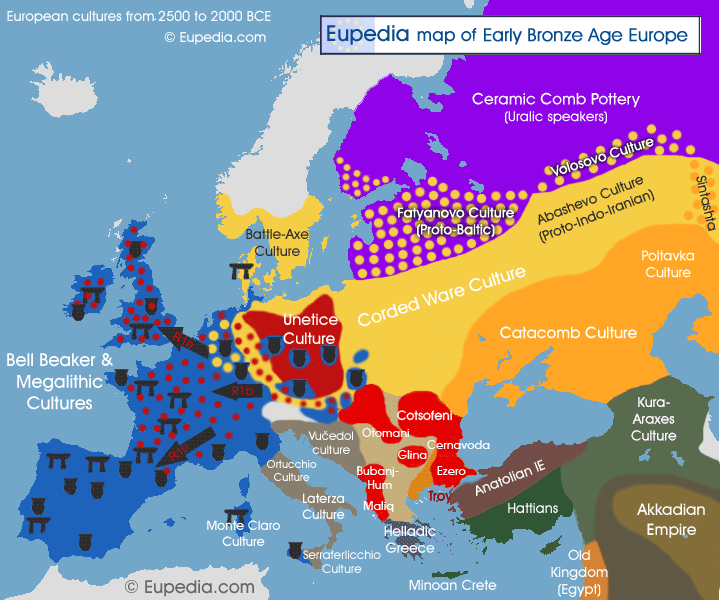
Unetice Culture (c. 2300-1600 BCE)
Quick Facts
- Associated with the diffusion of Proto-Germanic and Proto-Celto-Italic speakers.
- Emergence of chiefdoms. Long-distance trade in bronze, amber, faience and gold prestige goods.
- Widespread use of bronze. Gold, copper and bronze objects include torcs, flat axes, halberds, flat triangular daggers, bracelets with spiral-ends, disk- and paddle-headed pins and curl rings.
- Coarse pottery typically decorated with twisted cord impressions, and sometimes with other types of impressions or incisions.
- The dead were inhumed in flat graves or in barrows/tumuli for richer burials. Corpses were accompanied by ceramic vessels, jewellery, personal items made of bronze or bone, and occasionally flint tools. Coffins were sometimes used.

Historical context of the Unetice culture
Genetic Analysis
Y-DNA & mtDNA
| MtDNA samples from the East Bell Beaker (Proto-Unetice) and Unetice cultures |
|---|
| Hg |
R/HV
|
H
|
V
|
J
|
T1
|
T2
|
U2
|
U4
|
U5
|
U8
|
K
|
I
|
W
|
X
|
| East Bell Beaker (Proto-Unetice) (n=47) |
1
|
20
|
0
|
1
|
2
|
2
|
1
|
3
|
9
|
0
|
4
|
1
|
3
|
0
|
| % |
2%
|
42.5%
|
0%
|
2%
|
4.5%
|
4.5%
|
2%
|
6.5%
|
19%
|
0%
|
8.5%
|
2%
|
6.5%
|
0%
|
| Unetice (n=87) |
2
|
18
|
3
|
6
|
2
|
7
|
7
|
2
|
13
|
2
|
9
|
8
|
4
|
4
|
| % |
2.5%
|
20.5%
|
3.5%
|
7%
|
2.5%
|
8%
|
8%
|
2.5%
|
15%
|
2.5%
|
10.5%
|
9%
|
4.5%
|
4.5%
|
The following mtDNA and Y-DNA samples were tested by Allentoft et al. (2015).
| Sample
|
Y-DNA
|
mtDNA
|
Location
|
Date
|
| RISE109 |
- |
U4 |
Wojkowice, Poland |
1850 BCE |
| RISE139 |
- |
U2e1f1 |
Chociwel, Poland |
2050 BCE |
| RISE145 |
- |
H6a1b |
Polwica, Poland |
2100 BCE |
| RISE150 |
- |
U5a1b1 |
Przeclawice, Poland |
1750 BCE |
| RISE154 |
- |
K1a4a1 |
Szczepankowice, Poland |
1850 BCE |
| RISE577 |
- |
T2b |
Velke Prilepy, Czech Republic |
? |
| RISE577 |
- |
K1b1a |
Moravska Nova Vez, Czech Republic |
? |
The following mtDNA and Y-DNA samples were tested by Haak et al. (2015).
| Sample
|
Y-DNA
|
mtDNA
|
Location
|
Date
|
| I0047 |
- |
V9 |
Halberstadt-Sonntagsfeld, Germany |
1950 BCE |
| I0114 |
I2a2 |
I3a |
Esperstedt, Germany |
2050 BCE |
| I0115 |
- |
U5a1i |
Esperstedt, Germany |
1850 BCE |
| I0116 |
I2c2 |
W3a1 |
Esperstedt, Germany |
2050 BCE |
| I0117 |
- |
I3a |
Esperstedt, Germany |
2130 BCE |
| I0164 |
- |
U5b2a1b |
Quedlinburg VIII, Germany |
1950 BCE |
| I0803 |
- |
H4a1a1 |
Eulau, Germany |
2050 BCE |
| I0804 |
I2 |
H3 |
Eulau, Germany |
2050 BCE |
The following mtDNA and Y-DNA samples were tested by Adler, C.J. (2012), Lee et al. (2012), Brandt et al. (2013) and Brotherton et al. (2013). Some samples were reported as belonging to the Bell Beaker culture, which could be considered Proto-Unetice.
Samples from Saxony-Anhalt, Germany
- HV6
- H (x7)
- H2a1a3
- H4a1a1a
- H5 (x2)
- H6a1b3
- H7h
- H11a
- H82a
- I (x2)
- I1
- I1a1 (x2)
- I3a
- K (x3)
- K1a (x2)
- K1a24a
- K2
- J (x2)
- J1b1a1
- J1c2e
- J1c3f
- J2b1a
- T1
- T1a
- T2 (x2)
- T2b (x3)
- T2c
- R
- U2
- U2e1
- U2e1f (x2)
- U2e2 (x2)
- U4
- U5
- U5a (x2)
- U5a1 (x3)
- U5a1a'g
- U5a2a
- U5b1a'b
- U5b2b3a1a
- U8a1a
- U8b1a1
- V (x2)
- W
- W3a1 (x2)
- X (x4)
Dodecad K12b admixtures of Unetice people
Y-chromosomal DNA and mitochondrial DNA are useful tools to follow prehistoric population migrations. However, as uniparental markers, they have their limitations and do not inform us about the whole genome composition of individuals, which can evolve very differently due to the randomness of chromosomal recombination, natural selection for specific genes, and of course to the fact that some men can have more children with multiple women, especially in the context of highly unequal prehistoric societies. The Dodecad K12b admixture calculator used here gives estimates of the ultimate region of origin of chromosomal segments outside of the X and Y chromosomes. This page provides a description of each K12b component with a distribution map among the present-day population. Average values for various ancient European populations can be found here.
| Sample ID |
Gedrosia |
Siberia |
NW Africa |
SE Asia |
Atlantic Med |
North Europe |
South Asia |
East Africa |
SW Asia |
East Asia |
Caucasus |
Sub-Saharan Africa |
| I0047 |
8.51 |
0.00 |
0.00 |
0.00 |
35.23 |
49.60 |
0.00 |
0.09 |
0.00 |
0.00 |
6.56 |
0.00 |
| I0114 |
11.94 |
0.05 |
0.60 |
0.00 |
34.36 |
43.87 |
0.06 |
0.21 |
3.68 |
0.00 |
5.24 |
0.00 |
| I0115_ESP3 |
8.53 |
0.12 |
0 |
0.58 |
24.34 |
50.44 |
2.51 |
0 |
0 |
1.13 |
10.94 |
1.39 |
| I0116_ESP4 |
13.09 |
1.03 |
0 |
0.51 |
32.55 |
50.7 |
0 |
1.4 |
0 |
0 |
0.72 |
0 |
| I0117_ESP29 |
6.55 |
1.9 |
0.64 |
0.07 |
33.97 |
46.42 |
0.18 |
0 |
1.61 |
0 |
7.87 |
0.79 |
| I0047_HAL16 |
11.47 |
0.00 |
0.00 |
0.00 |
32.02 |
46.57 |
0.00 |
0.40 |
0.00 |
0.00 |
9.25 |
0.35 |
| I0164 |
12.37 |
1.91 |
0 |
0 |
26.31 |
53.62 |
0 |
0 |
0 |
0 |
5.14 |
0.66 |
| I0803 |
7.97 |
2.63 |
0 |
0.00 |
29.21 |
48.80 |
0.00 |
1.95 |
0.00 |
0.00 |
9.44 |
0.00 |
| I0804 |
7.22 |
0 |
0 |
0 |
34.53 |
53.23 |
1.7 |
0 |
0 |
1.43 |
1.89 |
0 |
| RISE577 |
8.22 |
0 |
0 |
0 |
37.41 |
47.46 |
0 |
0.03 |
0 |
0 |
6.6 |
0.28 |
| RISE586 |
5.1 |
0 |
0 |
0 |
47.08 |
45.72 |
0 |
0 |
0 |
0 |
1.5 |
0.61 |
| RISE109 |
3.35 |
0.00 |
0.00 |
0.00 |
31.56 |
65.09 |
0.00 |
0.00 |
0.00 |
0.00 |
0.00 |
0.00 |
| RISE139 |
0.56 |
3.78 |
0.00 |
0 |
22.47 |
70.41 |
2.78 |
0 |
0 |
0 |
0 |
0 |
| RISE145 |
0 |
0 |
9.67 |
0 |
9.93 |
66.99 |
0 |
0 |
0 |
0 |
13.42 |
0 |
| RISE1 |
9.53 |
2.23 |
0 |
0 |
20.52 |
67.27 |
0 |
0 |
0 |
0 |
0.46 |
0 |
| RISE150 |
13.55 |
0 |
0.00 |
0.50 |
33.51 |
50.20 |
0.00 |
0.00 |
0.00 |
0.00 |
1.75 |
0.50 |
| RISE154 |
17.57 |
0 |
0 |
0.00 |
34.72 |
47.71 |
0.00 |
0.00 |
0.00 |
0.00 |
0.00 |
0.00 |
| RISE431 |
0.12 |
0 |
0.00 |
0.00 |
35.39 |
58.83 |
0.00 |
0.00 |
0.00 |
0.00 |
5.67 |
0.00 |
|
|
|
|
|
|
|
|
| Unetice culture |
8.09 |
0.76 |
0.61 |
0.09 |
30.84 |
53.50 |
0.40 |
0.23 |
0.29 |
0.14 |
4.80 |
0.25 |
Comparison with modern populations
Using the average values for each era above and comparing it with the Dodecad K12b averages for modern populations on Vahaduo, the genetic distance between populations can be compared. The smaller the value for the genetic distance, the most similar the population (1 being a perfect match). Under 5 is considered very close, 5 to 10 moderately similar, while over 10 is not genetically similar. Unetice people were genetically most similar to modern Scandinavians and Germans.
- Swedes : 4.2
- Danes : 6.4
- Germans : 7.0
- Norwegians : 7.1
- Northeast Poles : 7.6
- Sorbs from Lusatia : 8.0
- Icelanders : 8.0
- Czechs : 9.6
Another way to go, instead of comparing ancient averages with modern averages, is to look at the closest individual matches between modern people and ancient Gauls. This analysis was done using MyTrueAncestry.com to compare the genomes of the Unetice people (mostly from present-day Czechia) with those of modern Europeans. It showed that the closest match in term of genetic distance were the Belgians and Irish, followed by the North French and Dutch. Here is the full list of modern Europeans having a genetic distance smaller than 10 to the Unetice people.
- Belgians : 4.1
- Irish : 4.3
- North French : 5.0
- North Dutch : 5.0
- Scottish : 5.2
- West Germans : 5.5
- East Germans : 5.8
- English : 5.9
- Welsh : 6.7
- South Dutch : 6.7
- Czechs : 6.8
- South French : 6.8
- Finnish : 7.0
- Norwegians : 8.0
- Austrians : 9.7
- Hungarians : 9.7
- Swiss : 10.0
Follow-up
Find out the latest studies and discuss them on the Ancient DNA Forum.
|