
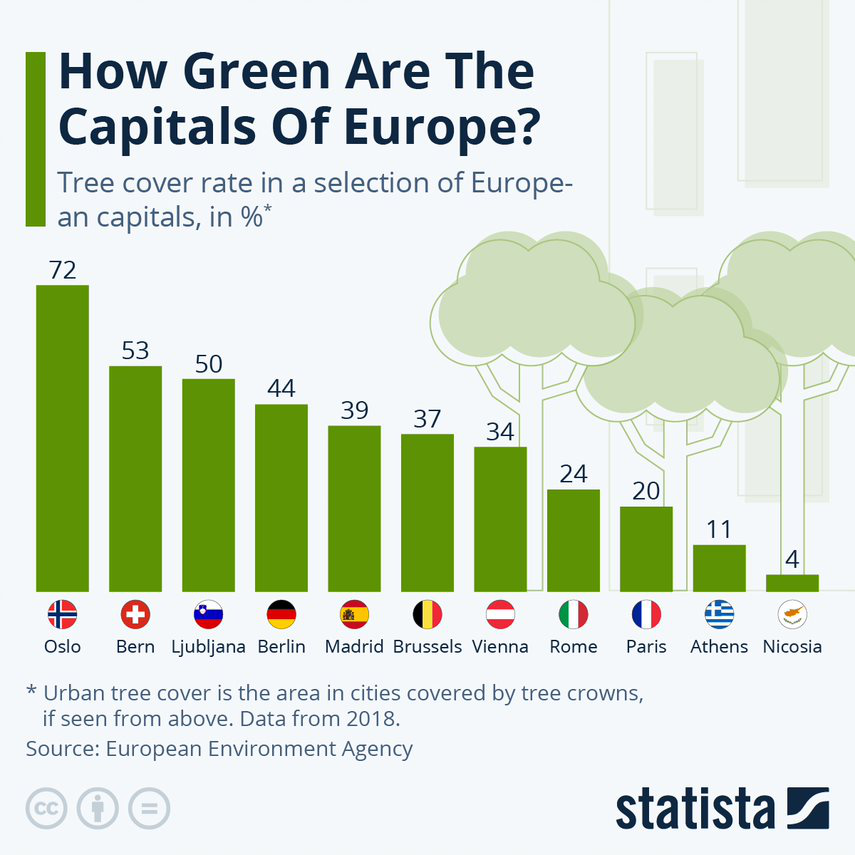
It is surprisingly difficult to rank European cities by greenery. There are many ways of calculating green spaces. There are public parks and forests, but should private gardens also be taken into account for the overall greenery? For big cities are we talking just about the city centre or the whole city with the suburbs?
Here are the 15 greenest cities in Europe by percentage of green spaces.
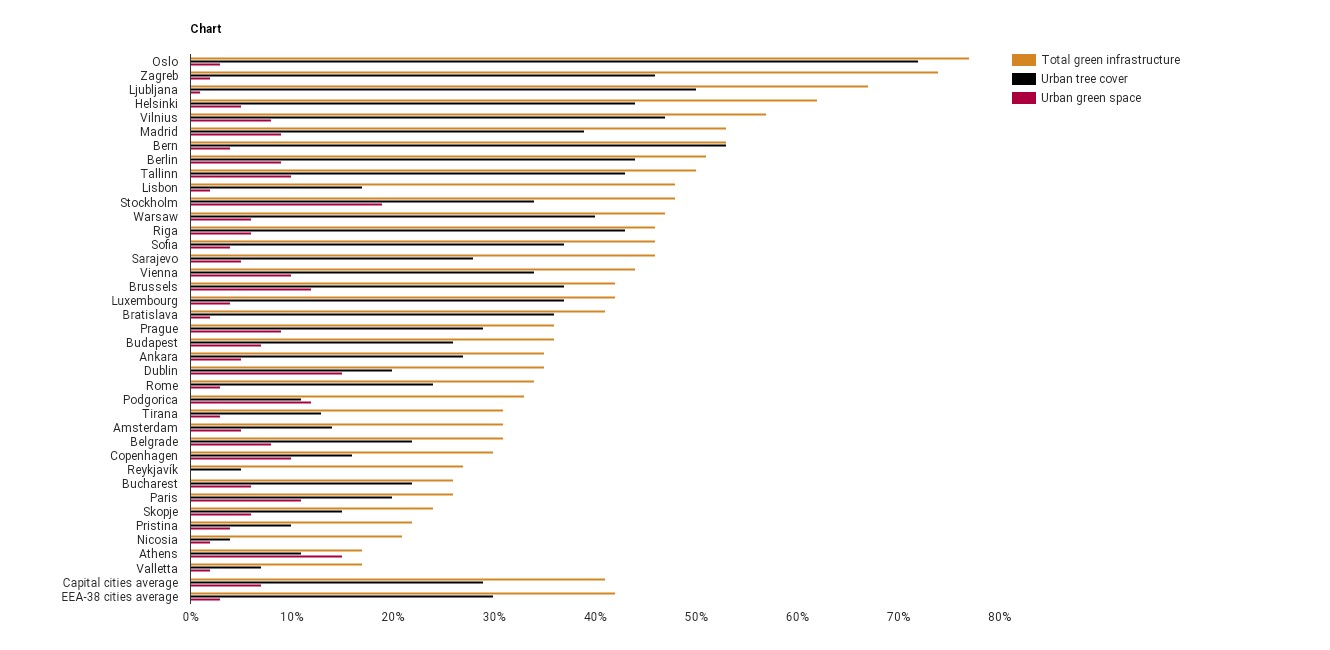
The chart below shows the percentage of total green infrastructure, urban green space, and urban tree cover in the area of EEA-38 capital cities according to the European Environment Agency.
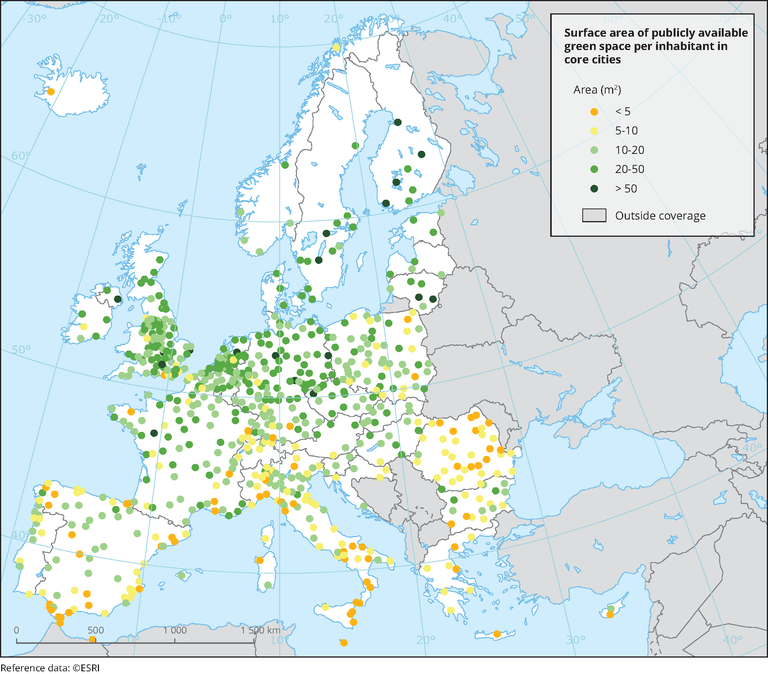
This map shows the surface area of publicly accessible green space per inhabitant across European cities (source: EEA). We can clearly see that the northern half of Europe is much greener than the southern half.
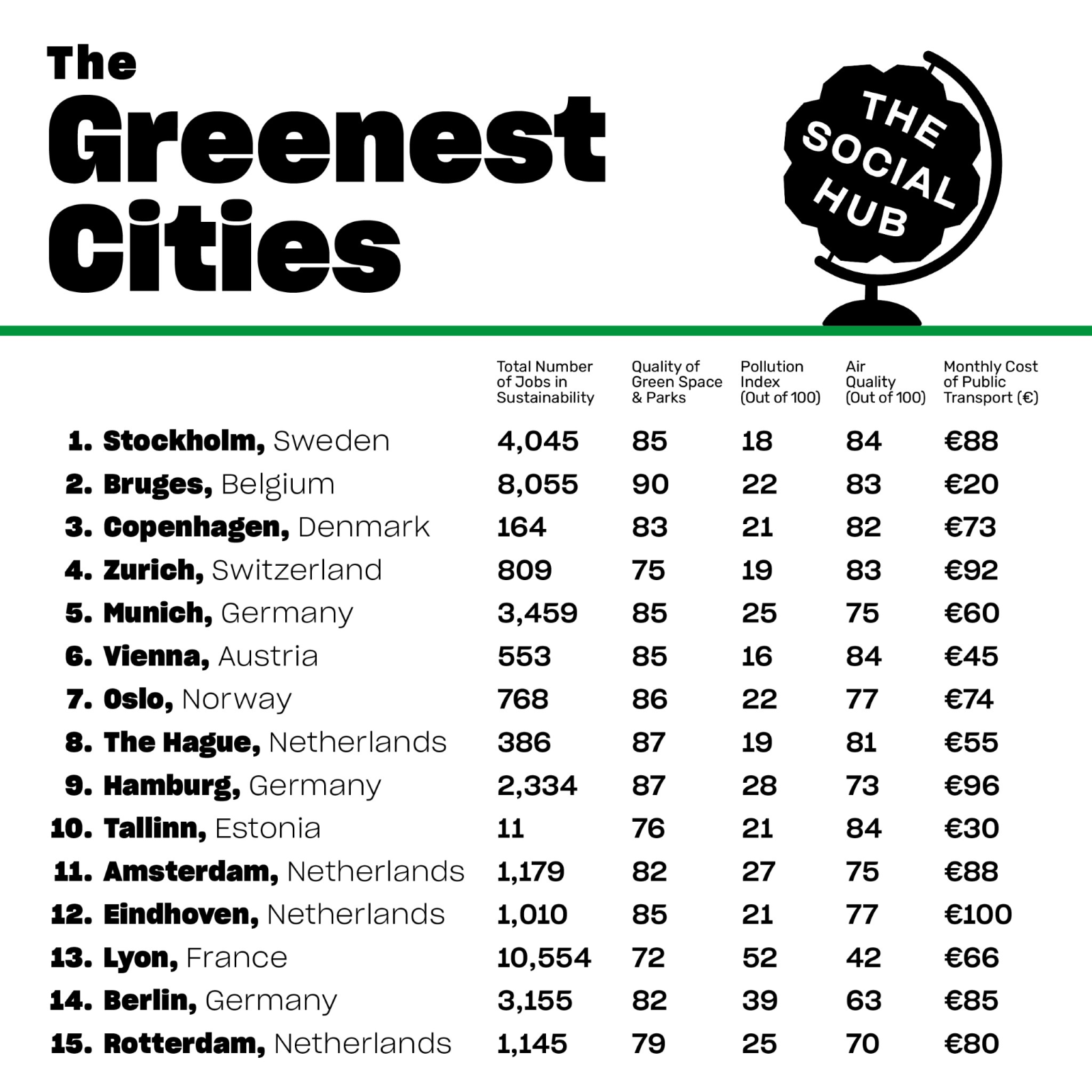
Another way of calculating which cities are the greenest is to take into account the quality of green spaces and parks as well as air quality and pollution. The ranking below went even further by taking into account the total number of jobs in sustainability and the monthly cost of public transport.
Another way of looking at it is to check only the number of public parks. Here is the ranking of large European cities with the highest number of public green parks.
Here are the 15 greenest cities in Europe by percentage of green spaces.
- Oslo, Norway: 72%
- Zagreb, Croatia: 72%
- Helsinki, Finland: 62%
- Vilnius, Lithuania: 57%
- Prague, Czechia: 56%
- Grenoble, France: 55%
- Bern, Switzerland: 53%
- Geneva, Switzerland: 52%
- Ljubljana, Slovenia: 50%
- Gothenburg, Sweden: 48%
- Stockholm, Sweden: 46%
- Madrid, Spain: 45%
- Vienna, Austria: 43%
- Edinburgh, UK: 42%
- Bratislava, Slovakia: 41%
The chart below shows the percentage of total green infrastructure, urban green space, and urban tree cover in the area of EEA-38 capital cities according to the European Environment Agency.
This map shows the surface area of publicly accessible green space per inhabitant across European cities (source: EEA). We can clearly see that the northern half of Europe is much greener than the southern half.
Another way of calculating which cities are the greenest is to take into account the quality of green spaces and parks as well as air quality and pollution. The ranking below went even further by taking into account the total number of jobs in sustainability and the monthly cost of public transport.
Another way of looking at it is to check only the number of public parks. Here is the ranking of large European cities with the highest number of public green parks.
- London - 3,000
- Berlin - 2,500
- Vienna - 2,000
- Hamburg - 1,460
- Paris - 480
- Dublin - 303
- Prague - 200
- Barcelona - 114
- Marseille - 68
- Rome - 63
Last edited:
 : 542m² per capita
 : Around 532m² per capita
 : 410m² per capita
 : About 373m² per capita
 : 357m² per capita
 : 332m² per capita
 : 313m² per capita
 : 235m² per capita
 : 180m² per capita
 : 166m² per capita
 : 135m² per capita
 : 131m² per capita
 : 125m² per capita
 : 120m² per capita
 : 114m² per capita
 : 113m² per capita
 : 109m² per capita
 : 102m² per capita (greenest in France)
 : 99m² per capita
 : 95m² per capita
 : 86m² per capita
 : 66m² per capita
 : 65m² per capita
 : 45m² per capita
 : 45m² per capita
 : 28m² per capita
 : 28m² per capita
 : 27m² per capita
 : 19m² per capita
 : 15m² per capita
 : 12m² per capita
 : 8m² per capita
 : 7m² per capita
 : 7m² per capita
 : 6m² per capita
 : 3m² per capita
 : 3m² per capita
 : 2m² per capita
 : 1m² per capita