• Don't want to see ads? Install an adblocker like uBlock Origin or use a Europe-based privacy-friendly browser like Vivaldi or Mullvad.

What Are Slavic countries?

Yes Poles are indeed of mixed ethnic origins (Slavic, Baltic, Germanic, Celtic, etc., etc.), but probably not as much mixed as Germans. Look for example at Y-DNA - in Poland there is a majority haplogroup (R1a), while in Germany no haplogroup has majority. Germans also in autosomal DNA plot in the middle between neighbouring European populations, which only confirms what Y-DNA says. Of course for example the Irish people are much more homogeneous.

76% of the Irish* have just one specific subclade of just one specific haplogroup, R1b-L21.

*(in a sample of 4700 Irish males, 3575 were R1b-L21, and many more were other subclades of R1b).

Of course however, Slavs got a significant amount of R1a from the Scythians, Sarmatians, Tatars and Turkic-speaking nomads. The Scythinas and Saramatians were already there but the others came later and entered eastern Europe during the Middle Ages. This is why Poles and other Slavs look more "exotic" than the Germans. In fact, I am sure the Slavs and Germans looked very similar until the Asian nomads came and changed the Slavic DNA.
 
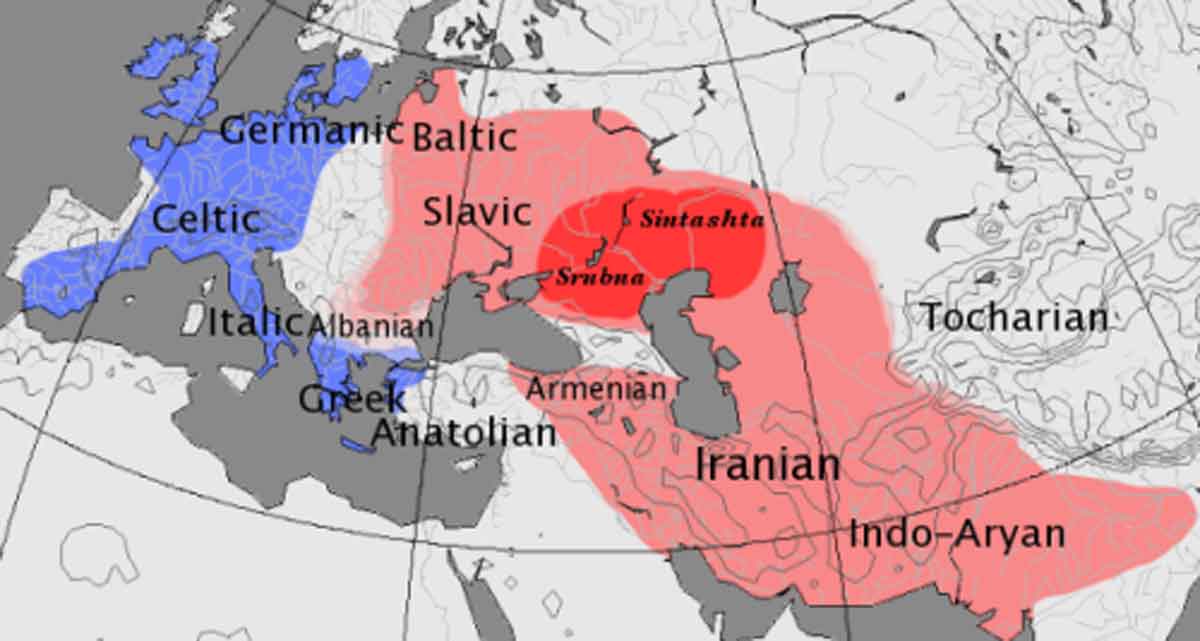
It was originally quite the opposite way than what you have suggested above - R1a in modern Tatar and Turkic speakers originally comes from Indo-Iranians who - during the Copper Age, the Bronze Age and the Early Iron Age - expanded eastward into Asia, from the Proto-Indo-Iranian homeland, the Sintashta-Arkaim culture - which was located in Eastern European part of Russia, between the Volga River, the Ural Mountains, the Caspian Sea, the Aral Sea, the Kara Kum Desert and the Kyzyl Kum Desert.

The Sintashta-Arkaim culture was the earliest phase of the Andronovo culture, which gradually expanded eastward. Before the "Andronovians", the Afanasievo culture had expanded eastward - those were mostly Tocharian-speakers. After them, Indo-Iranians came:

andronovo3.jpg


Indo-Iranians expanded into Asia as far as the Altai-Sayan Mountains and Western Mongolia, where they probably participated in ethnogenesis of Turkic peoples (IMO Turkic peoples could emerge from those Indo-Europeans mixing with local East Asians). Proto-Turkic peoples emerged by the very eastern end of the Indo-European expansion - in Inner Mongolia and North-Eastern China.

It was only later during the Late Iron Age and Medieval times, when Turks expanded westward, absorbing large parts of Indo-European populations - and this is how they acquired R1a (but most of Turkic R1a are different subclades than Slavic R1a, as they split from the Slavic branch of R1a some 5000 years ago, when Proto-Indo-Iranians emerged, and during the next centuries had expanded eastward).

Even those Turkic peoples who live in China - like Uyghurs - are a mixture of Caucasoid and Mongoloid elements. But their language is most closely related to languages of purely Mongoloid peoples - such as Japonic-speakers, Koreanic-speakers, Mongolic-speakers, Tungusic-speakers.

By contrast the Tajiks of China - who share high frequency of R1a haplogroup with Uyghurs, but do not share language with them (Uyghurs speak Turkic, Tajiks preserved their Indo-European language) - show less of Mongoloid admixture, and more closely resemble original Indo-Iranians:

http://www.theapricity.com/forum/sh...-old-tattoos&p=3629015&viewfull=1#post3629015

Pamiri Tajiks are on overall genetics closest to Old Indo-Iranians among modern Indo-Iranian people and have much R1a (mostly around 40% but some isolated "tribes" have more than 60%) but R1a peaks today among Pashtuns and Northwest Indians. If you remove the east asian ancestry from Kazakh and Kyrgyz you get probably almost pure Indo-Iranians and the non-east asian part of them looks like 50% Pamiri Tajik/Pashtun and 50% Russian/Finno-Ugrian.

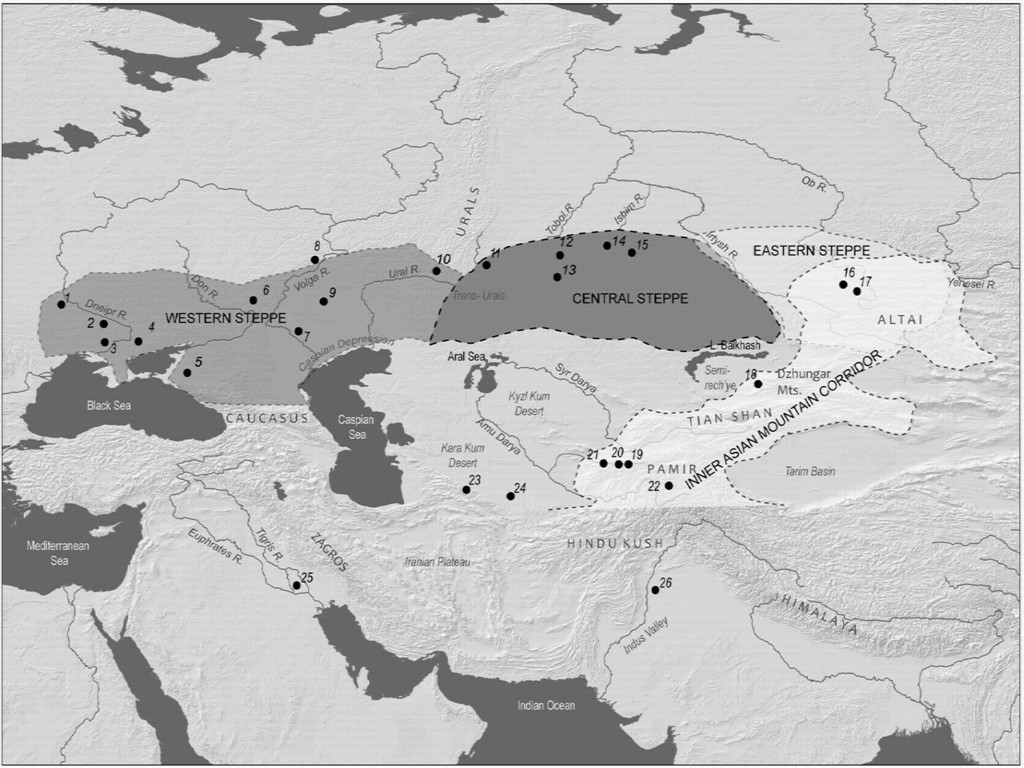
Turkic westward expansion eventually reached the Western steppe (map below) during Late Roman times and the Middle Ages, where they had contact with East Slavic peoples. But Turkic branch of R1a (which itself had been inherited by Turks from Indo-Iranians before), is quite different than the vast majority of Slavic (and European in general) R1a, and - despite sharing a common ancestor known as Z645 - they split as early as 5000 years ago (on the onset of Aryan expansion form the Ural Region nto Asia).

steppe.jpg


All this shows that no more than a few percent of R1a among Slavs might be from Turks (a "back-migration" of R1a from East-Central Asia), because 96% of Slavic R1a belongs to European branch Z283 branch, while 98% of Central Asian and South Asian (including Turkic) R1a belongs to the originally Indo-Iranian - later partially assimilated by expanding Proto-Turks - branch Z93 (this branch is also the most numerous haplogroup in North-Western India, where Aryan influence was the strongest out of all regions of India). Those two branches split 5000 years ago.

Indo-Iranians who lived in western regions of the steppe probably also belonged to Z283, at least large perrcent of them.

Z93 was the predominant branch among those Indo-Iranians, who moved eastward, into Asia.

As for Tatars - Tatars, if I remember correctly, partially share the same subclades of R1a as Slavs, but that's because they got them from Slavs, not the other way around. Genes of modern Tatar-speakers and people who identify as Tatars, are largely European. If anything it seems that Slavs influenced Tatar genetics more than Tatars influenced Slavic genetics. Crimean Tatars also partially descended from local Goths

Here is an ethnic Tatar from Poland-Lithuania, Selim Chazbijewicz:

https://www.youtube.com/watch?v=kQqPf6Dm1NI

 
Most of what you call "exotic" looks among Slavs, probably originates from prehistoric populations of North-Eastern Europe.

From Stone Age hunter-gatherers of North-Eastern Europe - some of them looked like that, as reconstructions show. The video below calls those people "Finno-Ugrians", but in fact they spoke neither Finno-Ugric nor Slavic, because both these languages expanded to that region more recently. They were hunter-gatherers who spoke some unknown language, and were absorbed by both Finno-Ugrians and partially by Balto-Slavs.

As you can see those hunter-gatherers had pretty diverse looks:


You can find this kind of looks also among Scandinavians, especially in northern Scandinavia.

It may seem "exotic" / "unusual", but it is more Prehistoric North-Eastern European than anything else. Not Turkic.

And I'm not saying that ALL of Prehistoric North-Eastern Europeans looked like that, but some of them.
 
As I wrote above, you have also people with this "exotic" looks in Scandinavia:

 
Find also reconstructions of faces of Sintashta and Andronovo (Proto-Aryans and maybe more):

map_sintashta.jpg


Indo-Iranian_origins.png


They looked similar to modern East Slavs. So this facial type is not from Medieval Turkic influence.

==============================

Andronovo man (reconstruction):

7fa9c7187e02.jpg
 
By the way R1b is also common among Turkic-speaking peoples, see for example Bashkirs (they have more R1b than R1a). R1a is not a monolith, just like R1b - there are different subclades, of different origins and distribution.

Certain ethnic groups of Sub-Saharan Africans, for example, have a lot of R1b (12 out of ethnic groups listed in the link below have between 10% and 96% of R1b - but it is R1b-V88, a subclade of R1b that is not present in Europe):

https://en.wikipedia.org/wiki/Y-DNA_haplogroups_by_populations_of_Sub-Saharan_Africa

Y-DNA of a Black African who died on the island of Saint Martin in ca. 1660-1688 turned out to be R1b (link):

http://www.pnas.org/content/112/12/3669.full.pdf
 
And you claim that it wasn't?

It took the Franks (later the Germans that emerged from Eastern Francia) about 500 - 600 years to completely conquer all areas to the east of the Oder-Neisse line (or the present-day border of Germany). By contrast conquering the Saxons (who were also Pagans until they were forcibly converted by the Franks) took only several decades. You claimed that first evidence of Slavs in East Germany and Austria is from the 700s, but that's not true (see below - first archaeological evidence is from ca. 550-600, first written sources from the 600s). And when the Obodrites and the Veleti were first mentioned, they were already strong established tribal unions, so they must have existed for some time before that.

Below is the early timeline of the history of Slavs in Germany - until Charlemagne's death. From Charlemagne's death it took about 400 more years to conquer them (but for example the Veleti and the Obodrites were conquered by Germans already in 963, but in 983 they started the Great Slav Rising and became independent again - following that Great Slav Rising they were independent for the next 200 years, until 1150-1200, some of them even longer up to 1250, when Germans finally captured all areas to the west of the Oder-Neisse line, the present-day border of Germany):

http://en.wikipedia.org/wiki/Great_Slav_Rising

Early timeline of Slavs in Germany (until Charlemagne's death in 814; the next period from 814 to 1250 was even more interesting). Slavic colonization of what is now East Germany (and what used to be part of West Slavdom before the Northern Crusades) started in the 6th century.

Here is the timeline of the earliest phase of history of Slavs in Germany, from the beginning of historical record until the death of Charlemagne:

⦁ 512 - the Heruli migrate from middle Danube to North Germany and encounter territories already inhabited by Slavs on their way there (source: Procopius)
⦁ 6th century - Slavic settlement at Prague, Bohemia, numbers over 600 houses: http://www.archaeobotany.org/download/posters/novak_roztoky_abstract_whv2010.pdf
⦁ ca. 550 - Slavs start migrating into what is now East Germany
⦁ 595 - Slavs (probably ancestors of Slovenes or / and Croats) fight against Frankish-dependent Bavarian duke Tassilo in modern Austria and Bohemia
⦁ 596 - Slavs, probably allied with the Avars, defeat the Bavarians under Tassilo, killing 2,000 of them
⦁ 610 - battle of Aguntum (4 km to the east of present-day Lienz), Bavarians finally stop Slavic westward expansion in this region (source: Paul the Deacon)
⦁ 620s - a major war between Slavs and Avars (who had previously been allies)
⦁ 624 - a smuggler of weapons from the Frankish Empire, Samo (born near Sens at the Yonne river in central France), who had previously been illegally smuggling across the border and selling weapons to Slavs, enters Slavic lands, joins Slavs in their fight against the Avars, and due to his merits in battle, united Slavic tribes elect him their king (source: Fredegar's chronicle). Samo was probably a Gallo-Roman.
⦁ 630 - Walluk, duke of Carantanians (northern Slovenes), joins Samo's Federation.
⦁ 631 - Slavic Federation defeats the Frankish Empire in the battle of Wogastisburg
⦁ 631 - after the victory at Wogastisburg Slavic armies invade and plunder Thuringia
⦁ 632 - Dervan, duke of Surbi (Sorbs) joins the Slavic Federation under king Samo
⦁ 636 - Dervan is killed in one of battles against Randulf, governor of Thuringia
⦁ 661 - the federation disintegrates into many realms again after Samo's death. According to Fredegar's chronicle Samo had 12 Slavic wifes, 22 sons and 15 daughters.
⦁ 772 - Charlemagne invades Southern Saxons (who are Pagans)
⦁ 777 - the conquest of Southern Saxons by the Franks is completed
⦁ 780 - first Frankish contact with the Slavic Obodrites at the Middle Elbe
⦁ 782 - Slavic Sorbs raid and plunder Thuringia and Frankish-controlled Saxony
⦁ 782 - Saxon uprising against Franks, led by Saxon duke Widukind. Obodrites side with Franks
⦁ 785 - uprising squashed, Widukind surrenders and agrees to convert to Christianity in Attigny
⦁ 789 - Wieczan (Witzan) becomes the supreme duke (rex / princeps) of Obodrites
⦁ 789 - Obodrites mentioned as "old good allies" of Charlemagne (against Saxons)
⦁ 789 - Wieczan asks Charlemagne for assistance against his troublesome eastern neighbours, the Holy Union of the Veleti, under supreme duke Drogowit.
⦁ 789 - Charlemagne, allied with Frisians, Sorbs and Obodrites (under duke Wieczan), invades Veleti. Frankish army crosses the Elbe near modern Wolmirstadt. Allied forces besiege Brenna, the main stronghold of Veleti duke Drogowit. Seeing that resistance is pointless, Drogowit negotiates peace. Veleti pay a single tribute to Charlemagne. Charlemagne satisfied with tribute returns back to Francia.
⦁ 795 - Obodrite duke Wieczan (dux Witzan), ally of Franks against Nordalbingians (northernmost Saxon tribe, who remain independent from Frankish rule).
⦁ 795 - at the Elbe near Bardowick Nordalbingians ambush Obodrites, killing Wieczan
⦁ ca. 796 - Drozko elected new rex / princeps of the Obodrites. Drozko has a son named Czedrog (Chedrog). Drozko continues pro-Frankish policies of Wieczan and Charlemagne is his ally. Danes, Northern Saxons and Veleti are his enemies.
⦁ 795-798 - in revenge for Wieczan's death, Charlemagne raids Nordalbingians and carries out first forcible population transfers and deportations of Saxons.
⦁ 798 - battle of Swentana (Bornhöved) between Obodrites under Drozko and Nordalbingians (at the same time Charlemagne's army is near Minden, raiding Ostphalia). Obodrites win. About 3 - 4 thousand Saxons perish.
⦁ 799 - son of Charlemagne mediates in conflict between Obodrites and Veleti
⦁ 804 - conquest of Nordalbingians by Franks (with Veleti help) is completed, forcible deportation of over 10,000 Nordalbingian men, with families, to Gaul.
⦁ 804 - in Hollenstedt at the Elbe Drozko is crowned King by Charlemagne, he is also awarded Nordalbingia, which becomes part of the Slavic Obodrite realm (sources: Ann. Regni Francorum a 804, Chron. Moiss a 804). Archaeological evidence of Slavic settlements and Slavic pottery in Nordalbingia discovered in Hamburg and in Domplatz, dated to 8th-9th centuries (R. Schindler connects these with Drozko's reign).
⦁ ca. 805 - Charlemagne fortifies Frankish-Slavic border (limes sorabicus and limes saxonicus) and establishes permanent military posts along it. He introduces capitulare duplex in 805 - a kind of embargo for export of weaponry to Slavic lands (including even his allied Obodrites). Several places are chosen for trade with Slavs.
⦁ 805 - Franks invade the Sorbian-Lusatian tribe of the Glomaci
⦁ 805 - duke Lecho of the Bohemians (Czechs) dies in battle against Charlemagne
⦁ 806 - Sorbs (Siurbs) agree to pay tribute to Charlemgne after their duke - Miliduch (Milidouch / Milito) - is killed in a battle against Franks near modern Halle.
⦁ 808 - Drozko, king of the Obodrites. Godelaib, one of their minor dukes.
⦁ 808 - the Danes under duke Godfred (his realm is in Jutland), allied with the Veleti, invade the Obodrite realm (Jutland had previously become a refuge for Saxon refugees during Frankish-Obodrite invasions of Nordalbingia). Danes and Veleti manage to capture several Obodrite strongholds in the process.
⦁ 808 - at least two out of member-tribes of the Obodrite realm, Smolincy and Linianie, betray and unite with Danish-Veleti army. King Drozko is forced to abandon his realm and escapes to Francia. Godelaib is captured and executed. Godfred annexes Nordalbingia, two other Obodrite provinces - Obodrsko and Wagria - pay tribute.
⦁ 808-809 - Veleti wage offensive war against Obodrites and then against Franks
⦁ 808 - Charlemagne sends his son to crush the Veleti and Obodrite traitors, but he is defeated and has to retreat. Godfred proposes peace to Charlemagne, negotiations take place in Bandenflut at the Stör River, but they fail and war continues on.
⦁ 809 - Drozko returns from exile to his country. He signs truce with Danes in exchange for giving them one of his sons (maybe Chedrog) as a hostage. He allies with Saxons against Veleti and these Obotrite trines which seceded from his realm. Allied Obodrite loyalists and Saxons besiege a stronghold of Smolincy at Connoburg. The stronghold is captured and destroyed, power over rebellious tribes is restored.
⦁ 809 - Godfred violates the truce and invades Obodrites, he demolishes Slavic coastal town at Rerik (near modern Wismar), and deports local merchants to Haithabu (Hedeby), Denmark. Drozko is killed by Danish assassins at Rerik.
⦁ 809 - after the death of Drozko Charlemagne deprives the Obodrites of Nordalbingia (land of Northern Saxons) and incorporates it to his Empire. The land is depopulated due to war, disease and deportations, so he brings in new settlers from entire Empire. Charlemagne establishes three new castles to strengthen the defence of his borders: first is at Eselfeld at the Stör River, second is at Hamburg, third is at Hochbucki near Lenzen at the Elbe.
⦁ 810 - Veleti attack the Frankish Empire and destroy their new castle at Hochbucki
⦁ 812 - Franks and Obodrites (under their new grand duke, Slavomir) in retaliation invade Veleti territories and manage to force them to pay a tribute.
⦁ 813 - coronation of Louis I by Charlemagne in Aachen.
⦁ 814 - death of Charlemagne, Louis I takes power in the Empire. Those of Slavic tribes which had been paying tribute to Charlemagne, stop paying it.
As far as I remember the population of what is now Germany numbered no more that 4 million. You have some reliable information: how many lived there? I know the Germans outnumbered the Slavs in that area. However, 1 million seems too high. Either way if the Slavs were so numerous why dis the Saxons conquer them relatively fast? The Saxons only numbered around half million? I know the first phase was started in the 9th century and it ended in the 12th century. Do you know the phases of conquest? This is very similar to the Christians in Iberia conquering the Moors.
 
It was originally quite the opposite way than what you have suggested above - R1a in modern Tatar and Turkic speakers originally comes from Indo-Iranians who - during the Copper Age, the Bronze Age and the Early Iron Age - expanded eastward into Asia, from the Proto-Indo-Iranian homeland, the Sintashta-Arkaim culture - which was located in Eastern European part of Russia, between the Volga River, the Ural Mountains, the Caspian Sea, the Aral Sea, the Kara Kum Desert and the Kyzyl Kum Desert.

The Sintashta-Arkaim culture was the earliest phase of the Andronovo culture, which gradually expanded eastward. Before the "Andronovians", the Afanasievo culture had expanded eastward - those were mostly Tocharian-speakers. After them, Indo-Iranians came:

andronovo3.jpg


Indo-Iranians expanded into Asia as far as the Altai-Sayan Mountains and Western Mongolia, where they probably participated in ethnogenesis of Turkic peoples (IMO Turkic peoples could emerge from those Indo-Europeans mixing with local East Asians). Proto-Turkic peoples emerged by the very eastern end of the Indo-European expansion - in Inner Mongolia and North-Eastern China.

It was only later during the Late Iron Age and Medieval times, when Turks expanded westward, absorbing large parts of Indo-European populations - and this is how they acquired R1a (but most of Turkic R1a are different subclades than Slavic R1a, as they split from the Slavic branch of R1a some 5000 years ago, when Proto-Indo-Iranians emerged, and during the next centuries had expanded eastward).

Even those Turkic peoples who live in China - like Uyghurs - are a mixture of Caucasoid and Mongoloid elements. But their language is most closely related to languages of purely Mongoloid peoples - such as Japonic-speakers, Koreanic-speakers, Mongolic-speakers, Tungusic-speakers.

By contrast the Tajiks of China - who share high frequency of R1a haplogroup with Uyghurs, but do not share language with them (Uyghurs speak Turkic, Tajiks preserved their Indo-European language) - show less of Mongoloid admixture, and more closely resemble original Indo-Iranians:

http://www.theapricity.com/forum/sh...-old-tattoos&p=3629015&viewfull=1#post3629015

Turkic westward expansion eventually reached the Western steppe (map below) during Late Roman times and the Middle Ages, where they had contact with East Slavic peoples. But Turkic branch of R1a (which itself had been inherited by Turks from Indo-Iranians before), is quite different than the vast majority of Slavic (and European in general) R1a, and - despite sharing a common ancestor known as Z645 - they split as early as 5000 years ago (on the onset of Aryan expansion form the Ural Region nto Asia).

All this shows that no more than a few percent of R1a among Slavs might be from Turks (a "back-migration" of R1a from East-Central Asia), because 96% of Slavic R1a belongs to European branch Z283 branch, while 98% of Central Asian and South Asian (including Turkic) R1a belongs to the originally Indo-Iranian - later partially assimilated by expanding Proto-Turks - branch Z93 (this branch is also the most numerous haplogroup in North-Western India, where Aryan influence was the strongest out of all regions of India). Those two branches split 5000 years ago.

Indo-Iranians who lived in western regions of the steppe probably also belonged to Z283, at least large perrcent of them.

Z93 was the predominant branch among those Indo-Iranians, who moved eastward, into Asia.

As for Tatars - Tatars, if I remember correctly, partially share the same subclades of R1a as Slavs, but that's because they got them from Slavs, not the other way around. Genes of modern Tatar-speakers and people who identify as Tatars, are largely European. If anything it seems that Slavs influenced Tatar genetics more than Tatars influenced Slavic genetics. Crimean Tatars also partially descended from local Goths

Here is an ethnic Tatar from Poland-Lithuania, Selim Chazbijewicz:

Yes I am aware of the Indo-Iranian speakers emigrated from somewhere in southern Russia and went south and east. That is obvious. They created the Skythians, Aryans, and Tocharians and others. But you seem to forget that the Indo-Iranians DID mix with the Mongols in the eastern parts of Kazakhstan and NW China (Altai region) and created the "Turks." There is genetic evidence of European males and Mongoloid females in burials all along the area I just mentioned. So you contradicted yourself: You said:
" Indo-Iranians expanded into Asia as far as the Altai-Sayan Mountains and Western Mongolia, where they probably participated in ethnogenesis of Turkic peoples (IMO Turkic peoples could emerge from those Indo-Europeans mixing with local East Asians). Proto-Turkic peoples emerged by the very eastern end of the Indo-European expansion - in Inner Mongolia and North-Eastern China. It was only later during the Late Iron Age and Medieval times, when Turks expanded westward, absorbing large parts of Indo-European populations - and this is how they acquired R1a (but most of Turkic R1a are different subclades than Slavic R1a, as they split from the Slavic branch of R1a some 5000 years ago, when Proto-Indo-Iranians emerged, and during the next centuries had expanded eastward)."
BUT the Turks had already absorbed a lot of R1a before they returned to Europe as Huns, Khazars, Bulgars, and Avars. Yes they married lots of European females, especially from R1a cultures, and this was later transferred into the Slavs. Do you know how much Turkish DNA is found in Slavs?
You are also putting too much emphasis on DNA. Y haplos do not determine race. Lets use our imagination for a bit: I am I2a1. Does this mean I am a Sardanian? I dont have any ancestors that I can recall that came from there or the Balkans. Lets go further: Imagine thousands of years ago one of my ancestors carried the I2a1 and married a Nordic woman whose ancestors carried R1b, I1, and R1a. The result would be 1/2 I2a1 and 1/2 R1b, I1, R1a. Lets say that the males from this union married into other kinds of women with J1 or E1b1, or L DNA. Does this mean the I2a1 determines the phenotypes of the descendants? They might carry this marker but their race would be different. Just because you have R1a does not make all Slavs Slavs. It could be Turkish or Indo-Iranian mix. All I am saying is you are taking genetics as gospel -- the panacea of all knowledge. I believe its not so. History proves sometimes its otherwise.

By the way the "Tatar" man on the video proves my point. he might be "Tartar" but he has very little Asian in him. He looks totally like a Pole.
 
Most of what you call "exotic" looks among Slavs, probably originates from prehistoric populations of North-Eastern Europe.

From Stone Age hunter-gatherers of North-Eastern Europe - some of them looked like that, as reconstructions show. The video below calls those people "Finno-Ugrians", but in fact they spoke neither Finno-Ugric nor Slavic, because both these languages expanded to that region more recently. They were hunter-gatherers who spoke some unknown language, and were absorbed by both Finno-Ugrians and partially by Balto-Slavs.

As you can see those hunter-gatherers had pretty diverse looks:


You can find this kind of looks also among Scandinavians, especially in northern Scandinavia.

It may seem "exotic" / "unusual", but it is more Prehistoric North-Eastern European than anything else. Not Turkic.

And I'm not saying that ALL of Prehistoric North-Eastern Europeans looked like that, but some of them.

And whats the difference whether the Slavs get it from Finno-Uralic or Tatars/Turks/Mongols???? It still gave them that "exotic" look. I know from looking at Edupedia DNA the Russians have a almost 25% of Finno-Uralic DNA and this is what makes them seem Mongoloid. But most of the other Slavs also have this "exotic" look. We also need to remember that the Ukrainian Kossaks were half Tatar in the beginning before they mixed with the Ruthenians. Note the Lithuanians, Latvians, and Estonians. They have considerable N DNA. The Finns seem not to be European at all!!! Poland is not like Russia and Ukraine has no N. Nevertheless the R1a is also coming form the Asiatic or Turkish speaking peoples.

DNA of Europe
European I R1a R1b N T G J2 J1 E1 Q

Finland * 29 + 5 + 4 + 61+ 0 = 99% 0 + 0 + 0 + 1 + 0 = 1%
Latvia * 8 + 40 + 12 + 38 + 1 = 99% 0 + 0 + 0 + 0 + 1 = 1%
Lithuania* 13 + 38 + 5 + 42 + 1 = 99% 0 + 0 + 0 + 1 + 0 = 1%
Norway 36 + 26 + 32 + 3 + 0 = 97% 1 + 0 + 1 + 1 + 0 = 3%


Estonia* 19 + 32 + 8 + 34 + 4 = 97% 0 + 1 + 0 + 2 + 0 = 3%

Belarus * 24 + 51 + 7 + 10 + 0 = 92% 1 + 2 +1 + 4 + 0 = 8%

Poland 16 + 58 + 13 + 4 + 1 = 92% 1 + 2 + 0 + 4 + 1 = 9%
Russia * 16 + 46 + 6 + 23 + 2 = 93% 1 + 3 + 0 + 2 + 1 = 7%
Sweden 42 + 16 + 22 + 7 + 0 = 87% 1 + 3 + 0 + 3 + 3 = 10%

Slovakia 24 + 42 + 15 + 3 + 1 = 85% 4 + 2 + 1 + 7 + 1 = 15%
Germany 22 + 16 + 45 + 1 + 1 = 85% 5 + 4 + 0 + 5 + 1 = 15%
Ukraine* 18 + 45 + 8 + 8 + 1 = 80% 3 + 7 + 1 + 6 + 1 = 18%

Czechs 24 + 34 + 21 + 1 + 1 = 81% 5 + 6 + 0 + 6 + 2 = 19%
Switzerland 24 + 4 + 50 + 1 + 1 = 80% 7 + 3 + 1 + 7 + 2 = 20%

Croats 44 + 24 + 9 + 0 + 1 = 78% 3 + 6 + 1 + 10 + 2 = 22%
Bosnians (All) 59 + 15 + 4 + 2 + 1 = 81% 1+ 4 + 0 + 12 + 2 = 19%

Serbia* 42 + 16 + 8 + 2 + 1 = 69% 2 + 8 + 1 + 18 + 2 = 31%

Bulgaria* 26 + 17 + 11 + 1 + 2 = 56% 5 + 11 + 3 + 24 + 1 = 44%

Sorry for the distortion. I tried to fix it but the format is messed up. But you can see the N and Q if you count the columns.
 
Find also reconstructions of faces of Sintashta and Andronovo (Proto-Aryans and maybe more):

map_sintashta.jpg


Indo-Iranian_origins.png


They looked similar to modern East Slavs. So this facial type is not from Medieval Turkic influence.

==============================

Andronovo man (reconstruction):

7fa9c7187e02.jpg

This face looks strikingly more Nordic than Slav or other Europeans. He looks like a German from NE Germany or a Celt, or a Swede.

By the way the map on top showing the blue color has errors. The Celts never occupied the south or eastern part of Iberia. It was the Iberians. So the language never reached there.
 
The Sintashta-Arkaim culture was the earliest phase of the Andronovo culture, which gradually expanded eastward. Before the "Andronovians", the Afanasievo culture had expanded eastward - those were mostly Tocharian-speakers. After them, Indo-Iranians came:

andronovo3.jpg


Even those Turkic peoples who live in China - like Uyghurs - are a mixture of Caucasoid and Mongoloid elements. But their language is most closely related to languages of purely Mongoloid peoples - such as Japonic-speakers, Koreanic-speakers, Mongolic-speakers, Tungusic-speakers.

By contrast the Tajiks of China - who share high frequency of R1a haplogroup with Uyghurs, but do not share language with them (Uyghurs speak Turkic, Tajiks preserved their Indo-European language) - show less of Mongoloid admixture, and more closely resemble original Indo-Iranians:


steppe.jpg


All this shows that no more than a few percent of R1a among Slavs might be from Turks (a "back-migration" of R1a from East-Central Asia), because 96% of Slavic R1a belongs to European branch Z283 branch, while 98% of Central Asian and South Asian (including Turkic) R1a belongs to the originally Indo-Iranian - later partially assimilated by expanding Proto-Turks - branch Z93 (this branch is also the most numerous haplogroup in North-Western India, where Aryan influence was the strongest out of all regions of India). Those two branches split 5000 years ago.

Indo-Iranians who lived in western regions of the steppe probably also belonged to Z283, at least large perrcent of them.

Z93 was the predominant branch among those Indo-Iranians, who moved eastward, into Asia.

Last year I worked in Urumqi, China and saw a lot of Uygurs and some Tajiks. The Uygurs look very Asiatic (Mongolid) but some looked like Middle Easterners and would pass for Iraqis or Sicilians. However, the Tajiks looked very European. A Polish teacher who worked with me in Beijing went to Kashgar on a holiday and when he came back he told me he saw a lot of blond-haired children in a school and it seemed like he was in Europe. When you see a Tajik that does not look European, they almost always looked Middle Eastern or like Afghans. What is the DNA of Tajiks? Z93? Some Tajiks could easily pass for Austrians or Swiss, especially the mountain Tajiks. The low land Tajiks look either mongoloid or Middle Eastern.
 
By the way R1b is also common among Turkic-speaking peoples, see for example Bashkirs (they have more R1b than R1a). R1a is not a monolith, just like R1b - there are different subclades, of different origins and distribution.

Certain ethnic groups of Sub-Saharan Africans, for example, have a lot of R1b (12 out of ethnic groups listed in the link below have between 10% and 96% of R1b - but it is R1b-V88, a subclade of R1b that is not present in Europe):

https://en.wikipedia.org/wiki/Y-DNA_haplogroups_by_populations_of_Sub-Saharan_Africa

Y-DNA of a Black African who died on the island of Saint Martin in ca. 1660-1688 turned out to be R1b (link):

http://www.pnas.org/content/112/12/3669.full.pdf

Yes it fascinating to see that so much R1b is with the Bashkirs. Isn't it something like 40%? Anyway all Tocharian mummies tested some had R1b but the majority had R1a. This means the Andranovo culture must had had a mix of R1a and R1b. I also read the Tocharians spoke a Kentum dialect in the beginning but then changed to Sentum later??? This perhaps a later invasion of Indo-Iranians? Which one spoke a Kentum dialect? Tocharian A and B?
 
image

Figure 2. Spatial frequency distribution maps of East Eurasian lineages.
A- Pre-Iron Age period; B- Iron Age period. Frequency values and detailed information for populations 1–8 are shown in table 3. 1- Mongolia (Altai), 2- Gorny Altai, 3- West Kazakhstan, 4- Central Kazakhstan, 5- South Kazakhstan, 6- East Kazakhstan, 7- SW Siberia, 8- Mongolia (Egyin Gol).
doi:10.1371/journal.pone.0048904.g002

image

"Tracing the Origin of the East-West Population Admixture in the Altai Region (Central Asia)"

This clearly shows that by the Iron Age most of the Europeans in Central Asia had become "mestizos". During the Bronze Age the Saka had reached all the way into W China and the Altai region. They then mixed with Mongoloid women (and probably men) and the Mongoloid DNA had spread with the Saka and other possible Turkish-speaking tribes into Russia. So we can conclude that during by the start of the Iron Age two types of Indo-Iranians lived in the steppes: 1) the European Skythians and Sarmatians and the hybrids (mestizos) possibly of Turkish speaking descendants of the Saka. The Saka had clearly mixed with Mongoloid people throughout the time they roamed Kazakhstan. And this predates the time of the Huns and other Turkish speakers. So these nomads already lived so close to Europe they eventually mixed with the Slavs.

By the way the "authentic" Turks and Mongols were originally very backward and they seem to have copied everything from the Indo-Iranians and converted their culture into the Skythian. Typical of Asians. Nothing changes.
 
Last edited:
Eastern (Lithuanian) Poles (if you've been to so many countries, I wonder who do you find most similar):

https://www.youtube.com/watch?v=Sfg4Xo6zpDM


I am not sure what you mean: similar to Germans? If so I would say about 10% tops. This was filmed in Vilnius, right? I visited there once several years ago. How many Poles live in Lithuania? Do they get along with the Lithuanians? is there much mixing? When I was there I thought Lithuanians looked much closer to Germans than Poles. But thats my perception. If you wanted specifics -- the conductor at the beginning, blonde girl with camera, girl with yellow shirt, a guy with glasses and with a boy on top being interviewed, blond lady with a child on carriage, two blonde little girls being interviewed, old man with hat, and blond girl with dog.

By the way, whats with the Black Madonna? I remember seeing her everywhere in Poland and Lithuaunia.
 
in the earliest phase of the Slavic Crusade, expulsions indeed took place.

Many of those Slavs from what is now East Germany, expelled from their homeland by the Germans during the 12th century, escaped eastward to the Polish realm, where they melted into Polish people. One such region about which we know for sure, that it was ethnically cleansed of Slavs through expulsion, was Wagrien (Wagria). But - as I also wrote before - some Slavs were allowed to stay there

This is exactly what I was saying in the previous posts but you kept saying that there must have been a lot of mixing between Slav and Saxons, which implies many stayed. According to the definition of ethnic cleansing it does not only involve mass killings but also mass deportations and elimination of the culture. This does not mean all people are killed or expelled. Many people in this blog seem to think when I state "ethnic cleansing" that it was like what the Nazi tried to do with the Jews. I am certain some Slavs were allowed to stay and eventually assimilated but they were kept in a state of apartheid for a long time and given the worst lands. Many German peasants were brought in order to develop the land. So -- like I said before -- the Slav population would have suffered from reduced numbers by neglect and being made second class citizens. This is what the German authors and other historians said. I might be 'biased" but its not my fault: I learned from the winners. You are giving me the "loser" perspective and that is good. I am trying to get a balanced perspective. However, now after all this massive information that you have given me you agree??? Whats going on?

By the way how can 1 million Slavs live in an area of East Germany, which is roughly the size of Moldova (30-32,000 mi2)? Given that there was much underdevelopment and too much forests, how can people in such numbers sustain themselves? What? 25-30 person per square mile and all that forest and underdeveloped land??? How will they eat??? I would say they numbered around 300,000.
230px-West_slavs_9th-10th_c..png


I dont see the Wagrians listed here. Do you have a better map showing all the Slavic tribes?
 
Last edited:
No of Tocharian mummies had R1b.

At first 7 were tested and all 7 were R1a, then 4 more and in total 11 had R1a and one had K*.

What is the DNA of Tajiks? Z93?

45% have R1a (Z93 I guess) and over 18% have J (probably J2, IIRC).

=================

As for that Andronovo Proto-Aryan guy.

You are mistaken, he was clearly of Baltid (East Baltic) anthropological type:

http://www.theapricity.com/forum/sh...ssify-this-Andronovo-guy-and-this-Yamnaya-guy

He is not Nordid at all. But both Baltid and Nordid types are frequent among Slavs.

=================

The rest of my answers later because now I don't have time.
 
Last edited:
I tried a million times to paste the results of my poll but it does not allow it. I have a piece of shit computer. So that is probably why. All I can tell you is that your methodology was faulty. 1) you chose men and women from middle age to very old age. As anyone knows when people age they tend to look more and more similar. 2) You chose women who wear glasses, with studio pictures, and make up. We know that women put on make up in order to hide their appearance or to look better or different. So this makes it very hard to tell the difference. 3) Men with suits and ties also distort their real looks.

It would have been much better if you used a sample from ages 18-45 and with no professional suits or studio pictures. You should know that studios distort the look so as to seduce you.

I can show you the results of my poll. Perhaps you can help?
 
No of Tocharian mummies had R1b.

At first 7 were tested and all 7 were R1a, then 4 more and in total 11 had R1a and one had K*.


45% have R1a (Z93 I guess) and over 18% have J (probably J2, IIRC).

=================

As for that Andronovo Proto-Aryan guy.

You are mistaken, he was clearly of Baltid (East Baltic) anthropological type:

http://www.theapricity.com/forum/sh...ssify-this-Andronovo-guy-and-this-Yamnaya-guy

He is not Nordid at all. But both Baltid and Nordid types are frequent among Slavs.

=================

The rest of my answers later because now I don't have time.

OK I grant you that the guy might be Baltic -- but dont you think that Balts and Germans look very similar? And why do you take the opinions of a Pole (who is biased) and an Italian and conclude that that is a "Balt!" Talk about biased opinons?
 
No of Tocharian mummies had R1b.
As for that Andronovo Proto-Aryan guy.

You are mistaken, he was clearly of Baltid (East Baltic) anthropological type:

http://www.theapricity.com/forum/sh...ssify-this-Andronovo-guy-and-this-Yamnaya-guy

I humbly would disagree with that classifcation. I don't see any baltid features in him, except maybe his strong brachycephaly, but even that is not uniquely baltid. I'm not sure how to classify him, but he looks at least slightly "falian".
And the second guy is not at all baltid for sure.
But I'm no expert, just hobbyist.
 
I humbly would disagree with that classifcation. I don't see any baltid features in him, except maybe his strong brachycephaly, but even that is not uniquely baltid. I'm not sure how to classify him, but he looks at least slightly "falian". And the second guy is not at all baltid for sure. But I'm no expert, just hobbyist.

I agree. He has a round head -- typical of Slavs. But he looks more possibly Italo-Celtic or maybe just Celtic. The second guy clearly looks Italian of the very ancient sort.
 
Back
Top