• Don't want to see ads? Install an adblocker like uBlock Origin or use a Europe-based privacy-friendly browser like Vivaldi or Mullvad.

What Are Slavic countries?

Johannes said:
I told you already that the Slavs were attacked and conquered during the 9th and up to 12th centuries. The were almost ethnically cleansed.

That was far more complex. In some areas there was ethnic cleansing (for example in Wagrien), but in most areas - not.

And even in Wagrien - which was, according to written sources, utterly devastated - after the conquest some Slavs remained, because Germans brought in priests to convert Wagrian Slavs to Christianity. One of those missionaries was Helmold of Bosau:

https://en.wikipedia.org/wiki/Helmold

Moreover, until the 12th century Germans conquered only areas to the west of the Oder-Neisse Line (current German eastern border). German expansion into areas located to the east of the current German-Polish border started only in the 13th century.

And in some places there was no military expansion, but only immigration of German settlers to Slavic-inhabited areas.

Lower Silesia for example was never conquered, but Polish rulers of that region let in German immigrants to settle there.

Polish rulers also let in German immigrants to other parts of Poland - but those became assimilated (Polonized) over time.

In Lower Silesia, however, local Polish dukes "betrayed", adopting German culture and language. When Poland was fragmented into semi-independent duchies (all ruled by the same - Piast - dynasty, but civil wars were frequent in that period), some dukes tended to lean politically towards foreign realms (Bohemia and the HRE), and some of them slowly alienated themselves from the Polish world.

See for example this line of descent from the first king of Poland - Boleslav I - to Elisabeth II, queen of the UK.

Boleslav I was one of 29xgreat-grandparents of Elisabeth II - here you have the detailed genealogy:

I underlined (bold text) male members of the Polish Piast dynasty, as well as (bolded Italic) the Hohenzollerns:

29x Boleslav I Piast, king of Poland (born 967 - died 1025)
28x Mieszko II Piast king of Poland (990 - 1034)
27x Casimir I Piast duke of Poland (1016 - 1058)
26x Vladislav I Piast duke of Poland (1043 - 1102)
25x Boleslav III Piast duke of Poland (1086 - 1138)
24x Casimir II Piast supreme duke of Poland (1138 - 1194)
23x Conrad I Piast supreme duke of Poland (1187 - 1247)
22x Siemowit I Piast duke of Mazovia & Sieradz (1215 - 1262)
21x Siemowit I Piast duke of Mazovia & Sieradz (1215 - 1262)
20x Boleslav II Piast duke of Mazovia & Sandomir (1251 - 1313)
19x Troyden I Piast duke in Mazovia (1284 - 1341)
18x Euphemia princess of Cieszyn & in Mazovia (1310 - 1374) x Casimir I Piast duke of Cieszyn & in Upper Silesia (1280 - 1358)
17x Premislav I Piast duke of Cieszyn & in Upper Silesia (1332 - 1410)
16x Anne princess of Cieszyn & in Lower Silesia (1374 - 1420) x Henry IX Piast duke in Lower Silesia (1369 - 1420)
15x Louis III Piast duke in Lower Silesia (1405 - 1441)
14x John I Piast duke in Lower Silesia (1425 - 1453)
13x Frederick I Piast duke in Lower Silesia (1448 - 1488)
12x Frederick II Piast duke in Lower Silesia (1480 - 1547)
11x Sophia princess of Legnica (1525 - 1546) x John George Hohenzollern elector of Brandenburg (1525 - 1598)
10x Joachim III Frederick Hohenzollern elector of Brandenburg (1546 - 1608)
9x John Sigismund Hohenzollern elector of Brandenburg, prince of Prussia (1572 - 1619)
8x George William Hohenzollern elector of Brandenburg, prince of Prussia (1593 - 1640)
7x Frederick William I Hohenzollern elector of Brandenburg, prince of Prussia (1620 - 1688)
6x Frederick I Hohenzollern king of Prussia (1657 - 1713)
5x Frederick William I Hohenzollern king of Prussia (1688 - 1740)
4x Sophia Dorothy of Brandenburg-Schwedt (1719 - 1765) x Frederick William Hohenzollern of Brandenburg-Schwedt (1700 - 1771)
3x Sophia Dorothy princess of Württemberg (1736 - 1798) x Frederick II Eugene duke of Württemberg (1732 - 1797)
2x Louis Frederick duke of Württemberg (1756 - 1817)
Alexander duke of Württemberg (1804 - 1885)
Francis Württemberg duke of Teck (1837 - 1900)
Mary of Teck queen of the UK (1867 - 1953) x George V Koburg Windsor king of the UK (1865 - 1936)
George VI Windsor king of the United Kingdom (1895 - 1952)
Elisabeth II Windsor queen of the United Kingdom (born 1926 - )

As you can see this lineage goes from Polish rulers, via German rulers, ending on English rulers. So they changed their ethnic identity a few times. And as you can see, all of them between 29 x great-grandfather and 12 x great-grandfather were Piast dynasty members. Sophia princess of Legnica was also from the Piast dynasty, but she married into the Hohenzollerns of Brandenburg.

The moment when they abandoned the tradition of using Slavic given names shows probably when they changed their identity.

The same method - tracing the use of Slavic given names by the population - can be used to check where did Slavs live in Germany. This method shows that in many parts of Germany - also west of the Oder River - some people had Slavic names even in the 1700s.

You might also check Draväno-Polabisch - a Slavic dialect of Obotrite, spoken in one part of Lower Saxony until ca. 1800.
 
Germans came down from Scandinavia and Denmark in the old days and settled in areas all the way to the Vistula River. "Slavs" lived in the area around the Prypet Marches and Western Ukraine.
I don't think we can call them Germans yet. Let's say when Germanic tribes came from Scandinavia, who do you suppose they conquered and mixed from Rhine to Vistula? Or you think they committed their first ethnic cleansing, to keep their ethnicity clean?
I'm not saying there were Slavs there, but obviously some related genetically to Slavs people, as usually the neighbors are.

Surprising affinity of Swedes to all Slavs and Balts, stronger than to Celts, or even Germanic Holland population. What does that mean?
http://journals.plos.org/plosbiology/article?id=10.1371/journal.pbio.1001555

I am sure the populations living in Central Europe during the Iron Age looked very similar. But its already proven that German peoples occupied at least half of Poland and all of Germany (Greater Germania) and they mixed with Slavs. BUT in a very limited number.
Wait a minute, you said that Slavs were in Pripet Marshes. How did they mixed with Germanics west off Vistula?


I told you already that the Slavs were attacked and conquered during the 9th and up to 12th centuries. The were almost ethnically cleansed.
Obviously you are very biased. There is lack of genetic, archaeological or written records to confirm such supposition. And yet you are so strongly sure about this. It might only mean one thing. You really want this to be true.

BUT 20% is not a lot! You just proved what I have said: 20% R1a is the average for Eastern Germans!
As you see there is some surviving slavic R1a, even though many Slavic men was killed during German advances. Obviously Slavs were not exclusively R1a, therefore there need to be other surviving paternal DNA. What about MtDNA and autosomal DNA? We can assume more women survived German onslaught than men. If, let's say, 20% of uni-parental Y chromosome is Slavic in East Germany, then we can suppose that total Slavic genome can rich at least 40%.
Somehow I have a feeling that you still going to counter this with your biased "40% is not a lot". If we're talking about genetic contribution of ethnic minority into "pure" Germanic genome, it is a lot.
Why don't we wait for autosomal comparison between East Germans and Poles, or even better for ancient DNA from said areas, to further the discussion.
 
^ When it comes to dynasties:

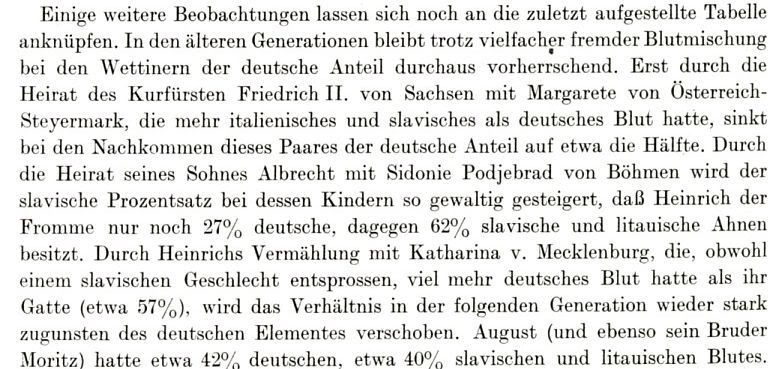
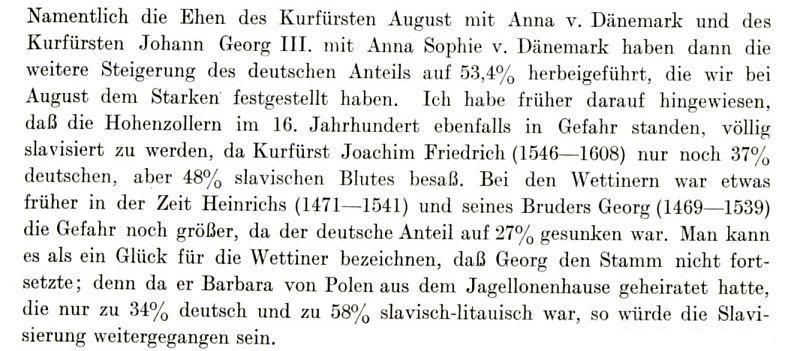
Here is an excerpt from a Nazi era (1937) German publication in which they estimated how much Slavic blood certain German rulers had. For example they established, that Joachim Friedrich Hohenzollern (1546-1608) was only 37% German, and 48% Slavic:

Joachim Friedrich Hohenzollern: https://en.wikipedia.org/wiki/Joachim_III_Frederick,_Elector_of_Brandenburg

brandenburgerich6.jpg


Another German monarch - Heinrich der Fromme - was established to be only 27% German and 62% Slavic and Lithuanian:

Heinrich der Fromme: https://en.wikipedia.org/wiki/Henry_IV,_Duke_of_Saxony

brandenburgerich5.jpg


I find it ironic that such a publication was written by anti-Slavic German Nazis, and not by some Pan-Slavic activists. LOL. :laughing:

Well, actually I'm not sure if the author was Anti-Slavic, but he published this in 1937 in Leipzig:

Erich Brandenburg, "Die Ahnen Augusts des Starken" (Abhandl. der Saechs. Akademie der Wissenschaften, Phil.-hist. Klasse, Bd.43, Nr.5), Leipzig 1937.
 
There are Sumerian terms also in Turkic and Arabic languages, etc., as well as in Hebrew:

http://www.quora.com/What-currently...-roots-or-is-most-closely-related-to-Sumerian

https://en.wiktionary.org/wiki/Category:Terms_derived_from_Sumerian

Those loanwords entered Hebrew either from Akkadian ---> Aramaic or directly from Aramaic:

https://books.google.pl/books?id=So...6AEwBQ#v=onepage&q=Sumerian loanwords&f=false

As you can see there is no need for a close neighbourhood in time and / or in space for a loanword to enter.


Nope. They don't even need to be adopted from the original language.

For example Hebrew adopted Sumerian loans from Aramaic, Aramaic from Akkadian, and Akkadian from Sumerian.


Or that they spoke Non-Sumerian but used some Sumerian loanwords, which they later transmitted to others.

ok we are not speaking about 20th century where everybody is learning 2-3 languages,,
we speak about neolithic to iron age,
a language to be transmited to another area that times needed speakers, no Books, no tablets, no easy learning methods,
loan words entered cause in one language vocabulary for 3 reason
1) is poor to describe something, or has not such,
like οινος vino wine, οικονομια economy,
2) it easier to express, we say car, and not automobile, we say 'mouse' and not 'cursor driver', etc in every language
3) resist of some words of the 'losing' speakers' if someone searches in the mixing zones, for example among Celtic and Germanic will realise what I am talking about

so the existance of summerian in IE are either cause IE were beside Summerian reason 1 and 2
(same was Akkadian. and espesially Elam, etc)
or indeed neolithic spoke Summerian, and enter IE as a linguistic resist,

Personally I believe the 1, IE where beside Summerian,

now the spread of Summerian to both Semitic and IE (and Turkic) is something to observe,
but the upsence of Uralic in 'old' IE is also something to observe,
also notice that for some Turkic is a mix of IE and East Asian languages,
so either Summerian were the lang of Agricultural boom,
or IE spread the Summerian vocabulary which absorve

now about Hebrew, is strange case, since some even consider it same with proto-Greek
but Elam was next to Summerian, and Akkadian also next to Summerian
BUT ABRAAHAM WAS CHALDIAN NOT JEW, FROM UR of Chaldians, brothers of Arams,
Ur of Chaldians is URIM of Summerian
,
so Jews lost their primary language (Chaldian, Semitic and Summerian) which was close to Aramaic through time, or possible after Egypt, or Sinai and desert
and not adopted Summerian
It is the oposite with Jews, they lost Summerian, and not adopted
 
Coming back to that 1937 publication:

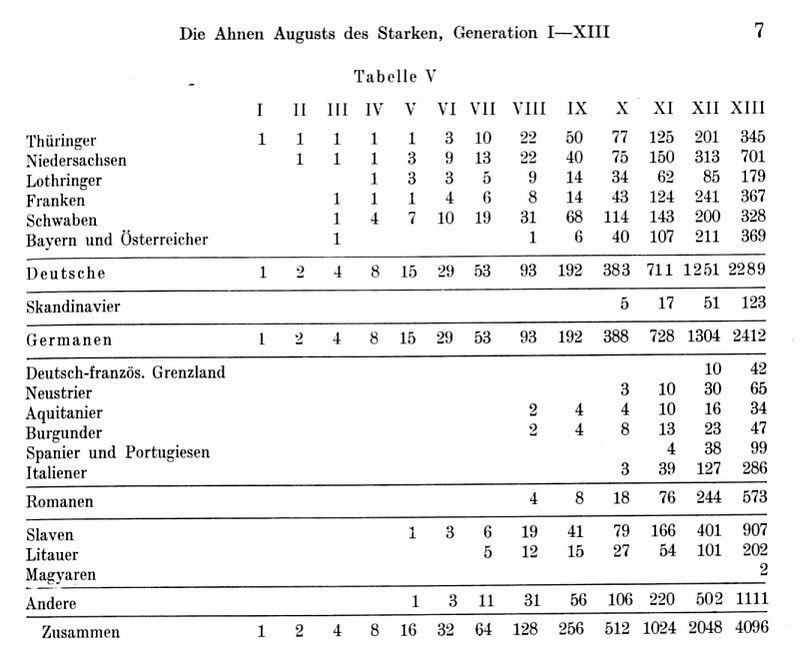
Chart showing ethnic origins of ancestors of Augustus the Strong (Wettin dynasty) according to that 1937 publication:

https://en.wikipedia.org/wiki/Augustus_II_the_Strong

Augustus II - unlike those Slavic weaklings Hohenzollerns :) - had mostly German ancestry (which made him "the Strong" :)):

Among his 4096 ancestors from 14 generations, there were only 907 Slavs (22%):

brandenburgerich1.jpg


And here a chart for previous generations, up to 27 generations:

27_generations.png


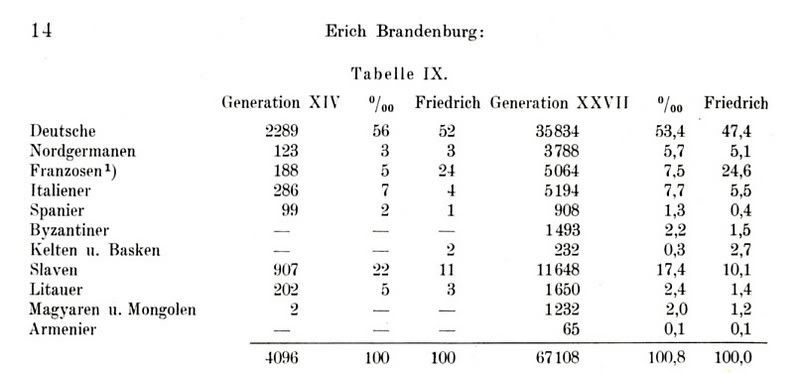
Comparison of 14 generations and 27 generations (in the latter case numbers in thousands, apparently):

brandenburgerich2.jpg


Around one percent of his ancestors were Mongols (and another one percent Magyars)?
 
Yetos, theory Tomenable is speaking about is here:
http://en.m.wikipedia.org/wiki/Indo-Uralic_languages
Wiki has main points, critics, answers to critics.
It is a theory with scientists supporters and scientists critics.

But it has nothing to do with Uralic loans into IE. If this theory is correct those are not loans but rather cognates. And as cognates they are present also in Greek.

Maybe another topic is needed under Linguistics to go into details re this theory.

yes
there also Indo-Semitic theories
Uralo-Turkic etc,
maybe we can reconstruct the pan-language?
 
Coming back to that 1937 publication:

Chart showing ethnic origins of ancestors of Augustus the Strong (Wettin dynasty) according to that 1937 publication:

https://en.wikipedia.org/wiki/Augustus_II_the_Strong

Augustus II - unlike those Slavic weaklings Hohenzollerns :) - had mostly German ancestry (which made him "the Strong" :)):

Among his 4096 ancestors from 14 generations, there were only 907 Slavs (22%):

brandenburgerich1.jpg


And here a chart for previous generations, up to 27 generations:

27_generations.png


Comparison of 14 generations and 27 generations (in the latter case numbers in thousands, apparently):

brandenburgerich2.jpg


Around one percent of his ancestors were Mongols (and another one percent Magyars)?

How nice that you're keeping your sense of humor. :) I'm afraid I sometimes misplace mine!
 
^ When it comes to dynasties:

Here is an excerpt from a Nazi era (1937) German publication in which they estimated how much Slavic blood certain German rulers had. For example they established, that Joachim Friedrich Hohenzollern (1546-1608) was only 37% German, and 48% Slavic:

Joachim Friedrich Hohenzollern: https://en.wikipedia.org/wiki/Joachim_III_Frederick,_Elector_of_Brandenburg

brandenburgerich6.jpg


Another German monarch - Heinrich der Fromme - was established to be only 27% German and 62% Slavic and Lithuanian:

Heinrich der Fromme: https://en.wikipedia.org/wiki/Henry_IV,_Duke_of_Saxony

brandenburgerich5.jpg


I find it ironic that such a publication was written by anti-Slavic German Nazis, and not by some Pan-Slavic activists. LOL. :laughing:

Well, actually I'm not sure if the author was Anti-Slavic, but he published this in 1937 in Leipzig:

Erich Brandenburg, "Die Ahnen Augusts des Starken" (Abhandl. der Saechs. Akademie der Wissenschaften, Phil.-hist. Klasse, Bd.43, Nr.5), Leipzig 1937.

What does this have to do in what we are arguing about????? We all know the nobility is notoriously mixed. They married anyone who had power or money or land. Even the Russian, Polish, and Lithuanian nobility had Tatar and Mongol blood. We are talking about peasants. An peasants dont mix. The conquest of the Slavs in Eastern Germany was similar to what happened in USA. Anglo-Americans expelled and massacred most of the Indians and the Indians were put in reservations (ethnically cleansed) . The Spaniards tried to do the same in Latin America but the Church and the Emperor stopped them. The same scenario would have happened to the Slavs. The Slavs were probably reduced to serfdom and slavery and were given the worst land and held with very few liberties. This would have reduced their numbers.

The Germans came in with their families. So mixing between them would have been very limited. Dont try to compare how we live in the 21st century to that of the Dark Ages. In the Dark Ages people were nasty, brutal, and life was short. If a German peasant saw Slav land and knew he could take it, he would try to steal it without any "Christian conscience." Germans were ruthless barbarians who had recently converted to Christianity and were land hungry.
 
That was far more complex. In some areas there was ethnic cleansing (for example in Wagrien), but in most areas - not.

And even in Wagrien - which was, according to written sources, utterly devastated - after the conquest some Slavs remained, because Germans brought in priests to convert Wagrian Slavs to Christianity. One of those missionaries was Helmold of Bosau:

https://en.wikipedia.org/wiki/Helmold

Moreover, until the 12th century Germans conquered only areas to the west of the Oder-Neisse Line (current German eastern border). German expansion into areas located to the east of the current German-Polish border started only in the 13th century.

And in some places there was no military expansion, but only immigration of German settlers to Slavic-inhabited areas.

Lower Silesia for example was never conquered, but Polish rulers of that region let in German immigrants to settle there.

Polish rulers also let in German immigrants to other parts of Poland - but those became assimilated (Polonized) over time.

In Lower Silesia, however, local Polish dukes "betrayed", adopting German culture and language. When Poland was fragmented into semi-independent duchies (all ruled by the same - Piast - dynasty, but civil wars were frequent in that period), some dukes tended to lean politically towards foreign realms (Bohemia and the HRE), and some of them slowly alienated themselves from the Polish world.

See for example this line of descent from the first king of Poland - Boleslav I - to Elisabeth II, queen of the UK.

Boleslav I was one of 29xgreat-grandparents of Elisabeth II - here you have the detailed genealogy:

I underlined (bold text) male members of the Polish Piast dynasty, as well as (bolded Italic) the Hohenzollerns:

29x Boleslav I Piast, king of Poland (born 967 - died 1025)
28x Mieszko II Piast king of Poland (990 - 1034)
27x Casimir I Piast duke of Poland (1016 - 1058)
26x Vladislav I Piast duke of Poland (1043 - 1102)
25x Boleslav III Piast duke of Poland (1086 - 1138)
24x Casimir II Piast supreme duke of Poland (1138 - 1194)
23x Conrad I Piast supreme duke of Poland (1187 - 1247)
22x Siemowit I Piast duke of Mazovia & Sieradz (1215 - 1262)
21x Siemowit I Piast duke of Mazovia & Sieradz (1215 - 1262)
20x Boleslav II Piast duke of Mazovia & Sandomir (1251 - 1313)
19x Troyden I Piast duke in Mazovia (1284 - 1341)
18x Euphemia princess of Cieszyn & in Mazovia (1310 - 1374) x Casimir I Piast duke of Cieszyn & in Upper Silesia (1280 - 1358)
17x Premislav I Piast duke of Cieszyn & in Upper Silesia (1332 - 1410)
16x Anne princess of Cieszyn & in Lower Silesia (1374 - 1420) x Henry IX Piast duke in Lower Silesia (1369 - 1420)
15x Louis III Piast duke in Lower Silesia (1405 - 1441)
14x John I Piast duke in Lower Silesia (1425 - 1453)
13x Frederick I Piast duke in Lower Silesia (1448 - 1488)
12x Frederick II Piast duke in Lower Silesia (1480 - 1547)
11x Sophia princess of Legnica (1525 - 1546) x John George Hohenzollern elector of Brandenburg (1525 - 1598)
10x Joachim III Frederick Hohenzollern elector of Brandenburg (1546 - 1608)
9x John Sigismund Hohenzollern elector of Brandenburg, prince of Prussia (1572 - 1619)
8x George William Hohenzollern elector of Brandenburg, prince of Prussia (1593 - 1640)
7x Frederick William I Hohenzollern elector of Brandenburg, prince of Prussia (1620 - 1688)
6x Frederick I Hohenzollern king of Prussia (1657 - 1713)
5x Frederick William I Hohenzollern king of Prussia (1688 - 1740)
4x Sophia Dorothy of Brandenburg-Schwedt (1719 - 1765) x Frederick William Hohenzollern of Brandenburg-Schwedt (1700 - 1771)
3x Sophia Dorothy princess of Württemberg (1736 - 1798) x Frederick II Eugene duke of Württemberg (1732 - 1797)
2x Louis Frederick duke of Württemberg (1756 - 1817)
Alexander duke of Württemberg (1804 - 1885)
Francis Württemberg duke of Teck (1837 - 1900)
Mary of Teck queen of the UK (1867 - 1953) x George V Koburg Windsor king of the UK (1865 - 1936)
George VI Windsor king of the United Kingdom (1895 - 1952)
Elisabeth II Windsor queen of the United Kingdom (born 1926 - )

As you can see this lineage goes from Polish rulers, via German rulers, ending on English rulers. So they changed their ethnic identity a few times. And as you can see, all of them between 29 x great-grandfather and 12 x great-grandfather were Piast dynasty members. Sophia princess of Legnica was also from the Piast dynasty, but she married into the Hohenzollerns of Brandenburg.

The moment when they abandoned the tradition of using Slavic given names shows probably when they changed their identity.

The same method - tracing the use of Slavic given names by the population - can be used to check where did Slavs live in Germany. This method shows that in many parts of Germany - also west of the Oder River - some people had Slavic names even in the 1700s.

You might also check Draväno-Polabisch - a Slavic dialect of Obotrite, spoken in one part of Lower Saxony until ca. 1800.

Again thanks again for your excellent research. Some of this stuff I was aware but not as you have showed. Again nobility dont matter. They always mixed. Its the peasants that we need to focus. Peasants dont mix that much. So stick to them. Yes I agree that a lot of the Germanic expansion was peaceful. Never the less, it affected the Slavic settlements and eventually reduced them because the Germans eventually outnumbered the Slavs. It looked to me like what happened in USA.
 
The Germans came in with their families. So mixing between them would have been very limited. Dont try to compare how we live in the 21st century to that of the Dark Ages. In the Dark Ages people were nasty, brutal, and life was short. If a German peasant saw Slav land and knew he could take it, he would try to steal it without any "Christian conscience." Germans were ruthless barbarians who had recently converted to Christianity and were land hungry.
I don't think they were so land hungry. Population of East Germany and Prussia was always 4 times lower per sq. kilometer than West and South Germany.
German immigrants to Poland during late middle ages preferred to settle in cities and not in villages.
I also don't think there was hatred between Germans and Poles or Slavs back then, and strong national attitude only showed up in 19th and 20th century. Germans and Jews were allowed to settle in Poland, and later in very liberal and multi-ethnic Polish Lithuanian Commonwealth. You are actually extrapolating nationalism of 20 century on middle ages.
 
Never the less, it affected the Slavic settlements and eventually reduced them because the Germans eventually outnumbered the Slavs.

More like what happened in the Arab world, where locals started speaking Arabic and identifying as Arabs. Egyptians - for example - speak Arabic, adher to Islam and identify as Egyptian Arabs ("Egyptian" being like "Austrian" - a national identity, not an ethnic one, since Egyptians are ethnic Arabs and Austrians are ethnic Germans), but are mostly descended from local people who lived there before the Arab Caliphate, and who spoke a language ancestral to modern Coptic.

There is still a small group of people who identify as Copts and speak Coptic, just like in Germany there are still Sorbs.

The Arab Caliphate imposed Arabic language and culture on its population, just like the Holy Roman Empire imposed German language and culture on its population. Of course migrations of both "original Arabs" and "original Germans" also took place, but those migrations did not entirely replace the indigenous populations of conquered territories.

It looked to me like what happened in USA

The USA was inhabited mostly by hunter-gatherers, who tend to have very low population density. They usually need ca. 5 - 10 km2 to feed one person, so that population density can be ca. 0,1 - 0,2 people per 1 km2.

By contrast, Slavic people were Iron Age agriculturalists, and estimated population density in West Slavic lands in the Early Middle Ages was 3 - 6 people per km2 (on average 4 per km2). Later in some areas it increased to 8 - 10 or more people per 1 km2 due to natural growth and gradual progress in technology and agricultural productivity.

But even accepting the average density of just 4 people per km2 gives you as many as 1,000,000 Slavs in 250,000 km2 of Slavic lands that Germans gradually Germanized (in reality the process of Germanization was not immediate but gradual, it lasted for centuries, during which the density of Slavic-descended population was also increasing).

So what happened there was not like what happened in the USA, where also lack of immunity to European diseases decimated Native populations, shortly after contact with Europeans. By contrast Slavs were immune to European - including "German" - diseases, so they had a much greater chance to survive than Native Americans.

It was more like what happened in Mexico, where Spanish-speakers think that they are 100% Spanish and "White":

Introduction:

White_Browns.png


The video (note how these Mestizos describe themselves as "Spanish", "White" or "Black African" - but no of them even think that they might be at least partially descended from the Aztecs and other indigenous, Native Mexicans):

https://www.youtube.com/watch?v=3e6ChgL1EC4


While in reality vast majority of them have at least 50% Native Mexican (Aztecs, Mayans, and other tribes) ancestry.

Angus Maddison estimated ethnic structure of the population of Mexico in 1825 (by the end of Spanish rule) as:

- 70,000 unmixed peninsular Spaniards (from Iberia)
- 1,200,000 unmixed whites of Spanish extraction (but born in America)
- 1,900,000 mestizos (mixed people descended from Spanish-native Mexican unions)
- 3,700,000 unmixed native Mexican Amerindians
- 10,000 Sub-Saharan (Black) Africans

Source: http://www.ggdc.net/maddison/oriindex.htm (check "Appendix B").

The total population was 6,9 million, including 3,7 million unmixed natives and 1,9 million mestizos (both together were over 80%). As you can see unmixed native population in Mexico was still over 50% of the total in 1825. And unmixed Europeans were over 18%. The reduction of the percent of natives in censuses after 1825 is surely due to increasing number of mixed marriages (and maybe also due to immigration), but many people are simply more willing to identify as mestizos or whites than as natives, even if most of their ancestry is native and they have relatively few European ancestors.

================================

The same applies to modern Germans, who think they are 100% Germanic just like Mexicans think they are 100% Spanish. But the reality is that Germans are to a large extent Slavic (as well as Celtic, Roman, Baltic, etc.).

Just a simple look at frequencies of Y-DNA shows you, that Germans are among the most mixed nations in Europe.

And there is nothing strange in this - after all they live in the very geographical middle of the continent.

When you look at autosomal DNA plots, you will also find out that Germans plot in the middle of all Europeans. Which shows that Germans are a mix of all people around them, plus of course a fair bit of their own flavour.
 
Last edited:
The Germans came in with their families.

The Spanish also came to Mexico with their families. There were 1,270,000 unmixed Spanish people - males and females - in Mexico in 1825. But they were only 18% of the population. While unmixed Mexican Amerindians were 3,700,000 (over 50% of the population). Nowadays the percent of unmixed Spanish people in Mexico is much lower, and also the percent of unmixed Natives is much lower. Today absolute majority of Mexicans are Mestizos - people of mixed origins.

Even as late as 1825 only 28% of the population were Mestizo, 18% pure White and 54% pure Native.

Today, Mestizos are between 60% and 90% (according to CIA Factbook 62% of modern Mexicans are Mestizo, 28% Native and 9% White - but in reality those 28% Natives and 9% Whites are also at least to some extent mixed).

Even if pre-Columbian Mexico was more densely populated than Early Medieval Slavic lands - which is arguable (all estimates of population of pre-Columbian Mexico are guesstimates), then still we need to remember about diseases.

Massive mortality from European diseases - such as smallpox - decimated the Aztecs and other tribes of Mexico. By contrast no such a thing applied to Slavs, because they had the same immunity to European diseases as Germans.

===============================

So, here are the results of ethnic mixing in Mexico since 1825 until 2015:

Proportions of ethno-racial groups in 1825 (Angus Maddison) / in modern times (CIA Factbook):

Mestizos - 28% / 62%
Natives - 54% / 28%
Whites - 18% / 9%

others - 0% / 1%

CIA Factbook: http://en.wikipedia.org/wiki/Mexico#cite_ref-218
A. Maddison: http://www.ggdc.net/maddison/oriindex.htm

Smilar things must have taken place in the HRE, with gradual ethnic intermarriage over the centuries making most people "part-German part-Slavic", with numbers of both "purely German" and "purely Slavic" people declining. One thing which facilitated mixing in the HRE - compared to Mexico - is that you can't tell a German apart from a West Slav just by how they look, because they look very similar. By contrast Natives in Mexico are a "visible minority", both in pigmentation and in anthropological terms (they are less similar to all Europeans than Europeans are to each other).
 
I also don't think there was hatred between Germans and Poles or Slavs back then

There was some hatred between Germans and Poles already in the Middle Ages.

But that hatred was between them as "nations", not really as people (and for example German-speakers in Poland were not considered to be Germans in the Middle Ages - so there was no hatred between them and their Polish-speaking neighbours). But similar hatred was also between Germans and Danes. Actually, Danes and Poles tended to have friendly relations and to be allies, both against Germans and against Swedes. By contrast, Slavic Obotrites and Veleti sometimes were German allies against Poland - for example in the early 11th century.

So there was no such a thing as "Germanic solidarity" or "Slavic solidarity" back then. There never was such a solidarity, except for times of Pan-Germanic and Pan-Slavic movements in the 1800s-1900s.

There was some hatred between Germans and Poles already in the Middle Ages.

But that hatred was between them as "nations", not really as people

For example Jan Ostroróg (born 1436, died 1501) in his treatise complained that Polish/Slavic language was discriminated in Germany, and he also complained that in Poland, Polish language was not promoted strongly enough. He wrote that sermons in German should be banned and replaced by Polish, because most people didn't understand German.

Ostroróg also claimed that all immigrants who come to Poland, should learn to speak Polish. He was very modern-thinking and civic-thinking for a 15th century person. But he was such a "Nigel Farage" of his time. :)

Check this excerpt from Ostroróg's "Monumentum pro Reipublicae Ordinatione Congestum" ("Treatise on Improving the Republic") - original text (in Latin - quite ironic, he defended Polish language, but wrote his treatise in Latin!):

About_Sermons.png


In English:

"XXII. About Sermons in the German Language:

Oh what an ungracious and hideous thing for the Poles, that in many places in our churches sermons are given in German language, and this takes place in a lofty and magnificent setting, where only one or two old women listen to them, while at the same time the crowds of Poles are squeezed somewhere in the corner with their preacher. And because nature itself implanted eternal discord and hatred between these two languages (as well as in some other aspects), I exhort you not to say the mass in that language. Let the one who wants to live in Poland learn to speak Polish! Unless we are such simpletons that we forget that the Germans treat our language in a similar fashion in their country. And if, after all, such sermons are needed for the foreign immigrants, let them take place somewhere in secluded spots, without damage to the dignity of the Poles."


Another excerpt from Ostroróg's treatise (about monasteries established by German monks):

About_Monks.png


"XX. About Enrolling Monks to the Monasteries.

Lords ruling the Republic! How feeble-minded are you, that until this day you have tolerated the fact, that from monasteries - dowered with land and income by our ancestors, built on Polish soil and with its crops fed by the Poles - they are excluding our kinsmen and not allowing them to join the convents; and this only because they are bound by an act of law, which tells them to enroll only Germans to the convent. This act of law is ridiculous and contrary to church laws. Because who dares to impose such a yoke upon the sovereign Kingdom of Poland - the King of which does not recognize the lordship of anyone above him - under the false guise of an act of law? You, brave men - if you want to be considered brave - must stop allowing the Germans - and especially these boorish and effeminate monks - to make fun of the Polish nation, and to deceive it with their bogus piety."


Another excerpt (this one not related to sermons in German or to German monks, but to church in general):

About_Priests.png


Translation:

"XVIII. About the Pride of Priests:

Many of you, or maybe all of you, even if less fit to pastoral work, are applying for the priestly dignity, because idleness tends to be pleasant and attractive, while inaction tends to be nice and engaging. Perhaps, if I am not mistaken, the thing which encourages them to do this, is what Saint Paul said: Who desires a bishopric, desires something good. However, they don't know, that desiring itself is evil. One who steals gold, steals something good, but stealing itself is evil. And every priest, if we believe church laws, is a bishop, generally speaking. Sirs! Have you read what I wrote above, as well as what Hieronymus wrote, many of you would have chosen another way of life, and really valued the afterlife more than the earthly life. Myself being a Pole, and seeing what is happening in Poland now, I could not be silent about this."


Here you can find the entire treatise (in Latin):

http://mbc.cyfrowemazowsze.pl/dlibra/doccontent?id=3481&from=FBC
 
I don't think they were so land hungry. Population of East Germany and Prussia was always 4 times lower per sq. kilometer than West and South Germany.
German immigrants to Poland during late middle ages preferred to settle in cities and not in villages.
I also don't think there was hatred between Germans and Poles or Slavs back then, and strong national attitude only showed up in 19th and 20th century. Germans and Jews were allowed to settle in Poland, and later in very liberal and multi-ethnic Polish Lithuanian Commonwealth. You are actually extrapolating nationalism of 20 century on middle ages.

The territory that the Germans occupied during the Early Middle Ages was roughly the size of the former West Germany. Germany was heavily forested with swamps and bogs all over the place. Germans lived in small villages and towns were beginning to grow into cities. Also Germans were starting to clear the land for farming. Likewise the fecundity of the Germans has traditionally produced large populations and they have always migrated from their native lands in search for new ones. So the population in Germany has always been large compared to other areas. Thus they needed more land. The conquest of the Slavs was not about hatred. It was simply the Germans wanting to steal Slav property because they were disorganized and pagan. Religion was a distant and secondary motive.
 
Wait a minute, you said that Slavs were in Pripet Marshes. How did they mixed with Germanics west off Vistula?.

Around 200 AD the German tribes occupied all of Poland west of the Vistula and the ones who lived in the areas around the Vistula must have had contact with the Slavs who lived near them. If you bother to look at a map you can see the Pripet Marshes extend form Belarus and Ukraine into Poland. The Slavs did not live in the marshes, they lived all around it. Its a big area. If you want me to be more specific it was the Goths and their relatives the Gepids who first had contact with ancient Slavs.
 
Obviously you are very biased. There is lack of genetic, archaeological or written records to confirm such supposition. And yet you are so strongly sure about this. It might only mean one thing. You really want this to be true.

As you see there is some surviving slavic R1a, even though many Slavic men was killed during German advances. Obviously Slavs were not exclusively R1a, therefore there need to be other surviving paternal DNA. What about MtDNA and autosomal DNA? We can assume more women survived German onslaught than men. If, let's say, 20% of uni-parental Y chromosome is Slavic in East Germany, then we can suppose that total Slavic genome can rich at least 40%.
Somehow I have a feeling that you still going to counter this with your biased "40% is not a lot". If we're talking about genetic contribution of ethnic minority into "pure" Germanic genome, it is a lot.

I am not being "very biased." All I am telling you is what I read in books. Why dont you go to the library and read so you can see were I am coming from. You also dont seem to know the definition of ethnic cleaning. Its not just about killing or extermination it is also about expulsion and eradication of a culture. My "bias" is that the Slavs suffered heavy casualties and were expelled, and some remained. We dont know the exact numbers. All we can do is to infer. Thats all. I am not making anything up. Go find out. And I never said Germans were pure. You said it. You are right that women would have contributed to the DNA. But Germans brought their families and there was no reason to marry large amount of Slav females. Germans were not Conquistadors. However, you are right; we need to wait for more evidence.
 
I don't think they were so land hungry. Population of East Germany and Prussia was always 4 times lower per sq. kilometer than West and South Germany.
German immigrants to Poland during late middle ages preferred to settle in cities and not in villages.
I also don't think there was hatred between Germans and Poles or Slavs back then, and strong national attitude only showed up in 19th and 20th century. Germans and Jews were allowed to settle in Poland, and later in very liberal and multi-ethnic Polish Lithuanian Commonwealth. You are actually extrapolating nationalism of 20 century on middle ages.

I never said the motivation of the Saxons in attacking the Slavs was "hatred". You seem to focus on that and also mass killings. The main motive seems to have been plunder and stealing the land from a pagan people. The popes allowed the crusaders to do so and they did it with questionable motives. Of course there was hatred as well -- the Slavs were pagan and spoke a different language -- but hatred was secondary.

Read about the Teutonic Knights. Their motives for "conquering" Slavs, Prussians, and Lithuanians was pure greed for land and the Slavs and Lithuanians knew it.
 
More like what happened in the Arab world, where locals started speaking Arabic and identifying as Arabs. Egyptians - for example - speak Arabic, adher to Islam and identify as Egyptian Arabs ("Egyptian" being like "Austrian" - a national identity, not an ethnic one, since Egyptians are ethnic Arabs and Austrians are ethnic Germans), but are mostly descended from local people who lived there before the Arab Caliphate, and who spoke a language ancestral to modern Coptic.

There is still a small group of people who identify as Copts and speak Coptic, just like in Germany there are still Sorbs.

The Arab Caliphate imposed Arabic language and culture on its population, just like the Holy Roman Empire imposed German language and culture on its population. Of course migrations of both "original Arabs" and "original Germans" also took place, but those migrations did not entirely replace the indigenous populations of conquered territories

True the Germans had "created" (actually the pope did it) the "Holy Roman Empire" during the 9th century and it became more organized by the 10th. And yes the conquest of the Slavs in Eastern Germany occurred when the Holy Roman Empire was becoming an "actual" empire. But the Slavs were pagan and they had no rights whatsoever. This is why they lost all their lands. Your confusing the Dark Ages with what happened after the Slavs were conquered. Later on yes the occupation of Slav territories was more cultural than racial. The only areas were the Germans settled in large numbers during the 10-12th centuries was in Western Czech Republic and Western Poland. Only the Teutonic Knights continued east.
 
But even accepting the average density of just 4 people per km2 gives you as many as 1,000,000 Slavs in 250,000 km2 of Slavic lands that Germans gradually Germanized (in reality the process of Germanization was not immediate but gradual, it lasted for centuries, during which the density of Slavic-descended population was also increasing).

Where do you get such a large figure? The heavily forested areas of ancient Germany would have made it quite crowded. Plus as far as I recall form reading about this is that the Slavs were composed of four or five tribes and not heavily populated and very disorganized. This is why they were easily conquered. IF they constituted 1 million, it would have been very difficult to defeat them. Here is a map:
250px-Polabian_Slavs.png
 
Back
Top