• Don't want to see ads? Install an adblocker like uBlock Origin or use a Europe-based privacy-friendly browser like Vivaldi or Mullvad.

Genetic study The Roman Military Community as a Melting Pot: Biomolecular Evidence from the Lower Rhine Limes

Maciamo

Veteran member
Admin
Messages
10,632
Reaction score
4,461
Points
113
Location
Lothier
Ethnic group
Italo-celto-germanic
A new preprint from De Coster at al.
Study Objective​

The research investigates the demographic makeup of Roman military communities stationed along the empire's frontier, known as the Lower Rhine Limes. To understand the origins of these populations, the authors utilized ancient DNA (aDNA) and other biomolecular evidence extracted from archaeological remains. This scientific approach allows researchers to accurately trace the geographic and genetic lineage of individuals who lived in these military camps.

Major Findings​

The study's ancient DNA analysis establishes that these border communities possessed highly heterogeneous ancestry profiles. The biological evidence supports broader historical theories about Roman military demographics:
  • The Roman army acted as a massive genetic and cultural melting pot that blended diverse populations.
  • Military units successfully integrated citizens, non-citizen auxiliaries, and camp followers from across the empire into cohesive communities.
  • Soldiers stationed far from their homelands actively intermingled with local populations, forging multicultural frontier societies
ff9893604db087436cf99113.png
 
Seems like most of them were relatively locally-sourced soldiers, with exception of the Greek (Aegean/West Anatolian?) individual, and to a lesser extent the Estonian (Who could plausibly have also come from the surrounding area).

1774885729324.png
 
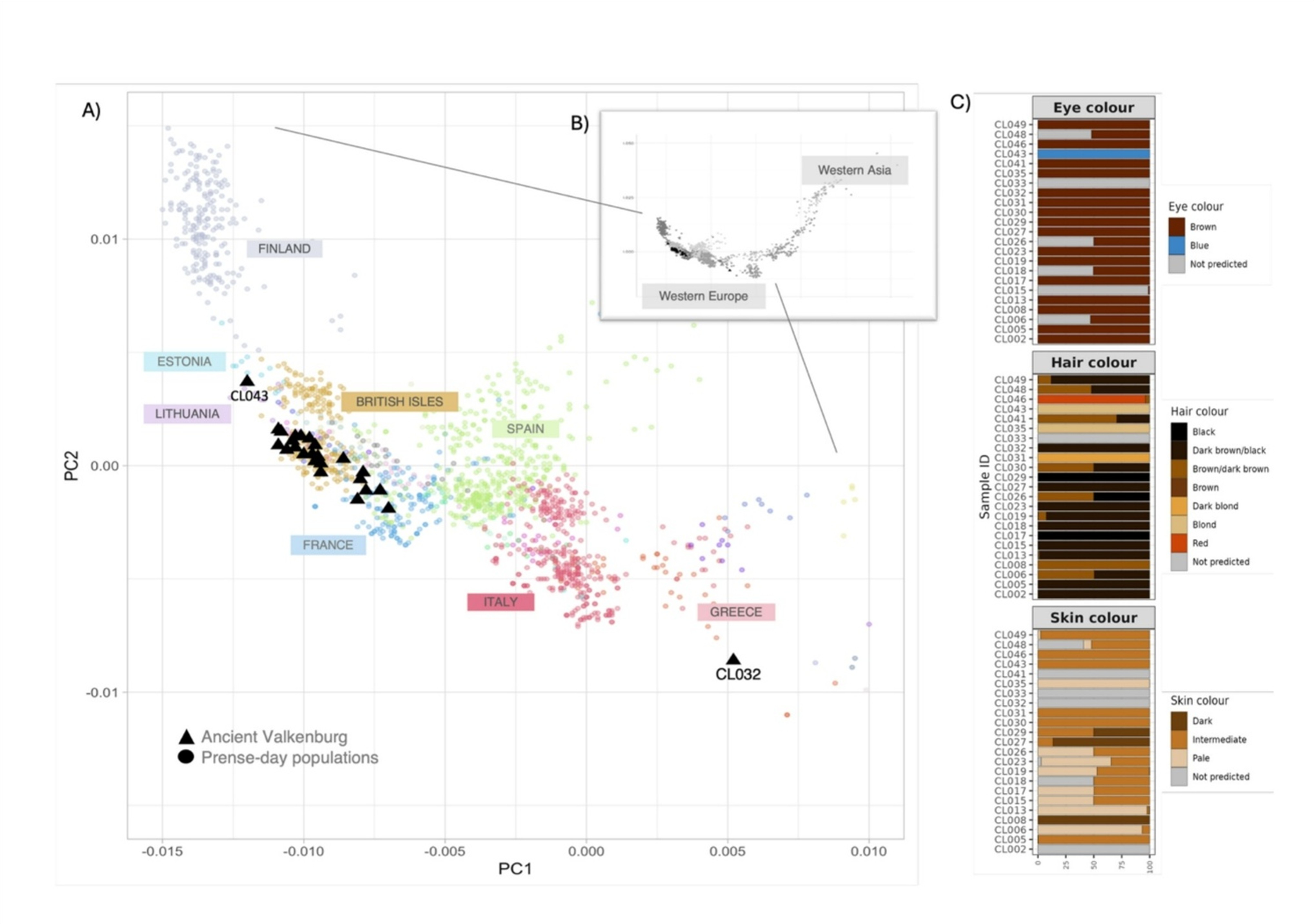
Very interesting. This is from the most northwestern part of the Empire (Praetorium Agrippinae) in present day Holland. One sample is clustering somewhat south of Greece and one with Estonia. The others were from Western Europe.

I think the German side (Cologne, Xanten,Trier, Mainz,…) of the Limes will be even more diverse.
 
Here are the haplogroups. All the samples are from Valkenburg near Leiden in South Holland (not Valkenburg near Maastricht). They all date from the Early Imperial period (0-200 CE) except CL023 that dates from the Iron Age (500-100 BCE). Autosomally all cluster around the Low Countries and France, except CL043 who appears to be from the Baltic and CL032 from Greece. Oddly, the Iron Age sample has an African mtDNA haplogroup.

I have a feeling that the the haplogroup columns have been shifted one row down. It would make far more sense if the Baltic sample was I1-L22, the Greek sample J2a1, and the Iron Age sample was R1b-P312 with mtDNA T2b6a.

Sample IDmtDNAY-DNASubclade
CL017 (Ind 50, E21)H6a1b4R1b1a1b1a1a1c1aR-U106>Z381>Z306
CL018 (Ind 52, E23)HV0+195NANA
CL023 (Ind 62, E23)T2b6aNANA
CL026 (Ind 66, E11)N1a1a1a2NANA
CL029 (Ind 69, E13)J1c1NANA
CL031 (Ind 76, E22)H4a1a1a3NANA
CL026 (I031)N1a1a1a2NANA
CL005 (I081)H6a1b4R1b1a1b1a1a1c1aR-U106>Z381>Z306
CL007 (I002)U5a1a1R1b1a1b1a1a2c1a1kR-P312>L21>DF13>S1026
CL029 (I018) (XY)H1+16311R1b1a1b1a1a2R-P312
CL015 (I024)J1c1R1b1a1b1a1a2R-P312
CL023 (I041) (Iron Age)L2bNANA
CL027 (I042)T2b6aR1b1a1b1a1a2R-P312
CL019 (I051)U5a1b1R1b1a1b1a1a1c1a2b1R-U106>Z381>Z306>DF96>S25234
CL032 (I052) (Greece)H8c1R1b1a1b1a1a2b1a1~R-P312>U152>L2>L20
CL002 (I085)K1a4J2a1a1b2a1b1b~J2a1-L25>L70>Z423
CL033 (I120)J1c3gR1b1a1b1a1a1c1R-U106>Z381>Z156
CL041 (I134)H1aeNANA
CL018T2c1d1R1b1a1b1a1a2b1R-P312>U152>L2
CL048 (I019A)T2bR1b1a1b1a1a1c1a1R-U106>Z381>Z306>DF98
CL049 (I019B)U5b2a2R1b1a1b1a1a3a1R-S1194>S1200>S14328
CL008 (I007)I2NANA
CL013 (I037)T2b6aNANA
CL043 (I074) (Baltic)K1a3a1R1b1a1b1a1a2e1R-P312>DF19>DF88
CL006 (I079)I2aI1a1b1I1-L22
CL046 (I092)U5a2c1R1b1a1b1a1a2e1R-P312>DF19>DF88
CL030 (I114)HV16NANA
CL035 (I121)K1a+195E1b1b1a1b1aE-V13
CL010 (I028)H11aR1b1a1b1a1a2bR-P312>U152
CL025H2a2bR1b1a1b1a1a1cR-U106>Z381

21 Y-DNA samples:

- One E-V13
- One I1-L2
- One J2a1
- One Celto-Germanic R1b-S1194
- Six Batavian R1b-U106
- Two Germanic R1b-DF88
- Nine R1b-P312, including at least three confirmed Italic U152.
 
Last edited:
A new preprint from De Coster at al.

Study Objective​

The research investigates the demographic makeup of Roman military communities stationed along the empire's frontier, known as the Lower Rhine Limes. To understand the origins of these populations, the authors utilized ancient DNA (aDNA) and other biomolecular evidence extracted from archaeological remains. This scientific approach allows researchers to accurately trace the geographic and genetic lineage of individuals who lived in these military camps.

Major Findings​

The study's ancient DNA analysis establishes that these border communities possessed highly heterogeneous ancestry profiles. The biological evidence supports broader historical theories about Roman military demographics:
  • The Roman army acted as a massive genetic and cultural melting pot that blended diverse populations.
  • Military units successfully integrated citizens, non-citizen auxiliaries, and camp followers from across the empire into cohesive communities.
  • Soldiers stationed far from their homelands actively intermingled with local populations, forging multicultural frontier societies
ff9893604db087436cf99113.png


At a cursory glance I'm not seeing how the study came to any of its conclusions. All samples with the exception of one or two, look homogeneously Germanic, which is expected for its location. It's well known that Roman military settlements attracted many locals due to the relative wealth and trade value they brought - this is part of why so many of Germany's densely populated provincial capitals started as such. I haven't gotten too far into this paper just yet, but as far as I can tell there is also no indication any of these people were Roman soldiers or descended from such - this appears effectively an assumption on the author's part. Maybe I just need to dig deeper to find where these claims are being drawn from but it seems to me the author is obsessed with pushing a narrative his own data does not seem to back. We all know that locals flocked to Roman encampments, but as to how that makes Rome's legions "a massive genetic and cultural melting pot that blended diverse populations." seems rather politically driven and quite far fetched.
 
At a cursory glance I'm not seeing how the study came to any of its conclusions. All samples with the exception of one or two, look homogeneously Germanic, which is expected for its location. It's well known that Roman military settlements attracted many locals due to the relative wealth and trade value they brought - this is part of why so many of Germany's densely populated provincial capitals started as such. I haven't gotten too far into this paper just yet, but as far as I can tell there is also no indication any of these people were Roman soldiers or descended from such - this appears effectively an assumption on the author's part. Maybe I just need to dig deeper to find where these claims are being drawn from but it seems to me the author is obsessed with pushing a narrative his own data does not seem to back. We all know that locals flocked to Roman encampments, but as to how that makes Rome's legions "a massive genetic and cultural melting pot that blended diverse populations." seems rather politically driven and quite far fetched.
About Half of the samples cluster with France. How could they be Germanic? Germanics of these days would be more Scandinavian-like, anyway. It’s more likely that these were Gallo-Romans.
 
About Half of the samples cluster with France. How could they be Germanic? Germanics of these days would be more Scandinavian-like, anyway. It’s more likely that these were Gallo-Romans.

The way I see it is that the samples cluster with modern France have mixed local Batavian/Germanic ancestry with Roman/Italian (+ a few other regions). That's what the Y-DNA haplogroups suggest. The paper also says:

Along the Lower Rhine Limes, the Roman period is characterized by sustained interaction between incoming populations and regional communities (Verhagen, Joyce, and Groenhuijzen 2019). In their study, McColl et al. (McColl et al. 2024) identified a clear shift from predominantly local ancestry to a more diverse genetic profile during the early Roman period, particularly among individuals from Valkenburg.

The strong variability in strontium signatures observed in both groups nonetheless demonstrate that long distance mobility was a widespread phenomenon within the Valkenburg community. [...] At the same time, they do prove that some level of long-distance connectivity existed and shaped the community at Valkenburg, indicating that individuals with diverse geographic origins were incorporated into the settlement across multiple generations.

Rather than a closed military enclave, Valkenburg appears to have been a place where individuals of different geographic origins, cultural practices and social identities lived in proximity and participated in a shared borderland environment. This picture aligns with recent archaeological work emphasizing the socially mixed character of military settlements, where soldiers, families, labourers, and other non-military individuals formed interdependent communities rather than rigidly separated groups (Allison 2013; Walas 2015; Greene 2019; James 1999; Haynes 1999a). The Valkenburg assemblage offers a tangible biomolecular example of the heterogeneity long suggested in archaeological and historical studies (Haynes 2013; Haynes 1999b), underscoring how borderland populations were fundamentally shaped by movement, interaction, and continual demographic renewal.

The biomolecular evidence from Valkenburg demonstrates that this Roman borderland settlement became a demographic melting pot, shaped by sustained mobility and population heterogeneity. Integrated isotopic and genetic analyses reveal that individuals of diverse geographic origins were incorporated into a shared community along the Lower Rhine Limes, consistent with emerging views of Roman military settlements as socially entangled rather than homogeneous entities.

Strontium and oxygen isotope data indicate that mobility were widespread and occurred across different life stages.
 
The way I see it is that the samples cluster with modern France have mixed local Batavian/Germanic ancestry with Roman/Italian (+ a few other regions). That's what the Y-DNA haplogroups suggest. The paper also says:

Yes, I agree. That’s a possibility. I haven’t taken the Y-DNA into consideration. I was just looking at the autosomal DNA and their position on the PCA. I guess the descendant of a Roman/Italian and a Batavian/Germanic would cluster more or less around modern France.
 
Last edited:
It’s far from a homogeneous local population, but it’s not Rome level diversity neither. Calling it a melting pot it’s a bit of an exaggeration.
 
Here are the haplogroups. All the samples are from Valkenburg near Leiden in South Holland (not Valkenburg near Maastricht). They all date from the Early Imperial period (0-200 CE) except CL023 that dates from the Iron Age (500-100 BCE). Autosomally all cluster around the Low Countries and France, except CL043 who appears to be from the Baltic and CL032 from Greece. Oddly, the Iron Age sample has an African mtDNA haplogroup.

I have a feeling that the the haplogroup columns have been shifted one row down. It would make far more sense if the Baltic sample was I1-L22, the Greek sample J2a1, and the Iron Age sample was R1b-P312 with mtDNA T2b6a.

Sample IDmtDNAY-DNASubclade
CL017 (Ind 50, E21)H6a1b4R1b1a1b1a1a1c1aR-U106>Z381>Z306
CL018 (Ind 52, E23)HV0+195NANA
CL023 (Ind 62, E23)T2b6aNANA
CL026 (Ind 66, E11)N1a1a1a2NANA
CL029 (Ind 69, E13)J1c1NANA
CL031 (Ind 76, E22)H4a1a1a3NANA
CL026 (I031)N1a1a1a2NANA
CL005 (I081)H6a1b4R1b1a1b1a1a1c1aR-U106>Z381>Z306
CL007 (I002)U5a1a1R1b1a1b1a1a2c1a1kR-P312>L21>DF13>S1026
CL029 (I018) (XY)H1+16311R1b1a1b1a1a2R-P312
CL015 (I024)J1c1R1b1a1b1a1a2R-P312
CL023 (I041) (Iron Age)L2bNANA
CL027 (I042)T2b6aR1b1a1b1a1a2R-P312
CL019 (I051)U5a1b1R1b1a1b1a1a1c1a2b1R-U106>Z381>Z306>DF96>S25234
CL032 (I052) (Greece)H8c1R1b1a1b1a1a2b1a1~R-P312>U152>L2>L20
CL002 (I085)K1a4J2a1a1b2a1b1b~J2a1-L25>L70>Z423
CL033 (I120)J1c3gR1b1a1b1a1a1c1R-U106>Z381>Z156
CL041 (I134)H1aeNANA
CL018T2c1d1R1b1a1b1a1a2b1R-P312>U152>L2
CL048 (I019A)T2bR1b1a1b1a1a1c1a1R-U106>Z381>Z306>DF98
CL049 (I019B)U5b2a2R1b1a1b1a1a3a1R-S1194>S1200>S14328
CL008 (I007)I2NANA
CL013 (I037)T2b6aNANA
CL043 (I074) (Baltic)K1a3a1R1b1a1b1a1a2e1R-P312>DF19>DF88
CL006 (I079)I2aI1a1b1I1-L22
CL046 (I092)U5a2c1R1b1a1b1a1a2e1R-P312>DF19>DF88
CL030 (I114)HV16NANA
CL035 (I121)K1a+195E1b1b1a1b1aE-V13
CL010 (I028)H11aR1b1a1b1a1a2bR-P312>U152
CL025H2a2bR1b1a1b1a1a1cR-U106>Z381

21 Y-DNA samples:

- One E-V13
- One I1-L2
- One J2a1
- One Celto-Germanic R1b-S1194
- Six Batavian R1b-U106
- Two Germanic R1b-DF88
- Nine R1b-P312, including at least three confirmed Italic U152.
Nice to see another roman J2L70. As I've been stating for sometime now, this subclade indeed played a relevant role on the roman empire expansion. It is found, on roman times, besides Italy, on Western or Eastern Roman Limes.
 
At a cursory glance I'm not seeing how the study came to any of its conclusions. All samples with the exception of one or two, look homogeneously Germanic, which is expected for its location. It's well known that Roman military settlements attracted many locals due to the relative wealth and trade value they brought - this is part of why so many of Germany's densely populated provincial capitals started as such. I haven't gotten too far into this paper just yet, but as far as I can tell there is also no indication any of these people were Roman soldiers or descended from such - this appears effectively an assumption on the author's part. Maybe I just need to dig deeper to find where these claims are being drawn from but it seems to me the author is obsessed with pushing a narrative his own data does not seem to back. We all know that locals flocked to Roman encampments, but as to how that makes Rome's legions "a massive genetic and cultural melting pot that blended diverse populations." seems rather politically driven and quite far fetched.
I agree, "Very heterogenic" sounds like Sub-Saharan Africans, Indians, Eskimos, Tasmanians, etc.

...None of them even fall outside of the broad European continuum, with 95% of them clustering with British and French!
 
About Half of the samples cluster with France. How could they be Germanic? Germanics of these days would be more Scandinavian-like, anyway. It’s more likely that these were Gallo-Romans.

Only about six cluster with modern French and this part of the PCA in turn still yet overlaps modern Germans as well as can be seen below. I really do not see it a large leap of faith to assume all or nearly all of these are actually just Germanic speakers. Could some be romanized Gauls? Sure, but this looks nothing like a melting pot even from a purely European context. And as to how the Roman legions are implicated in this claim becomes even more strange to me.

PCA_plot_of_European_individuals.png
 
Last edited:
I agree, "Very heterogenic" sounds like Sub-Saharan Africans, Indians, Eskimos, Tasmanians, etc.

...None of them even fall outside of the broad European continuum, with 95% of them clustering with British and French!

Agreed. And North/Central French at that.
 
Only about six cluster with modern French and this part of the PCA in turn still yet overlaps modern Germans as well as can be seen below. I really do not see it a large leap of faith to assume all or nearly all of these are actually just Germanic speakers. Could some be romanized Gauls? Sure, but this looks nothing like a melting pot even from a purely European context. And as to how the Roman legions are implicated in this claim becomes even more strange to me.

PCA_plot_of_European_individuals.png
They could be mixed individualls, too. Going by their Y-DNA. Though, Germans and Germanics are not the same, most Germanics were Scandinavian-like, at least those I’ve seen. Germans on the other hand can be divided into north, south and east, some overlapping with their respective neighbors.

I agree, calling it a melting pot is an exaggeration but I didn’t even talk about that or the claim of the Roman legions.
 
Last edited:
I agree with more than a remark here. But we can speak of a "REGIONAL" melting-pot at the European level (regional because only a part of the European variability is evident for the majority. That said we have to be cautious on PCA interpretations, which can hide diverse crossings with close apparent results; it's why uniparental markers and strontium analysis are of worth.
 
Wikipedia suggests Praetorium Agrippinae was primarily a camp for auxiliary units. so these people might be gaulish auxiliaries. still remarkable that we have a greek like individual among them, in one of the most northern roman camps in continental europe. this indicates that in the actual legionary camps diversity was bigger.
 
I'm just amazed by the relatively dark pigmentation (eyes and skin), even on a so small sample...
 
I'm just amazed by the relatively dark pigmentation (eyes and skin), even on a so small sample...
That also caught my eye. Only the Estonian outlier is predicted to have blue eyes while the rest is brown eyed.

I would take the skin colour prediction with a grain of salt. Intermediate predictions seem to be light skinned in reality.
 
That also caught my eye. Only the Estonian outlier is predicted to have blue eyes while the rest is brown eyed.

I would take the skin colour prediction with a grain of salt. Intermediate predictions seem to be light skinned in reality.
very possible; even with 5 categories skin pigmentation fo other pops in other surveys the results were surprising.
 
They could be mixed individualls, too. Going by their Y-DNA. Though, Germans and Germanics are not the same, most Germanics were Scandinavian-like, at least those I’ve seen. Germans on the other hand can be divided into north, south and east, some overlapping with their respective neighbors.

I agree, calling it a melting pot is an exaggeration but I didn’t even talk about that or the claim of the Roman legions.

It's really hard to know what different Germanic speakers looked like in different locations during this time. I doubt they were all homogeneously Scandinavian after pushing into central Europe, although I'm sure some areas retained this profile. I don't think there's any way to definitively determine if these samples considered themselves Gauls, Germans or somewhere between the two, but what I don't understand is why the author default assumes they were in fact mixed and that this is proof of a melting pot. I don't believe strontium isotopes nor Y dna constitutes meaningful enough data to make that determination at all.
 
Back
Top