-
Don't want to see ads? Install an adblocker like uBlock Origin or use a Europe-based privacy-friendly browser like Vivaldi or Mullvad.
You are using an out of date browser. It may not display this or other websites correctly.
You should upgrade or use an alternative browser.
You should upgrade or use an alternative browser.
The Kingdom of Tartessos.
- Thread starter Carlitos
- Start date


Carlitos
Junior Member
- Messages
- 845
- Reaction score
- 5
- Points
- 0
- Location
- Occident.
- Ethnic group
- Ethnic group of those who are going to die.
- Y-DNA haplogroup
- E1b1b1a3 V22+
- mtDNA haplogroup
- J1c
The Tartessian language is an extinct pre-Roman language once spoken in southern Iberia and has recently been classified as a Celtic language. The oldest known indigenous texts of Iberia, dated from the 7th to 6th centuries BC, are written in Tartessian. The inscriptions are written in a semi-syllabic writing system and were found in the general area in which Tartessos was located and in surrounding areas of influence. Tartessian language texts were found in Southwestern Spain and Southern Portugal (namely in the Conii areas of the Algarve and southern Alentejo. This variety is often referred as Southwest script). According to John T. Koch and others, Tartessian may have been the earliest written Celtic language.

Wilhelm
Regular Member
- Messages
- 1,658
- Reaction score
- 57
- Points
- 0
- Location
- Spain
- Ethnic group
- Celtiberians
- Y-DNA haplogroup
- R1b-S26
- mtDNA haplogroup
- H1
yes, it's very interesting the Tartessian civilization. We have had discussions here about it. Some say they spoke a Celtic language, others say Pre-Celtic, and others say only a indo-european. What it's clear is that they were an early wave of indo-europeans of the proto-Celtic branch
Taranis
Elite member
yes, it's very interesting the Tartessian civilization. We have had discussions here about it. Some say they spoke a Celtic language, others say Pre-Celtic, and others say only a indo-european. What it's clear is that they were an early wave of indo-europeans of the proto-Celtic branch
I must say, I completely disagree about that. As I stated in this thread, the 2009 paper by Koch is highly dubious and his identification of Tartessian as a Celtic language is highly spurious at best, deceitful at worst.
In a nutshell, includes:
- Koch fails to make sound correspondences, he just takes cherrypicked words from various Celtic languages.
- Plethora of gross mistranslations from the Tartessian script, some which are quintessential for identifying Celtic cognates, and they totally go out of the window when you transliterate the words correctly.
- The phonemic inventory of the Tartessian script itself is totally alien for a Celtic language, indeed if the Tartessian language was actually Celtic, it makes no sense for the Tartessian script to develop in the way it actually did.
- Koch completely ignores the phonemic inventory of Tartessian and ignores the differences that Tartessian makes between r and r´ or s and s´. There is no Semantic constrain whatsoever.
- Koch transliterates some words from left to right, whereas the common consensus is that Tartessian is (just like the Phoenician script) written from right to left. I have no idea how Koch justifies doing that.
- Now, if you think that somebody who has a chair as professor for the Celtic languages could never do such a blunder, find out for yourself that yes he can. Read the paper, take yourself an afternoon time and you'll see the plethora of troubles associated with the assessment of Tartessian as a Celtic language.
My personal impression is that Koch has the ad hoc hypothesis that the Celtic languages MUST have originated in the Atlantic Façade, and since Tartessos was part of the Atlantic bronze age, Tartessian must have been a Celtic language, adjusting any evidence to match that.
Aristander
Regular Member
- Messages
- 194
- Reaction score
- 3
- Points
- 0
- Ethnic group
- German
- Y-DNA haplogroup
- R1b1b2a1b*
- mtDNA haplogroup
- H1
I have to agree with Taranis, I have not been all that impressed by Koch's work. Too much of his writing seems like he is reaching too deeply and making too many conjectures from less than adequate information.
I keep expecting the next paragraph of his writing to profess the existence of "Ancient Aliens" bringing the technology of language to our primative ancestors.
I keep expecting the next paragraph of his writing to profess the existence of "Ancient Aliens" bringing the technology of language to our primative ancestors.
Taranis
Elite member
Well, as they say, "extraordinary claim requires extraordinary evidence", and in this case the evidence is very sparse. I mean, I have heard "He doesn't need to prove it's Indo-European, since he already has proven that it's Celtic", but the total absence of sound correspondence makes you suspicious. I for one have serious doubts that Tartessian is even Indo-European at all.
There's other issues. First off, we do not know if the "Tartessian" language was actually used by the denizens of Tartessos, since evidence of Tartessian script is only sparse in the Tartessian area (ie, the Guadalquivir valley). The area where most of the "Tartessian" inscriptions were found in an area that was, according to ancient sources, inhabited people called the Conii or the Cunetes/Cynetes (though they too may not have been the same).
Regardless of that, both the Tartessian script/language and the ancient civilization of Tartessos are definitely fascinating.
There's other issues. First off, we do not know if the "Tartessian" language was actually used by the denizens of Tartessos, since evidence of Tartessian script is only sparse in the Tartessian area (ie, the Guadalquivir valley). The area where most of the "Tartessian" inscriptions were found in an area that was, according to ancient sources, inhabited people called the Conii or the Cunetes/Cynetes (though they too may not have been the same).
Regardless of that, both the Tartessian script/language and the ancient civilization of Tartessos are definitely fascinating.
Last edited:
Carlitos
Junior Member
- Messages
- 845
- Reaction score
- 5
- Points
- 0
- Location
- Occident.
- Ethnic group
- Ethnic group of those who are going to die.
- Y-DNA haplogroup
- E1b1b1a3 V22+
- mtDNA haplogroup
- J1c
It is possible that the kingdom of Tartessos was formed by a Celtic tribe and, perhaps of Iberian origin. Perhaps the arrival of the Celts in the area began to build something different in the area and launched after the Phoenicians.
Although I am Spanish, my mitochondrial DNA is from the Portuguese Alentejo, an ancestor of approximately 1860 and the Alentejo was Tartesso territory and I have been awarded my mitochondrial DNA is Celtic Germanic, I have taken two men match with Irish surname and a woman French name to 37 and because I have not been tested to 67, perhaps match would take them to 67.
Although I am Spanish, my mitochondrial DNA is from the Portuguese Alentejo, an ancestor of approximately 1860 and the Alentejo was Tartesso territory and I have been awarded my mitochondrial DNA is Celtic Germanic, I have taken two men match with Irish surname and a woman French name to 37 and because I have not been tested to 67, perhaps match would take them to 67.
Taranis
Elite member
It is possible that the kingdom of Tartessos was formed by a Celtic tribe and, perhaps of Iberian origin. Perhaps the arrival of the Celts in the area began to build something different in the area and launched after the Phoenicians.
The 'Tartessian' language was definitely not a Celtic language (and is very unlikely to have been otherwise Indo-European at all, and indeed, the Algarve region would be one of those relatively secluded places where you could expect a non-Indo-European language to survive). It's very doubtful in my opinion that there was any Celtic presence at all in the south of Iberia by the 7th century BC when the 'Tartessian' script began to be used. The Tartessian script fell out of use soon after the 5th century.
Herodotus (5th century BC) distinguishes the Cynetes from Celts (though that shoud be taken with a grain of salt).
Strabo (1st century BC) considers the Conii to be Celtic.
It's possible (though by no means necessary) that the so-called "Cynetes" were a non-Indo-European people who inhabited the Algarve region and who were the speakers of the 'Tartessian' language and who were Celticized in subsequent centuries.
What is also possible that the city/civilization of Tartessos itself spoke the Iberian language and not 'Tartessian', since most Tartessian inscriptions have been found in the Algarve, and only few have been found in the Guadalqivir valley. Conversely, the (Southeast-Iberian) Meridional script, which probably evolved out of the Tartessian script, has been found in the western parts of the Guadalqivir area, and there are multiple settlements with Iberian names in later centuries. In so far the possibility of Tartessos as Iberian-speaking is also feasible.
Last edited:
Carlitos
Junior Member
- Messages
- 845
- Reaction score
- 5
- Points
- 0
- Location
- Occident.
- Ethnic group
- Ethnic group of those who are going to die.
- Y-DNA haplogroup
- E1b1b1a3 V22+
- mtDNA haplogroup
- J1c
historical truth should be known over the ideological fashions or topics of the moment. And the historical truth is that so-called Celts were actually Celtic. In this regard, the conclusions of the linguists are final: All deciphered inscriptions, in a large area extending from the Guadalquivir valley to the Pyrenees from the plateau east and south to the Bay of Biscay, respond to a type of Celtic language. Does that mean he was wrong Diodorus of Sicily, the sources before him? The classics had their reasons. The Celts were Celtic, but Celtic had received the cultural influence of Iberian civilization at that time stretched across the Mediterranean Sea, like the French Celts or Celtic Midi Italian Southern Alps had entered with Iberians Ligurian and Etruscan. the Celts used a script Iberian type. Perhaps that is why he thought of the mixing hypothesis.
the Celts: Celtic took some time for signs of alien writing to write in their own language. The most important element in this work has been perhaps the bronze Botorrita, whose character undoubtedly Celtic. It is, yes, a Celtic peculiar, different from other parts of Europe, very archaic and, well, different even to other findings allegedly Celtic Iberian Peninsula itself, such as those on Lusitanian dialect. That means that Celtic penetration in Spain was very early in the first years of the first millennium BC, and since then came to be uninterrupted for three or four centuries.
What's more, the study of the Lusitano and the former hydronyms of the peninsula to the conclusion that, prior to this early Celtic penetration, we must accept the arrival of Indo-European groups, perhaps a Celtic still not very different from the rest of Indo-European peoples, perhaps those primordial Indo eventually formed a single people. We face a hypothesis that after the contributions of linguistics can be handled with absolute security bond. To all this must be added as evidence Celtic origin Argantonio name, the famous king of Tartessos, on the southern tip of the peninsula, and that allows us to suspect, at least, the presence of an aristocracy of character in an Indo-European civilization to now held by only Iberian. The nature of the myth clearly Herculean Tartessos Habis (or Habidis), very closely related to other heroes like the Celtic area, seem to support this suggestion, as well as religious worship to the wild boar, deer, horse and bull spread throughout Peninsula
In short, the language has been practiced on the history of Spain such an operation which took place on the Mycenaean civilization. In the case of Mycenae, the majority opinion was that it was an oriental civilization and Pelasgians, inherited perhaps from Crete, until it was discovered that his writing, the "Linear B", was actually an archaic form of Greek, Mycenaean era Indo-European. Similarly, research on the written testimonies of the first Spain has led to the conclusion that our peninsula was, above all, Celtic, significantly lessening the weight of Iberian and cercanoriental component. Of course, there remain several problems: first, to know the exact origin of Tartessos and civilization, to confirm the evidence of Celtic presence in it, the second, to elucidate the origin and extent of the Iberians, whether it was a village perhaps native-heir of the megalithic civilization, or if came from North Africa and the third, solving the problem of the Basques, who are still unaware of whether they belong to the Iberian area or if they came to Spain with the first waves of migration, for Finally, reveal the identity of some other Indo-European groups that likely arrived in Spain in prehistoric times and are still wrapped in a cloud of mystery. But what is beyond question is that the early history of Spain should be written again.
the Celts: Celtic took some time for signs of alien writing to write in their own language. The most important element in this work has been perhaps the bronze Botorrita, whose character undoubtedly Celtic. It is, yes, a Celtic peculiar, different from other parts of Europe, very archaic and, well, different even to other findings allegedly Celtic Iberian Peninsula itself, such as those on Lusitanian dialect. That means that Celtic penetration in Spain was very early in the first years of the first millennium BC, and since then came to be uninterrupted for three or four centuries.
What's more, the study of the Lusitano and the former hydronyms of the peninsula to the conclusion that, prior to this early Celtic penetration, we must accept the arrival of Indo-European groups, perhaps a Celtic still not very different from the rest of Indo-European peoples, perhaps those primordial Indo eventually formed a single people. We face a hypothesis that after the contributions of linguistics can be handled with absolute security bond. To all this must be added as evidence Celtic origin Argantonio name, the famous king of Tartessos, on the southern tip of the peninsula, and that allows us to suspect, at least, the presence of an aristocracy of character in an Indo-European civilization to now held by only Iberian. The nature of the myth clearly Herculean Tartessos Habis (or Habidis), very closely related to other heroes like the Celtic area, seem to support this suggestion, as well as religious worship to the wild boar, deer, horse and bull spread throughout Peninsula
In short, the language has been practiced on the history of Spain such an operation which took place on the Mycenaean civilization. In the case of Mycenae, the majority opinion was that it was an oriental civilization and Pelasgians, inherited perhaps from Crete, until it was discovered that his writing, the "Linear B", was actually an archaic form of Greek, Mycenaean era Indo-European. Similarly, research on the written testimonies of the first Spain has led to the conclusion that our peninsula was, above all, Celtic, significantly lessening the weight of Iberian and cercanoriental component. Of course, there remain several problems: first, to know the exact origin of Tartessos and civilization, to confirm the evidence of Celtic presence in it, the second, to elucidate the origin and extent of the Iberians, whether it was a village perhaps native-heir of the megalithic civilization, or if came from North Africa and the third, solving the problem of the Basques, who are still unaware of whether they belong to the Iberian area or if they came to Spain with the first waves of migration, for Finally, reveal the identity of some other Indo-European groups that likely arrived in Spain in prehistoric times and are still wrapped in a cloud of mystery. But what is beyond question is that the early history of Spain should be written again.
Taranis
Elite member
historical truth should be known over the ideological fashions or topics of the moment.
"Historical truth". Mind you, but all historical sources should be taken with a grain of salt. Wether it was lack of knowledge, innocent mistakes, cultural bias or politically-motivated propaganda, all historic sources tend to be inaccurate to varying degrees. Also, there is always the matter that our knowledge of history is incomplete. Therefore, "historical truth" is never absolute.
And the historical truth is that so-called Celts were actually Celtic. In this regard, the conclusions of the linguists are final: All deciphered inscriptions, in a large area extending from the Guadalquivir valley to the Pyrenees from the plateau east and south to the Bay of Biscay, respond to a type of Celtic language.
That is absolutely wrong! The inscriptions of the Iberian penninsula were certainly not all Celtic! Where did you take that from? We have a bewildering variety of inscriptions from the Iberian peninsula, and most of them (with the notable exception of Celtiberian!) are decisively not Celtic:
- "Tartessian" (also known as Southwestern script) mainly from the Algarve. They clearly depict a non-Celtic (and almost certainly also non-Indo-European) language. These are the most ancient inscriptions on the Iberian penninsula.
- The various Iberian scripts (Meridional, Levantine and Graeco-Iberian scripts, though the Levantine one is the most common), starting about 4th century BC, used to write the Iberian language, which was definitely not Indo-European. There is the possibility that Basque and Iberian were related, or that Basque was merely influenced by Iberian (or vice versa). The Meridional script is the oldest writing system for Iberian, found in eastern Andalusia, Murcia and the Valencian country. It's similar to the Tartessian script. The Levantine script has been used in the north (Catalonia), and it shows considerable modifications (probably under Greek influence). The Graeco-Iberian was a modification of the Greek alphabet and was used only around Alicante.
- Celtiberian inscriptions (around 2nd century BC), from the Ebro valley area. The Celtiberians created their own modified version of the Levantine script, adapted for writing a Celtic language. There are also later Celtiberian inscriptions from the 1st century BC which are written in the Latin script.
- Lusitanian inscriptions, written also in Latin during the Roman period. They show a non-Celtic, but clearly Indo-European language.
- For the other areas of the Iberian penninsula, we basically have no inscriptions whatsoever. We only have place names and tribal names from Roman sources, meaning they're 3rd century at the earliest. Even there, we have a bewildering variety of names (for example, a Ligurian etymology for some names has been suggested), most notably including the Aquitanian (Old Basque) names in the northeast. Well, on the other hand, there obviously are also many Celtic names.
Does that mean he was wrong Diodorus of Sicily, the sources before him? The classics had their reasons. The Celts were Celtic, but Celtic had received the cultural influence of Iberian civilization at that time stretched across the Mediterranean Sea, like the French Celts or Celtic Midi Italian Southern Alps had entered with Iberians Ligurian and Etruscan. the Celts used a script Iberian type. Perhaps that is why he thought of the mixing hypothesis.
the Celts: Celtic took some time for signs of alien writing to write in their own language. The most important element in this work has been perhaps the bronze Botorrita, whose character undoubtedly Celtic. It is, yes, a Celtic peculiar, different from other parts of Europe, very archaic and, well, different even to other findings allegedly Celtic Iberian Peninsula itself, such as those on Lusitanian dialect. That means that Celtic penetration in Spain was very early in the first years of the first millennium BC, and since then came to be uninterrupted for three or four centuries.
Diodorus of Sicily lived in the 1st century BC, and the Botorrita plates are dated circa 2nd to 1st century BC. It's very hard to tell from that (due to these sources being so young) how the situation in Iberia was like in the earlier centuries of the 1st millennium BC. If we go by the inscriptions mentioned above (Iberian and Tartessian), it's clear that the south of Iberia was clearly Non-Indo-European, and that Celtic penetration into that area occured only centuries later.
What's more, the study of the Lusitano and the former hydronyms of the peninsula to the conclusion that, prior to this early Celtic penetration, we must accept the arrival of Indo-European groups, perhaps a Celtic still not very different from the rest of Indo-European peoples, perhaps those primordial Indo eventually formed a single people. We face a hypothesis that after the contributions of linguistics can be handled with absolute security bond. To all this must be added as evidence Celtic origin Argantonio name, the famous king of Tartessos, on the southern tip of the peninsula, and that allows us to suspect, at least, the presence of an aristocracy of character in an Indo-European civilization to now held by only Iberian. The nature of the myth clearly Herculean Tartessos Habis (or Habidis), very closely related to other heroes like the Celtic area, seem to support this suggestion, as well as religious worship to the wild boar, deer, horse and bull spread throughout Peninsula
I'm not sure I understand what you are trying to say there. If you think the original homeland of the Indo-Europeans was in Iberia... well... that's total nonense, because basically all evidence speaks against THAT.
The case for the name "Arganthonius" as Celtic is highly doubtful. The name clearly has to do something with "silver-", but the root word "Argent-" exists in many branches of Indo-European. Also, "Arganthonius" is the ancient name for a mountain range in northwestern Anatolia. Since the name occurs in multiple languages and in (apparently) two different locations, the case for "Arganthonius" to be Celtic very poor.
Also, Herodotus, as mentioned, was geographically confused. Herodotus claims that Arganthonius was an ally of the Phocaeans, which seems improbable, given that Phocaea was located in northern Ionia - unless you consider than the mountain "Arganthonius" was also located in the same area as Phocaea. Also, there is a recurring confusion of "Tartessos" and "Tarsus" in Antiquity.
In short, the language has been practiced on the history of Spain such an operation which took place on the Mycenaean civilization. In the case of Mycenae, the majority opinion was that it was an oriental civilization and Pelasgians, inherited perhaps from Crete, until it was discovered that his writing, the "Linear B", was actually an archaic form of Greek, Mycenaean era Indo-European. Similarly, research on the written testimonies of the first Spain has led to the conclusion that our peninsula was, above all, Celtic, significantly lessening the weight of Iberian and cercanoriental component. Of course, there remain several problems: first, to know the exact origin of Tartessos and civilization, to confirm the evidence of Celtic presence in it, the second, to elucidate the origin and extent of the Iberians, whether it was a village perhaps native-heir of the megalithic civilization, or if came from North Africa and the third, solving the problem of the Basques, who are still unaware of whether they belong to the Iberian area or if they came to Spain with the first waves of migration, for Finally, reveal the identity of some other Indo-European groups that likely arrived in Spain in prehistoric times and are still wrapped in a cloud of mystery. But what is beyond question is that the early history of Spain should be written again.
Well, it seems clear to me, no offense, that you wish to rewrite the early history of the Iberian penninsula, but what you represent as "facts" are speculations and fabrications.
Last edited:
Wilhelm
Regular Member
- Messages
- 1,658
- Reaction score
- 57
- Points
- 0
- Location
- Spain
- Ethnic group
- Celtiberians
- Y-DNA haplogroup
- R1b-S26
- mtDNA haplogroup
- H1
WOW...So you are now contradiciting all the historians who agree that Celtiberian was a FULL Celtic language.- Celtiberian inscriptions (around 2nd century BC), from the Ebro valley area. The Celtiberians created their own modified version of the Levantine script, adapted for writing a Celtic language. There are also later Celtiberian inscriptions from the 1st century BC which are written in the Latin script.
Taranis
Elite member
WOW...So you are now contradiciting all the historians who agree that Celtiberian was a FULL Celtic language.
No man, read closely what I wrote. I was talking about the scripts, not the languages. Celtiberian was written in two different scripts, the Celtiberian (a modified version of the Levantine Iberian script) and later in the Latin alphabet. Obviously, Celtiberian was a Celtic language.

The Celtiberian script is outstanding in so far as it's the only Paleohispanic script that was ever really used for a Celtic (or even Indo-European at all) language.
Carlitos
Junior Member
- Messages
- 845
- Reaction score
- 5
- Points
- 0
- Location
- Occident.
- Ethnic group
- Ethnic group of those who are going to die.
- Y-DNA haplogroup
- E1b1b1a3 V22+
- mtDNA haplogroup
- J1c
Taranis
I'm not sure I understand what you are trying to say there. If you think the original homeland of the Indo-Europeans was in Iberia... well... that's total nonense, because basically all evidence speaks against THAT.
God forbid!, I have no interest in saying that Celtic, Indo-European, Afro-european, East-European is in the Iberian Peninsula.
Taranis
Elite member
Well then, let me apologize.
However, I would like to re-iterate that it's very unlikely that southern Iberia was already Celtic-speaking in the earlier half of the 1st millennium BC, and that the so-called 'Tartessian' script clearly depicts a non-Indo-European language:

However, I would like to re-iterate that it's very unlikely that southern Iberia was already Celtic-speaking in the earlier half of the 1st millennium BC, and that the so-called 'Tartessian' script clearly depicts a non-Indo-European language:
Carlitos
Junior Member
- Messages
- 845
- Reaction score
- 5
- Points
- 0
- Location
- Occident.
- Ethnic group
- Ethnic group of those who are going to die.
- Y-DNA haplogroup
- E1b1b1a3 V22+
- mtDNA haplogroup
- J1c
In my opinion sentimental, the Celts would join other people who already inhabited the territory that later became the kingdom of Tartessos, the Celts might be the spark that would cause the push towards a new civilization, driven by the trade after the Phoenicians.
The Celts arrived and the natives themselves gave way to a new man they call tartessos, Celtic and Native cease with the passage of time and logically to be Celts the memory as to identify themselves as Native tartessos.
Tartessos not advocating that were or may have felt a Celtic nation or territory as understood today, as to form a new civilization on ethnic background could not be recalled, to affect the culture created is not as important to adopt or from setting up a Celtic language was not Celtic, according to some scholars, if you know what I mean.
Strabo says that "(the Turdetani) are writing ... Iberians are also other writing, but not the same, being also their different languages."
The Chinese language could be written with Latin alphabet, and probably no Chinese would understand the meaning when viewing the written Chinese language with Latin alphabet. A Pakistani can write their language with Arabic script and Arabic did not understand anything written.
The Celts arrived and the natives themselves gave way to a new man they call tartessos, Celtic and Native cease with the passage of time and logically to be Celts the memory as to identify themselves as Native tartessos.
Tartessos not advocating that were or may have felt a Celtic nation or territory as understood today, as to form a new civilization on ethnic background could not be recalled, to affect the culture created is not as important to adopt or from setting up a Celtic language was not Celtic, according to some scholars, if you know what I mean.
Strabo says that "(the Turdetani) are writing ... Iberians are also other writing, but not the same, being also their different languages."
The Chinese language could be written with Latin alphabet, and probably no Chinese would understand the meaning when viewing the written Chinese language with Latin alphabet. A Pakistani can write their language with Arabic script and Arabic did not understand anything written.
Carlitos
Junior Member
- Messages
- 845
- Reaction score
- 5
- Points
- 0
- Location
- Occident.
- Ethnic group
- Ethnic group of those who are going to die.
- Y-DNA haplogroup
- E1b1b1a3 V22+
- mtDNA haplogroup
- J1c
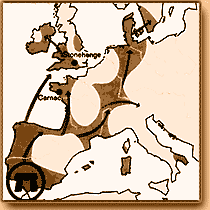
The Greek and Egyptian people had flourishing trade relations with Tartessos, the ancient seaport and commercial centre on the southern west coast of Spain, a city that is definitely lost as we know today. Tartessos is assumed to have been located near Gadeira! Under the name of Tharshish, this port was already mentioned in the Bible.
“(...) For the king had at sea a navy of Tharshish with the navy of Hiram: once in three years came the navy of Tharshish, bringing gold, and silver, ivory, and apes, and peacocks. So king Solomon exceeded all the kings of the earth for riches and for wisdom.(...)“
Herodot (a Greek historian, 5th century BC) mentions a city known as Tartessos, located beyond the Pillars of Hercules. He also points out that the returning Greek seafarers made a bigger profit than any Greek before them.
In the south of Spain, 10 000-year-old precious metal mining stocks as well as several colossal buildings have been brought into connection with the Tartessan culture. Some researchers think that Tartessos was actually Atlantis. This Atlantis stretched from the south of Spain to Morocco, i.e. the very region connected with the Tartessan culture. In my opinion, the doom of Tartessos must not necessarily be the result of a catastrophe. Rather, it could have been destroyed by the powerful commercial metropolis of the Carthagians who violently fought their enemies. It could also be that Tartessos was an Atlantean colony unable to survive after Atlantis was lost. However, this theory is valid only in case Atlantis was situated in the Atlantic Ocean. It is equally possible that Atlantis never existed. Maybe the Egyptians simply described an aspiring trading nation like Tartessos that fell victim to its rivals.
Strabo’s characterization of the Tartessians: they are the most civilized Iberian people. They can write and own ancient books and poems as well. Also, they have laws put into verse which they believe to be 7 000 years of age.
people involved in the tin trade with Britain and other islands gave rise to the assumption that Tartessos was a continent
Tartessos supplied all nations in the Mediterranean area with metals