
Duarte
Regular Member
- Messages
- 2,773
- Reaction score
- 2,055
- Points
- 113
- Ethnic group
- Brazilian
- Y-DNA haplogroup
- R-FGC35133
- mtDNA haplogroup
- B2hh1
Paraguayan War, 160 years: the discoveries that contradict what schools taught about the bloody conflict
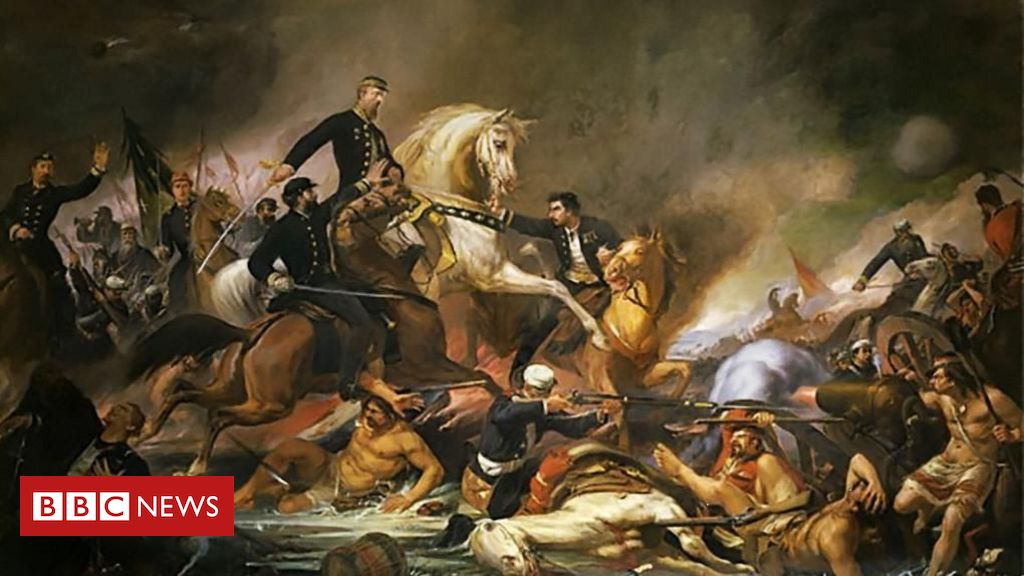
For at least two decades, most Brazilian students have been taught the wrong history about the Paraguayan War , the largest and bloodiest international armed conflict ever to occur in Latin America.
The version most often told by History teachers was the one popularized by left-wing ideologues who opposed the military regime that ruled Brazil during the dictatorship, from 1964 to 1985. Focusing on an aversion to foreign imperialism and any interference by major powers in South American destinies, the narrative was sold that the 19th century conflict had been caused, financed and indirectly led by Great Britain.
In this story, Paraguay emerged as a country that was on its way to being considered developed, with industrialization, social justice and unparalleled production of wealth, independently, thus configuring an exception in that context of new American countries that were achieving autonomy from the colonizers at the price of economic dependence on rich nations.
Seeing themselves threatened by that small country that would become a competitor for their influence, especially in Brazil and Argentina, the English poured money and military reinforcements. The result: a massacre that would have condemned Paraguay to poverty and underdevelopment. The end of the South American dream.
"Where is any document that proves it was England? There is no official document, there is nothing that shows that the English government had any interest in waging war in the region," says historian Francisco Doratioto, a retired professor at the University of Brasília (UnB). The expert gave an interview to BBC News Brasil on Tuesday morning (10/12).
The contemporary view of the conflict, officially triggered by Paraguay's declaration of war on Brazil on December 13, 1864 , the eve of the invasion of the neighboring country's forces into the then province of Mato Grosso, is the one constructed by historians such as Doratioto after meticulous research into Paraguayan, Brazilian, Argentine, Uruguayan and English historical documents.
In 2002, the historian released his best-known book: Maldita Guerra: Nova História da Guerra do Paraguai , consolidating himself as an authority on the subject. Other scholars who were recognized for rewriting the history of this war were historians Ricardo Salles (1950-2021) and, in a pioneering way, Moniz Bandeira (1935-2017).
The Paraguayan War lasted from December 1864 to March 1870. On one side was the small Republic of Paraguay, with around 400,000 inhabitants. On the other, the Triple Alliance formed by Brazil, Argentina and Uruguay — together, they had just over 11 million inhabitants.
The result was devastating. It is estimated that the Paraguayan population was reduced to less than 190,000 people. "90% of the men died," says Doratioto. "Of the males, only the elderly and children remained."
"He is not a historian and makes methodological errors that any undergraduate student [if he did] would not pass the subject", points out Doratioto. "But it has the great merit of reviving a theme that was abandoned by historians and military personnel who came with a jingoistic and official view of the war."
In this work, it is noted that the author tries to convey his indignation at the cruelties committed during the war. “He goes for hearts and wins through emotion”, analyzes Doratioto. "At the time, when I read that, I thought it was correct."
So much so that the historian was one of the vast majority of his generation who told this version in classrooms, when he was a school teacher in São Paulo.
"I taught this," he admits. "I remember I had a brilliant student who, at the end of a class, asked me: but, professor, if England wanted access to the Paraguayan market and went to war to gain that access, what was the logic in destroying that market?"
The revisionism that brought this narrative to light at the time had one focus: to demoralize the military who authoritatively led the country. And, in addition, to criticize the imperialist influence of foreign forces.
"At the historical moment in which that was written, in the midst of the military regime, the democratic sectors of society had lost their space", he contextualizes.
"Suddenly a book appeared saying that Caxias, who is the patron saint of the Brazilian Army, had practically committed war crimes, ordering the throwing of cholera-ridden corpses into the Paraguay River to contaminate Paraguayan troops," Doratioto comments. "The book demoralized the icons of the military regime. It gave ideological warfare an advantage against the military regime."
In this example brought by the historian, the narrative is that Marshal Luís Alves de Lima e Silva (1803-1880), the Duke of Caxias, who commanded the Brazilian troops in Paraguay, would have determined that the bodies of those who had died from a cholera epidemic that killed 4 thousand of his soldiers should be thrown into the Paraguay River, on the outskirts of Humaitá, so that they would contaminate the Paraguayan soldiers entrenched kilometers away in a biological war.
But Doratioto points out contradictions: the first, of a geographical nature. The direction in which the river flows is contrary to what would make sense in this narrative. "The corpses swam against the current? That's absurd", provokes the historian.
The other is the fact that the military had the custom of burning or burying those who died during campaigns. "Since it was a marshy region, the river water ended up contaminated. And this caused the epidemic that killed even more Brazilian soldiers," he explains.
In a letter to his wife, Caxias lamented that he had lost "an army" before even entering combat, as almost 4,000 Brazilian soldiers died of cholera in the episode.
Another problem with the narrative spread by Chiavenato was that it portrayed Paraguay as a country at another level of development, with advanced industrialization, railways and a society based on social justice.
"Heavy industry in Paraguay in 1864? It practically didn't exist. There was a foundry. Protosocialism? Like protosocialism? It was a structure of exploitation of the peasant who harvested yerba mate and even according to Marxist logic there was a, in quotation marks, surplus value appropriated by the Paraguayan State of the peasant", he exemplifies.
For Doratioto, the idea of targeting British imperialism and vilifying it for the cruelties of war also finds justification in the context of the dictatorship. The Brazilian ideological left considered American imperialism as its enemy, since the United States supported the 1964 coup and the military governments in the region. Thus, the protagonist changed, but there was the same semantics for configuring the "enemy."
If this revisionist version of history became popular in Brazil because of the left, the curious thing is that in Argentina it was consolidated by the right.
"[In the neighboring country, this narrative] is basically the authoritarian thinking of the xenophobic right that has existed since the 1920s and 1930s, a thinking that is constructed against the English, against English imperialism," he says. "And in Brazil it is recycled in the face of an anti-United States sentiment."
In the center of the continent and without offering the riches that were important in the colonial world, that is, precious metals, Paraguay had already experienced a certain isolation during Spanish rule. This impacted the formation of its society.
"It was and still is the only bilingual society in South America, with the Guarani culture embedded in the colonizer's culture", explains Doratioto.
Furthermore, the female population was larger than the male population. This was precisely because, with the lack of gold and silver, the territory ended up becoming a transit point for contraband - the women settled down, but the men came and went.
With the independence of the former Hispanic colonies, the elite of Buenos Aires "tried to become a center of power," explains the historian. "They sought to keep all the provinces of the former Viceroyalty of the Río de la Plata, that is, Uruguay, Bolivia and Paraguay, subordinate to them," he says.
Paraguay refused and ended up alone.
In charge of the country was the dictator Gaspar de Francia (1766-1840). "He established an impressive, almost surrealist dictatorship," Doratioto says. "To give you an idea, he broke with Rome and established his own Catholic Church. He also prohibited intercultural marriages and imprisoned part of the elite…"
South American isolation only strengthened its regime, as it ended up justifying the need for its authoritarian and centralized power.
His successor was Carlos Antonio López (1790-1882) who, according to Doratioto, "had a very clear vision of the complicated situation" the country was facing. "He tried to open up Paraguay, in a controlled manner," he comments.
In this process, he gained the support of the Brazilian Empire, which also had its interests: it did not want Argentina to be so powerful in the geopolitical chess game that was taking shape in South America.
López decided to create a prepared elite in his country. He financed the sending of two dozen young people to study in Europe, hired an English company to represent Paraguayan interests before the major powers, and began investing in military equipment. He also hired English technicians to carry out specific infrastructure projects in his country.
"But Paraguay was an agricultural country, it had no higher education schools, it only had an iron foundry and a small railway that connected Asunción to a military camp and which was the third in Latin America", he points out.
The modernization experienced by Paraguay, according to the historian, had only military and defense purposes. It did not aim at an egalitarian society or social justice.
With his death, the presidency was assumed by his son, Francisco Solano López (1827-1870). Who, less pragmatic than his father, ended up being the author of the declaration of war that would make the conflict between the South American countries inevitable.
According to historian Moniz Bandeira, the conflict was motivated by economics. In the 1860s, isolated Paraguay lacked the funds to continue the timid but calculated modernization project undertaken by López Sr.
"To increase exports, Paraguay needed to find an outlet to the sea," Doratioto summarizes. The historian, however, comments that even if this access were possible, the country would have had difficulties. "It was a small country with medieval agricultural techniques. And no [Paraguayan] farmer was interested in producing more for export. They were subsistence farmers, at a very low level."
Addressing Paraguayan Chancellor José Berges, the Englishman wrote that "England is also in conflict with Brazil" and that "particularly yes, if it can serve, at the very least, to contribute to the reconciliation of the two countries [Paraguay and Brazil], I hope that Your Excellency will not hesitate to use me".
The letter is dated December 7, 1864, five days before the declaration of war issued by the Paraguayan government.
One of the main points of revisionist historiography is to say that proof of English interest and involvement would be the fact that there was financing from the European power in the Brazilian and Argentine campaigns that would end up decimating half of Paraguay.
In fact, these loans did occur. But Doratioto has arguments to contextualize this fact. "The logic of capital has neither nationality nor patriotism. Capital is in search of remuneration and guarantees," he points out. "English bankers lent to Brazil and Argentina, of course. Are they going to lend to Paraguay, an isolated country in the interior of the continent, with no access to the external market, no gold and waging war against three countries on its own initiative?"
He also points out that this English financing was not as significant as one might imagine for the Brazilian side of the war. According to the historian, around 12% of Brazil's war expenses were financed with foreign loans only.
In his book, for example, the historian says that Brazilian fighters even killed children who pretended to be soldiers in the Paraguayan trenches.
"War is always savagery. The accusations against Caxias are part of a dialectic of war: all military leaders in combat gave orders to kill, until the Second World War the one who killed the most won a war", he argues.
Doratioto assesses that the historical figure of the Duque de Caxias "to date has not been sufficiently explored by historians". And he understands that "demoralizing him", at the time of the dictatorship, "was demoralizing the military regime".
Sorce:
 www.bbc.com
For at least two decades, most Brazilian students have been taught the wrong history about the Paraguayan War , the largest and bloodiest international armed conflict ever to occur in Latin America.
The version most often told by History teachers was the one popularized by left-wing ideologues who opposed the military regime that ruled Brazil during the dictatorship, from 1964 to 1985. Focusing on an aversion to foreign imperialism and any interference by major powers in South American destinies, the narrative was sold that the 19th century conflict had been caused, financed and indirectly led by Great Britain.
In this story, Paraguay emerged as a country that was on its way to being considered developed, with industrialization, social justice and unparalleled production of wealth, independently, thus configuring an exception in that context of new American countries that were achieving autonomy from the colonizers at the price of economic dependence on rich nations.
Seeing themselves threatened by that small country that would become a competitor for their influence, especially in Brazil and Argentina, the English poured money and military reinforcements. The result: a massacre that would have condemned Paraguay to poverty and underdevelopment. The end of the South American dream.
"Where is any document that proves it was England? There is no official document, there is nothing that shows that the English government had any interest in waging war in the region," says historian Francisco Doratioto, a retired professor at the University of Brasília (UnB). The expert gave an interview to BBC News Brasil on Tuesday morning (10/12).
The contemporary view of the conflict, officially triggered by Paraguay's declaration of war on Brazil on December 13, 1864 , the eve of the invasion of the neighboring country's forces into the then province of Mato Grosso, is the one constructed by historians such as Doratioto after meticulous research into Paraguayan, Brazilian, Argentine, Uruguayan and English historical documents.
In 2002, the historian released his best-known book: Maldita Guerra: Nova História da Guerra do Paraguai , consolidating himself as an authority on the subject. Other scholars who were recognized for rewriting the history of this war were historians Ricardo Salles (1950-2021) and, in a pioneering way, Moniz Bandeira (1935-2017).
The Paraguayan War lasted from December 1864 to March 1870. On one side was the small Republic of Paraguay, with around 400,000 inhabitants. On the other, the Triple Alliance formed by Brazil, Argentina and Uruguay — together, they had just over 11 million inhabitants.
The result was devastating. It is estimated that the Paraguayan population was reduced to less than 190,000 people. "90% of the men died," says Doratioto. "Of the males, only the elderly and children remained."
Version war
Doratioto explains that the version once taught in Brazil ended up becoming the best known and most widespread in the country, especially due to the military dictatorship. And its most popular record was the book American Genocide: The Paraguayan War , published in 1979, written by journalist Júlio José Chiavenato."He is not a historian and makes methodological errors that any undergraduate student [if he did] would not pass the subject", points out Doratioto. "But it has the great merit of reviving a theme that was abandoned by historians and military personnel who came with a jingoistic and official view of the war."
In this work, it is noted that the author tries to convey his indignation at the cruelties committed during the war. “He goes for hearts and wins through emotion”, analyzes Doratioto. "At the time, when I read that, I thought it was correct."
So much so that the historian was one of the vast majority of his generation who told this version in classrooms, when he was a school teacher in São Paulo.
"I taught this," he admits. "I remember I had a brilliant student who, at the end of a class, asked me: but, professor, if England wanted access to the Paraguayan market and went to war to gain that access, what was the logic in destroying that market?"
The revisionism that brought this narrative to light at the time had one focus: to demoralize the military who authoritatively led the country. And, in addition, to criticize the imperialist influence of foreign forces.
"At the historical moment in which that was written, in the midst of the military regime, the democratic sectors of society had lost their space", he contextualizes.
"Suddenly a book appeared saying that Caxias, who is the patron saint of the Brazilian Army, had practically committed war crimes, ordering the throwing of cholera-ridden corpses into the Paraguay River to contaminate Paraguayan troops," Doratioto comments. "The book demoralized the icons of the military regime. It gave ideological warfare an advantage against the military regime."
In this example brought by the historian, the narrative is that Marshal Luís Alves de Lima e Silva (1803-1880), the Duke of Caxias, who commanded the Brazilian troops in Paraguay, would have determined that the bodies of those who had died from a cholera epidemic that killed 4 thousand of his soldiers should be thrown into the Paraguay River, on the outskirts of Humaitá, so that they would contaminate the Paraguayan soldiers entrenched kilometers away in a biological war.
But Doratioto points out contradictions: the first, of a geographical nature. The direction in which the river flows is contrary to what would make sense in this narrative. "The corpses swam against the current? That's absurd", provokes the historian.
The other is the fact that the military had the custom of burning or burying those who died during campaigns. "Since it was a marshy region, the river water ended up contaminated. And this caused the epidemic that killed even more Brazilian soldiers," he explains.
In a letter to his wife, Caxias lamented that he had lost "an army" before even entering combat, as almost 4,000 Brazilian soldiers died of cholera in the episode.
Another problem with the narrative spread by Chiavenato was that it portrayed Paraguay as a country at another level of development, with advanced industrialization, railways and a society based on social justice.
"Heavy industry in Paraguay in 1864? It practically didn't exist. There was a foundry. Protosocialism? Like protosocialism? It was a structure of exploitation of the peasant who harvested yerba mate and even according to Marxist logic there was a, in quotation marks, surplus value appropriated by the Paraguayan State of the peasant", he exemplifies.
For Doratioto, the idea of targeting British imperialism and vilifying it for the cruelties of war also finds justification in the context of the dictatorship. The Brazilian ideological left considered American imperialism as its enemy, since the United States supported the 1964 coup and the military governments in the region. Thus, the protagonist changed, but there was the same semantics for configuring the "enemy."
If this revisionist version of history became popular in Brazil because of the left, the curious thing is that in Argentina it was consolidated by the right.
"[In the neighboring country, this narrative] is basically the authoritarian thinking of the xenophobic right that has existed since the 1920s and 1930s, a thinking that is constructed against the English, against English imperialism," he says. "And in Brazil it is recycled in the face of an anti-United States sentiment."
Why war?
Since its independence in 1811, Paraguay has been in an atypical situation. Trapped and without access to the sea, it had difficulty in distributing its products internationally — mainly yerba mate and timber.In the center of the continent and without offering the riches that were important in the colonial world, that is, precious metals, Paraguay had already experienced a certain isolation during Spanish rule. This impacted the formation of its society.
"It was and still is the only bilingual society in South America, with the Guarani culture embedded in the colonizer's culture", explains Doratioto.
Furthermore, the female population was larger than the male population. This was precisely because, with the lack of gold and silver, the territory ended up becoming a transit point for contraband - the women settled down, but the men came and went.
With the independence of the former Hispanic colonies, the elite of Buenos Aires "tried to become a center of power," explains the historian. "They sought to keep all the provinces of the former Viceroyalty of the Río de la Plata, that is, Uruguay, Bolivia and Paraguay, subordinate to them," he says.
Paraguay refused and ended up alone.
In charge of the country was the dictator Gaspar de Francia (1766-1840). "He established an impressive, almost surrealist dictatorship," Doratioto says. "To give you an idea, he broke with Rome and established his own Catholic Church. He also prohibited intercultural marriages and imprisoned part of the elite…"
South American isolation only strengthened its regime, as it ended up justifying the need for its authoritarian and centralized power.
His successor was Carlos Antonio López (1790-1882) who, according to Doratioto, "had a very clear vision of the complicated situation" the country was facing. "He tried to open up Paraguay, in a controlled manner," he comments.
In this process, he gained the support of the Brazilian Empire, which also had its interests: it did not want Argentina to be so powerful in the geopolitical chess game that was taking shape in South America.
López decided to create a prepared elite in his country. He financed the sending of two dozen young people to study in Europe, hired an English company to represent Paraguayan interests before the major powers, and began investing in military equipment. He also hired English technicians to carry out specific infrastructure projects in his country.
"But Paraguay was an agricultural country, it had no higher education schools, it only had an iron foundry and a small railway that connected Asunción to a military camp and which was the third in Latin America", he points out.
The modernization experienced by Paraguay, according to the historian, had only military and defense purposes. It did not aim at an egalitarian society or social justice.
With his death, the presidency was assumed by his son, Francisco Solano López (1827-1870). Who, less pragmatic than his father, ended up being the author of the declaration of war that would make the conflict between the South American countries inevitable.
According to historian Moniz Bandeira, the conflict was motivated by economics. In the 1860s, isolated Paraguay lacked the funds to continue the timid but calculated modernization project undertaken by López Sr.
"To increase exports, Paraguay needed to find an outlet to the sea," Doratioto summarizes. The historian, however, comments that even if this access were possible, the country would have had difficulties. "It was a small country with medieval agricultural techniques. And no [Paraguayan] farmer was interested in producing more for export. They were subsistence farmers, at a very low level."
English investment
One of Doratioto's findings that indicate that Britain did not want a war in South America is a letter from diplomat Edward Thornton, then the British ambassador to Argentina and Paraguay — based in Buenos Aires, as Asunción did not have this post.Addressing Paraguayan Chancellor José Berges, the Englishman wrote that "England is also in conflict with Brazil" and that "particularly yes, if it can serve, at the very least, to contribute to the reconciliation of the two countries [Paraguay and Brazil], I hope that Your Excellency will not hesitate to use me".
The letter is dated December 7, 1864, five days before the declaration of war issued by the Paraguayan government.
One of the main points of revisionist historiography is to say that proof of English interest and involvement would be the fact that there was financing from the European power in the Brazilian and Argentine campaigns that would end up decimating half of Paraguay.
In fact, these loans did occur. But Doratioto has arguments to contextualize this fact. "The logic of capital has neither nationality nor patriotism. Capital is in search of remuneration and guarantees," he points out. "English bankers lent to Brazil and Argentina, of course. Are they going to lend to Paraguay, an isolated country in the interior of the continent, with no access to the external market, no gold and waging war against three countries on its own initiative?"
He also points out that this English financing was not as significant as one might imagine for the Brazilian side of the war. According to the historian, around 12% of Brazil's war expenses were financed with foreign loans only.
Military violence
Regarding the war atrocities committed by Duque de Caxias and his troops, Doratioto agrees that they were highlighted to tarnish the image of the patron of the Army in the context of the dictatorship. But he confirms them.In his book, for example, the historian says that Brazilian fighters even killed children who pretended to be soldiers in the Paraguayan trenches.
"War is always savagery. The accusations against Caxias are part of a dialectic of war: all military leaders in combat gave orders to kill, until the Second World War the one who killed the most won a war", he argues.
Doratioto assesses that the historical figure of the Duque de Caxias "to date has not been sufficiently explored by historians". And he understands that "demoralizing him", at the time of the dictatorship, "was demoralizing the military regime".
Sorce:
Guerra do Paraguai, 160 anos: as pesquisas que contradizem o que a escola ensinou sobre o conflito sangrento - BBC News Brasil
Guerra do Paraguai foi ensinada como um exemplo de imperialismo britânico tentando arrasar uma potência em ascensão. Mas essa visão foi revisada por historiadores.
www.bbc.com

