• Don't want to see ads? Install an adblocker like uBlock Origin or use a Europe-based privacy-friendly browser like Vivaldi or Mullvad.

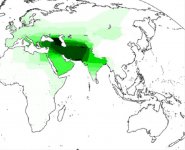
New migration map of haplogroup R1b

.. Do you know about Mil Espaine - there might be more to this Irish/Celto-Iberian Q-Celtic [Gaelic] link than just coincidence and speculations; ....

Sure, doesn't every Irishman (well, Irish-American)? I don't know about any related truths though. It sounds like a myth, although there does seem to be a glimmer or archaic Celtic from Ireland to Iberia. In that regards, it may be an echo of the Atlantic Bronze Age.

However, Irish and British R1b are quite different overall than Iberian. This is what L21 and DF27 are showing us.
 
... The Indo-European proto-Keltic migration across modern France occurred from 1600-800 BC;
With Aquitania remaining Iberian [NON-Indo-European] and everything east of the Rhone Ligurian [NON-Indo-European] all the way into Roman times;

I apologize as I probably misunderstood you.

Are you saying Ligurian is proven non-Indo-European?

Are you saying everything in SW France (Aquitaine) and Iberia was non-Indo-European until Roman times?

If the answer to either is yes, please explain. I looked at your link to a google/books page or something but it was restricted. Please explain the key points of your proofs directly.

"Celtic from the West: Alternative Perspectives from Archaeology, Genetics, Language and Literature" by Koch and Cunliffe, 2009. I'm sure the books from the 1800s and 1960s are very nice, but this is a very recent book by two highly esteemed authors and legitimate authorities. They have access to the latest dating, archaeological and linguistic data. They are a bit behind on the genetics though, but at least they thought about it.
This book is an exploration of the new idea that the Celtic languages originated in the Atlantic Zone during the Bronze Age, approached from various perspectives: pro and con, archaeology, genetics, and philology. This 'Celtic Atlantic Bronze Age' theory represents a major departure from the long-established, but increasingly problematic scenario in which the story of the Ancient Celtic languages and that of peoples called Keltoi 'Celts' are closely bound up with the archaeology of the Hallstatt and La Tene cultures of Iron Age west-central Europe. The 'Celtic from the West' proposal was first presented in Barry Cunliffe's Facing the Ocean (2001) and has subsequently found resonance amongst geneticists. It provoked controversy on the part of some linguists, though is significantly in accord with John Koch's findings in Tartessian (2009). The present collection is intended to pursue the question further in order to determine whether this earlier and more westerly starting point might now be developed as a more robust foundation for Celtic studies. As well as having this specific aim, a more general purpose of Celtic from the West is to bring to an English-language readership some of the rapidly unfolding and too often neglected evidence of the pre-Roman peoples and languages of the western Iberian Peninsula. Celtic from the West is an outgrowth of a multidisciplinary conference held at the National Library of Wales in Aberystwyth in December 2008. In addition to 11 chapters, the book includes 45 distribution maps and a further 80 illustrations. The conference and collaborative volume mark the launch of a multi-year research initiative undertaken by the University of Wales Centre for Advanced Welsh and Celtic Studies [CAWCS]: Ancient Britain and the Atlantic Zone [ABrAZo]. Contributors: (Archaeology) Barry Cunliffe; Raimund Karl; Amilcar Guerra; (Genetics) Brian McEvoy & Daniel Bradley; Stephen Oppenheimer; Ellen Rrvik; (Language & Literature) Graham Isaac; David Parsons; John T. Koch; Philip Freeman; Dagmar S. Wodtko.
http://www.amazon.com/books/dp/1842174754

I actually don't agree with "Celtic from the West". I'm just trying to make the point that it is far, far, far from proven that IE languages were not spoken along the Atlantic long before Hallstatt folks.

IE speaking people may have reached this far much earlier than traditional Hallstatt thinking. PIE is much older than Hallstatt and there are artifacts, such as the Stelae, that provide evidence of links all the way from the the Steppes to the Atlantic.
 
... Whats U-106; Urnfield or Bell-Beaker ? ...

U106 is an SNP also known as S21.

I don't think it was actually in the main narrative of the article on Kromsdorf, but I've read several times that the R1b in the Beaker folks was U106-, in other words NOT U106. Again this is Thuringia.

Sparkey said:
I don't have the study on hand, but I am reading other reports (World Families (http://www.worldfamilies.net/forum/index.php?topic=10580.0) and elsewhere) that they also tested U106 in addition to M269. Why they tested U106 rather than something more useful, I'm not sure... maybe to make it comparable to other ancient DNA studies. Anyway, predictably, they were U106-.
http://www.eupedia.com/forum/archive/index.php/t-27508.html
 
I apologize as I probably misunderstood you.

Are you saying Ligurian is proven non-Indo-European?

Are you saying everything in SW France (Aquitaine) and Iberia was non-Indo-European until Roman times?

If the answer to either is yes, please explain. I looked at your link to a google/books page or something but it was restricted. Please explain the key points of your proofs directly.

No you understood exactly; Iberians and Ligurians are non-Indo-Europeans (pre-Indo-Europeans)

Charles Anthon - A classical dictionary (1841)
"The Aquitani, according to Strabo (190), differed from the Gallic race both in physical constitution and in language. They resembled, he tells us, the Iberians rather than the Gauls."

James Cowles Prichard - Researches Into the Physical History of Mankind, Vol.II (1826)
"CAESAR informs us, that Gaul was occupied in his time by three nations, who differed from each other in language and manners. The third of these nations, viz. the Aquitani, were, as we have already observed, a branch of the Iberian stock"

The Basques today still speak a non-Indo-European language;

---

As for the Ligurians; i will scout this forum and return with the quotes; i have to find them first (again);
 
U106 is an SNP also known as S21.


1037.gif


I don't think it was actually in the main narrative of the article on Kromsdorf, but I've read several times that the R1b in the Beaker folks was U106-, in other words NOT U106. Again this is Thuringia.

Ok, now i get it; Kromsdorf is U106minus --- got it; thanks
Would have surprised me if Bell-Beaker were U106;
 
Most of my maps ? I only made two migration maps, for R1a and R1b. As I said before, I cannot invent data. My maps are based on archeological records of Indo-European cultures. There is no trace of them in Dalmatia before 1000 BCE (actually that's about the time when the Illyrians could have started migrating to Dalmatia, but it's rather fuzzy). That also explains why R1b is so low in Dalmatia, esp. in Bosnia.

Most R1a came to Dalmatia with the Slavic migrations, approx. 1500 years after when my maps end.

same map as yours in this link

http://www.waughfamily.ca/Ancient/R1b.pdf

interesting, some of the information
 
How do you know the Beaker people were originally a Neolithic people?

Because that is what it says in archaeology books. Only the late Beaker period had bronze artefacts, and I believe that the reason is that these sites were actually Indo-European cultures that had acquired Beaker pottery by trade (or the opposite, Beaker people who acquired bronze artefacts by trade).

You are saying that the Beakers could not have conquered from Western Europe? Are you assuming that the all Beaker folk types originated in Portugal with the first identification of the pottery?

The various regional groups may have different mixes. Are you assuming all Beaker people were of one genetic type? Some of the regional groups, i.e. continental, might have been more successful, per the reflux theory.

The archaeological record points to a West Iberian origin of the Beaker culture. I don't think that the people using bell beakers throughout western Europe were descended from the tribe that invented bell beakers. The only genetic similarity between Western Europeans at the time stemmed from their shared Mesolithic and Neolithic ancestry (Megalithic culture, associated with mtDNA H1 and H3 among others, and Y-DNA I2, G2a and E1b1b). As you said yourself the dental traits of Bell Beaker people show that they were not one genetic type.

Also, is it really required that they conquered Western Europe in one fell swoop? I think in some of your writings you talk of thousands of years of Celtic chieftain dominance. This is what I would call amplification.

Obviously they were several waves between the early Bronze Age and late Iron Age. That's how various subclades of R1b spread. But from the start R1b took over all western Europe, even if they were an elite minority at the beginning.
 
That's and copy and paste of my R1b page on Eupedia. The map is also mine, the old one from 2009 I mention in the first post of this thread.

how do u make these maps and where do u get the info. I know u dont use Microsoft office u must have some very advanced computer. I mean how do u know how lets say R1a is distributed exactley in every little spot do u every guess. I doubt they have Y DNA from every little region or city. If u make them solely that is incredible that must take alot of different resources and tons of work.

I attempted to make a distributions map of west Asian aust DNa in the globe13 test. here is where i got my info i used MS paint.https://docs.google.com/spreadsheet/ccc?key=0ArAJcY18g2GadF9CLUJnTUdSbkVJaDR2UkRtUE9kaUE#gid=2
attachment.php


India was the hardest DRaviden ethnic groups in eastern India had almost no west Asian while India Iranian groups had tons. I did not know who to repsent diff parts of Asia because Dravidian are so diff from Indo Iranian speakers. I also notcied Indo Iranian speakers have usuelly at least 5% north euro while their neighbors have almost none. For example Kurds have 4,8% north euro assyrians who live in teh same area 0%. It is very consitant.

i made a thread of the Human family tree according to aust DNA in the globe13 test. here is a link to it http://www.eupedia.com/forum/thread...Tree-discovered-through-globe13-austomnal-DNA

The Caucasin family is North euro- west Asian and southwest asian-Mediterranean but north euro and west asian are much more related.(disbution of west Asian can give an idea where Europeans ancestors lived before Europe and how they migrated. it seems they migrated either through Turkey or Caucus) I noticed that south asia was in between the Oceania Monloid family, caucasin, and sub sahren african there a unque group. Dravidians are not Caucasians. Other reasons why i dont think they are is they dont have brown hair. Brown hair is very popular in Europeans, mid easterns, and north Africans but is almost non existnt in the rest of the world. also mid easterns and north africans have brown to light brown skin unlike south Asians aka Dravidian who have almost totally black skin because of inter marriage Pakistani skin is a little darker than for example assyrians.

Another reason is the genes they have discovered so far for pale skin in Europeans also exists in north Africans and mid easterns but a t a lower rate. but Dravidian dont have those genes another phiscal triat they dont have that Caucasians do. i am not sure but dont Dravidian not have any Caucasian mtDNA haplogroups RO(and descendants), U(including K), JT(and decadents), X, I, W. From what i have read on their mtdan which is not alot they have mainly R but not RO. Their Y DNA and mtDNA is most related to Oceania Mongoloid like Chinese or Australian aboriginals.

I know they have Caucasian skulls, facial features, body hair, body build. But they are not in the same family as Mid eastern, north Africans, and Europeans. They are most likely long lost relatives that is why they have Caucasian features they are kind off their own race but probably most related to Caucasians.
 

Attachments

  • west asian aust. DNA.jpg
    west asian aust. DNA.jpg
    42.1 KB · Views: 938
We do have an Urnfielder R1b ancient find at Lichenstein, BTW.

It's strange that speaking about the Lichtenstein Cave you mention only r1b (in fact only one R1b sample was found) and say nothing about two R1a and a lot of I2 samples.

 
how do u make these maps and where do u get the info. I know u dont use Microsoft office u must have some very advanced computer. I mean how do u know how lets say R1a is distributed exactley in every little spot do u every guess. I doubt they have Y DNA from every little region or city. If u make them solely that is incredible that must take alot of different resources and tons of work.

I use Photoshop. All my maps are 'hand-made'. I draw them pixel by pixel, and it does take a few hours to make each map, even after I have collected all the data.
 
I use Photoshop. All my maps are 'hand-made'. I draw them pixel by pixel, and it does take a few hours to make each map, even after I have collected all the data.

that is incredible it took me hours and hours over a 2 week to make the west Asian map. I want to get some photoshop now. Thanks for making these maps. I cant find nearlly as good info on any website or source i an find here. When u talk about R1b or R1a u really give an idea how it spread unlike Wikipedia.
 
No you understood exactly; Iberians and Ligurians are non-Indo-Europeans (pre-Indo-Europeans)

Charles Anthon - A classical dictionary (1841)
"The Aquitani, according to Strabo (190), differed from the Gallic race both in physical constitution and in language. They resembled, he tells us, the Iberians rather than the Gauls."

James Cowles Prichard - Researches Into the Physical History of Mankind, Vol.II (1826)
"CAESAR informs us, that Gaul was occupied in his time by three nations, who differed from each other in language and manners. The third of these nations, viz. the Aquitani, were, as we have already observed, a branch of the Iberian stock"

The Basques today still speak a non-Indo-European language;

---

As for the Ligurians; i will scout this forum and return with the quotes; i have to find them first (again);

I agree that Basque is not an IE language. I don't know that much about the Iberians but I'm not sure it is a given that the Basques descend from the Iberians.

I'm pretty sure it is not a given that Ligurian is non-IE. I can't claim that is IE, although some linquists have said that it is. I'm just saying we don't know and it could have been IE. It also follows I'm saying that IE languages may have been spoken in Iberia before Hallstatt. How can we know they weren't? IE is old enough for sure.
 
Mikewww said:
How do you know the Beaker people were originally a Neolithic people?

Because that is what it says in archaeology books. Only the late Beaker period had bronze artefacts, and I believe that the reason is that these sites were actually Indo-European cultures that had acquired Beaker pottery by trade (or the opposite, Beaker people who acquired bronze artefacts by trade).

Well, I guess in one sense all people of the Chalcolithic either descend from Neolithic people or Neolithic and Mesolithic people. The question where the people from before the Beakers came about?

It may be different by region and time is my point, which it appears you agree with as you note below.
The archaeological record points to a West Iberian origin of the Beaker culture. I don't think that the people using bell beakers throughout western Europe were descended from the tribe that invented bell beakers. The only genetic similarity between Western Europeans at the time stemmed from their shared Mesolithic and Neolithic ancestry (Megalithic culture, associated with mtDNA H1 and H3 among others, and Y-DNA I2, G2a and E1b1b). As you said yourself the dental traits of Bell Beaker people show that they were not one genetic type...

I'm sure you've read this but for the others,

"Europe During the Third Millennium BC and Bell Beaker Culture Phenomenon: Peopling History Through Dental Non-Metric Traits Study" by Desideri, 2008.

"Phase 2: Part of the Corded Ware on the edge of the phenomenon was individualized and adopted, by borrowing, some of the western Bell Beaker traditions. Diffusion of this new society - the Beakers - continued toward the east. At the same, certain eastern elements diffused toward the west."

She actually makes a distinction and talks about this "bounce back" or reflux of people westward as "Beakers" rather than "Bell Beakers" but she is only one I know of uses that terminology distinction. Most seem to just refer to different regions of Bell Beaker folks. I think GloomyGonzales supports this idea, Gloomy? Maybe we should call Desideri's westward phase II Beakers something like Beakerized Corded Ware people.

I am very interested in your comment on the timing of metallurgy within the Bell Beakers. I've been told that Beaker folks in Portugal did have copper so I'd like to understand more about what metallurgical practices the Beakers had, when and where.

The Amzallag work on metallurgy has caused me to rethink that metalworking is not metalworking is not metalworking. There are significant differences in the technologies. Perhaps the furnace smelting was not in the original Bell Beaker cultures but came in later. There would be some sense if this aligned with the Desider's Phase 2.
 
It's strange that speaking about the Lichtenstein Cave you mention only r1b (in fact only one R1b sample was found) and say nothing about two R1a and a lot of I2 samples.

Is it really that strange to focus on R1b in a thread titled "New migration map of haplogroup R1b" ?

If you read the thread back around post #66 and the vicinity you'll see where I said things like,
... It was the Urnfield (Lichenstein) ancient DNA where we found both R1b and I.
.. The various regional groups may have different mixes. Are you assuming all Beaker people were of one genetic type? Some of the regional groups, i.e. continental, might have been more successful, per the reflux theory.

I'm clearly not a purist and in no way suggest the Beakers or Urnfielders were pure of any one haplogroup. It would seem hard to believe if they were, I think.

In fact, that was the point I was trying to make in getting into this part of the conversation, that these people were probably mixed and probably have regional variations.

However, I apologize because in my Urnfield quote I was going by memory and I forgot to mention R1a when I mentioned haplogroups R1b and I. I guess one needs to be extra sensitive in giving equal billing or something, but let me restate clearly I do NOT advocate single culture = single haplogroup correlations in any kind of exclusive manner.
 
I use Photoshop. All my maps are 'hand-made'. I draw them pixel by pixel, and it does take a few hours to make each map, even after I have collected all the data.
Thanks to Maciamo for his work on this. The maps are very helpful. Besides the graphics work, there must be a lot of behind the scenes work to gather, transform and collate the data in a logical way.
... from a selfish perspective, have you had a chance to look at and project DF27 yet?
 
I apologize as I probably misunderstood you.

Are you saying Ligurian is proven non-Indo-European?

Are you saying everything in SW France (Aquitaine) and Iberia was non-Indo-European until Roman times?

If the answer to either is yes, please explain. I looked at your link to a google/books page or something but it was restricted. Please explain the key points of your proofs directly.

"Celtic from the West: Alternative Perspectives from Archaeology, Genetics, Language and Literature" by Koch and Cunliffe, 2009. I'm sure the books from the 1800s and 1960s are very nice, but this is a very recent book by two highly esteemed authors and legitimate authorities. They have access to the latest dating, archaeological and linguistic data. They are a bit behind on the genetics though, but at least they thought about it.
This book is an exploration of the new idea that the Celtic languages originated in the Atlantic Zone during the Bronze Age, approached from various perspectives: pro and con, archaeology, genetics, and philology. This 'Celtic Atlantic Bronze Age' theory represents a major departure from the long-established, but increasingly problematic scenario in which the story of the Ancient Celtic languages and that of peoples called Keltoi 'Celts' are closely bound up with the archaeology of the Hallstatt and La Tene cultures of Iron Age west-central Europe. The 'Celtic from the West' proposal was first presented in Barry Cunliffe's Facing the Ocean (2001) and has subsequently found resonance amongst geneticists. It provoked controversy on the part of some linguists, though is significantly in accord with John Koch's findings in Tartessian (2009). The present collection is intended to pursue the question further in order to determine whether this earlier and more westerly starting point might now be developed as a more robust foundation for Celtic studies. As well as having this specific aim, a more general purpose of Celtic from the West is to bring to an English-language readership some of the rapidly unfolding and too often neglected evidence of the pre-Roman peoples and languages of the western Iberian Peninsula. Celtic from the West is an outgrowth of a multidisciplinary conference held at the National Library of Wales in Aberystwyth in December 2008. In addition to 11 chapters, the book includes 45 distribution maps and a further 80 illustrations. The conference and collaborative volume mark the launch of a multi-year research initiative undertaken by the University of Wales Centre for Advanced Welsh and Celtic Studies [CAWCS]: Ancient Britain and the Atlantic Zone [ABrAZo]. Contributors: (Archaeology) Barry Cunliffe; Raimund Karl; Amilcar Guerra; (Genetics) Brian McEvoy & Daniel Bradley; Stephen Oppenheimer; Ellen Rrvik; (Language & Literature) Graham Isaac; David Parsons; John T. Koch; Philip Freeman; Dagmar S. Wodtko.
http://www.amazon.com/books/dp/1842174754

I actually don't agree with "Celtic from the West". I'm just trying to make the point that it is far, far, far from proven that IE languages were not spoken along the Atlantic long before Hallstatt folks.

IE speaking people may have reached this far much earlier than traditional Hallstatt thinking. PIE is much older than Hallstatt and there are artifacts, such as the Stelae, that provide evidence of links all the way from the the Steppes to the Atlantic.

I have to say this, the ideas brought up in "Celtic from the West" can be broken down into three pieces:

1) Celtic languages were spoken in the Atlantic region before the emergence of the Hallstatt Culture (or rather, the detachment of Celtic languages and culture from the Hallstatt Culture).

2) Celtic languages evolved in the Atlantic region.

3) Tartessian was a Celtic language.

Now I personally am totally fine with #1 (especially if we really assume that the Beaker-Bell Culture was indeed Indo-European), but I am seeing a lot of problems with #2 and I have my doubts on #3.

The greatest problem I have with the Celtic-from-the-West idea is that after all Indo-European languages spread from the East (it does not matter which scenario for the origin you prefer, all scenarios place the origin further eastwards), and you have to explain how the ancestor of the Celtic languages wound up so far in the west (Beaker-Bell could explain this perfectly, of course). The other problem I have is when you say that the Atlantic Bronze Age was (exclusively) Celtic, what does this make of the bearers of the (for the greater part simultaneous, but further eastward) Hallstatt Culture? I'd be fine with the idea that Hallstatt was something else (but what?), that Celtic languages evolved on two fronts (which some board members suggested before), but if you make such a huge paradigm shift, I think you can't ignore such a problem altogether.

With regard for #3, I would recommend this.

The Indo-European proto-Keltic migration across modern France occurred from 1600-800 BC;
With Aquitania remaining Iberian [NON-Indo-European] and everything east of the Rhone Ligurian [NON-Indo-European] all the way into Roman times;

Nobody1, I would greatly appreciate it if you were to present us your evidence that Ligurian was non-Indo-European (ideally in a separate thread, in the Linguistics sub-forum). And by "present us your evidence", I don't mean "quote some 19th century guy"... :wary2:
 
Last edited:
About Mil Espaine (milesians) :

Sure, doesn't every Irishman (well, Irish-American)? I don't know about any related truths though. It sounds like a myth, although there does seem to be a glimmer or archaic Celtic from Ireland to Iberia. In that regards, it may be an echo of the Atlantic Bronze Age.

However, Irish and British R1b are quite different overall than Iberian. This is what L21 and DF27 are showing us.


It sounds like a myth, but a myth with a big monument near to Hercules tower in La Coruña, Spain:

0001breogan_zps3d2bd0bc.jpg


I Think it was a myth until the genetic evidences, not yet at all.

This is Breogan, who (in the myth) had viewed the irish coasts from the Galician coast and told it to his people to bring them to Eire.
 
Last edited:
Back
Top