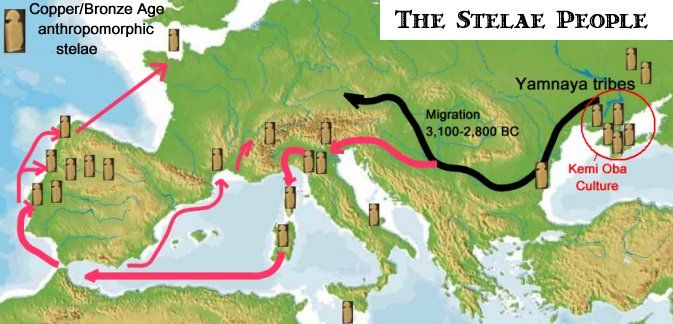
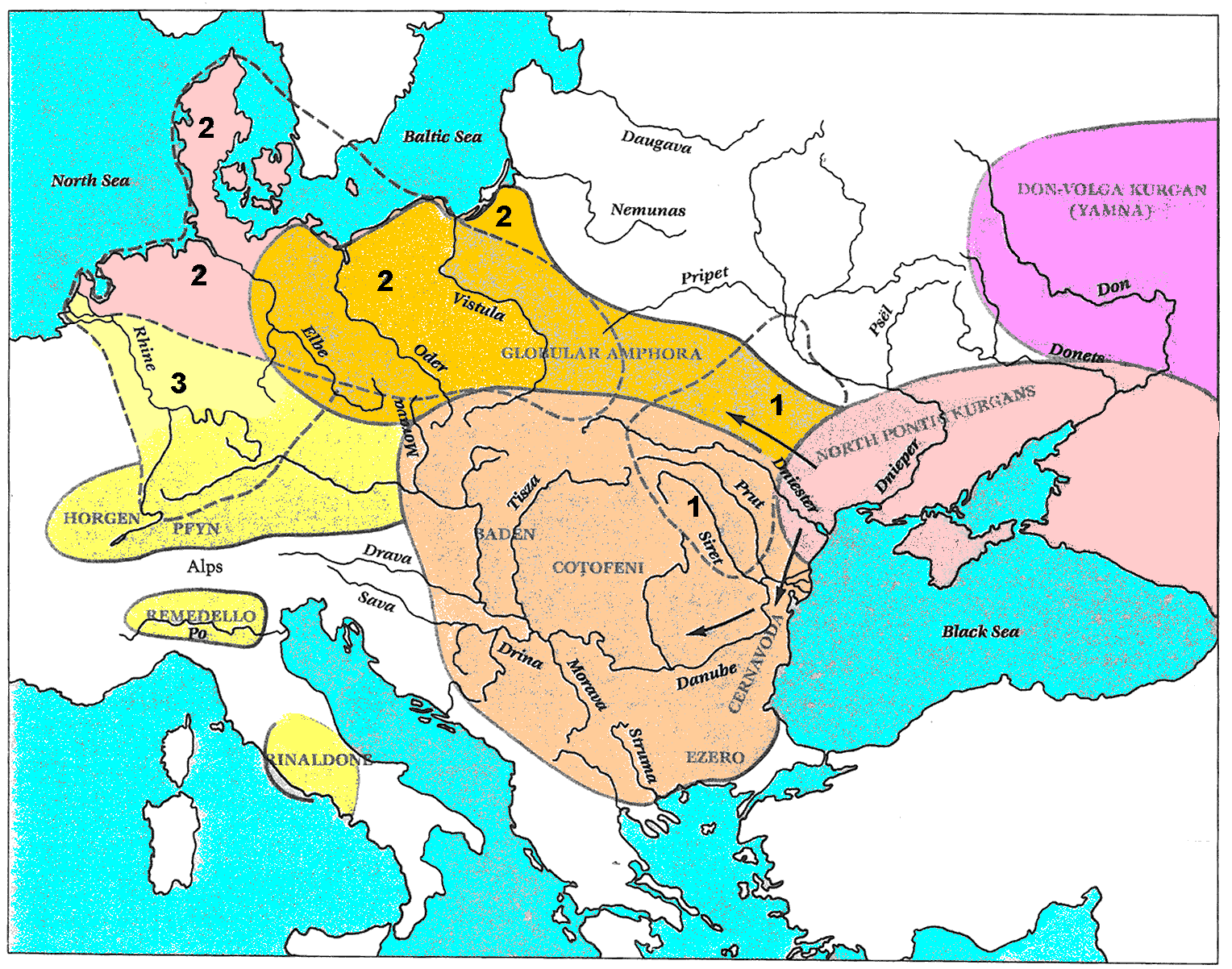
I asked Jean, the author of that map, what happened to the black line of Stelae going through continental Europe. She said the Stelae trail in that direction went cold, but she thinks the people kept going towards the Low Countries and ultimately resulted in the Rhenish Bell Beakers and finally the Beakers in Britain... the Amesbury Archer and such. I can't find those posts, so that is just by memory. She has a book coming this fall so we'll see how specific she is about this.
There is something to be said for that, since the R1b-P312 folks in Iberia are very heavily DF27+ while the P312 type in Northern France and particularly the Isles is dominated by L21+ (S145).
I have to admit that the overall distribution pattern of R1b (well, broadly L51 and it's subclades) seems to match up with the overall extend of the Beaker-Bell Culture. However, as I noted in the past, the distribution pattern of the subclades inside Western Europe doesn't add up with the expansion pattern of the Beaker-Bell Culture. If Beaker-Bell really migrated - by some maritime route - more or less straight to Portugal and radiated across Europe from there, I'd expect the oldest subclades of R1b (L51, basically) to cluster in Iberia, and frankly, that doesn't seem to be the case. So in my opinion, there must be a solution for this, and I can see three possibilities:
1) the chronology / dating of Beaker-Bell is off, and the oldest sites really are at the western edge of the Alps, not in Portugal.
2) Beaker-Bell has multiple origins, so that Beaker-Bell metalware indeed originated in Portugal but the demic movement occured from Central Europe.
3) the expansion of R1b did not actually follow the expansion of Beaker-Bell, but it's disappearance.
(I will not make any statement on the ethnic or lingustic association for the Beaker-Bell people, as frankly, I am tired of getting a beating from the experts for that type of speculation

)
How do you know that the "Stelae People" carried R1b into Europe when the only known remains from such a culture Remedello I
was G2a [Ötzi 3300 BC]; doesnt seem to fit .... or does it;
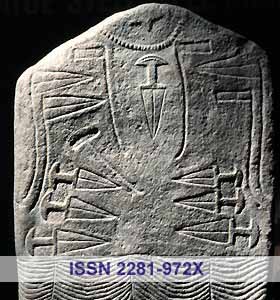
Arco Stele - 3rd Mil. BC - Remedello II
(decorated with Daggers/Halberds/Axes) compare with Kurgan steles
You bring up a good topic with Ötzi. Something that always bugged me about that 'Stelae People' map and the association with R1b is Sardinia: autosomally Ötzi is closest with modern Sardinians, and modern Sardinians are also heavy in the Y-haplogroups G2a and I2, which were found in Neolithic sites. If Beaker-Bell started with the demic movement of these 'Stelae People', and this migration went through Sardinia early on, then why are Sardinians most representative of the pre-Beaker situation?
With Maciamo's map, I (mostly) agree on his spread patterns, but I can't agree on some of the dates. In particular the timing, as that seems to somewhat contradict the Kromsdorf site.