
I have updated the map Market share of newly registered electric & hybrid cars. You can see how the market share dramatically increased in many countries from 2021 to 2025.

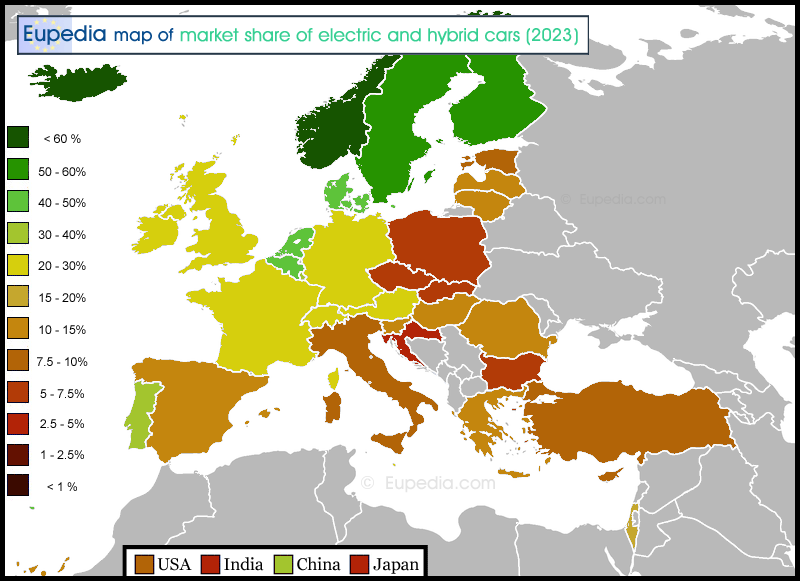



The transition to more sustainable mobility is a global issue, which is why countries are investing in electrification: to reduce emissions and seek alternatives to fossil fuels. Considering that the MAGA (Make America Great Again) movement, led by Donald Trump, is widely recognized for adopting a denialist or skeptical stance regarding global warming, frequently characterizing it as a "hoax," Trump's position on electric cars is not surprising. Elon Musk's contradictory stance of maintaining a political alliance with MAGA while being CEO of a pioneering electric vehicle company may have greatly contributed to Tesla's loss of market share in Europe and China. However, the scenario of automobile electrification cannot be seen as uniform worldwide; solutions must be adapted to the reality of each market or country. While a 100% electric vehicle fleet may be the ideal solution for countries like Norway, Sweden, or the Netherlands, for example, it is far from being a solution for countries like Brazil. In this scenario, Brazil occupies a unique position — not only because of its clean energy matrix, but also because of the ideal combination of automotive technology and renewable resources.I wonder if we can have a map like that by county in the US. I know that in my area, although very Republican and MAGA, there are a a lot of Teslas. I guess they don't believe everything that Trump says about electric cars.
A report published today in The Economist magazine addresses the issue of the massive use of biofuels in Brazil. In a way, it confirms what I wrote above.However, the scenario of automobile electrification cannot be seen as uniform worldwide; solutions must be adapted to the reality of each market or country. While a 100% electric vehicle fleet may be the ideal solution for countries like Norway, Sweden, or the Netherlands, for example, it is far from being a solution for countries like Brazil. In this scenario, Brazil occupies a unique position — not only because of its clean energy matrix, but also because of the ideal combination of automotive technology and renewable resources.
