• Don't want to see ads? Install an adblocker like uBlock Origin or use a Europe-based privacy-friendly browser like Vivaldi or Mullvad.

J2b2-L283 (proto-illyrian)

I wish I could post an image, but I don't have 20 posts. This is what the Illyrian/West Balkans J2B2-L283 grouping is shaping out to be


https (colon) //i (dot) imgur (dot) com/tkDdJbf (dot) png

Pardon for the typo. That's supposed to be Z597 not Z517.
 
I wish I could post an image, but I don't have 20 posts. This is what the Illyrian/West Balkans J2B2-L283 grouping is shaping out to be
https (colon) //i (dot) imgur (dot) com/tkDdJbf (dot) png
Pardon for the typo. That's supposed to be Z597 not Z517.

tkDdJbf.png


There is what you have :smile:

It does make sense based on available data. The other IA Slovenian, I22940, 475 BCE, I was able to classify it to J-Z38240 branch. So it's definitely shaping up like J-Z597>Z2507>Y15058>Z38240 was more northern.

While the oldest J-Z597>Z2507>Z638 comes from south Dalmatia, and we currently have no ancient J-Z638 north of there. And yes, J-Z631 "Celtic" doesn't make much sense anymore :)
 
The Proto-Illyrians were an IE-speaking people. As such, they clearly didn't originate in the Balkans. Illyrians are a Balkanic people. Proto-Illyrians no.

Like Maciamo put it, this is associated with the Illyrian colonisation of the Balkans. But I don't think it was complete population replacement through and through, especially in the areas close to Greece.

Yes. That's not the part that confused me.

"The proto-Illyrians descended from Central/Eastern Europe and caused an almost complete population turnover in the Slavic part of the Western Balkans."

This bit did. But I have a feeling its just a case of anachronism with your statement that does not reflect any worldview so no need for us to dwell on it.
 
There is what you have :smile:
It does make sense based on available data. The other IA Slovenian, I22940, 475 BCE, I was able to classify it to J-Z38240 branch. So it's definitely shaping up like J-Z597>Z2507>Y15058>Z38240 was more northern.
While the oldest J-Z597>Z2507>Z638 comes from south Dalmatia, and we currently have no ancient J-Z638 north of there. And yes, J-Z631 "Celtic" doesn't make much sense anymore :)

Thank you! I agree.

Yes. That's not the part that confused me.
"The proto-Illyrians descended from Central/Eastern Europe and caused an almost complete population turnover in the Slavic part of the Western Balkans."

This bit did. But I have a feeling its just a case of anachronism with your statement that does not reflect any worldview so no need for us to dwell on it.


Oh yes, I was simply talking about Bosnia/Croatia/Slovenia geographically, not ethnically. As in, the non-Albanian part of the Western Balkans. Slavic tribes did not live there in antiquity.

The point I was making is that there is a geographical reason for the insulation of the southwestern Balkans as opposed to the northwestern part, and this played out both during the Illyrian colonization and the later Slavic colonization.
 
Yes. That's not the part that confused me.

"The proto-Illyrians descended from Central/Eastern Europe and caused an almost complete population turnover in the Slavic part of the Western Balkans."

This bit did. But I have a feeling its just a case of anachronism with your statement that does not reflect any worldview so no need for us to dwell on it.


it means ..............where the current slavs are today in the western balkans ...the proto-illyrians occupied in the past

so..slovenia, croatia, Dalmatia, Montenegro, Bosnia ..................
 
tkDdJbf.png

There is what you have :smile:
It does make sense based on available data. The other IA Slovenian, I22940, 475 BCE, I was able to classify it to J-Z38240 branch. So it's definitely shaping up like J-Z597>Z2507>Y15058>Z38240 was more northern.
While the oldest J-Z597>Z2507>Z638 comes from south Dalmatia, and we currently have no ancient J-Z638 north of there. And yes, J-Z631 "Celtic" doesn't make much sense anymore :)


what about foggia Italy ?
 
what about foggia Italy ?

Do we have deep subclades for those? I don't think we can make any claims until we have deep subclades. If we do, we can see how those were affected as well.

Even for the Z638 south Dalmatian -> Albanian strata, I am inferring based on modern distribution of Z638, because that Z638 ancient Dalmatian is the only Z638 we received in that last batch.
 
Thank you! I agree.


Oh yes, I was simply talking about Bosnia/Croatia/Slovenia geographically, not ethnically. As in, the non-Albanian part of the Western Balkans. Slavic tribes did not live there in antiquity.

The point I was making is that there is a geographical reason for the insulation of the southwestern Balkans as opposed to the northwestern part, and this played out both during the Illyrian colonization and the later Slavic colonization.

I agree. Personally I even thought of writing a paper on this. But time is lacking to read through enough sources for it to be of decent quality.

There is two factors I feel played a huge part. Geography is a given and is the third.
1. https://www.history.com/news/536-volcanic-eruption-fog-eclipse-worst-year
a) Justinian Plague happened during this period. Killed perhaps 40% of Rome (the capital) population. https://en.wikipedia.org/wiki/Plague_of_Justinian
b) Volcanic Winter during this period, causing famine and social upheaval, population movements.
2. Illyrian Revolt (possibly the hardest war the Romans ever fought, in contention with the Punic War. IMO the hardest cause at this time Rome was at its peak and it was a struggle.) There is books on this revolt to which this Wikipedia article does no justice: https://en.wikipedia.org/wiki/Bellum_Batonianum#Aftermath ... Suffice to say as far as historical genocide, this one was unfortunately very successful(hate to use this word, but it is the fittest to describe what I mean) if we are to judge by modern DNA distribution.

Now combining 1 to the aftermath of 2, one understands both the motive for the Slavic migration as well as the opportunity in the power vacuum in the region.

Last of course the Albanian alps as a barrier to population movements in combination with the southern Illyrian tribes not having revolted is the third factor we foreshadower earlier.
 
Now, as some have mentioned, it is surprising, how Greek geographers of the time were so correct in their references for a population spanning some 1000km being one people (since ethnicity would be an anachronistic word for the time). The dozen samples from Croatia and Slovenia vindicates these old geographers. And likely puts an end to a debate that too often was in the realm of linguistics. However, this was already mentioned elsewhere in the commentary to the paper.

Now, what I feel needs to be added to those remarks is regarding the cultural origin of L283.
Given the above statement, and if it holds that Illyrians were sort of homogeneous L283 of diverse subclades as the data supports... while we are talking about IE peoples (which is the consensus regarding Illyrians) ... wouldn't the logical continuation be that L283 == Illyrians; Illyrians == IE; are we left with L283 == IE?

Again, if that happens to be the case, there is two scenarios, one that L283 was Indo Europeanized somewhere, the other that it was present in the genesis of IE as a minor branch.
For what is worth had it been IE-zed by the IE expansions on the way to the Balkans, wouldn't the samples we have found be more heterogeneous, and within them L283 a minor fraction? Which in turn leads me to believe that either the IE-zation of L283 happened very early somewhere in the steppe, or that it was present as a minor linage during the genesis of IE somewhere North of the Caucasus(for which we do have ancient samples).
 
Do we have deep subclades for those? I don't think we can make any claims until we have deep subclades. If we do, we can see how those were affected as well.
Even for the Z638 south Dalmatian -> Albanian strata, I am inferring based on modern distribution of Z638, because that Z638 ancient Dalmatian is the only Z638 we received in that last batch.

Yeah, unfortunately, the coverage of the samples from the Daunian paper is too low to get any Y subclades (~0.01 to 0.05x). Hopefully they are resequenced in a future paper or something + more samples from the Messapian region. I strongly suspect they are at least J-Z597+ though. I remember just a few years ago we didn't even have a single ancient J-L283, and look where we are now :)
 
tkDdJbf.png


It does make sense based on available data. The other IA Slovenian, I22940, 475 BCE, I was able to classify it to J-Z38240 branch. So it's definitely shaping up like J-Z597>Z2507>Y15058>Z38240 was more northern.

I'm quite of the opposite opinion, I don't see how the data support such a map:
--> Most of the area that is circled have no-DNA coverage, and diversity didn't point there for Z638 (at least not only there, we will discuss that below)
--> Italy is completely ignored, when it appear that during Iron Age J-Y15058 was also well diffused in Italy.
--> Mono-sample assumption for Z638 from a sample 700+ after splitting from other branches.
--> No discussion of the Z2507- slovenian sample, which place a 4400 year old diversity fairly north at Z597 stage.
--> J-Y15058 expansion occured in ~1800-1700bc, looking at the very low diveristy of these new Croatian data, it is likely a land where they arrived.
--> Thus the south Z638 sample post-date this expansion, its location might not be that indicative in term of diffusion center, which trace diversity that is 4200 years old.
--> On top of that, we have the Mokrin sample Z615 with Z2505- in northern Serbia from ~4000 ypb, thus a 5000 year old diversity found there at Z615 level.

While the oldest J-Z597>Z2507>Z638 comes from south Dalmatia, and we currently have no ancient J-Z638 north of there. And yes, J-Z631 "Celtic" doesn't make much sense anymore :)

Ouch, I won't go that fast with one single sample. There still a lot of place in the north where Z631 could be hidding, point is it has yet to be found during 1st millenium BC.

Because, let go there and claim that Z638 and Z631 are in the south by EIA. We have to make them diffuse from there. Favored solution for the defender of this theory is a Roman-Empire based diffusion. But it has several problems:
--> The oldest Z631 samples found in Rome appears to have a western-like admixture, not an eastern-like. Which already create some stress about a southern origin.
--> Romans have to come and collect all Z631 branches, but not touching at all to other purely Albanian clades that where already diffused (in fact those clades seems to indicates that haplogroups have hard times to exit Albania). Then, they need to send them specically to a single northern location (~South-eastern germany/southern Poland).
--> Diversity of Z631 is not that strong in Albania, it is biased high by a significant oversampling for Yfull data, but when using FTDNA data where this over-sampling is not present, there is no diveristy center for Z631 around Albania ... but then you have a spurious one around England (for similar oversampling reasons).

This south-Croatian Z638 sample, can be explained by a population movement occuring when J-Y15058 expanded and diffused in Croatia, because it splitted from other clades with a northern diversity center before the diversification of J-Y15058.

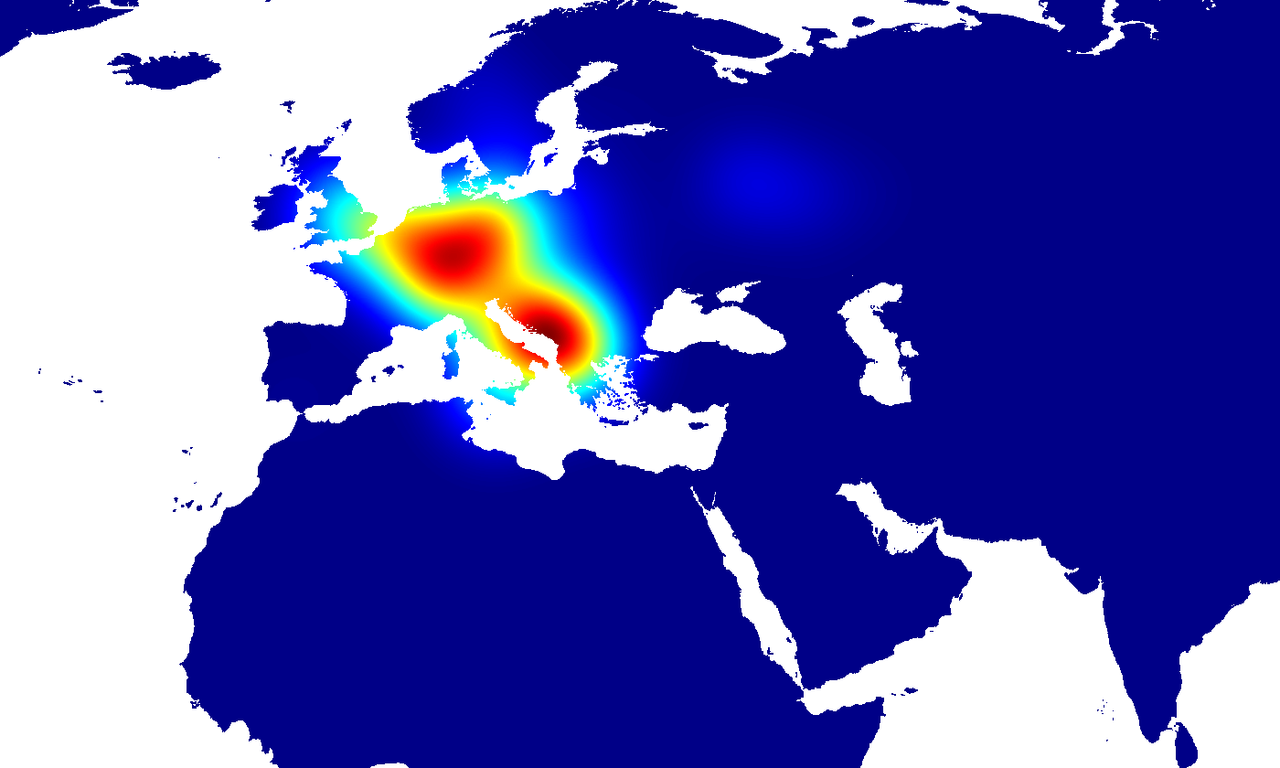
I recently posted some modern-diversity maps, here is what Z597 diversity (over 500 years) was showing

map-diversity-J-Z597.png


Illustrating two expansions, one toward Balkans, and one toward central Europe.

If we split for some subclades:
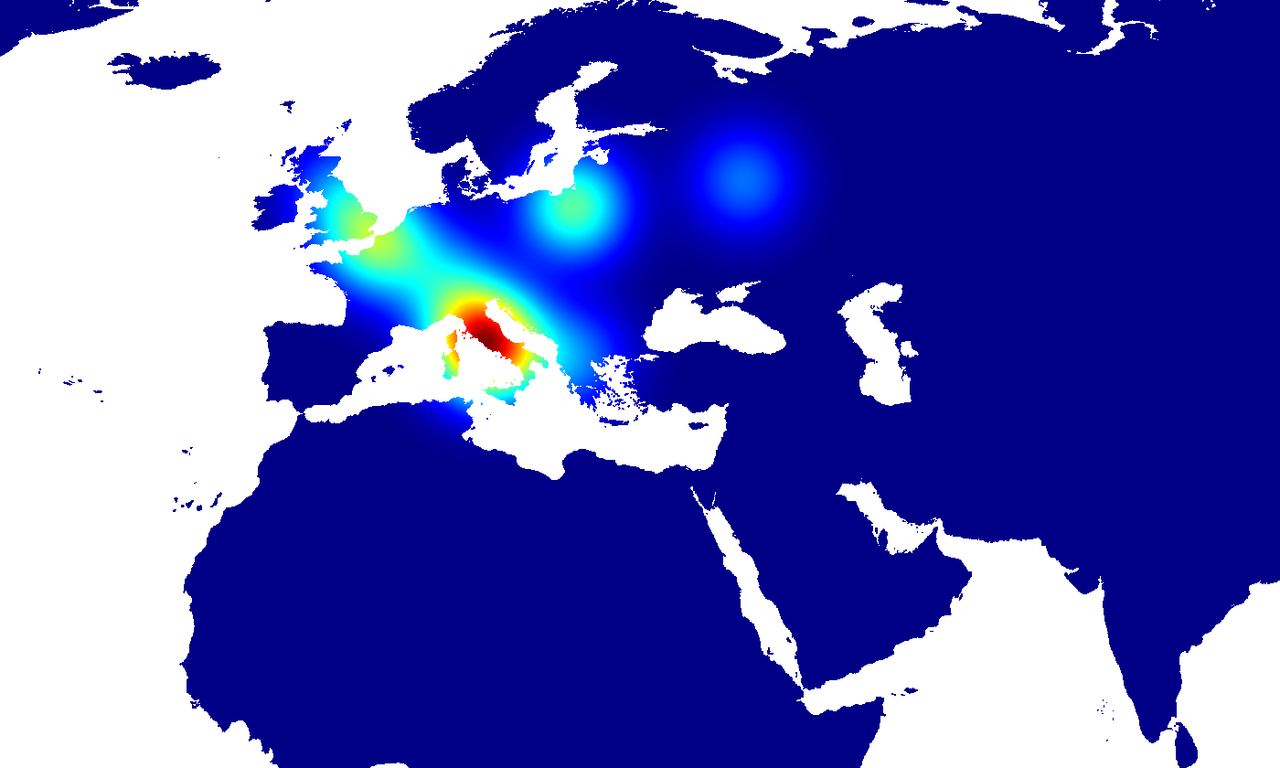
J-Y15058:
map-diversity-J-Y15058.png


Even in such noisy conditions (not a lot of samples), what modern deversity says strinkingly match with what ancient DNA says. The clade is around the adriatic.

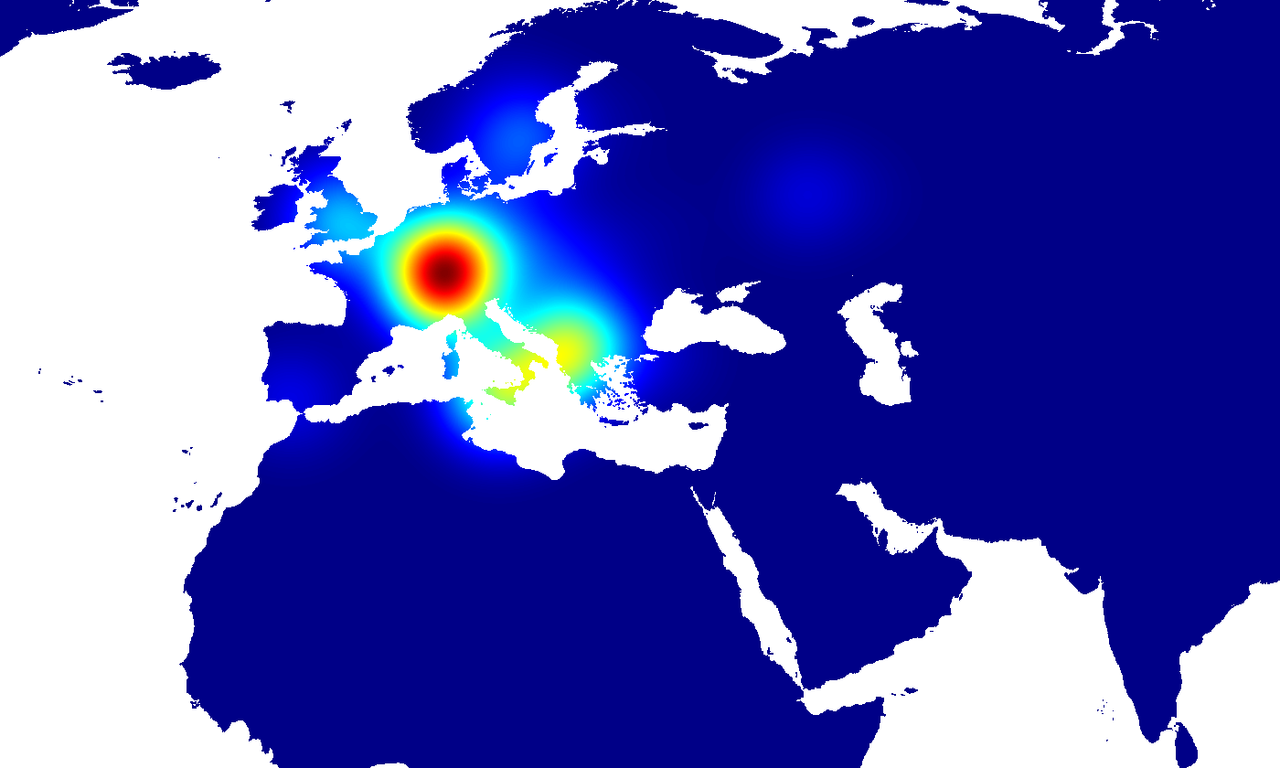
For J-Z638 :
map-diversity-J-Z638.png


We have the main location of diversty around Switzerland, but we also have a bit a signal in southern Balkans, which again correspond to the new study findings, showing that few Z638 expanded there.

Looking at that, we have little to no reasons to have doubts about the diversity probe ...
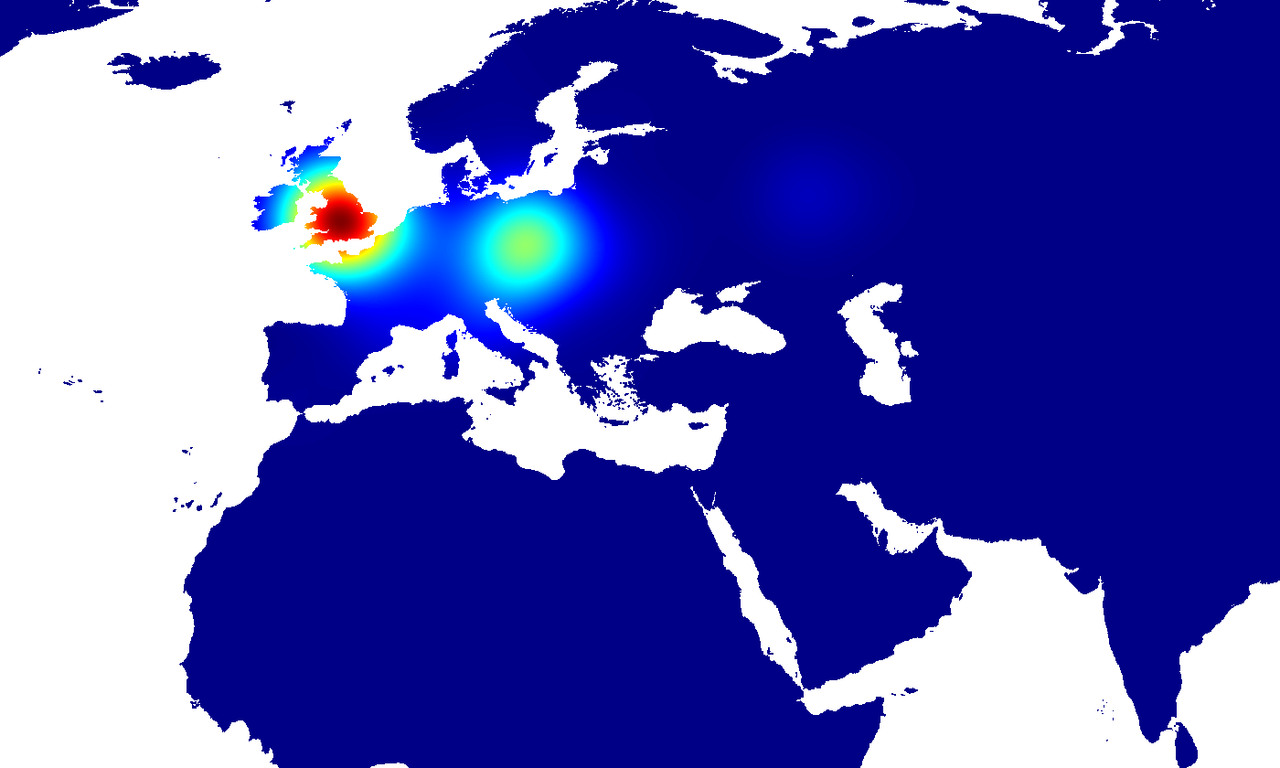
Then, let look at Z631 :
map-diversity-J-Z631.png


The diversity center is in southern Poland (poorly sampled by ancient DNA). There is a spurious diversity center in England, I won't believe that too much. It is caused mainly by over-sampling issues. The same issue that create over-diversity in Albania when using Yfull data.

Thus, I won't be so quick to exclude a central european origin of Z631, in a population yet to be sampled, and it remains unsampled places where they could easily hide.
 

I really like your analysis Ghurier. And if I am honest both theories have their merits at the moment. And I have been devils advocate(because in reality I was in the other camp) in private conversations in the past arguing the possibility of the scenario you are defending.

I would say there is problems with both data sets, yfull and ftdna.
Seeing you know your way around data, you might understand that the ftdna model is flawed, as we are talking about tests of various depths that might hide further classification. Say I might have done a test at the depth of J-M102, at that point despite my test contributing to the sample size, it is not indicative of my terminal clade.
On the other hand as you said, as of now YFULL has sampling biases.

Why I am waiting to see as the data becomes clearer which of the hypotheses comes on top.


But for some reason, maybe whatever machine learning picks up that comes up with such schemas:

main-qimg-5bb64ebb1d515879dd4d2066b6a5930e

has something to do with this?

34tk5b4W

map-diversity-J-Z597.png

map-diversity-J-Z638.png

34tk5b4W


Not sure there is even a way to test.
 
So basically from what I understand most of the Albanian belongs to the branch J-Z638 which also the sample 'I26726' in Croatia belonged to.

I26726, 1461 BCE, Croatia_MBA, Gudnja cave, J-L283>>Z615>Z597>Z638-Z1297 (B440-, Y37818-, Y1421-)

yfull.com/tree/J-Z638/

Basically found on the Adriatic coast, not too far away from Albanian lands, obviously indicating a Western Balkan origin.

There seems to also be some Albanian under the branch J-PH1602 which some of these Illyrian samples belonged to.

I23911, 844 BCE, Croatia_EIA, Smiljan, J-L283>>Z615>Z597>Z38240>PH1602>Y86930
I23995, 743 BCE, Croatia_EIA, Smiljan, J-L283>>Z615>Z597>Z38240>PH1602>Y86930
I24638, 681 BCE, Croatia_EIA, Smiljan, J-L283>>Z615>Z597>Z38240>PH1602>Y86930
I24639, 681 BCE, Croatia_EIA, Smiljan, J-L283>>Z615>Z597>Z38240>PH1602>Y86930

I am just trying to learn a bit here as my expertise is mostly in history. Though from a look Z638 dominates by far.
 
So basically from what I understand most of the Albanian belongs to the branch J-Z638 which also the sample 'I26726' in Croatia belonged to.
yfull.com/tree/J-Z638/
Basically found on the Adriatic coast, not too far away from Albanian lands, obviously indicating a Western Balkan origin.
There seems to also be some Albanian under the branch J-PH1602 which some of these Illyrian samples belonged to.
I am just trying to learn a bit here as my expertise is mostly in history. Though from a look Z638 dominates by far.

Exactly! It's as simple as that. In today's day and age, especially since there is already so many useful J-L283 available, aDNA in combination with modern diversity speak for themselves.
 
I really like your analysis Ghurier. And if I am honest both theories have their merits at the moment.
And I have been devils advocate(because in reality I was in the other camp) in private conversations in the past arguing the possibility of the scenario you are defending.

I completely agree, I'm more aligned with central European origin "yet", but I won't completely rule out a southern origin, even if for me problems with this second theory are bigger than what it solves with the data we have.

I would say there is problems with both data sets, yfull and ftdna.

Seeing you know your way around data, you might understand that the ftdna model is flawed, as we are talking about tests of various depths that might hide further classification.

Depends how deep you want to go.
For instance, when playing with Z597/Z638, I'm fairly confident about diversity even based on FTDNA, because you just need to resolve clades forming right after Z597/Z638.
However, it would be foolish to try to resolve very deep clade that way ... because then diversity is just turning into number-count.


Say I might have done a test at the depth of J-M102, at that point despite my test contributing to the sample size, it is not indicative of my terminal clade.
On the other hand as you said, as of now YFULL has sampling biases.

I was thinking about sampling bias lately ... and there is difinitely no good way to handle that, mainly because differences in population growth is by itself a "sampling bias".

Why I am waiting to see as the data becomes clearer which of the hypotheses comes on top.

Honestly, I was disapointed to see that these new data (11 samples after all) showed so little diversity. Thus, if by end-Bronze-age/early-Iron-age some L283 were in Croatia. This study didn't help much to identify the place of origin, it goes as far at providing a southern 2200bc diversity, and a northern 2400bc diversity.
Which, both can be explained with south-->north or a north-->south migration.

But for some reason, maybe whatever machine learning picks up that comes up with such schemas:

main-qimg-5bb64ebb1d515879dd4d2066b6a5930e

has something to do with this?

I'm very "low" on linguistic questions, not my favorite readings (always had the feeling that it is a bit a "too" interpretative science).
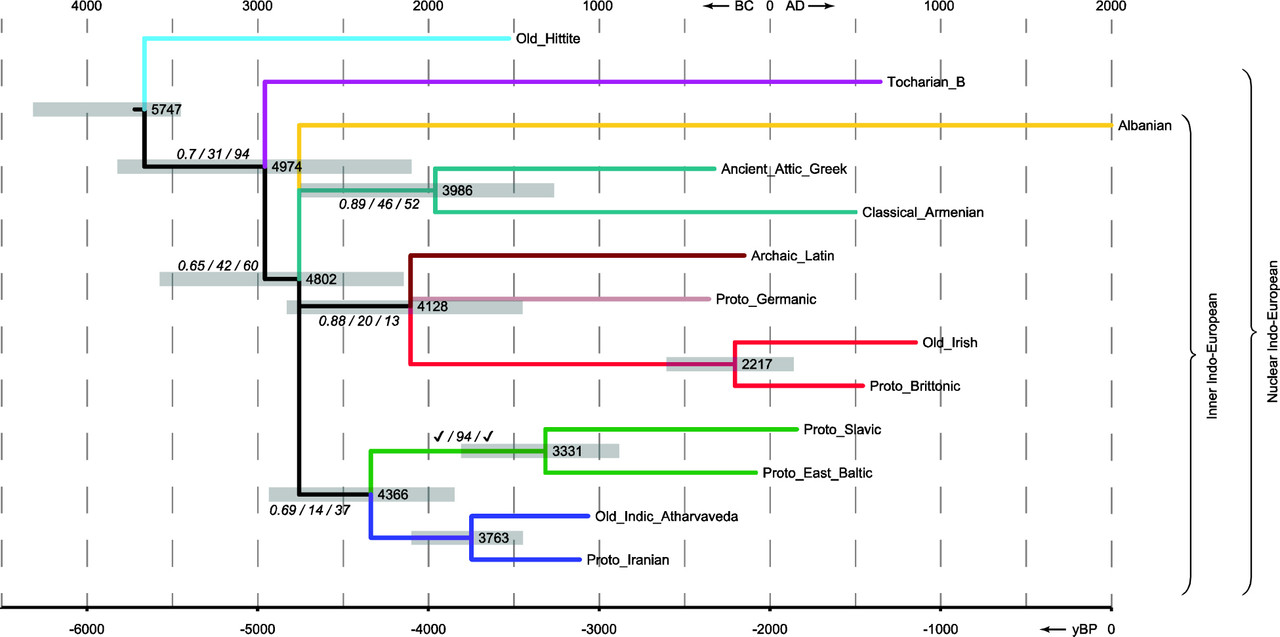
But, if this Germano-Albanian grouping is a real linguistic thing (in my memories Albanian is strongly moving in linguistic trees depending on the authors), then it would look interestingly like the diversity split of Z597 or Z638.
If there is a time-calibrated version of this linguistic tree, it could be insteresting to look a the epoch of this potential Germano-Albanian split if it match Z597/Z638 expansion.

From Kassian et al. 2020 : https://www.degruyter.com/document/doi/10.1515/ling-2020-0060/html

graphic-j-ling-2020-0060-fig-001.jpg


Thus, a split from roughly 3500 to 2000 BC, it roughly correponds to the Yfull ranges for Z597 (3700-2300 BC) and Z638 (3000-1900 BC) diversifications.

But after, we also found some L283 in Etruria and Nuragic Sardinia in EIA ... in such condition one could try to link L283 with non-IE languages.
Thus, I'm not complely sure about what to think of Linguistic based conclusions.


Thrako_Illyrian said:
So basically from what I understand most of the Albanian belongs to the branch J-Z638 which also the sample 'I26726' in Croatia belonged to.

Basically found on the Adriatic coast, not too far away from Albanian lands, obviously indicating a Western Balkan origin.

True, most Albanian are below J-Z638, but it won't be correct to say that All J-Z638 subclades are found in Albania.
Therefore, what this Z638 sample shows, is that around 1400bc, some Z638 (more precisely Z2197) were in Southern Croatia.
However, by the diversification time of Y15058 and Y38240, we know that the main Croatian expansion likely occured around 1800-1700BC, when Z2197 formed in 2200BC.
Similarly, we find a Z2507+ and a Z2507- in Slovenia, clades that got defined arount 2400BC, way before the expansion of Y15058 and Y38240.

Thus, technically with those data we cannot say in which direction was performed the expansion.
Because if we go by this logic of mono-sample reasoning, you have to place Z2507 in Slovenia in 2400BC, but Z2197 in southern Croatia in 2200BC.
By ~2200-2400BC, I would find such migration weird.
Thus I wouldn't say "oviously", this is a possibility. But more samples are needed to comclude.
 
I completely agree, I'm more aligned with central European origin "yet", but I won't completely rule out a southern origin, even if for me problems with this second theory are bigger than what it solves with the data we have.

I know you had a theory about Z631 being Celtic (I'm Z631 too), but it's simply a southern Illyrian marker. That's it. It's spread is certainly mostly linked to the Roman Empire. It likely entered Italy with Messapian migrations.

You say there's "no data". Look in Albania. It's all Z638. It's not a coincidence the southernmost Z638 aDNA marker is from southern Dalmatia, just a few hundred kms from Albania.

If you want to read more about it, read Hunter Provyn's blog (who is also Z631). Google this

First Ancient J-Z631 Found in the Via Salaria Necropolis in Rome
 
I know you had a theory about Z631 being Celtic (I'm Z631 too), but it's simply a southern Illyrian marker. That's it. It's spread is certainly mostly linked to the Roman Empire. It likely entered Italy with Messapian migrations.

That's a "strong" position considering the data we have.
Thus you say that Z631 is a southern Illyrian marker, when diversity is not in southern Illyria and where the only ancient sample we have is from Italy and present a Celtic admixture. Interesting conclusions.


You say there's "no data". Look in Albania. It's all Z638.

That's what I find exhausting about such topic.
The main arguments that can be used rely on:
--> ancient samples location,
--> ancient admixtures,
--> modern diversity.
and most of the time, you see peoples flipping from one argument to another without much reasons other than showing their interpretation is the good one.

On my side, I stick on diversity analyses (and build my model from a combined analysis a the philogenic tree and the diversity), thus I just verifies that ancient samples/admixtures are not incompatible. I prefer to define my methodology and then apply it to find a conclusion, than flipping methodology to support my favorite theory (which produces well known validation biases).

Logically speaking, Albanian being mostly Z638 is no proof that the haplogroup originated there.
Because there is other region with heavy Z638 diveristy. Then finding from which place Z638 migrate, is not that easy.
Going by that reasoning, R1b whould have originated in western Europe, I think we would agree it is not the case ?

If you find a sample by ~1400BC somewhere, if this sample is linked to a clade appearing around 2200BC (Z2197 for exemple), and if in the same area there is good reasons to think that there has been a L283 expansion around 1800-1700BC (Y15058 & Y38240), this 1400BC is of little help to identify the direction of the migration.

Such sample could be a strong argument, but it need dates to "align" in a more clear way, for exemple: if this sample was a J-Y23094 (defined in 1200 BC, post expansion of Y15058/Y38240) from 1000BC ... then it would be a way stronger argument. But Z2197 (defining ~2200BC) found somewhere in 1400BC where a L283 expansion occured around 1800-1700BC, is nearly informationless about migrations.
Truth to be said, same apply to the Z2507- sample, Z2507 got define around 2400 BC, it is found in 666 BC in an area where Y15058 expansion occured ... thus it can fit either with a northern or a southern origin.

Interestingly, the southern Z638 sample would have been a "stronger" argument if the Y15058 samples didn't showed up. Because with these samples, we now know where the 1700-1800BC expansion occured. Before that, it was hard to validate a pre-1300BC expansion in this area, and thus a 1400BC sample would have had way more impact on our reasoning.
This illustrates how "blind" we are with ancient sample when a single one can modify significantly our view ... which encourage to be carefull with strong and definitive statements, because conclusions based on one sample are easily affeceted by statistical noise.

Beyond that, if someone claims that the southern Z638 is proof of an origin of Z638 there, it also have to consider that Z2507 originated in Slovenia (I guess you agree on that ?).
If not, the methodology varies with what the author try to demonstrates (and we exit the world of sience).
Such reasoning imply a Slovenian --> Albania movement from 2400 to 2200BC. I find that migration direction unlikely at that time.
But if we drop the Slovenian sample argument, we have to drop the Z2197 at the same time.

Interpretations of the current data could fit in many models :
--> Z597 around Slovenia, with a southward 1800-1700BC migration containing Y15058 and some Z638 branches.
--> Z597 in the south, with a migration northward in 1800-1700BC containing Y15058 and Z2507-, and some Z638 branches.
--> Z597 in the eastern Balkan, with Z2197 being left on the way when migrating from lower Danube to central Europe around 2200 BC
.
Yet, the new data are saying nothing to separate those models. But we have modern diversity. And modern diversity seems to favored a northern center of diffusion during EIA.
Diversity of Z631 and Z1043 would have hard time to fit with a Roman-based diffusion from Illyria, because the expansion of this clades predates the Romans. Thus, the Romans would have to come in Albania, mainly gather all Z631/Z1043 branches, but without touching other already diffused clades established here. It didn't sound very convincing to me.

Up to now, I was more align with the thinking that western Balkan got "colonised" by some L283 around 1300-1200BC. There is now good arguments to push this date back to 1800-1700BC. But data are not really saying much more than that.
Then, a second wave of L283 probably arrived around 1300-1200 BC (Y86181 for exemple). By that time, one would expect a north --> south migration instead of the opposite.


It's not a coincidence the southernmost Z638 aDNA marker is from southern Dalmatia, just a few hundred kms from Albania.

If you read me, you'll read that I currently think some Z638 arrived in southern Balkan around ~1800-1700BC (before this paper I would have said ~1300-1200BC, but this paper solves the question of the 1800-1700 BC expansion of Y15058 & Y38240).
That is basically what is favoring the diversity map I presented. In fact, this diversity map didn't says anything about the "arrival" date of Z638. But with the 1400BC sample and the Z2197 mutation, we can braket the arrival between 2200-1400BC, and there is now good evidence for a L283 expansion in the western Balkans around 1800-1700BC.

As I said, you jump on the Z638 sample, and you place it in Albania in 2200BC ... but you completely ignore Z2507- & Z2507 samples, that would place Z2507 in Slovenia in 2400.
Sounds like cherry picking to me. In fact these data are unsufficient to conclude definitely.

If you want to read more about it, read Hunter Provyn's blog (who is also Z631). Google this

First Ancient J-Z631 Found in the Via Salaria Necropolis in Rome

Hunter Provyn is doing a great job ... but what he says reflect his own interpretation. Sometimes I agree, sometimes not.
Note that the "Roman" J-Z631 present a western admixture ... in fact, in term of ethnicity his autosomal DNA look more Celtic than Roman.
Thus yet, from the data I know of, we have:
--> Z631 diversity center in central Europe
--> a ~2000 years old Z631 in Rome with a Celtic-like admixture

Here again we enter the magical world of cherry picking:
-When people look at the old J-L283 at Mokrin, if they are supporters of an indo-european origin (which I found far from being convincing with what we have), they will use autosomal DNA to show this dude was carying Steppe ancestry.
-When you look at Sardinian sample, the same peoples won't consider that much the admixture and will get satisfied with a complex admixture cleaning process.
-When looking at Z631 sample, here again, admixture is ignored and only location is retained.

For me, there is something strange about such methodology. It didn't look like science to me, it sounds like ideology, because the criteria that are used are place to validate a model, not to derive a model from the data.
Maybe Z631 will show up as not having its root in central Europe ... but current data are not saying that.

Personnally, I consider modern diversity as a very good proxy. Honestly, I don't know a single case where modern diversity completely fails.
Where, with ancient DNA, you are affected by sampling bias in a very significant way.
Most of the time Ancient sample are found ~500-1000 years post-split, implying an already strong level of migration-based convolution. Ancient samples are like modern diversity, with a bit less convolution but with a huge undersampling.

 
True, most Albanian are below J-Z638, but it won't be correct to say that All J-Z638 subclades are found in Albania.
Therefore, what this Z638 sample shows, is that around 1400bc, some Z638 (more precisely Z2197) were in Southern Croatia.
However, by the diversification time of Y15058 and Y38240, we know that the main Croatian expansion likely occured around 1800-1700BC, when Z2197 formed in 2200BC.
Similarly, we find a Z2507+ and a Z2507- in Slovenia, clades that got defined arount 2400BC, way before the expansion of Y15058 and Y38240.

Thus, technically with those data we cannot say in which direction was performed the expansion.
Because if we go by this logic of mono-sample reasoning, you have to place Z2507 in Slovenia in 2400BC, but Z2197 in southern Croatia in 2200BC.
By ~2200-2400BC, I would find such migration weird.
Thus I wouldn't say "oviously", this is a possibility. But more samples are needed to comclude.

I do not think that anyone ever said that all Z638 is found in Albania nor did anyone talk about any kind of expansion from my understanding. We are merely stating the fact that it was found on the Adriatic coast near Albania is most likely where the Albanian subclades originated somewhere around in the Western Balkans too or developed there and not that the haplogroup originated there. This can also be added together with linguistic research.

Linguistic evidence suggest that Messapic could have been the descendant of an unattested paleo-balkanic language. Based upon lexical similarities with the Illyrian languages, some scholars contend that Messapic may have developed from a dialect of pre-Illyrian, meaning that it would have diverged substantially from the Illyrian language(s) spoken in the Balkans by the 5th century BC.A number of shared features with proto-Albanian may have emerged on their side as a result of linguistic contacts between Proto-Messapic and Pre-Proto-Albanian within the Balkan peninsula in prehistoric times.

en.wikipedia.org/wiki/Messapic_language

This would mean Albanian originated most likely from local Iron Age Western Balkan populations.

Irrelevant of the fact that it would be found anywhere else outside the Balkans or wherever it originated. Even if they found these branches in other places of the Balkans one would have to study further subclades to prove the Albanian came from there IMO.

There are Albanians who fall under those other Illyrian branches too and I haven't seen any of these branches witnessed among Eastern Balkan lands. That's why so far all the evidence points to a Western Balkan origin for J2b2 Albanians from Iron Age populations / Illyrians.

Of course it is also possible J-Z638 did originate in the Western Balkans as that Illyrian is the oldest Z638 found so far.
 
We are merely stating the fact that it was found on the Adriatic coast near Albania is most likely where the Albanian subclades originated somewhere around in the Western Balkans too or developed there and not that the haplogroup originated there.

This is not what you said. You said Z638 originated from there. Which means they were at this location (or nearby) by 2200BC (which a long shot to prove with current data).
To my knowledge, there is no such proof, and the current paper is not proving nor favoring that (in part because of the Z2507- sample).

If your claim, is just to say that Z638 clearly Albanian branches were likely arrived by ~1400BC ... I agree, I would even go as far as saying they were arrived in southern Balkan around 1700BC at least (it is almost a given).
However, this clades are limited to : PH4679 and Y86181. For other, it is not that easy to say when they arrives.


This can also be added together with linguistic research.

I have a strong "opinion" on that. For me mixing Linguistic and DNA is like mixing apples and potatoes.
For sure, there is some correlation, but culture and DNA are different things that do not fully overlap, same apply to linguistic.
For instance, if we go there, ancient L283 are found :
-Illyria : IE language
-Etruria : non-IE language
-Nuragic Sardinia : non-IE-language
It is not really helping, unless you cherry pick your favorite one.

This would mean Albanian originated most likely from local Iron Age Western Balkan populations.

Now you just have to prove that J-L283 (all of them) were speaking Messapic language ... We know that by ~1000bc some L283 were likely speaking Nuragic languages.
Haplogroup migration are not matching perfectly languages ... if you believe the opposite, you are likely among people believing R1b is not a indo-european vector as Basque peoples, heavy in R1b, are speaking a non-indo-european language.

Irrelevant of the fact that it would be found anywhere else outside the Balkans or wherever it originated. Even if they found these branches in other places of the Balkans one would have to study further subclades to prove the Albanian came from there IMO.

You found one sample in the Balkan, Z638 : It is obviously from there, 0% of doubt.
If you found one sample outside of the Balkan : It is from the Balkan too ...
I think it is not a very scientific methodology.

Regarding to finding Z638 somewhere else ... it is found in one single sample yet (700+ years post split, and post expansion of some cousin clades in the same area) ... statistically it didn't says a lot.
And we have an ancestral diversity Z2507/Z2507- at Z597 stage in Slovenia.
Thus again, if you go by that reasoning, you are claiming that Z2507 migrated from Slovenia to Southern Balkan between 2400 and 2200BC.
I'm not buying that version. I would prefer an expansion attested by diversification around 1700BC ... either from North-->South or South-->North.
And looking at diversity, I still put my coin on North-->South.

There are Albanians who fall under those other Illyrian branches too and I haven't seen any of these branches witnessed among Eastern Balkan lands. That's why so far all the evidence points to a Western Balkan origin for J2b2 Albanians from Iron Age populations / Illyrians.

What I'm saying :
--> For sure at least some J-L283 arrived around Albania in ~1800-1700 BC with the expansion of Y15058 and Y38240. These new data are clearly going in that direction. And no, Y15058 is likely not a local devellopement in Croatia ... the diversity found in this recent paper is too low for that, the Sister clades are not here.
--> Likely, some clades arrived around ~1300-1200 BC (Y86181 for exemple).
All these dudes were already arrived at the start of Iron-age, no-one challenges that to my knowledge.
Then, it didn't says anything for all specific clade of J-L283.

For exemple: If you find a R-DF27 in England, it didn't means this clade originated there because R-L21 is there too.
Here your seems to make the assumption that because we can confirm the presence of some L283 clades at a given moment, you says all are from there.
This argument is not logically valid. It didn't says if the conclusion is right or wrong, but the logic you use to reach this conclusion is invalid ...

Of course it is also possible J-Z638 did originate in the Western Balkans as that Illyrian is the oldest Z638 found so far.

Again, if your reasoning is based on this single sample, you have to consider the Z2507- sample in Slovenia.
A question you are not adressing.
 
Yes, I don't think anyone is claiming J-Z638 originated in Albania, although it's certainly possible it was just north of there. IMO, we're most likely looking at the region between Northwestern to North Balkans (including modern Slovenia), where it would've quickly expanded mostly further southward as suggested by ancient I26726, 1461 BCE, Croatia_MBA, J-Z638>Z1297* and the modern diversity/TMRCA of its "brother" J-Z638>Y21045 in the western Balkans. Anything north of there is special pleading at this point.

We can play around with modern diversity maps all we want, but as that old saying goes: "Where is the beef?" Where is the ancient DNA to back it up? Especially when central and northwestern Europe is already far better sampled than the Balkans. If one were to look at USA ~1000 years from now, without being aware of its history, they would model J-Z638, or any J-L283 for that matter, as expanding from the USA as modern diversity is the greatest :) Same thing goes for subclade J-Z638>Z1297>Z631.
 
Back
Top