

Tautalus
Regular Member
- Messages
- 580
- Reaction score
- 1,482
- Points
- 93
- Ethnic group
- Portuguese
- Y-DNA haplogroup
- I2-M223 / I-FTB15368
- mtDNA haplogroup
- H6a1b2y
This paper explores whether ancient human DNA can survive on cave walls and within rock art, a question that has remained open because pigments and wall surfaces rarely preserve biological material. Sampling across eleven caves in Spain and Portugal, the researchers analysed pigments, calcite crusts, unpigmented wall surfaces, sediments, and even a red ochre coated bird bone airbrush. Only one pigmented sample, a calcite crust from Escoural, yielded authentic ancient human mitochondrial DNA, showing clear damage patterns and no accompanying faunal DNA, suggesting direct human contact with the wall. Additional unpigmented wall samples from Escoural and Covarón also contained ancient human DNA, though some were mixed with faunal DNA, indicating indirect deposition through sediment or environmental processes. Nuclear DNA from the Covarón samples was sufficiently preserved to place the individuals firmly within the genetic variation of Western hunter‑gatherers, closely aligned with the Villabruna and Oberkassel clusters. Although direct dating was not possible, DNA damage patterns, haplogroups, and archaeological context suggest that the wall derived DNA is at least several thousand years old and potentially much older. The findings show that cave walls can preserve ancient human DNA, though rarely and in highly localised patches, and they open a new avenue for understanding who moved through and interacted with decorated caves.
Abstract
Previous efforts to link Palaeolithic cultural records to specific populations through DNA analysis have focused on materials from archaeological floor deposits such as bones, sediments, and artefacts. In this study, we explore whether rock art, a spatially distinct expression of human activity, can also preserve DNA traces from its creators. We analyse DNA preservation in pigment samples collected in and around 24 rock art panels from 11 caves across Spain and Portugal, including simple marks (from nine sites), hand stencils (Maltravieso Cave, Extremadura, Spain), and figurative paintings (Cave of Altamira, Cantabria, Spain). We recover traces of ancient human mitochondrial and nuclear DNA, unaccompanied by faunal DNA, from a pigmented calcite crust at Escoural Cave (Portugal), as well as from an unpigmented cave wall sample from the same site. The absence of faunal DNA in both samples suggests direct DNA deposition through human contact. In contrast, three additional unpigmented samples, from Escoural and Covarón Cave (Asturias, Spain), yielded mixtures of human and faunal DNA, suggesting indirect deposition. Although our results do not conclusively link ancient human DNA preservation to the generation of cave art, we show that traces of human DNA can persist on cave walls for thousands of years.
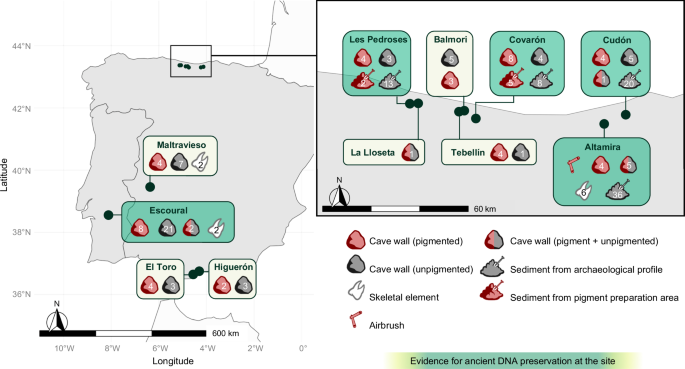
Investigating ancient human DNA preservation on cave walls and in rock art - Nature Communications
Ancient DNA can be preserved on materials from archaeological floor deposits such as bones, sediments and artifacts. Here, the authors investigate whether Palaeolithic wall art can preserve human DNA for study.www.nature.com