-
Don't want to see ads? Install an adblocker like uBlock Origin or use a Europe-based privacy-friendly browser like Vivaldi or Mullvad.
You are using an out of date browser. It may not display this or other websites correctly.
You should upgrade or use an alternative browser.
You should upgrade or use an alternative browser.
Interesting Maps and Graphs
- Thread starter Angela
- Start date

Tautalus
Regular Member
- Messages
- 580
- Reaction score
- 1,482
- Points
- 93
- Ethnic group
- Portuguese
- Y-DNA haplogroup
- I2-M223 / I-FTB15368
- mtDNA haplogroup
- H6a1b2y
Most relevant companies and brands by country of origin
Germany

England

France

Italy

Spain

Netherlands

Belgium

Denmark

Norway

Sweden

Switzerland

USA

Germany
England
France
Italy
Spain
Netherlands
Belgium
Denmark
Norway
Sweden
Switzerland
USA
HereToLearn
Regular Member
I’d nuance the treatment of Trentino. Historically, Trentino was part of the wider Tyrolean/Habsburg space (often called Italian Tyrol or Welschtirol) so its inclusion in a broader “Tyrol” is not baseless. But culturally it is not simply the same thing as German-speaking Tyrol or South Tyrol, and it can also be understood within the broader Triveneto / Tre Venezie framework, especially Venezia Tridentina.Europe historical and cultural regions

More generally, the Italian “cultural” regions on the map seem to track modern administrative regions too neatly. Many of today’s Italian regions contain several distinct historical-cultural areas, so a genuinely cultural map should probably subdivide them more.
Last edited:

Countries in blue (negative scores) have no political polarization at all, meaning that people supporting different political parties can interact in a completely friendly manner. Conversely, the redder a country is on the map, the more hostile people are towards people with different political beliefs.

Duarte
Regular Member
- Messages
- 2,771
- Reaction score
- 2,053
- Points
- 113
- Ethnic group
- Brazilian
- Y-DNA haplogroup
- R-FGC35133
- mtDNA haplogroup
- B2hh1
Analyzing this map requires a certain degree of caution so that you are not misled into thinking that everything that tends towards blue is absolutely good and everything that tends towards red is absolutely bad.View attachment 19581
Countries in blue (negative scores) have no political polarization at all, meaning that people supporting different political parties can interact in a completely friendly manner. Conversely, the redder a country is on the map, the more hostile people are towards people with different political beliefs.
If the blue wave can indicate, in the case of Europe, countries where political differences are resolved in a civilized manner between the parties involved, and the negative score undoubtedly seems to be a good indicator of political sobriety and respect for differences, the blue wave that seems to sweep across parts of Asia and Africa hides a harsh reality of places where, if you don't behave amicably towards those in power, you will be running serious personal, professional, and even life-threatening risks. Being friendly in these places is a matter of survival. You cannot and should not enter into conflict with those in power, unless you are not smart enough to value your personal well-being and that of your family. Indeed, to cite just a few examples, it is well known that there are no political parties or political freedom in Saudi Arabia, Oman, or the United Arab Emirates. These countries are absolute monarchies that formally prohibit political parties and opposition groups. In China, the Communist Party of China is the leading political force of the state and society, and other parties recognize the leadership of the Communist Party and operate within an official system of "multiparty cooperation and political consultation" where they do not compete for power with the Communist Party but assist in the administration of the state. In Uzbekistan and Turkmenistan, all official Parties are strictly loyal to the government, and there is no real opposition. And the list about the contradictions of the Blue Wave on the map could go on pointed if I wanted.
HereToLearn
Regular Member
To my mind, the treatment of Italy looks rather arbitrary. It is as though the author knew in advance what the map was supposed to look like, but had no real idea how to distinguish between different areas except by relying on a stereotypical south-to-north gradient. Southern parts of Lombardy louder than its northern parts? On what basis? Campania quieter than Basilicata? I find that very hard to believe. Etc. etc.

Rapid urbanisation: in 2000, there were only two African cities with more than 5 million inhabitants; today there are nearly twenty, and by 2050 there will be twice that number. There are already 106 African cities with at least 1 million inhabitants!
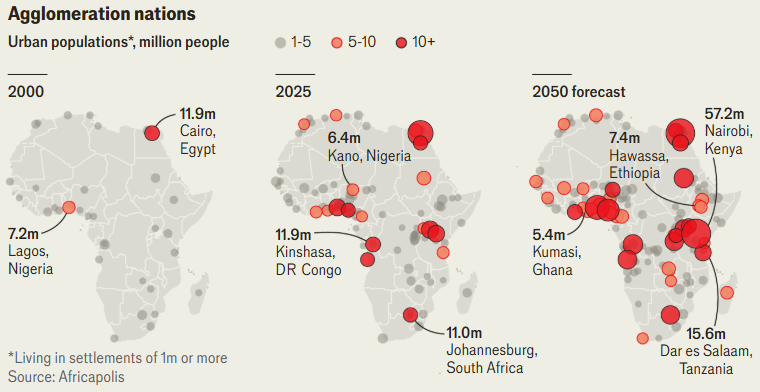
The craziest thing is that Kenya currently has a population of 58 million, but by 2050 its capital, Nairobi, alone is projected to have a population of 57 million! It's hard to imagine a single city with the current population of Italy (and by 2050, the population of Italy will have shrunk to 54 million).
The craziest thing is that Kenya currently has a population of 58 million, but by 2050 its capital, Nairobi, alone is projected to have a population of 57 million! It's hard to imagine a single city with the current population of Italy (and by 2050, the population of Italy will have shrunk to 54 million).