• Don't want to see ads? Install an adblocker like uBlock Origin or use a Europe-based privacy-friendly browser like Vivaldi or Mullvad.

Genetic study Genetic portrait of Piast Dynasty

Tomenable

Well-known member
Messages
6,012
Reaction score
1,732
Points
113
Location
Poland
Ethnic group
Polish
Y-DNA haplogroup
R1b-L617
mtDNA haplogroup
W6a
The genetic portrait of the Piast Dynasty

This project aims to unravel the genetic portrait of the Piast Dynasty, the first historical ruling dynasty of Poland, which reigned from the 10th to the 14th century. By employing advanced genetic analysis techniques, including DNA sequencing of ancient remains, this study seeks to uncover the hereditary characteristics and ancestral origins of the Piast rulers. This research not only provides a deeper understanding of the genetic makeup of one of Europe's formative dynasties but also offers significant insights into the broader historical and migratory patterns in medieval Europe. The findings from this project are expected to enhance our comprehension of early European dynastic histories and contribute to the fields of genetics, archaeology, and medieval studies, thereby enriching our knowledge of cultural and biological heritage.

PRJEB78346


Secondary Study Accession: ERP162650
Study Title: The genetic portrait of the Piast Dynasty
Center Name: Institute of Bioorganic Chemistry Polish Academy of Sciences
Study Name: The Piast Dynasty
ENA-FIRST-PUBLIC: 2025-05-29
ENA-LAST-UPDATE: 2025-05-29
 
Apparently the Piast dynasty belonged to Y-haplogroup R1b-P312>U152 although one (or two?) non-paternity event affected one branch which became R1a.

1748892064209.jpeg


This is consistent with the test done in 2017 on the remains of Janusz III of Masovia, which were already found to belong to haplogroup R1b, although the clade was not yet determined at the time.

Someone posted the results on the Piast family tree on Twitter.

1748892180269.jpeg


The R1a-Z280 individual is Casimir I of Warsaw (pl: Kazimierz I warszawski; 1329/31 – 1355), who was just a prince and never king of Poland.

I am not sure who are the R1a-M458 > CTS11962 individuals in the first image.
 
Last edited:
According to Figlerowicz the main line of the Piasts was R1b-S747 (in ancient DNA found among the Picts and today mainly in the UK):

[R1b-S747 is also known as R1b-L1335]

SKJAHqf.jpeg


2ZddE2R.jpeg


Csg0ZnS.jpeg


However, another geneticist Michal Golubinski checked Piast DNA samples published at ENA and he thinks that it was rather R1b-U152.

We will see who is right in near future.
 
Also it can be added that the oldest tested Piast (PIAST01) is either Wladyslaw Herman or Boleslaw III Krzywousty.

So we don't know if there were any non-paternity events among previous Piasts between Mieszko I and Boleslaw III.

There is a theory that Krzywousty was not a biological son of Herman.

So it is possible that there was a NPE just before their PIAST01 lifetime.
 
Last edited:
But shouldn't it be possible with IBD to check if PIAST05 was either grandson or great-grandson of PIAST01?

In such case, it should be possible to establish if PIAST01 is Herman and Krzywousty. Why couldn't they do it?
 
From another forum:

“PIAST02 dated to 1113, with an estimated age of 40 years, would perfectly match Zbigniew, the first-born son of Wladyslaw Herman and his first Polish wife, Przeclawa.”

But I doubt this. Zbigniew was probably buried somewhere else.
 
Last edited:
According to Figlerowicz the main line of the Piasts was R1b-S747 (in ancient DNA found among the Picts and today mainly in the UK):

[R1b-S747 is also known as R1b-L1335]

However, another geneticist Michal Golubinski checked Piast DNA samples published at ENA and he thinks that it was rather R1b-U152.

We will see who is right in near future.

R1b-L1335 doesn't seem very likely as it's found mostly in the British Isles.
 
This Pictish sample is LUN004.
 
R1b-L1335 doesn't seem very likely as it's found mostly in the British Isles.
Among 3026 male participants of Genomic Map of Poland project there is nobody with R1b-L1335.

However, among FTDNA customers there is at least one family from Poland with R1b-L1335.
 
Lucas Lapinski in the Genetic Genealogy Facebook group:

“Are the Piasts a family from the R1b group?
Not necessarily.

I calmly analyzed the scraps of knowledge we got from the source data over the weekend, and the Monday conference.

What we know for sure:
1. 33 burials were analyzed that were classified as "Piasts"
2. the data of a dozen or so Y-DNA samples were given, from which we have haplogroups R1a and R1b
3. the lineages of three of the five sons of Boleslaw the Wrymouth have been examined
4. we have no data from generations earlier than Boleslaw the Wrymouth
5. we don't seem to have even a sample of the Wrymouth himself (the dating of the sample completely disagrees).

Undeniably, the offspring of the duke's youngest son - born after his father's death - Casimir “the Just”, belonged to the male group designated R1b. We do not know if Casimir himself, but certainly already his son Konrad the Just, whose sample was marked as No. 05 - YES.
Only Konrad's great-great-grandson Casimir I Trojdenovic turned out to be a “R1a side-shot", all the others - samples 5, 11, 13, 15, 16 and 17 are R1b.

While quantitatively R1b prevails, counting the filial lines themselves, a serious doubt is introduced:

1. the son of Krzywousty Casimir senior (+1131), who died young, marked as sample 02, is Haplogroup R1A
2. the son of another of Krzywousty's sons, Boleslaw the Curly - Prince Leszek - sample 03 - is also Haplogroup R1A

If we do not have a confirmed and researched descendants of the Greater Poland line of Mieszko “the Old” or the eldest son - the Silesian line of Wladyslaw the Exile, which will confirm the R1B (or R1A) line, then as of today we only know that not the Piasts belonged to the R1b line, but specifically the Piasts of the Mazovian-Cuyavian line from the line of the posthumous child, about which we can not be sure whether he was the son of the Wrymouth (he was not even included in the will)

* TWO LINES of Boleslaw the Wrymouth's descendants belong to haplogroup R1A.
* TWO LINES are still unexplored.
* ONE LINE of the Wrymouth's descendants are carriers of the Y chromosome of haplgroup R1B.

This much we know as of today.

Having experience in Y-DNA research for more than a dozen years, I am very cautious about such revelations.
I don't know if I'm reasoning correctly. Please correct me if I am wrong.

Below is my summary, and from a slide from the conference

Translated with DeepL.com (free version)"

3X4UNL6.jpeg


UB6qvx0.jpeg
 
Last edited:
Lapinski wrote:

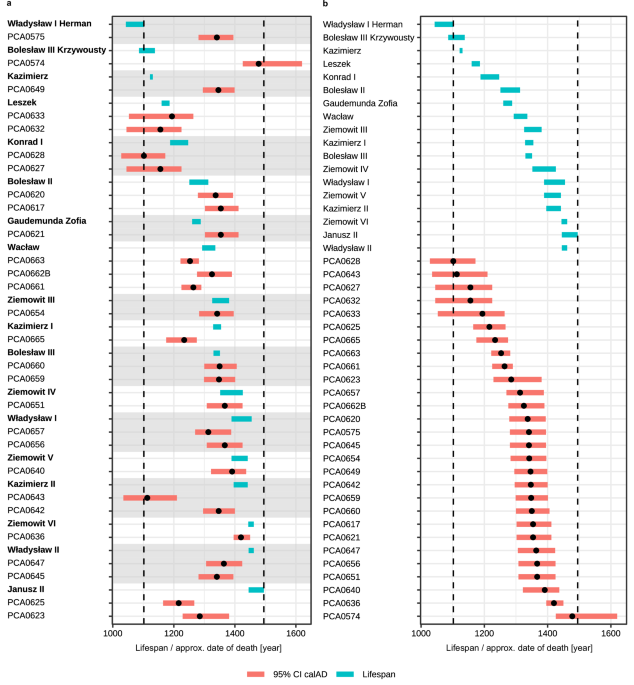
5. we don't seem to have even a sample of the Wrymouth himself (the dating of the sample completely disagrees).

He is talking about this slide from the conference:

OCUP2wD.jpg
 
On the other hand, PIAST02 died at age around 40 according to this slide:

LINK

So it seems that he could not be Kazimierz (who died as a child at age 9).

We will see who is who when the paper is published in Nature Communications.
 
This reminds that infidelities were relatively common, even among royal families and that we cannot assume that entire Y-DNA lineages remained unchanged over long periods of time.

Once the paper is published and we know exactly who is who, I'd like to retrace all the mtDNA genealogies of all the associated royals and aristocrats. It will also serve to confirm the identification of other remains in the future.

For my part I find it frustrating that the two Piast lines from which I descend happen to be exactly the two sons of Bolesław III that were not tested, namely the lines of Władysław II and Mieszko III.
 
Last edited:
R1b-S747 was an incorrect assignment as it turns out, the Piasts have nothing to do with the Picts:


"So what conclusion can be drawn? According to the archaeologist, in light of the currently available, incomplete data, it is incorrect to establish the haplogroup of the Piasts as R1b-S747 and connect it with the Picts from Scotland. - Instead, it can be said that at least one of their lines (Kuyavian-Masovian) belonged to haplogroup R1b. It was present in Polish lands even before the arrival of the Slavs. This would rather indicate the local origin of the Piasts. That is, quite different from what Prof. Marek Figlerowicz and his team suggest,” Dr. Blaszczyk points out."

Translated with DeepL.com (free version)
 
"although one (or two?) non-paternity event affected one branch which became R1a."

There is no NPE detected.
The difference in haplotypes is caused by wrong identifcation of remains, wrong remains in the graves and some remains which were examined, are not Piasts' graves. Which one is which has not been yet revealed, and in some cases the people who made the research did not know themselves with what do they deal. In some gaves are buried for example Plock's bishops, and some of them are most likely idetifiable by comparing to the results of the known Y of distant family members.
 
There is no NPE detected.
The difference in haplotypes is caused by wrong identifcation of remains, wrong remains in the graves and some remains which were examined, are not Piasts' graves. Which one is which has not been yet revealed, and in some cases the people who made the research did not know themselves with what do they deal. In some gaves are buried for example Plock's bishops, and some of them are most likely idetifiable by comparing to the results of the known Y of distant family members.
I am also curious as to who the remains of the two J2a samples belong to? PCA0618 and PCA0619 both belong to J2a.

Hopefully the paper will explain once it is published.
 
Hopefully the paper will explain once it is published.

I don't think so. It may do more harm than good.
Figlerowicz is clueless. He doesn't know what he is doing.
The best what is expected from his work is correct data, and nothing more.
But even this is not expected to be 100% correct.
 
Hello all. I recently received an update to my big Y results on familytree dna. I am down stream of U152 to a rare or under tested branch (minor subclade) that so far only 2 people have ever tested for

The update showed that I have 4 new Rare connections to people in the Piast dynasty.

The first two samples,
PCA0252 and PCA0660 say that only 29 other people are this closely related and it’s a “rare connection” 1 in 24000

The next two ,
PCA0659 and PCA0665 say the same thing except there’s 52 other people that are this closely related and it’s 1 in 13000

Familytree dna says that more information about these connections that I have will be added soon.
 
The article has been published:


"Here we present an interdisciplinary investigation of Piast necropolises scattered throughout Poland. Within eight sites, we find 33 sets of skeletal remains likely to belong to the Piasts. Archaeogenomic analyses confirm the identities of ten as Piasts. Based on genomic data obtained for them, we determine the mitochondrial haplogroups of more than 200 historical figures from 10 European royal dynasties. The Y haplogroup lineage identified in the Piasts (R1b-BY3549) is currently rare. The same Y haplogroup lineage in databases of ancient DNA is found in three individuals who lived in North-Western Europe (present-day France, the Netherlands, and England). Together, these findings may suggest that the Piasts were of non-local origin and support the hypothesis that the state-building processes occurring in the 9th-11th centuries in East-Central Europe were induced not only by local elites but also by foreigners."

I'm surprised that the authors did not mention the possibility of Lugian or Vandal origin of this lineage.
 
Back
Top