• Don't want to see ads? Install an adblocker like uBlock Origin or use a Europe-based privacy-friendly browser like Vivaldi or Mullvad.

E-V13 Frequencies and New Data

E-V13 from the Timacum Slog, Viminacium and Himera
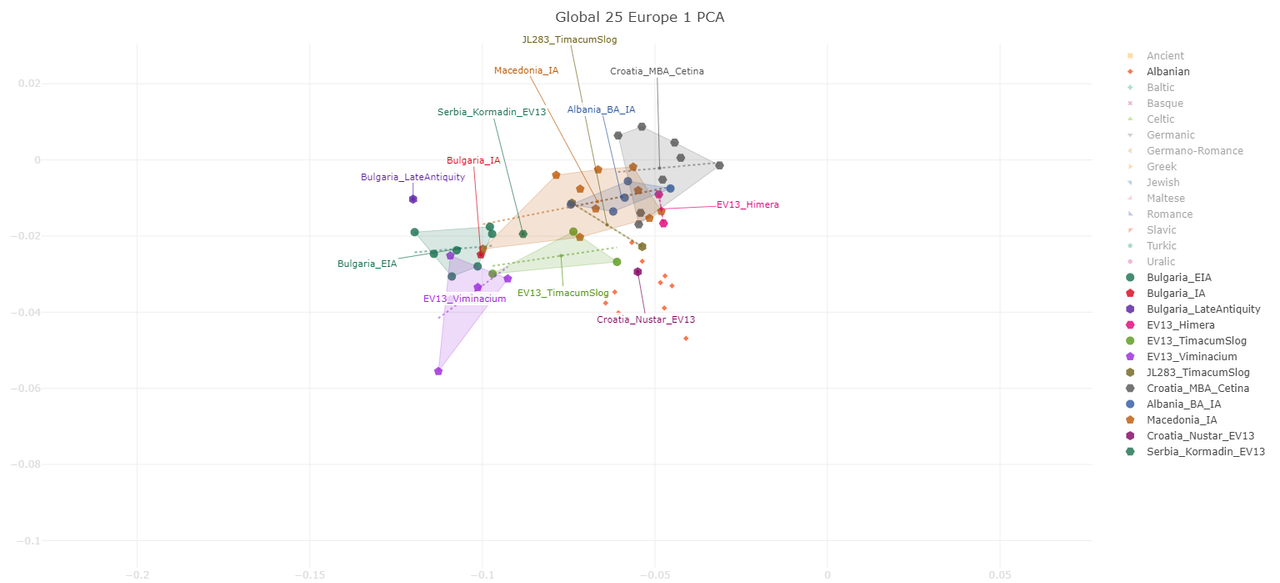
Vahaduo-Global-25-Views-1.png
 
With the new tools from YFull, its easier to use YFull data for maps and statistics. Unfortuanately, it is, for many regions/people, a much smaller or sometimes skewed data base, but it remains very useful and a great addition to our toolkits in any case.

For the E-V13 debate I used the maps showing the frequency of the main branches in a direct comparison. I think the general trends and modes of expansion for the main branches are pretty obvious on these frequency maps, actually.

First the maps without the routes:

E-V13-branches-map.jpg


Second with the routes for their main expansions:

E-V13-branches-map-w-routes.jpg


It is absolutely apparent that E-Z5017 had the latest/strongest core expansion within E-V13. I think this goes back all the way to the Belegis II-Gáva into Basarabi transition, but being accelerated by the South Dacian expansion in the Late Iron Age and the Vlach expansions in the Early Medieval period.

E-BY5022 being obviously among the first to have its peak expansion, and then being pushed to and distributed rather on the fringes of the East, with some expansions into the North West in the Roman area of secondary order.

Compared to both E-Z5018 and E-BY5022, the E-Z5017 "core strength" is very remarkable. The data on Ukraine and Russia is very bad on YFull, by the way, because of the many minorities and low ethnic Ukrainian testing in particular.
 
Adding to my last post some statistics and numbers from YFull, which main advantage is that E-BY5022 being reported in comparable numbers directly, due to the lack of predictions for other branches, and the higher numbers of testers from some regions, most notably Albania - on the contrary, the representative character of the testers is very bad for Ukraine and Germany, among others. The data base is pretty small, but most of the results are rather consistent and add up.

Anyway, here are some numbers - I always compared the main branch with the E-V13 total, to get a relative share of the specific main branch in the total E-V13 population. This is sometimes more important than the total regional frequency:

E-V13-branches-numbers.jpg


Looking at Romania, it is the only country which is in the top group of all main branches - its E-V13 population practically exists only of main branches (Z5018, Z5017, BY5022). That's remarkable because its not the case for any other country. Interestingly, 1 out of 2 Romanian BY5022 members comes from the Eastern part of the country - BY5022 being also present in Moldova. The data base is super small, but this might point to BY5022 being more common in the East, especially since Z5017 totally dominates South Western ethnic Romanians in particular.

The whole area from Romania-Bulgaria through to the West Balkan is completely dominated by E-Z5017. E-Z5017 cuts through E-Z5018 dominated areas, with Z5018 being still high in most of these areas. But it looks like it expanded "inside-out", on top of E-Z5018, from the South Dacian core (Southern Romania-North Eastern Serbia-Northern Bulgaria) of Basarabi and later Vlachs.

Armenia is interesting because it has so little Z5017, but received both from the North Z5018 and from the South-Greeks E-BY5022 at comparatively high levels. E-BY5022 peaks in Armenia, Syria and Iraq. Armenia with access to steppe influx has a lot of Z5018 as well, whereas otherwise BY5022 is far better represented in the Near East than Z5018 compared to European numbers.

England has a similar situation to Armenia, just being less extreme and more diverse, but still Z5018 and BY5022 being both significantly above average, pointing again to two different routes/origins of the branches.

We therefore have the following situation:
- The earliest expansion was of E-BY5022 which was concentrated in South Thracians. Its main routes of expansion were to the South East (Greece, Cyprus, Near East) and over sea (South Italy, but also Portugal and England).
- The next was that of E-Z5018, which gained a dominant position in much of E-V13 territories, likely due to its association with the Gáva-related Channelled Ware expansion. It had two very big expansion routes, one into the South Balkans (Albanians, Greeks), the other along the Danube Westward into Central Europe and to some degree also into Northern Italy.
- At the same time E-Z5017 made its big appearence, mainly with CTS9320, likely starting from Belegis II-Gáva or Vartop of the Southern Channelled Ware groups. It however did expand signfiicantly on top of the existing Z5018 layers, especially from Basarabi, into the South Dacian, into the Vlach periods, made its biggest impression on the very core zones of the Dacians, and from there into the West Balkans later, especially with the Vlachs.
 
E-M78/E-L618 in the Late Neolithic to pre-steppe Eneolithic period:

A map showing the most relevant groups with multiple samples:

E-L618-Neolithic-Eneolithic.jpg


The Southern Sopot sample is an earlier outlier, the later samples before the Eneolithic/steppe transition are all along the Danube-Tisza Eastwards towards West Ukraine. The highest concentration of E-L618 samples being so far from Late Lengyel at the Danube, over Tiszapolgar-Bodrogkeresztur, into Northern Tripolye-Cucuteni:

E-L618-Neolithic-Eneolithic2.jpg


Source for the map:

From the North Pontic paper:

Such as, Y chromosomal lineage diversity in the Epicardial culture of the Cardial Ware complex of the Neolithic Mediterranean
shows Near Eastern influence and Cardial/Epicardial mtDNA lineage frequencies and diversity
are comparable to those from Near Eastern Pre-Pottery Neolithic B sites142. A bearer of the
E1b1b1a1b1 haplogroup belonging to the Cardial Ware archaeological complex was reported
from the Croatian Zemunica Cave in western Balkans 8. Cardial Ware complex is considered to
have influenced the Late Neolithic-Eneolithic Hamangia culture of the west-northwest Pontic
143. Hamangia, in turn, is considered to have influenced the formation of Precucuteni-Trypillia A
144. The presence of the E1b1b1a1b1 lineage in Trypillia and a proto-Usaove individual
strengthens the link between Hamangia and CTAC as well as CTAC and Usatove and connects
the genetic ancestry of CTAC and Usatove with Cardial Ware.


Therefore we have a direct path, leading from early Impresso-Cardial settlements into the Danubian-Carpathian groups. Hamangia culture/Precucuteni:

1920px-Neoliticul_mijlociu_in_Romania.jpg


Tripolye-Cucuteni is also so important, because its the direct link to the Daco-Thracian customs of invisbile burials, cremations and disarticulated bodies. Short AI answer on the issue:

Did Cucuteni–Tripolye cremate or hide burials?
Likely yes — burial customs were mostly invisible, with rare inhumations and some symbolic cremation or body disposal.
Were there precursor groups with similar burial customs?
Yes — Vinča, Pre-Cucuteni, and Karanovo had similarly sparse burial evidence.

We see a direct line of evidence for the continuation of this practise from:
Pre-Cucuteni -> Tripolye-Cucuteni -> Cotofeni/Glina-Schneckenburg-> Makó/Nyirseg -> Eastern Otomani-Gyulavarsand/Wietenberg/Verbicoara-Tei -> Suciu de Sus-Lapus-Igrita -> Gáva-Holigrady, Belegis II-Gáva, Vartop, Insula Banului, Babadag -> Kustanovice, Sanislau-Nir, Bosut-Basarabi, Psenichevo -> Daco-Thracian historical cultures, especially North Thracians/Dacians and Daco-Carpi, even Daco-Romans to some degree before Christianisation/full Romanisation (Viminacium!)
 
RivermanWith the new tools from YFull, its easier to use YFull data for maps and statistics. Unfortuanately, it is, for many regions/people, a much smaller or sometimes skewed data base, but it remains very useful and a great addition to our toolkits in any case.

For the E-V13 debate I used the maps showing the frequency of the main branches in a direct comparison. I think the general trends and modes of expansion for the main branches are pretty obvious on these frequency maps, actually.

First the maps without the routes:

E-V13-branches-map.jpg


Second with the routes for their main expansions:


E-V13-branches-map-w-routes.jpg


It is absolutely apparent that E-Z5017 had the latest/strongest core expansion within E-V13. I think this goes back all the way to the Belegis II-Gáva into Basarabi transition, but being accelerated by the South Dacian expansion in the Late Iron Age and the Vlach expansions in the Early Medieval period.

E-BY5022 being obviously among the first to have its peak expansion, and then being pushed to and distributed rather on the fringes of the East, with some expansions into the North West in the Roman area of secondary order.

Compared to both E-Z5018 and E-BY5022, the E-Z5017 "core strength" is very remarkable. The data on Ukraine and Russia is very bad on YFull, by the way, because of the many minorities and low ethnic Ukrainian testing in particular.

Repost since the images were gone.
Also repost of the statistics from YFull:

E-V13-branches-numbers.jpg


I want to bring a very interesting use case by Victor Sava, to which he believes that Channeled-Ware initially started in MBA as part of numerous styles in Balkan-Carpathian complex to which in LBA it became dominant, it is likely that these southern migrants from Southern Carpathia migrated North in former Ottomany-Fuzsezabony territory to form the actual Gava Culture.

The new radiocarbon dates from the Late Bronze Age settlement in Șagu-Site A1_1 offer a new perspective on the emergence and distribution of channelled pottery. The association of radiocarbon dates with pottery coming from clear contexts proves that channelled pottery appeared in significant amounts as early as the 16th century BC. is circumstance also has an impact on the inner chronology of the Cruceni-Belegiš pottery, with the new available data outlining once more the lack of a clear definition regarding the evolution of this pottery style. At the same time, this early dating of the channelled pottery uncovered in Șagu leads to a reassessment of the origin and distribution patterns of this pottery decoration technique within the entire eastern Carpathian Basin.


The transition from Füzesabony is a critical event, but the most likely scenario is that local groups, possibly with Wietenberg connections and Nyírség ancestry, survived and from those Suciu de Sus emerged, which is the most important group in the North.
 
A showcase of the armour and weapons of Ancient Thracians.

513532391_1124006713090911_2595523061457389565_n.jpg


513934996_1124006833090899_1384165162819716621_n.jpg


504380894_1124006906424225_3442241382634789025_n.jpg


514347313_1124007059757543_968755162778486091_n.jpg


511077781_1124007366424179_981468648096404944_n.jpg


514348617_1124006739757575_1730589952593067673_n.jpg


514344234_1124007333090849_7811545577565569134_n.jpg


504380346_1124007023090880_107093192735443282_n.jpg


504381833_1124007663090816_8974837026620979590_n.jpg


514670280_1124007393090843_7679802035184341623_n.jpg


514349853_1124007609757488_7449485169311000481_n.jpg


514647483_1124007186424197_5817496319665608480_n.jpg


513532391_1124006713090911_2595523061457389565_n.jpg


Thracian greaves.

528525271_1164843772337661_941501158583314454_n.jpg
 
As for what's considered typical or not: E1b isn’t your standard Anatolian Neolithic Farmer lineage. It actually comes from an African origin through North Africa and Natufian populations, and was later absorbed by the original Anatolian farmers, who were mostly G2a, H2, and C1a-V20.

Well, no need to engage further cringey.

Screenshot 2025-08-13 at 13.12.15.png
 
Well, no need to engage further cringey.

View attachment 18631

Why would you compare the Natufians to the "Mesolithic Caucasus people"? And the claim that the Natufians laid the foundations for the Neolithic Revolution is not conclusive and to an extent even absurd. That claim would be much more in favour of the Anatolian Hunter-Gatherers/ANFs. Obviously the had the biggest population explosion which led to their rapid expansion, mainly into Europe, but also to the Middle East (Anatolia is not in the Middle East btw). Making this possible was an advanced agriculture, obviously more advanced than that of Levantines. Besides, the environmental and climatic conditions in Anatolia were much more suited for the development of agriculture than the Levantine desert with its scarce river systems. The history of the entire ME was heavily shaped by the struggle over water ressources, right up to this day. Entire religions and deities emerged out of that struggle. The ANFs and their descendants, the EEFs, gave birth to a number of "micro-civilisations." But somehow the "possible evidence" that the Natufians were the first to cultivate wheat and produce bread led to the conclusion that they started agriculture. And even if they did start it, the comparison to some hunter-gatherers from the Caucasus would not be appropriate.
 
Why would you compare the Natufians to the "Mesolithic Caucasus people"? And the claim that the Natufians laid the foundations for the Neolithic Revolution is not conclusive and to an extent even absurd. That claim would be much more in favour of the Anatolian Hunter-Gatherers/ANFs. Obviously the had the biggest population explosion which led to their rapid expansion, mainly into Europe, but also to the Middle East (Anatolia is not in the Middle East btw). Making this possible was an advanced agriculture, obviously more advanced than that of Levantines. Besides, the environmental and climatic conditions in Anatolia were much more suited for the development of agriculture than the Levantine desert with its scarce river systems. The history of the entire ME was heavily shaped by the struggle over water ressources, right up to this day. Entire religions and deities emerged out of that struggle. The ANFs and their descendants, the EEFs, gave birth to a number of "micro-civilisations." But somehow the "possible evidence" that the Natufians were the first to cultivate wheat and produce bread led to the conclusion that they started agriculture. And even if they did start it, the comparison to some hunter-gatherers from the Caucasus would not be appropriate.

Because there is very strong reasons to state who kickstarted the first human revolution, it was the Natufians, they laid the foundations for the agriculture, if u compare Mesolithic times, Natufians were the forefront of human innovations, I hate comparisons but i have to pinpoint this because there is a tendency at downplaying Natufians, it was not the Anatolian HG who started, they adopted it slowly by Natufian-derived populations mixing with Anatolian HG, respectively PPNA and PPNB in Northern Levant and South-East Anatolia corridor. And yes, afterwards Early Neolithic Revolution it was the Anatolian HG who became prominent and became dominant in Europe as well, scaling the farming into a real civilization-shaping force while the Natufians were more proto-farmers and proto-civilization.

Natufian Culture started declining at the dawn of Mesolithic to Neolithic transition due to climate changes, the Younger Drias climate change. Well, things happen, natural causes in quite some cases shifted the course of history.

Prior to Mesolithic time, in Paleolithic Egypt we find the world's first flint mining which is crucial for creating sharp and durable tools necessary for farming. There is strong clues that these Paleolithic Egyptians were the ancestors of latter Natufians in Levant, at least paternally.
 
Last edited:
Because there is very strong reasons to state who kickstarted the first human revolution, it was the Natufians, they laid the foundations for the agriculture, if u compare Mesolithic times, Natufians were the forefront of human innovations, I hate comparisons but i have to pinpoint this because there is a tendency at downplaying Natufians, it was not the Anatolian HG who started, they adopted it slowly by Natufian-derived populations mixing with Anatolian HG, respectively PPNA and PPNB in Northern Levant and South-East Anatolia corridor. And yes, afterwards Early Neolithic Revolution it was the Anatolian HG who became prominent and became dominant in Europe as well, scaling the farming into a real civilization-shaping force while the Natufians were more proto-farmers and proto-civilization.

Natufian Culture started declining at the dawn of Mesolithic to Neolithic transition due to climate changes, the Younger Drias climate change. Well, things happen, natural causes in quite some cases shifted the course of history.

Prior to Mesolithic time, in Paleolithic Egypt we find the world's first flint mining which is crucial for creating sharp and durable tools necessary for farming. There is strong clues that these Paleolithic Egyptians were the ancestors of latter Natufians in Levant, at least paternally.

I'm not downplaying the Natufians but they didn't quite make the leap some people think they did. They were still a population of hunter-gatherers. Anatolian HGs did not develop agriculture through mixing with Natufians. It is already known they they developed agriculture on their own, not through demic diffusion. The claim is that they transitioned to agriculture there after the Natufians. Some southern lines of the later ANFs mixed with Natufian-derived populations to form PPNA and PPNB. Those were impressive neolithic cultures. I think a more recent study also found some Iran_N and CHG admixture which is strange. PPNA/B were mainly Levantine-derived but how do we know it wasn't the Anatolian component that actually gave the cultural impetus? Or what language did they speak? Was it something more akin to Afro-Asiatic or "Anatolian" (not in the IE sense)?

I do recognise the role of climate change in the downfall of cultures and civilisations. The Near East is certainly known for that. As for flint mining, that's really a neolithic industry. Looking for it further back is open to arbitrary interpretation. Some claim the Ngwenya Mine in Swaziland to be the oldest example of flint mining or mining in general, 43.000 years ago. Not very convincing, isn't it?
 
I'm not downplaying the Natufians but they didn't quite make the leap some people think they did. They were still a population of hunter-gatherers. Anatolian HGs did not develop agriculture through mixing with Natufians. It is already known they they developed agriculture on their own, not through demic diffusion. The claim is that they transitioned to agriculture there after the Natufians. Some southern lines of the later ANFs mixed with Natufian-derived populations to form PPNA and PPNB. Those were impressive neolithic cultures. I think a more recent study also found some Iran_N and CHG admixture which is strange. PPNA/B were mainly Levantine-derived but how do we know it wasn't the Anatolian component that actually gave the cultural impetus? Or what language did they speak? Was it something more akin to Afro-Asiatic or "Anatolian" (not in the IE sense)?

I do recognise the role of climate change in the downfall of cultures and civilisations. The Near East is certainly known for that. As for flint mining, that's really a neolithic industry. Looking for it further back is open to arbitrary interpretation. Some claim the Ngwenya Mine in Swaziland to be the oldest example of flint mining or mining in general, 43.000 years ago. Not very convincing, isn't it?

Farming in Anatolia first appeared in SouthEast Turkey, from there it spread hundreds of years and millennias latter to Central and Western Anatolia, also to East in Iran.

SouthEast Anatolia was an Anatolian HG with substantial cultural influences from Northern Natufians like PPNA/PPNB potentially also some genetical influences, IMO, there was an influence from Natufians descendants on SouthEast Anatolians from where farming exponentially grew up while the actual Natufians due to climate change couldn't quite be as successful as the descendants of Anatolian HG. We would likely see E-L618 for the first time in SouthEast Anatolia, either that or as some people suggest, E-L618 might actually been present in Late Mesolithic Europe respectively SouthEast Europe.

The above two points are relevant to this paper since they strongly relate to the issue of diffusion patterns of domesticates and agriculture. The core-area-one-event model predicts the spread of domesticated plant populations from a centre of domestication [core area (in our view, southeastern Turkey and northern Syria)], which can be detected by temporal–spatial patterns found within archaeological and archaeobotanical assemblages and by genetic footprints of introgression, which can be detected by patterns of DNA polymorphism among respective populations. Indeed, the spread of domesticated plants within the Near East is in line with the spread of other cultural elements. For wheat and chickpea, based on available molecular genetic data and/or archaeobotanical remains, this may be described as a “ripples-wave of advance” pattern radiating out of the core area (Abbo et al., 2006; and see Tanno and Willcox, 2006a). These ripples are also notable in the works of other researchers, notwithstanding the domestication model they endorse (e.g., Willcox, 2005: Table 1; Tanno and Willcox, 2006a: Fig. 1; Kilian et al., 2007, Kılınç et al., 2017; Riehl et al., 2012; and see also Colledge et al., 2004; Colledge and Conolly, 2007, Colledge and Conolly, 2010; Coward et al., 2008). On the other hand, the autonomous-protracted model is expected to leave no specific spatial/diffusion patterns, neither among the archaeological-archaeobotanical data nor among DNA polymorphism data.


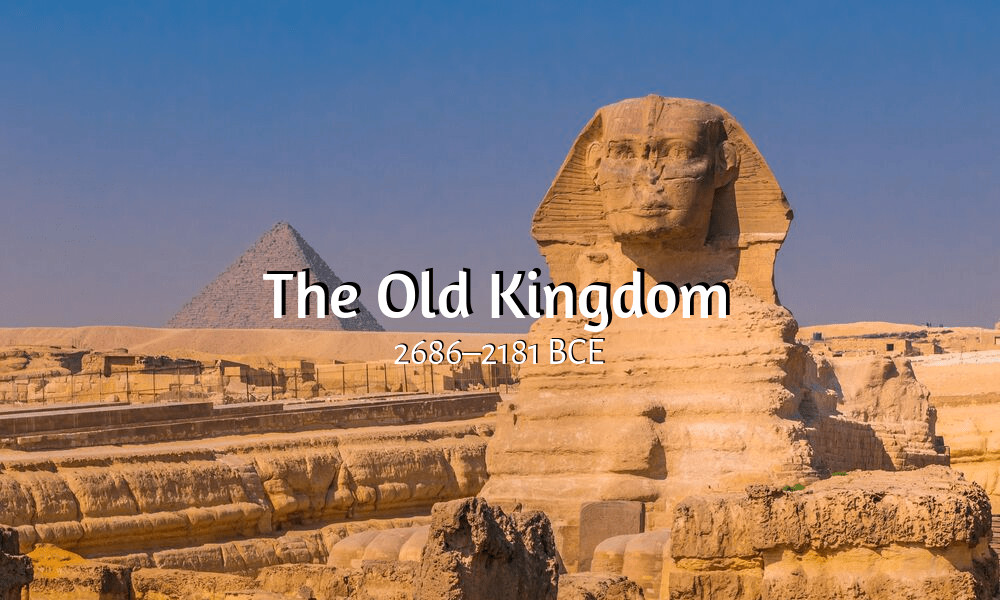
Well, we still got a bit of a glimpse on historical times about the closest what we can get of Natufian descendants, the Old Kingdom Egyptians.

16587658520the-old-kingdom-sphinx-pyramid.png
 
Anatolian hunter gatherers/farmers had Natufian-related ancestry anyway, so its not like they were genetically and culturally disconnected from each other.
I also it is possible to likely that Natufians were the source for the Afro-Asiatic language family/ethnicities.
 
Anatolian hunter gatherers/farmers had Natufian-related ancestry anyway, so its not like they were genetically and culturally disconnected from each other.
I also it is possible to likely that Natufians were the source for the Afro-Asiatic language family/ethnicities.

It makes sense that those Anatolians that lived on the southern fringes got in touch with the Natufians. But that's not true for Anatolian HGs/Farmers in general. The AHG transitioned to agriculture independently, even though agriculture itself probably started earlier in Upper Mesopotamia. And I would say that Natufian-related populations are almost certainly the source for Afro-Asiatic languages.

The ANF expansion is a remarkable phenomenon. Imagine the surplus in population that forced them to spread so rapidly and to such distant areas. It's really the Levantines having a lot of ANF ancestry rather than the other way round. The origin of the AHG lies in East Anatolia or the Caucasus. Aren't they basically Dzudzuana?

@Hawk

I'd say Ancient Egypt is the best example of a post-Natufian civilisation. As for haplogroup E-L618 and E generally, I wonder why it's not treated like a macro-haplogroup? I don't think it's credible to tie all of E to Natufians or Afro-Asiatic "ethnicities.". That haplogroup is almost 70.000 years old. We're talking about early modern humans here. Who could be the source population of E-L618 or E-M78? Natufians? I have my doubts. E was much more wide-spread in the Middle East before it was largely replaced by haplogroup J. There must have been a great diversity, ethnic and linguistic. It would be like saying all of R is Indo-European when it's not. Only R1a and R1b are IE.
 
There was as revision of the Albanian origins paper and this paragraph is absolutely correct and crucial:

Furthermore, individuals from Roman Serbia cladal to Bulgaria_EIA show considerable diversity705
in E-V13 subclades (e.g., E-BY5490, E-FGC33621, E-BY5022, E-CTS9320; Table S22),706
suggesting either proximity to or inclusion in the epicentre of E-V13 diversity, or significant707
migrations from it. Notably, two individuals (15518, I15504) belong to subclade E-FGC33646708
(Table S23), from which 3% of present-day Albanians descend73. The autosomal profile associated709
with these results suggests that some E-V13 subclades in modern Albanians may originate from710
Bronze and Iron Age Balkan populations with an autosomal profile fully or partially related to711
Bulgaria_EIA. Whether this autosomal profile was found beyond the territory of present-day712
Bulgaria in pre-Roman times, such as the Carpathian Mountains or the Danubian basin, remains713
an open question.

Before we don't have the Transyvlanian BA, Transylvanian Scythian-La Tene and Gomolava (Kalakacza to Bosut period) results in detail, from the frirst two we know they were rich in EEF and "Balkan-like", we can't say for sure how much they differed and in which direction from the BGR_EIA South Thracians. Concerning the percentages mentioned for BGR_EIA ancestry, we should remain careful, because so far most of these results come from the Roman era when there were individual and group migrations throughout the Empire, and mostly with non-main E-V13 branches.

Probably the authors read here in this forum too or they just came to the same conclusions, in any case:

However, not all populations with E-V13 were characterized by a Bulgaria_EIA-related autosomal715
profile. For example, two E-V13-bearing mercenaries from Himera in Sicily plot with West Balkan716
populations on the PCA (Fig. 3A), may derive large parts of their ancestry from BA Kosovo or717
Serbia (S1 Text, Table S4); and share IBD segments with both "Illyrians" (8.5 cM) and "Thracians"718
(11.5 cM) (Table S17). It is likely that these mercenaries may have originated from a Central719
Balkan zone of linguistic contact between "Illyrian" and "Daco-Thracian" groups1,7, thereby720
displaying genetic affinities to both. Importantly, the E-V13 subclade found in one of the Himera721
mercenaries (E-CTS6377) is characterized by daughter branches from which another 7% of722
Albanians descend (Table S23). Additionally, two Roman individuals from Croatia (R3664,723
R3659) also harbored E-V13 (Table S22), despite the absence of Bulgaria_EIA-related ancestry.724
Furthermore, 50% of Roman period individuals with E-V13 are modelled as deriving 15-80% of725
their ancestry from West or Central Balkan Bronze and Iron Age populations (Fig. S17).

My expectation is that especially the Belegis II-Gáva/Susani/Vartop groups will be closer to Illyrians autosomally, and this is essentially the Basarabi source, the main group of Southern Dacians. Since we see the same profile in the Eastern Vekerzug cluster and we already see a very similar to the same profile locals occasionally in Maros and Mezocsat, I think the North Thracian core as a whole will be more "West Balkan-like" than South Thracian. And this will be the main proifle of the main E-V13 branches, especially those under Z5017-CTS9320 and the main Z5018-S2979 ones. Presumably already due to the shared Cotofeni-Vucedol heritage.

Therefore:

The presence of E-V13 in the Himera individuals may indicate either: (1) early arrivals from more727
eastern areas whose Bulgaria_EIA-related ancestry became diluted, or (2) the IA/Roman period728
spread of at least some E-V13 lineages from central/western regions, possibly with an autosomal729
profile intermediate between west and east Balkan groups. One candidate population are the730
“Dardanians”, situated in the central part of the Balkans, having been influenced by other731
“Illyrians” in the West and by “Daco-Thracians” in the East1. Supporting the second possibility,732
the BA/IA ties of modern Albanian E-V13 lineages generally point to regions to the north, rather733
than the east of the present-day Albanian speaking area (Table S23). Based on these findings, it is734
possible that populations from which many Albanian-specific E-V13 subclades descend,735
regardless of linguistic affiliation, were largely or fully West Balkan autosomally during the736
Roman period.

I don't think this autosomal profile will be restricted to Dardanians, because otherwise it wouldn't have had a long presence in the East Carpathian sphere and especially this prominent position in the Vekerzug Eastern/Sanislau cluster. I also interpret the Transylvanian Scythian era/La Tene paper that way, that they could differentiate the local "Balkan-like" profile clearly from "Southern Balkan" individuals, suggesting they were more West/North Balkan-like. And these locals can be largely associated with the Sanislau group in the same time period and with locals derived from Gáva, Mezocsat (mixed Gáva-Kyjatice) and Northern Basarabi possibly (itself Gáva derived but with Belegis II-Gáva additoins).

Most paleo-Balkan haplogroups show signs of severe bottlenecking from the early Iron Age to750
Late Antiquity, while some E-V13 subclades exhibit a more continuous subclade diversification751
throughout the Iron Age (Fig. 11A). This trend suggests that some subclades of E-V13 may have752
followed a different demographic trajectory compared to those of J2b-Z638, R1b-BY611, R1b-753
PF7562, and I-M223, implying that they may have originated in different populations. Overall, the754
rate of diversification of all E-V13 Albanian-specific subclades increased significantly from 200755
CE onwards, mirroring the pattern of other Albanian lineages (Fig. 11A). This may indicate that756
some E-V13 lineages merged and co-expanded with local populations during the Iron Age or early757
Roman Period, which could explain the absence of E-V13 in the aDNA transect of Albania, despite758
being the most common haplogroup in the present-day Albanian population (Fig. S10).

This Roman era expansion, contrary to local Balkan lineages decline in the Roman era, can be best explained by the late Dacian peak.

My interpretation is therefore that there was a large Roman era resettlement of Dacians/Daco-Carpi/Daco-Romans into the area occupied by Dardanians, which likely already had E-V13 before. And this pulse migration changed the composition of this Pre-/Proto-Albanian core group quite significantly, introducing lineages which had a tribal expansion when the local Balkan ones were already under Roman rule.

The paper:

RadkoAncient DNA reveals the origins of the Albanians (v2)

Abstract
The origins of the Albanian people have long been debated, as they first appear in historical records in the 11th century CE, and their language is not closely related to any surviving Indo-European branches. To elucidate the origins of the Albanians, we analysed over 6,000 ancient West Eurasian genomes and 74 newly sequenced present-day ethnic Albanians. We detect remarkable continuity of West Balkan Late Bronze and Iron Age ancestry in Albania during the Early Medieval period, a pattern distinct from neighbouring Balkan regions. Utilising a wide range of population genetics methods, including an enhanced protocol to detect identity-by-descent (IBD) segments between ancient and present-day individuals, we reveal that present-day Albanians predominantly descend from Albania's Early Medieval inhabitants, who were present in Albania as early as 800-900 CE, preceding their historical attestation. Additionally, we observe geographically structured admixture with Medieval East European-related groups, averaging 10-20% across Albanians. Our findings provide unprecedented insights into the historical and demographic processes shaping present-day Albanians and locates the origins of this population into the Central-Western Balkans.


REVISION SUMMARY
The revised version of our manuscript, "Ancient DNA reveals the origins of the Albanians" consists of the following major changes: 1) We included 74 newly sequenced present-day Albanians, covering all dialects and subpopulations. Our expanded dataset encompasses the entire range of Albanian genetic diversity in the Balkans and greatly improves the resolution of our analyses. 2) We expanded our ancIBD analyses to include recently released Roman and Medieval samples from the Balkans, as well as the newly sequenced present-day Albanians. Our improved ancIBD technique identifies the most likely geographic origin of proto-Albanians. We also use IBD to evaluate the relationships within and between different Albanian dialectal groups. 3) We used DATES to estimate the timeframe for the arrival of steppe and northeast-European-related ancestry, respectively, in the region of present-day Albania. 4) To test for sex biases in the dissemination of northeast-European-related ancestry, we undertook extended qpAdm analyses to incorporate X-chromosome data and performed mtDNA haplogroup analysis. 5) We used Colate and hapROH to estimate the effective population size (Ne) of proto-Albanian founders. These revisions, along with new data and protocols, substantially strengthen our conclusions and offer novel insights into the genetic history of Albanians.
 
There is a potentially E-V13 sample from medieval Vlora Dukat

Our re-analysis of the Y-chromosome of a low coverage individual (I17623) from 9-10th 760 century761 Dukat in Albania, assigned his paternal lineage to haplogroup E-L539 (Table S22), possibly an762 indicator of E-V13 among early Albanians.

David Reich supplement:

According to the label found with individual I17623/2638, it could be associated with grave38 of Tumulus 2. This grave has been dated to the Early Medieval Period (9th-10th centuries CE),which corresponds with an important phase of the reuse of the prehistoric burial mound. The twolong sides of the grave pit were limited by medium size stones; similar stones were used for thecovering. The skeleton was oriented east-west with the head to the west. It was found in anextended supine position, with both forearms folded over the lower torso (109): 40, fig. 24. Thegrave inventory included a bronze applique and an iron finger ring, as well as an iron ring foundin the midsection of the skeleton.

 
@Hawk

I'd say Ancient Egypt is the best example of a post-Natufian civilisation. As for haplogroup E-L618 and E generally, I wonder why it's not treated like a macro-haplogroup? I don't think it's credible to tie all of E to Natufians or Afro-Asiatic "ethnicities.". That haplogroup is almost 70.000 years old. We're talking about early modern humans here. Who could be the source population of E-L618 or E-M78? Natufians? I have my doubts. E was much more wide-spread in the Middle East before it was largely replaced by haplogroup J. There must have been a great diversity, ethnic and linguistic. It would be like saying all of R is Indo-European when it's not. Only R1a and R1b are IE.

I don't know who tied all Y-DNA E to Natufians, Natufians largely were E-M34, while the E-M78 was largely Iberomaurusian-like. But some E-M78 migrated in Levant during Mesolithic introducing microburin technology via Mushabian Culture who migrated from Egypt, quite an innovation during that time. I suppose some small E-M78 clans were responsible for this, but still Natufians were largely E-M34, i am talking about E-M35 in general from which both Natufian E-M34 and Iberomaurusian E-M78 stemmed from.

I also think that Y-DNA E-M35 was something of more of Levant phenomena in Middle East which they expanded to in Paleolithic and Mesolithic and was largely absent anywhere else in Middle East, Levant is the only place archaeologically we can link to North Africa, the rest of Middle East was quite different.

Y-DNA E as a macro-haplogroup is too old, it is as if i lump Papua New Guinean Y-DNA S and M to Indo-European R1a, R1b, both which stem from Y-DNA K2b. Quite deeply separated and the changes they had on the way makes them astronomically different.
 
Last edited:
It's another nothing burger, the models are still weak despite a very easy right function(where anything can pass). IBD sharing are tiny, no smoking gun found. Davidski is just taking cash at this point. Gjergj and Alban, lol, just go on youtube and watch Alban speak.

Shtike and Kenete do not pass as one and the same in the models yet they chose to combine them in both qpdam and IBD, it would have been very telling if Shtike IBD aligned different from Kenete(which geographic directions the IBD went when compared to predecesor populations) and I am sure some of the authors read pages here, so the conscious decision to not disclose results to the fullest shows they're not interest in doing the right thing.

The models:
N5mu3Z0.png


Only the first one passes and barely(it;s literally a D- or F+). The profile itself is fictional as Shtike and Kenente cannot pass on a one on one test with each other, the foundation does not exists to proceed further.

Their Himera models are all fails:
GQGWWoN.png


I provided the most viable model using a much harder right function and got 0.8 p-value and passing SEs. Even their IBD runs shows Himera E-V13 most affinity to EIA Thracian, because as my model showed, the profile is primarily Daco-Thracian(plus some Slavic like source as secondary admixture). They talk about how the profile might be a hybrid of west Balkan and east Balkan, but if you plot coordinates on a PCA, it is blatant that such model is out of the question. This is extremely poor work for "alleged" professional who spent three-five years on this.

The paper is mehh, not worth talking about.

Real model on Himera's
vdcQZmJ.png
 
Last edited:
Still its great to have a step in the right direction, considering what we got for E-V13 in journal papers up to this point. Some of the main sources are still from around 2000 and talk about the "Neolithic" or "Greek" origins of E-V13, which being all completely debunked by now. I mean E-V13 is a Neolithic lineage, but only insofar, as it came with Neolithics. It didn't spread with Neolithic farmers, especially not the modern main branch which dates to the steppe/IE spread around 3200 BC.

And they begin to fully aknowledge the fact that E-V13 is a Daco-Thracian/Proto-Thracian haplogroup essentially. You can discuss many details, but don't be too critical. Again, compare this work with what we got up to this point...
 
Back
Top