• Don't want to see ads? Install an adblocker like uBlock Origin or use a Europe-based privacy-friendly browser like Vivaldi or Mullvad.

E-V13 Frequencies and New Data

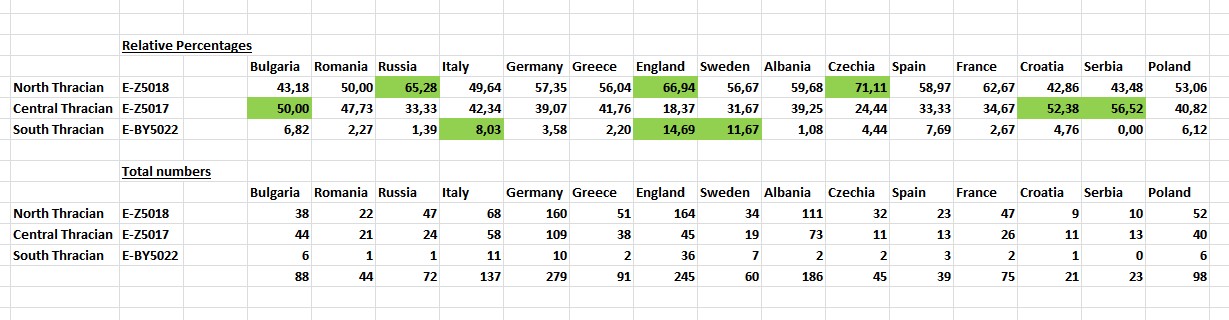
This time I added a couple of countries to the comparison chart of some of the main E-V13 branches:

Comparison-Main-Branches.jpg


Some comments to add:
- I marked in green the top three for every category
- Z5017 in Romanians would be even stronger if just counting Southern/South Western ethnic Romanians. Among those, Z5017 seems to be, based on the small FTDNA sample, absolutely dominant.
- For Romanians and Albanians I added the numbers of FTDNA and YFull, because Romanian samples are so few and so many more Albanians have tested at YFull. The other numbers are all from FTDNA only.

Some observations: E-Z5017 is indeed the central and lower Danubian V13 group. It dominates in South Western Romanians, North Western Bulgarians and Northern/Eastern Serbs in paticular, from where it expanded in Croatia among other areas. This seems to correspond largely both with the Basarabi culture and the Vlach origins, with E-Z5017 having the most bigger Vlach founder lineages of E-V13.

England is the only country which is top 3 in two categories: E-Z5018 and E-BY5022, which is otherwise rather untypical. This unusual position, with high Z5018 and BY5022, but low Z5017 for the English, being confirmed by both data sets (FTDNA and YFull), whereas e.g. for Albanians, the smaller FTDNA data set has a higher frequency of Z5017 than the larger YFull one, likely by chance.

What this probably shows is that the English likely received a strong Roman era South Thracian, as well as later Dacian and generally Germanic/German more Northern influx. But they had much less contacts to the central and Northern Balkans, to the South Dacian/Vlach population by comparison.

In the Czech sample, a large fraction is of German origin, but in any case, it shows that the areas with Slavs being by and large dominated by E-Z5018. Among the more Northern Slavic groups, Poles (not included) have a surprisingly high Z5017 presence though, especially if subtracting the non-Polish samples.
 
Based on the comparison of E-Z5018 vs. E-Z5017, I made a map which shows which countries/ethnicities are being dominanted, by and large, by which of these two main central to Northern branches of E-V13. The result is pretty striking I'd say:

E-Z5018-vs-E-Z5017.jpg


A very interesting observation is that the E-Z5018 zone 2 zone, dominated by Albanians and Greeks, has also some of the lowest frequencies of E-BY5022, the main South Thracian branch. It is nearly absent in this zone.
The E-Z5017 branch dominates not just in the more Northern Carpatho-Balkan sphere, but also in much of Poland and Ukraine. The only Northern country other than Poland, in which E-Z5017 dominates, is, likely by pure chance in a small sample, Norway. Italy can be split, while all other Germanic, Celtic, Romance, Baltic and Finnish countries being dominated by E-Z5018.
Among the Slavs, E-Z5018 mainly dominates in Czechia (partly due to Germanic influence) and Russia.

Going by these results, it looks like E-Z5017 did push E-Z5018 outward from the centre in a late phase. Because essentially, much of the Daco-Thracian core zone being, in moderns, dominated by E-Z5017. Such a distribution is being best explained by the centre being, at some point, likely fairly late, probably even by Daco-Romans, Pre-Vlachs, being taken over by E-Z5017.

The earliest possible date for this scenario would be with Basarabi, the latest possible scenario with Vlachs. The most likely might be post-Basarabi Dacians. Why? Because E-Z5018 is nearly everywhere still at about 40-50 %.

This would align best with a scenario in which E-Z5017 Dacian elites came on top of already existing North Thracian/Dacian people and unifying them. Likely from the area of the Tisza-Danube interfluve down to the Lower Danube, mouth of the Danube. Which is exactly where we would assume E-Z5017 with Basarabi.

Post-Basarabi South Dacians coming in on top of existing North Thracian/Dacian people, like we see from the archaeology, from groups like Sanislau-Vekerzug, Kustanovice etc., being not destroyed, but integrated into a common horizon of unified Dacians in the La Tene into Dacian period.

Such a scenario, and with this South Dacian core being later dominant among Daco-Romans and Proto-Vlachs, makes the most sense.

Now the question is, is the Southern Z5018 zone the result of an early push South by this Z5017 expansion, or an expansive movement which, to some degree, bypassed the Z5017 zone.

Or is, in an alternative scenario, the strong Z5017 dominance largely the result of a later Vlach expansion, in which Z5017 clearly played, among E-V13 branches, the main role.

Anyway, I think the visualisation of the distribution is quite interesting. Especially the ratio for Ukraine surprised me myself. The total numbers are even more striking, if considering that a couple of Z5018 samples from Ukraine are not actual Ukrainians, but mainly Ashkenazi Jewish. Which makes E-Z5017 even a bit more dominant among Ukrainians.

Same map as before with the absolute epicentre of E-Z5017 being marked:

E-Z5018-vs-E-Z5017-with-centre.jpg


Note that E-Z5018 has no such clear epicentre, and unlike E-BY5022 it wasn't replaced either, but reduced only. This strongly suggests a secondary E-Z5017 expansion on top of many Z5018 territories, on, to some degree, "friendly terms". Might be more than one movement too, by the way (like Basarabi, Dacian unification, Daco-Roman period, Vlach expansion), but the pattern is really striking. E-Z5018 is everywhere outside of the wider core zone dominant, in the whole periphery, but if looking carefully and correcting some data points, nowhere in the Dacian centre but Romania, where its still roughly about 1:1 even after correction for non-ethnic Romanians.
But even about 1:1 is already lower than say in most of the peripheral, Z5018 dominated regions of course.
 
Last edited:
I wouldn't read too much on differences, we cannot make such conclusions based on 1 site and absence of aDNA.
 
saw that at twitter
if i understand them it
look like a ancient byzantine dna from Iznik

Itk006-E-V68
(likely an e-v13 individual)

p.s
don't know the paper
but if i understand correctly these are only 16 out of total 70 samples


1747579148536.png
 
In the video at about 51:40 some samples have a more downstream position:

On Genarchivist, one user speculated there might be crusaders involved.
 
Samples prior to Justinian Plague are more important IMO.
 
This article caught my attention: https://greekreporter.com/2025/05/1...the-greeks-tracing-dna-through-the-millennia/

He rightfully so mention all periods and Y-DNA from Greece we know so far from the periods like Mesolithic times: Y-DNA I2a, and I2c.

Neolithic he mentions G2a and J2.

Bronze Age and Mycenae: J2a, G2a and R1b.

But the part which was interesting to me:

Greek DNA continuity in the Archaic and Classical period​

The Archaic 800-500 BC and Classical 500-323 BC periods represent the zenith of Greek cultural development. This era witnessed the rise of city-states like Athens and Sparta, the establishment of democratic institutions, and advancements in philosophy, arts, and sciences, with figures like Socrates, Plato, and Aristotle.

Genetic analyses of remains from these periods, such as those conducted by Dr. Christina Papageorgopoulou, indicate a continuation of earlier genetic profiles.

Y-chromosome haplogroups J2a, EV13, G2a, and R1b remained prevalent, reflecting continuity from Neolithic and Bronze Age populations. Mitochondrial haplogroups H, T, U, K, and J continued to dominate. The expansion of Greek colonies across the Mediterranean from the Black Sea to the Iberian Peninsula facilitated cultural exchange and some gene flow.
The isolation of the island has helped preserve genetic traits unique to its inhabitants, reflecting continuity from ancient times. Cypriots share genetic affinities with Greeks, carrying similar Y-chromosome haplogroups J2A and EV13. Mitochondrial DNA studies indicate shared maternal lineages, reflecting historical connections and migrations between the island and Greek mainland.

Dr. Christina Papageorgopoulou afaik still hasn't published classical period Greek results. But we know she is one of people in charge of CityLife project, Thessaloniki remains and classical times period. So, it looks like we will get E-V13 in Thessaloniki or even deeper in Central Greece if the blog post is basing the statement on upcoming results in pipeline and not on assumptions.

But, i think Thessaloniki in ancient times is really plausible IMO.
 
By sheer proximity to the Thracians and the known Thracian ancestral influence on Greeks, it would be strange if they have no E-V13 at all in a larger sample.
 
For some reason twitter links dont seem to work here, so im trying to share via a tiny url.

An indepth twitter thread and theory on origins of thracians and dacians that acknowledges ev13 as their main haplo:

https://tinyurl.com/yuf3585b
 
For some reason twitter links dont seem to work here, so im trying to share via a tiny url.

An indepth twitter thread and theory on origins of thracians and dacians that acknowledges ev13 as their main haplo:

https://tinyurl.com/yuf3585b

He is wrong on one thing. Kalakaca is not Illyrian, it is a stamped horizon with channeled traits.

Apparently from LBA to EIA there was a dual transition from channeling/fluting -> stamping and from cremation -> pit inhumations. It was likely for economic reasons since channeling and cremation is too expensive. The LBA saw dark ages for centuries.

Otherwise, i think it is solid work and need to be acknowledged. He has done his homework.

I also think the Proto location in Banat is too ambigious. I lean more toward Southern Carpathian + Haemus Mons for that period.
 
Last edited:
He is wrong on one thing. Kalakaca is not Illyrian, it is a stamped horizon with channeled traits.

Apparently from LBA to EIA there was a dual transition from channeling/fluting -> stamping and from cremation -> pit inhumations. It was likely for economic reasons since channeling and cremation is too expensive. The LBA saw dark ages for centuries.

Otherwise, i think it is solid work and need to be acknowledged. He has done his homework.

I also think the Proto location in Banat is too ambigious. I lean more toward Southern Carpathian + Haemus Mons for that period.

Also, the EBA origin is wrong, almost entirely i would say. From LBA-EIA interesting take.

Honestly, Maros group were dead-end group in Carpathians. He just made them from the same complex.

When you jump through cultures in EBA you have to provide sources. No archaeologist dares to make such connection dots. The area is too blurry.
 
Last edited:
He is wrong on one thing. Kalakaca is not Illyrian, it is a stamped horizon with channeled traits.

Apparently from LBA to EIA there was a dual transition from channeling/fluting -> stamping and from cremation -> pit inhumations. It was likely for economic reasons since channeling and cremation is too expensive. The LBA saw dark ages for centuries.

Otherwise, i think it is solid work and need to be acknowledged. He has done his homework.
I think he is energetic and bright, but has quite a few blindspots that don't add up for me. I will try a bit later when im freer to go deep into it. But the minimising of channelled ware's reach is a result of it not fitting into his construct and seems a bit motivated in this regard.
 
I think he is energetic and bright, but has quite a few blindspots that don't add up for me. I will try a bit later when im freer to go deep into it. But the minimising of channelled ware's reach is a result of it not fitting into his construct and seems a bit motivated in this regard.

At the EBA stage i would rather go with Cotofeni-Wietenberg who were far more related to Tei-Verbicoara traditions than the ones from Banat.

@Riverman might have a word as well.
 
If trying to find the Proto-Thracians, the main road to follow is the cremation rite. And the cremation rite comes, for the later Daco-Thracian Carpatho-Danubian cremation block, by and large from Transtisza-Transylvania.
He is probably right, if Gáva-related Channelled Ware wasn't impactful enough, that Verbicoara-Tei was the main source for (South) Thracians.

And he is probably also right, that the main early Dacian group is Basarabi. However, Basarabi itself is, by and large, a Gáva-derived group. There was exchange between Belegis and Pre-Gáva, going back and forth, but in the end, if looking at the transition to Belegis II-Gáva, Vartop and Insula Banului, these three main groups, which later contributed to Basarabi, aren't thinkable without actual, direct Gáva input. The chronology is also pretty clear about that in my opinion.

But in the end, that's probably even secondary.

More important is however, that Daco-Thracian people lived North of his Proto-Dacians, which largely overlap with Basarabi, since the Gáva-related groups were at the very least Daco-Thracian as well, if not being the main source by default.

Concerning the transition to inhumation, the main factor is very clearly the steppe invasion, first by Sabatinovka, which resulted in Noua-Coslogeni, and secondly and more importantly, the Cimmerian invasion which completely disrupted the Channelled Ware Daco-Thracian sphere.

Practically everywhere, be it Mezocsat, Kalakacza/Bosut-Basarabi, Psenichevo etc., inhumation only started when the steppe influences became visible in the repertoire. Especially in some core regions, the Cimmerian invasion completely disrupted the regional culture, destroyed settlements, eliminated regional elites and structures, downgraded material cultural production of the locals and the disappearance of professional workshops. Nowhere is this as clear as in former Kyjatice-Gáva territories later occupied by the fused Mezocsat group, with actual Cimmerian influences. The local ceramic production is stylistically largely the same as with Kyjatice and Gáva, just mixed up, but much coarser and less refined, simply downgraded and localised.

And I think we must understand this Cimmerian invasion as kind of a "shockwave" which went through nearly all Daco-Thracian territories, one way or another. South of Mezocsat all groups started to use more often inhumation than before, including Basarabi, which is clearly largely a descendant of Belegis II-Gáva, Vartop and/or Insula Banului, which all strictly cremated and showed many traits of a Southern Gáva expansion.

Only in the North, in some areas of retreat in Transcarpathia, late regional Gáva groups were not as much affected.

And the Cimmerians also introduced new,. more advanced iron metallurgy, weapons and horse breeds, tactics etc. Therefore this was a real shift for all the main groups South of Mezocsat (Kalakacza/Bosut-Basarabi, Psenichevo, Babadag).

If you look at the later historical Thracians, they have many Cimmerian and Scythian elements in their culture, which their Bronze Age ancestors likely never had. I mean the main weaponry of the early Daco-Thracians in the Late Bronze Age were Naue II swords, large shields and long spears with casted spearheads. They were more like hoplites, like the later Greeks, Etruscans and early Romans, than the Scythians and Cimmerians.

This shows, among many other things, how big of an impact the steppe cultures had on them, and the first big impact, after Noua-Coslogeni, which Gáva/Belegis II-Gáva/Vartop did defeat (!), with their hoplite-style warriors, was the Cimmerian invasion and the formation of the Thraco-Cimmerian horizon.
 
At the EBA stage i would rather go with Cotofeni-Wietenberg who were far more related to Tei-Verbicoara traditions than the ones from Banat.

@Riverman might have a word as well.

Yes, you need to look at where these cultures were coming from. Like Verbicoara-Tei being essentially cultures which emerged from a Cotofeni/Cotofeni-Vucedol base, just like the groups in Transylvania. That doesn't mean groups like e.g. Vatin were not relevant at all or completely unrelated, but by comparison, the Tisza-Transylvanian input seems to have been far more important.

Like Glina-Schneckenburg, Tei, Verbicoara and finally Vartop interacted with Transylvania and being all, for the most part, Cotofeni descendants.

Like Verbicoara had close interactions with Nyirseg and later Wietenberg people, which contributed to their formation. Vartop was based largely on Verbicoara-Tei but with a strong input from Belegis II-Gáva and Gáva-Holigrady.
 
By the way, the Avar samples from around Vienna begin to appear on YFull and they prove that the Csokorgasse group was highly diverse and represents most major V13 branches:
https://www.yfull.com/tree/E-V13/

We can already see how big the variety is, among others, the E-V13 tribe from Csokorgasse included:
E-CTS9320
E-Y3183
E-L241
E-BY5022

Most bigger E-V13 branches being represented, which is astonishing for such a relatively small sample from one site, which proves without a doubt, that something was going on here, likely a collective, en bloc movement of a specific people from the Tisza-Danube zone, because the Csokorgasse individuals are clearly more Avar culturally than those from Moedling and at the same time more Balkan shifted too, plus this dominance of E-V13 with a wide variety of branches.

So far they only used 12 samples, most of which are under CTS9320, from the main clan. Hopefully they can use more.
 
This new 2025 book is a gem, i didn't look in details: https://www.academia.edu/129359165/...troduction_of_Iron_in_Europe_and_Western_Asia

Christopher Pare argues that Bassarabi Culture was main axis of the spread of iron swords in Albania, Glasinac (through Bosut), Macedonia, Northern Greece, and even up north. Bassarabi-Novi Sad iron swords were one of the earliest proper iron swords.

He mentions that post Fluted-Ware horizon changes into Stamped-Ware. He never argues or opposes whether these two techniques represent techniques by different cultures, but i get the impression that we are talking about a transition from channeling/fluting into stamping techniques deep into South and then redistribution back north and change of the style. I guess channeling/fluting was too expensive for mass-production and stamping technique was more practical.

I might missed quite a lot of stuff, but it is packed with information about Balkans.
 
Basarabi was crucial for the Hallstatt transition, with direct influences up to Austria (especially Frög group) and even Bavaria.

There were Basarabi influences also in e.g. Bosnia by the way.

These influences represent in many instances for sure migration, but mostly on a smaller, mire individual scale ourside their main territory.
E.g. in Frög artisans, elite warriors, beides, entourage of these people.
 
This new 2025 book is a gem, i didn't look in details: https://www.academia.edu/129359165/...troduction_of_Iron_in_Europe_and_Western_Asia

Christopher Pare argues that Bassarabi Culture was main axis of the spread of iron swords in Albania, Glasinac (through Bosut), Macedonia, Northern Greece, and even up north. Bassarabi-Novi Sad iron swords were one of the earliest proper iron swords.

He mentions that post Fluted-Ware horizon changes into Stamped-Ware. He never argues or opposes whether these two techniques represent techniques by different cultures, but i get the impression that we are talking about a transition from channeling/fluting into stamping techniques deep into South and then redistribution back north and change of the style. I guess channeling/fluting was too expensive for mass-production and stamping technique was more practical.

I might missed quite a lot of stuff, but it is packed with information about Balkans.

A summary:

5.1 Knobbed, fluted and stamped potteryIn recent research on southern Thrace, four stages are recognized in the chronological developmentfrom the end of the Late Bronze Age to the start of the Early Iron Age.1

1. In the first phase, pottery is mainly undecorated and incised ornamentation is uncommon; the first examples of fluted decoration appear in this phase (‘Horizon of Fluted Ware I’, according toElena Bozhinova).

2. In the second phase, pottery with fluted and knobbed decoration, often with a polished surface,becomes predominant; at this time, stamped ornamentation already appears occasionally, mainlycomprising concentric circles, sometimes joined by tangents, and impressed pseudo-cord motifs(‘Horizon of Fluted Ware II’). This ‘lustrous’ pottery with fluted decoration shows that the EasternBalkans were strongly influenced by the Carpatho-Danubian region, while at the same time therewas a reduction of contact with the Aegean.2 As Carola Metzner-Nebelsick showed, the popularityof the polished and fluted pottery of ‘Gáva’ type, which even reached as far as Troy, demonstratesthe influential role of the north-eastern Carpathian Basin in large parts of eastern Europe at thistime.3

3. The ‘true’ Iron Age begins in the third phase (beginning ca. 950 BC, according to Bozhinova), inwhich stamped decoration is predominant on pottery, mainly composed of concentric circlesconnected by tangents, S-stamps, and impressed pseudo-cord (‘Pshenichevo I’). In the Bulgarianresearch tradition, the start of the Early Iron Age was traditionally equated with the onset of thepottery with fluted decoration. The ‘true Iron Age’, i.e. the introduction and use of iron, starts inthe Pshenichevo phase. According to Bozhinova, there is a reversal of the cultural orientation inThrace at this time, and Aegean (rather than Carpatho-Danubian) influence becomes dominant.4The pottery of the third phase is comparable with contemporary stamp-decorated wares aroundthe Iron Gates (Insula Banului/Ostrov) and in Dobrudja (Babadag).

4. Pottery with rich stamped decoration continues in the fourth phase (‘Pshenichevo II’), which iscontemporary with the Basarabi phenomenon along the Lower Danube.
 
What's crucial is that we have more of a fluent, smooth transition from one phase to the next, unlike it is in areas without a preceding Carpatho-Danubian cremation block tradition.

The most typical rite of the Proto-Thracians and later Dacians is the high prevalance of "invisible burials", due to some sort of deposition which left no archaeological traces, likely due to scattered ashes. And this tradition goes on from late Cotofeni groups, into Nyirseg and local Transylvanian groups, Tei, Verbicoara, Suciu de Sus, Wietenberg to some degree, but less, later Gáva, to some degree (less) Belegis II-Gáva, Vartop, Insula Banului and partly also Babadag (irregular burials oftentimes).
This trend goes somewhat down, with the Cimmerian intrusion and the disruption it caused, including early Channelled Ware, but we see a rise again in late Basarabi, but especially the Northern Basarabi and Gáva derivatives (Vekerzug Sanislau, Kustanovice, locals around Ciumbrud etc.), until culminating, once more, in the later Iron Age and historical Dacians.

Concerning what Zimnicea-Plovdiv-Cerkovna did, in the East Rhodopes, they introduced more advanced and widespread mining, a new form of subsistence (apparently kind of highland pastoralism, again something pretty typical for the Carpatho-Danubian core, since that's how already Cotofeni did survive the Yamnaya invasion) and a whole range of new bronze weapons and tools.

ZPC, with mining and highland pastoralism, did in fact occupy and exploit niches in the Rhodope region, which were barely used before at all. You can see, in the record, that a fairly advanced people came in, and did a planned colonisation. That's not some locals (which ones to begin with?!) which adopted a couple of symbols on their pots only - and even that would be an understatement, because very high end and complex patterns from Verbicoara-Wietenberg-Tei groups appeared in the East Rhodopes, which can barely be copied by locals out of nothing, yet alone what would be their motif to copy 1:1 such complex, and difficult to make patterns?

The whole scenery is dominated by this huge impact of a colonisation from the North. The only remotely similar scenario is when Gáva-related Channelled Ware groups came down, which, as we have established, likely meant that Thracian tribes met other Thracian/Daco-Thracian tribes. Which, by the way, was something earlier scholars sometimes argued for, that North Thracians/Dacians did influence South Thracians in the EIA.

Here a summary from a paper we discussed quite often, for the Turkish parts of the area in question:

In 1980, during the same Kırklareli survey campaign, a rescue excavation on a burial
mound took place. The site known as ‘Taşlıcabayır’ produced fifty-one fluted vessels
initially associated with the LBA, but later related to Troy VIIb2 and the Balkan EIA (see
Özdoğan 1987; 2001). It was part of a larger project that aimed to continue the work of
the 1930s, which had been encouraged by Ataturk himself, and to shed some light on
the archaeology of the Marmara region and the link between Anatolia and Europe.
Özdoğan noted that the results were quite different from those initially expected
(Özdoğan 2002: 284). Between 1980 and 1985 the Thracian parts of the project,
including the districts of Istanbul, Edirne, Kırklareli, Tekirdağ, Gelibolu and Ecebat, were
covered, resulting in the discovery of 300 prehistoric sites, 100 sites of later periods, 800
tumuli and 90 megalithic structures (Özdoğan 2001: 284). Study seasons took place
between 1989 and 1997 (see Özdoğan 1984; 1985; 1987; 1993; 1998). The results of this
project established that EBA settlements in European Turkey are few and small, part of
the Balkan pastoral communities, but also most probably in contact with Anatolia. There
was no settlement definitively dated in the 2nd millennium BC and new evidence was
registered only from the end of it, the transition between the LBA and the EIA, which
Özdoğan interpreted as belonging to a migration from Southeast Romania, which
brought with it the tumuli as well as the dolmen structures
(Özdoğan 2001: 287).

In the Eastern Rhodopes and Sakar by contrast, pastoral groups colonised a

specific mountain ecotone following ridge landforms with potential for regular access
to grazing lands and running water. This micro-region was perhaps also attractive for its
natural mineral resources as suggested by the gold ore exploitation at Ada Tepe.
The
only evidence for the burial rite practiced here are the dolmen structures with preserved
LBA pottery. The typical ceramic material is richly decorated incised ware, partially
overlapping with types distributed in the Upper Thracian Plain. Correspondence with
some of these pottery types can be seen in some ceramic traditions documented north
of the Danube, precisely in the Carpathian Basin and the Hungarian Plain, which is
potentially indicative of the origin of the incised ware in Thrace. In the western part of
the Rhodopes, possible nomadic or semi-nomadic groups brought cremation in tumuli
to the area and left little or no trace of permanent habitation.

In the LBA, in groups like Suciu de Sus, Lapus, but to some degree also ZPC, we find kind of more monumental sites, which however contain quite often no regular burials! This too, beside the whole ceramic, subsistence pattern, tools and techniques etc., etc. connect the Carpathian basin/Carpatho-Danubian block with the South Thracian groups and ZPC into early Fluted/Channelled Ware into Psenichevo as well.

The West Rhodopes were settled by groups from Brnjica (related to Vatin, Paracin and Belegis):
The pottery assemblage typical for this area partially overlaps with the types distributed in the
Eastern Rhodopes, but it is much closer to the ceramic tradition of the Brnjica culture.
Probably communities from the Brnjica culture also populated the middle Struma Valley,
forming a system of defensive settlements towards the end of the 13th century BC.

Like I said some months ago, the choice is ONLY between Verbicoara-Tei-Wietenberg/ZPC and Gáva-related Channelled Ware, all other groups were eventually eaten up.

A second spread can be connected with the groups of the Verbicoara and Tei in

Romania.
An indication of population movement can be traced through northwest and
central Bulgaria towards the Upper Thracian Plain and the East Rhodopes. The short life
of the sites in northwest and central Bulgaria can be explained by the temporary
character of the common cave sites, such as Devetashka, Tabashka, Emenenska and
Muselievo, (Bonev 2003: 32), which were probably those sites that survived due to
better preservation. It seems possible that there are two separate periods within the
Thracian LBA linked to separate pottery traditions originating in the areas north of the
Danube. The earlier period, associated with the 16th and 15th centuries BC, was based
on the Verbicoara and Tei traditions, but developed its own character in Upper Thrace
and the East Rhodopes. Later connections are associated with the cave settlements in
central-north and northwest Bulgaria and with the Govora group, which also originated
north of the Danube River.
Some of the LBA traditions in west Thrace and Thasos, could
have been related to either of these distributions or, in a more direct connection, with
the East Rhodopes. A large portion of the material culture in this area, however, seems
to have ‘arrived’ through the mechanism of the appearance of the Macedonian incised
ware. This combination of material culture gives the specific character of the west
Thracian sub-region (Figure 10.9 d). With respect to Macedonia per se, there are
substantial differences with the material from earlier phases. The roots of the
appearance of the incised ware in this area can be seen in Wietenberg and Monteoru.


The scenario of Verbicoara-Tei-Wietenberg vs. Gáva-related is no strict one, because we might in this case deal with some assimilation process indeed. That has the following reasons:
- When Gáva-related Channelled Ware spread, they met closely related people which split from them just a couple of generations ago. That kind of relationship makes any sort of cultural diffusion way more likely, than e.g. ZPC/Gáva vs. Illyrian, Mycenaean, Brygi and Paeonian groups.
- Also, when Gáva-related Channelled Ware unified the Daco-Thracian world, there was quite some population density in areas like the East Rhodopes. When Tei-Verbicoara-Wietenberg moved South, these areas were practically uninhabited. When the Gáva colonisers and warbands came, they met larger numbers of locals, which were specialised highlanders in some areas as well.

The most important point is, that whatever Psenichevo used, it came from the Carpatho-Danubian sphere with additions from the steppe (first Noua-Coslogeni, later Thraco-Cimmerian, finally Scythian). The Southern Greek/Aegean influence started to gain importance soon after the LBA-EIA, but that was too late for the main expansion and spread of both E-V13 and Daco-Thracians. This could only have caused a more Hellenised later culture and Aegean-Anatolian admixture, which the South Thracians likely acquired.

Funnily, some elements of say Psenichevo are more like what we find in LBA Transylvania, than what Gáva/post-Gáva produced. This is because Gáva was quite a shift there, while in the South, it looks like older Carpathian traditions survived in areas like the East Rhodopes, and kind of re-emerged, on top of Gáva-style, with additions from Encrusted Pottery, Aegean-Anatolian customs and the steppe.

But to imagine Psenichevo without the Carpathian roots is absurd. It was much more similar to the Carpathian traditions than to the Aegean-Anatolian ones. And locals are none of importance pre-ZPC.

 
Back
Top