

Tautalus
Regular Member
- Messages
- 580
- Reaction score
- 1,482
- Points
- 93
- Ethnic group
- Portuguese
- Y-DNA haplogroup
- I2-M223 / I-FTB15368
- mtDNA haplogroup
- H6a1b2y
Consumer accessible whole genome sequencing has crossed an important threshold, an individual with enough technical skill can now sequence significant portions of their own genome at home using commercially available equipment, without needing a university or hospital lab. It is not cheap, not easy, and not clinically equivalent to professional testing, but it is now technically feasible.
This project shows that sequencing your own genome at home has become technically possible using commercially available equipment. The setup centers on an Oxford Nanopore MinION sequencer, a desktop computer such as an Apple M3 Ultra Mac Studio, and AI tools like Claude to assist with the bioinformatics workflow. While this would have required a specialised laboratory only a few years ago, advances in sequencing technology, computing power, and AI have made it accessible to technically inclined individuals.
One of the biggest highlights is the use of nanopore sequencing, which reads long strands of DNA and can perform adaptive sampling, allowing the device to focus on specific genes of interest instead of sequencing the entire genome uniformly. The author used this capability to prioritise genes associated with autoimmune diseases due to a family history of those conditions. AI was not used to sequence the DNA itself but proved valuable for generating analysis workflows, identifying relevant genes, and simplifying many of the complex bioinformatics tasks that traditionally required expert knowledge.
The project demonstrates several important advantages. It gives individuals complete ownership of their raw genomic data, enables repeated analysis as new AI models and scientific discoveries emerge, and offers flexibility that commercial genetic testing services typically do not provide. Long read sequencing also enables analysis of genomic regions that are difficult for many conventional sequencing methods, including structural variants, HLA typing, and DNA methylation. It also highlights how consumer grade hardware has become powerful enough to process large genomic datasets locally.
However, the project also comes with significant drawbacks. The initial investment is substantial, with several thousand dollars required for the sequencer and laboratory equipment, while each sequencing run costs roughly another thousand dollars because of disposable consumables. The process requires careful laboratory work, around two days of sequencing time, approximately 100 GB of storage per run, and a solid understanding of molecular biology and bioinformatics. The resulting genome also has lower coverage than clinical grade sequencing, meaning its accuracy is insufficient for medical diagnosis without confirmation from accredited laboratories.
Overall, the project illustrates a significant shift in personal genomics. What was once limited to research institutions is now within reach of dedicated hobbyists and researchers, thanks to affordable sequencing devices and AI assisted analysis. At the same time, it is clear that home genome sequencing is still best viewed as an educational and exploratory endeavor rather than a replacement for professional clinical genetic testing.
This project shows that sequencing your own genome at home has become technically possible using commercially available equipment. The setup centers on an Oxford Nanopore MinION sequencer, a desktop computer such as an Apple M3 Ultra Mac Studio, and AI tools like Claude to assist with the bioinformatics workflow. While this would have required a specialised laboratory only a few years ago, advances in sequencing technology, computing power, and AI have made it accessible to technically inclined individuals.
One of the biggest highlights is the use of nanopore sequencing, which reads long strands of DNA and can perform adaptive sampling, allowing the device to focus on specific genes of interest instead of sequencing the entire genome uniformly. The author used this capability to prioritise genes associated with autoimmune diseases due to a family history of those conditions. AI was not used to sequence the DNA itself but proved valuable for generating analysis workflows, identifying relevant genes, and simplifying many of the complex bioinformatics tasks that traditionally required expert knowledge.
The project demonstrates several important advantages. It gives individuals complete ownership of their raw genomic data, enables repeated analysis as new AI models and scientific discoveries emerge, and offers flexibility that commercial genetic testing services typically do not provide. Long read sequencing also enables analysis of genomic regions that are difficult for many conventional sequencing methods, including structural variants, HLA typing, and DNA methylation. It also highlights how consumer grade hardware has become powerful enough to process large genomic datasets locally.
However, the project also comes with significant drawbacks. The initial investment is substantial, with several thousand dollars required for the sequencer and laboratory equipment, while each sequencing run costs roughly another thousand dollars because of disposable consumables. The process requires careful laboratory work, around two days of sequencing time, approximately 100 GB of storage per run, and a solid understanding of molecular biology and bioinformatics. The resulting genome also has lower coverage than clinical grade sequencing, meaning its accuracy is insufficient for medical diagnosis without confirmation from accredited laboratories.
Overall, the project illustrates a significant shift in personal genomics. What was once limited to research institutions is now within reach of dedicated hobbyists and researchers, thanks to affordable sequencing devices and AI assisted analysis. At the same time, it is clear that home genome sequencing is still best viewed as an educational and exploratory endeavor rather than a replacement for professional clinical genetic testing.

Biohacker Sequences Own Genome With Claude-Written Panel
Seth Showes' viral blog post describes sequencing his whole genome on an Oxford Nanopore MinION in his kitchen over 72 hours, with Claude generating the BED file that targeted his autoimmune-risk genes. The kit costs $3,200. The AI's role is more interesting than either number.awesomeagents.ai
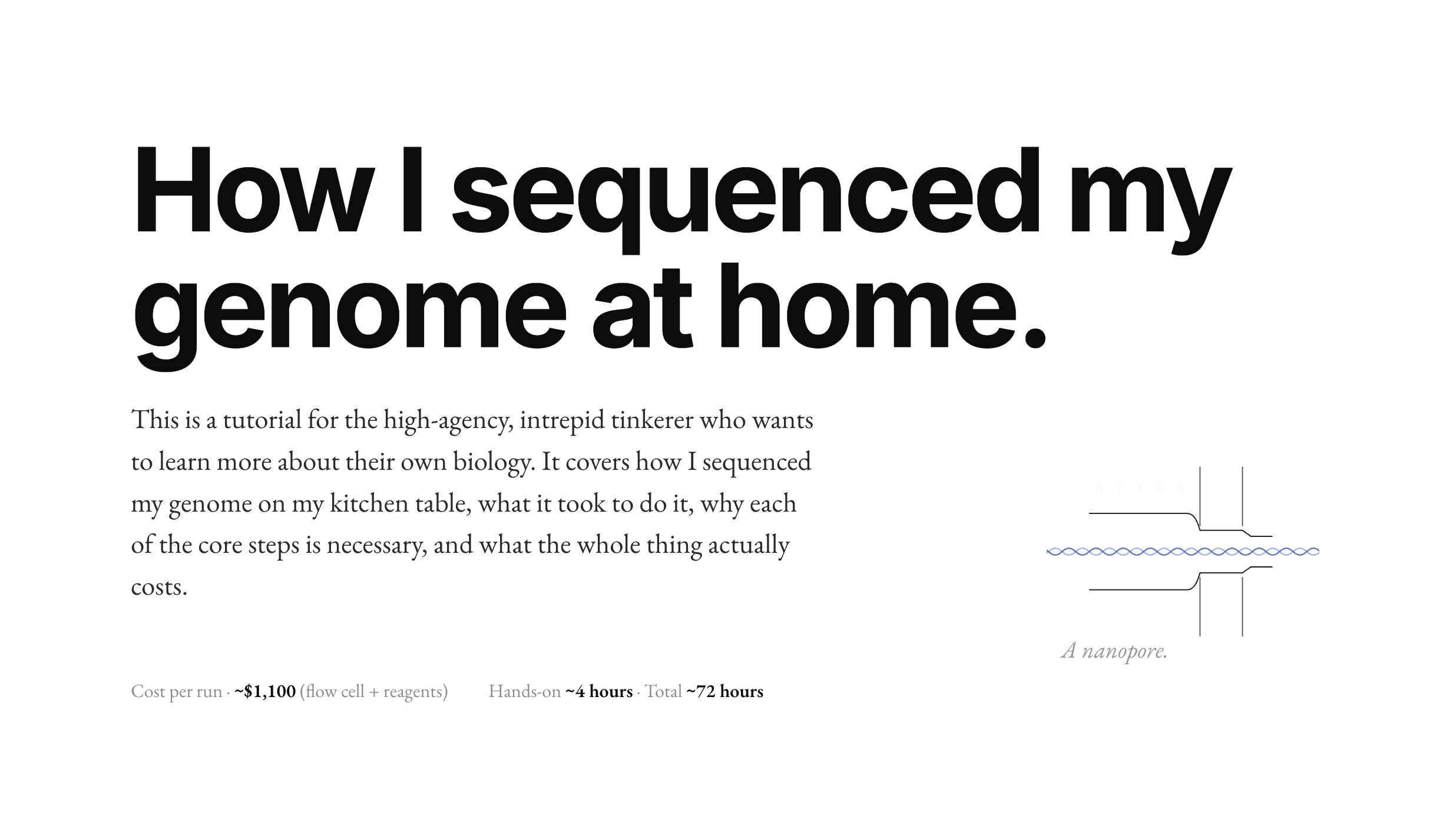
How I sequenced my genome at home
A tutorial for the high-agency, intrepid tinkerer: how I sequenced my genome on my kitchen table, what it took, why each step is necessary, and what it actually costs.iwantosequencemygenomeathome.com
Last edited: