
Most of us like to think we're fundamentally good people — but a new study published in Personality and Individual Differences (2026) suggests that human moral personality is more nuanced than a simple good-versus-bad divide. Researchers from Deakin University, Columbia University, and the University of North Texas identified three distinct personality profiles that reveal how "light" and "dark" traits co-exist within individuals, and how those configurations shape our social lives in surprisingly complex ways.
Prosocial behaviour and aggression followed the predicted pattern cleanly:
The researchers propose a "cooperative victim" pattern: highly trusting, forgiving, and prosocially oriented individuals may inadvertently make themselves vulnerable to exploitation by others. Meanwhile, the Malevolent class's elevated victimisation is thought to reflect a "provocation-victimisation cycle" — their own antagonistic behaviour invites retaliation, while their heightened vulnerable narcissism makes them acutely sensitive to perceived slights.
The Balanced class, by contrast, reported the lowest victimisation — possibly due to better social skills, conflict management strategies, or protective social networks.
The Light and Dark Within Us
The study, led by David Skvarc and colleagues, draws on two well-established personality frameworks:- The Dark Triad — Machiavellianism (manipulativeness), Narcissism (grandiosity and entitlement), and Psychopathy (callousness and impulsivity)
- The Light Triad — Kantianism (treating people as ends, not means), Humanism (valuing people intrinsically), and Faith in Humanity (seeing the best in others)
Three Types of People
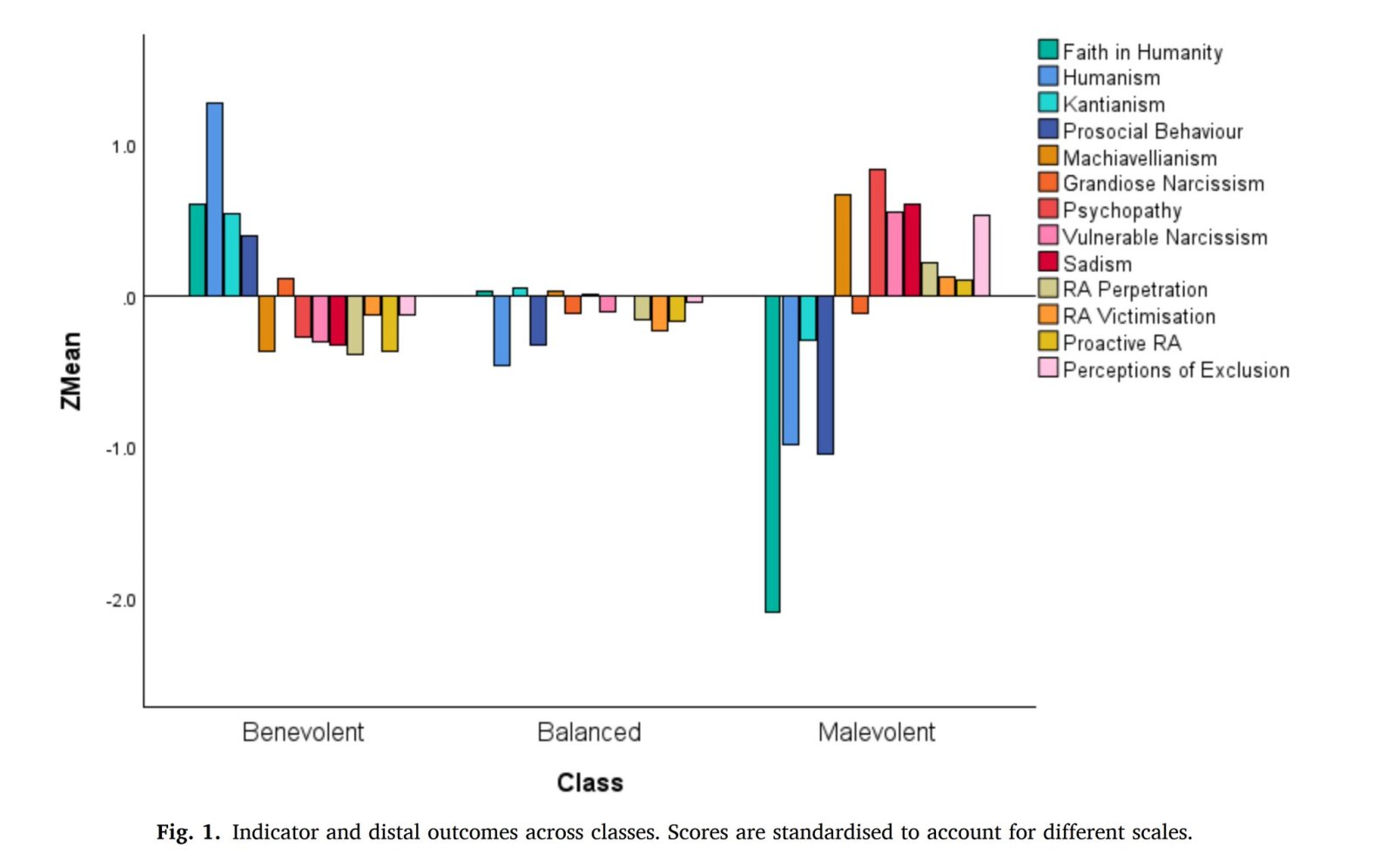
The analysis confirmed a clean three-class solution:- The Benevolent (20.7%): High Light Triad scores, low Dark Triad scores. Compassionate, trusting, prosocial.
- The Balanced (70.6%): Moderate levels on both light and dark traits. The vast majority of people fall here.
- The Malevolent (8.7%): Low Light Triad scores, high Dark Triad scores. Antagonistic, self-interested, low empathy.
Who Falls Into Each Group?
The demographic breakdown offers some striking patterns. The Benevolent class was strongly skewed female (81%) and tended to be younger (average age ~34). The Malevolent and Balanced classes mirrored the overall sample in their gender ratio (~33% male), suggesting that the male-skewed "dark" profile observed in some earlier online studies may reflect recruitment bias rather than a universal feature of malevolent personality.How These Profiles Behave — and Are Treated — in Social Life
Beyond personality scores, the study examined how each class fared in everyday social interactions, and the results were largely as expected — with one notable exception.Prosocial behaviour and aggression followed the predicted pattern cleanly:
- Benevolent individuals reported the highest prosocial behaviour and the lowest relational aggression perpetration
- Malevolent individuals showed the opposite — less helping, more aggression
- Balanced individuals fell predictably in between
The "Cooperative Victim" Paradox
Perhaps the most counterintuitive finding concerned relational aggression victimisation — being on the receiving end of behaviours like rumour-spreading or social exclusion. Logic might suggest that kind, prosocial people would be victimised least. In fact, the Benevolent class showed intermediate victimisation levels — higher than the Balanced class, though lower than the Malevolent class.The researchers propose a "cooperative victim" pattern: highly trusting, forgiving, and prosocially oriented individuals may inadvertently make themselves vulnerable to exploitation by others. Meanwhile, the Malevolent class's elevated victimisation is thought to reflect a "provocation-victimisation cycle" — their own antagonistic behaviour invites retaliation, while their heightened vulnerable narcissism makes them acutely sensitive to perceived slights.
The Balanced class, by contrast, reported the lowest victimisation — possibly due to better social skills, conflict management strategies, or protective social networks.
What Makes Someone "Malevolent"?
A key theoretical insight from the paper concerns the structure of the malevolent profile. The authors argue that malevolence is best understood not as the presence of uniquely pathological traits, but as a collapse of the prosocial baseline. In other words, what most defines the Malevolent class is not simply high psychopathy or Machiavellianism — it is the profound absence of faith in humanity, humanism, and care for others. This interpretation aligns with evolutionary models of prosociality as a default human tendency, with dark traits representing deficits from that baseline rather than alien additions.Limitations and What Comes Next
The authors acknowledge several limitations:
- The study was cross-sectional, preventing causal conclusions
- Self-report measures are vulnerable to social desirability bias, particularly for grandiose narcissism
- The sample, recruited through an Australian university and social media, may not fully generalise to other populations