• Don't want to see ads? Install an adblocker like uBlock Origin or use a Europe-based privacy-friendly browser like Vivaldi or Mullvad.

Question Ancestries of White Brazilians

Tomenable

Well-known member
Messages
6,027
Reaction score
1,751
Points
113
Location
Poland
Ethnic group
Polish
Y-DNA haplogroup
R1b-L617
mtDNA haplogroup
W6a
What percentages of white ancestry in Brazil are Portuguese, Italian, Spanish, German, Polish, etc.?

If all whites = 100%, then what % did the Portuguese, Italians, Spaniards, Germans, etc. contribute?
 
What percentages of white ancestry in Brazil are Portuguese, Italian, Spanish, German, Polish, etc.?

If all whites = 100%, then what % did the Portuguese, Italians, Spaniards, Germans, etc. contribute?
To my knowledge self identification with the white racial classification in places like Brazil and the rest of South America is rather differentiated from connotations in places like the US or the old colonial Anglosphere. In this case it is seen as more of an identification of majority European ancestry, but not necessarily being 100% racially European, whereas in the US/Australia/Canada/New Zealand it is rare that you come across someone identifying as white without a fully European background (albeit usually mixed European).
 
the aim of this threas seems to concern diverses ethnies of origin in Brasil, principally of Europe?
 
While the Portuguese component is the oldest and most widespread, millions of Europeans of other origins settled in Brazil. This is most noticeable in the southern states, those closest to my country, Uruguay. In Santa Catarina, for example, the German presence is striking. I once went to the city of Blumenau, and besides the German architecture, the vast majority of the population looked German. My family and I even joked that the few people who didn't look German were of African descent, and we'd say, "Do these people not know about intermediate skin tones?" And as for what Latin Americans consider white, that varies depending on the country and the percentage of white people in each one.
 
Southern Brazil has historically been the region with the highest percentage of white people. The Southern Region has had a white majority since colonial times, due to the smaller presence of indigenous and black populations. Even in the 19th century, it was a very sparsely populated region, following the reduction of Brazil's native population. The arrival of immigrants, mostly Germans and Italians, had a huge demographic and ethnic impact on this region, as they populated areas previously empty or inhabited by indigenous people. Southeastern Brazil also has a higher percentage of white people, as it was a major recipient of European immigrants, mainly Portuguese, Italians, and Spaniards. In the rest of the country, whites are not an absolute majority, as the contingent of those who self-identify as mixed-race predominates. In these other regions, those who self-identify as white are mostly of Portuguese descent. But this is changing very rapidly due to large internal migrations. Brazil is today an agricultural and agro-industrial superpower, and the Central-West region, which is the country's great grain-producing granary, is being colonized by migrants, entrepreneurs, investors, farmers, and laborers from the South and Southeast regions, who bring capital, labor, their ethnicity, and expertise, fleeing the saturation, bottlenecks, smallholdings, and very expensive land of the South and Southeast. The economic and ethnic profile of this region is changing rapidly, as is that of Brazil as a whole. If I were younger, I would be seeking opportunities in the Central-West of the country. Southern Brazil in no way resembles a Latin American country ethnically speaking, not even those Latin countries considered very European, such as Uruguay and Argentina, and I would say that in phenotypic terms, it doesn't even resemble Southern Europe at all. The states of Santa Catarina and Paraná, both in the Southern Region, are also major drivers of the country's economic growth and have increasingly attracted Brazilians from other regions of the country, who, unfortunately and absurdly, have also been victims of xenophobia and racism for not resembling the predominant ethnic type in those states and not fitting the profile of people they would like to see working and living there. The recent action by the mayor of Florianópolis, the capital of the state of Santa Catarina, to send back to their places of origin all those who arrive in the city and cannot prove they have a stable job or a place to live is causing quite a stir here. The City Council of my city, Belo Horizonte, copying the measure, approved a law to adopt this same type of automatic "deportation," adding that the belongings of the homeless population must be immediately collected by the municipal guard if they are littering, hindering the circulation of people, or the free exercise of economic activity by legally established merchants and companies, and that the homeless and drug addicts (the vast majority of those living on the streets) who cannot prove ties to the city must be returned to their cities and states of origin. This is an absolute lack of empathy from the right-wing rulers, who, not coincidentally, govern all the states and their respective capitals in the South, Southeast, and also the Midwest of the country. My son and his wife, natives of the state of Minas Gerais, like me, have lived in Paraná for three years and are building a prosperous and happy future there, where they are professionally very well established. They are fortunate to be the kind of outsiders that they don't mind having there and who go unnoticed. If it weren't for the climate there, which my wife and I particularly hate, I would get rid of all my assets here in Belo Horizonte and go there to be with them. But we are very happy where we are, and at the right time everything I have will be his in the great intergenerational transfer that is already looming all over the world, that is, if by then my wife and I haven't squandered everything we have on travel, leisure, fun, and good food, because at this stage of life we deserve it, and our son is doing very well and doesn't demand or ask for anything.
 
I agree with you, Duarte. Although Uruguay and Argentina have predominantly European origins, our people look different from those in southern Brazil. We have features more typical of southern Europe.
 
Southern Brazil has historically been the region with the highest percentage of white people. The Southern Region has had a white majority since colonial times, due to the smaller presence of indigenous and black populations. Even in the 19th century, it was a very sparsely populated region, following the reduction of Brazil's native population. The arrival of immigrants, mostly Germans and Italians, had a huge demographic and ethnic impact on this region, as they populated areas previously empty or inhabited by indigenous people. Southeastern Brazil also has a higher percentage of white people, as it was a major recipient of European immigrants, mainly Portuguese, Italians, and Spaniards. In the rest of the country, whites are not an absolute majority, as the contingent of those who self-identify as mixed-race predominates. In these other regions, those who self-identify as white are mostly of Portuguese descent. But this is changing very rapidly due to large internal migrations. Brazil is today an agricultural and agro-industrial superpower, and the Central-West region, which is the country's great grain-producing granary, is being colonized by migrants, entrepreneurs, investors, farmers, and laborers from the South and Southeast regions, who bring capital, labor, their ethnicity, and expertise, fleeing the saturation, bottlenecks, smallholdings, and very expensive land of the South and Southeast. The economic and ethnic profile of this region is changing rapidly, as is that of Brazil as a whole. If I were younger, I would be seeking opportunities in the Central-West of the country. Southern Brazil in no way resembles a Latin American country ethnically speaking, not even those Latin countries considered very European, such as Uruguay and Argentina, and I would say that in phenotypic terms, it doesn't even resemble Southern Europe at all. The states of Santa Catarina and Paraná, both in the Southern Region, are also major drivers of the country's economic growth and have increasingly attracted Brazilians from other regions of the country, who, unfortunately and absurdly, have also been victims of xenophobia and racism for not resembling the predominant ethnic type in those states and not fitting the profile of people they would like to see working and living there. The recent action by the mayor of Florianópolis, the capital of the state of Santa Catarina, to send back to their places of origin all those who arrive in the city and cannot prove they have a stable job or a place to live is causing quite a stir here. The City Council of my city, Belo Horizonte, copying the measure, approved a law to adopt this same type of automatic "deportation," adding that the belongings of the homeless population must be immediately collected by the municipal guard if they are littering, hindering the circulation of people, or the free exercise of economic activity by legally established merchants and companies, and that the homeless and drug addicts (the vast majority of those living on the streets) who cannot prove ties to the city must be returned to their cities and states of origin. This is an absolute lack of empathy from the right-wing rulers, who, not coincidentally, govern all the states and their respective capitals in the South, Southeast, and also the Midwest of the country. My son and his wife, natives of the state of Minas Gerais, like me, have lived in Paraná for three years and are building a prosperous and happy future there, where they are professionally very well established. They are fortunate to be the kind of outsiders that they don't mind having there and who go unnoticed. If it weren't for the climate there, which my wife and I particularly hate, I would get rid of all my assets here in Belo Horizonte and go there to be with them. But we are very happy where we are, and at the right time everything I have will be his in the great intergenerational transfer that is already looming all over the world, that is, if by then my wife and I haven't squandered everything we have on travel, leisure, fun, and good food, because at this stage of life we deserve it, and our son is doing very well and doesn't demand or ask for anything.
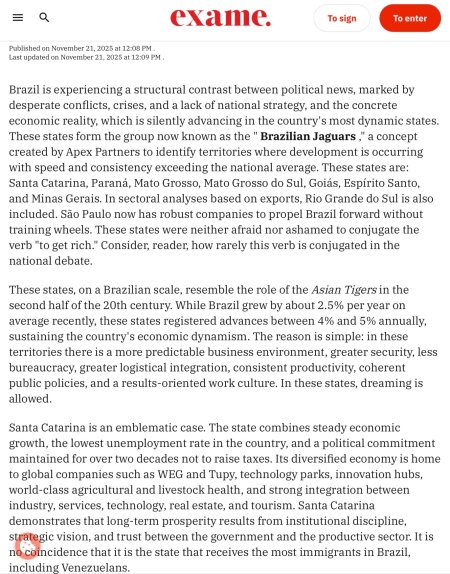
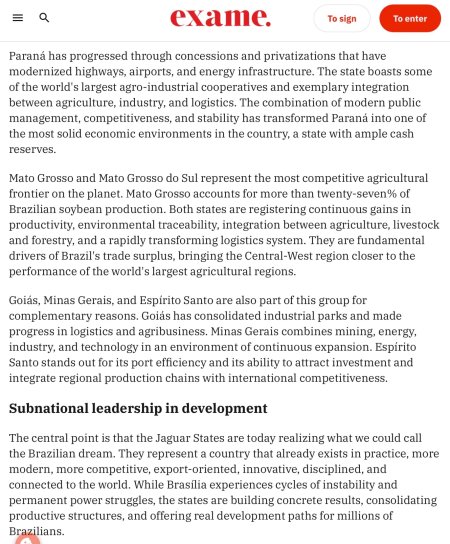
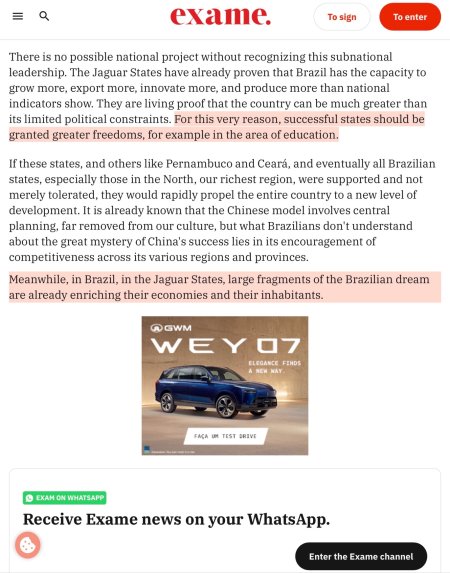
This news was published on November 21st of this year in a respected magazine of economics by here and, coincidentally, confirms everything I said above about the states that are currently the engines of Brazil's growth and which, curiously, are called the Brazilian jaguars. I wasn't familiar with this term, but the fact is that it shows I'm still up-to-date with the facts and events that surround me. I haven't lost my touch yet.
IMG_9520.png

The Jaguar States and the Brazil that is getting richer Group of states maintains accelerated growth rate and consolidates its own model of regional development.
 

Attachments

  • IMG_9521.jpeg
    IMG_9521.jpeg
    903.8 KB · Views: 142
  • IMG_9522.jpeg
    IMG_9522.jpeg
    809.4 KB · Views: 139
  • IMG_9523.jpeg
    IMG_9523.jpeg
    625.2 KB · Views: 147
Last edited:
Back
Top