

Rizla
Regular Member
- Messages
- 45
- Reaction score
- 23
- Points
- 0
- Ethnic group
- Scandinavian
- Y-DNA haplogroup
- I1
- mtDNA haplogroup
- H3n
This is an english translation I made of a danish article. The original article is here: https://videnskab.dk/kultur-samfund/alken-enge-massegrav-fra-jernalderen-faar-haarene-til-at-stritte The published scientific paper they refer to in the article is published on PNAS, and can be easily found through google.
I think it's fascinating that this battle is pretty close to the cimbri, both in time and place.
The article:
Basically, we do not know what happened on a battlefield in East Jutland just over 2,000 years ago, but one thing is certain: it was violent.
In a new study, archaeologists gather our preliminary knowledge of one of the most spectacular excavations on Danish soil, Alken Enge, and it is a horrific reading.
A mass burial in the small town of Alken has been shown to cover the bone material from a showdown where 13-year-olds have fought side by side with adult men, where the dead has been left to be ripped into pieces by hungry wolves, and where the bones subsequently has been collected and processed in the most bestial manner.
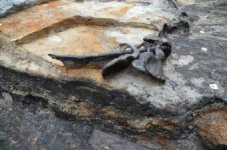
Most eye-catching is the find of four pelvis bones that has been put on a stick.
"There was a very strange atmosphere about the excavation when we found them. It clearly shows an act that, when you think about it, make one's hair stand up in the back of the neck" says Mads Kähler Holst, director of Moesgaard Museum and first author of the study.
"There was a lot of silence in the excavation that day," excavation leader and co-author Ejvind Hertz adds.
We have no idea what happened
Archaeologists have so far found 2,095 bones and fragments in the peat moss at Alken Enge. However, they have far from excavated the entire area. In the new study, they estimate that there are at least 380, possibly up to a 1,000 people, enshrined in the turbid moss water. People who have lost their life in a battle we currently know very little about.
Carbon analysis shows that all the bones originate from one major event very early in the first century, and historical sources tell us that this was a time of violent upsurge in Europe.
But who these people were, why they went into a battle and where the battle itself took place - we do not know.
"When we come so far north (Scandinavia, ed.), We have unfortunately no Roman written sources to tell us what has happened, so we have no idea, "says Ejvind Hertz, museum inspector at Museum Skanderborg.
Not a clash with the romans
The researchers feel reasonably sure that Alken Enge does not cover a clash between the Romans and the Germanics - a common name for tribal groups in and around Scandinavia - which would otherwise be an obvious thought.
Around year 1 CE, when the bones originated, some violent fighting between the Germans and the Romans took place as the Roman Empire slowly expanded to the north.
But it was also not uncommon for the different Germanic tribes to confront each other, when the Romans weren’t threatening their territories. It was a time of break-ups and people's migrations.
"We feel quite convinced that these people didn’t come from southern Europe, because we would probably be able to see that from the skeletons. On the other hand, they can have lived anywhere from the north of the Alps. We simply have no idea, "says Ejvind Hertz.
Sets the power structures in perspective
Nevertheless, Alken Enge tells a very unique story of power structures in the Iron Age, says an archaeologist who himself has not been involved in the excavation.
Alken Enge is the only place in Europe where we today have the remains of a whole army from the Germanic iron age, and the considerable collection of people show that what we see here is an unprecedented formation of a superpower, Katrine Balsgaard Juul said, a museum inspector at Vejlemuseerne.
"It is a really interesting find, which is not only important in the local area, but for all archaeologists in Europe. We can use it to put all our pits and villages in perspective, "says Katrine Balsgaard Juul, who has read the new study.
"We are always interested in finding out when we go from smaller tribes to a more formal structure - or even a decisive state. Alken shows that at some point in time there has been a form of organization of some very large geographical areas" she adds.
Many villages to one army
In order to set the find at Alken in a little perspective, one can imagine that in the villages of that time there may have been 3 to 5 main houses, says Katrine Balsgaard Juul.
In each of them has lived between 8 and 15 people, including both women and children.
That gives between 24 and 75 people in each village, and if we assume that about half were men or boys, we are down to 10-40 potential soldiers.
Most Alken warriors were between 20 and 40 years, while just under 5 percent were under 20 years. The youngest was 13 years old.
"If we say that at least 380 men died at this battle, how big has it been from the beginning? How many villages are required to procure such an army? One has to imagine that there has been large areas that, after such a battle, have completely lacked young men. A whole generation of men lost. It must have been quite harsh, "says Katrine Balsgaard Juul.
The excavation took place in the years 2012 to 2014 and was conducted in collaboration between archaeologists from Aarhus University, Skanderborg Museum and Moesgaard Museum.
"I doubt they could pass session"
In addition to the ravages of time on the skeletons, the researchers have also become more aware of the damage they have been inflicted. Some during the battle itself, others during a subsequent treatment that may have occurred in connection with sacrifice to the bog. Skulls have been broken, and in a pelvic bone for example, two deep grooves are cut on the inside. "It's hard to imagine that you can get a slash in there during the battle. That's something we almost think has happened afterwards, "says Ejvind Hertz.
Almost none of the men have previously healed fractures. In other words, they have probably never seen a battlefield before.
"We must say that it's quite an unexperienced army, and I doubt they could all pass our modern session. It's a strange, mixed flock, from the very skinny guys to some decently large and muscular types, and from the very young to the relatively old, "says Ejvind Hertz.
The bodies have been lying on the ground for half a year
Archaeologists can see that the dead have been left on the battlefield after the battle. Here they have lain up to a year, before the bones have been collected and transported to the bog by Alken Enge.
During that time, the bodies have probably mostly been transformed into skeletons, and has also become food for the predators of the area.
"These are people who have been killed with incredible violence in a big battle, and they just let them lie for a very long time. I think that's interesting, "says Katrine Balsgaard Juul, who points out that it might have been a war, that has been so extensive that one simply could not handle the dead. That theory is backed up by the fact that Alken Enge seems to be depopulated after the big battle. What used to be fully cultivated farms are being abandoned and taken over by forests. But she also has another explanation:
"It may be the last mockery of a defeated enemy. It is almost the worst one can imagine, that you will not be buried or handled properly when you are dead and thus denied access to afterlife. The ultimate degradation, "she says.
Handling of bones points to religion
Until now, the Germanic's bestial handling of corpses after acts of war, has had almost mythical status.
According to Mads Kähler Holst, the handling of the bones, as well as the fact that they have been transported to such a special place in the landscape, is a very deliberate act.
More precisely, they have been moved to a small landmark at Mossø, Denmark's fourth largest lake, which is located at Alken.
"It helps to emphasize that it is something religious," says Mads Kähler Holst, who was project leader on the excavation. However, the scientists do not dare to make concrete bids on which god or goddess the dead may be sacrificed to. The lack of written sources makes us virtually blind to the god world in the Nordic countries at this time, says Ejvind Hertz, who adds that the Germanics have probably been influenced by Celtic faith.
A 'once in a lifetime' excavation
Although there are still many unanswered questions - or perhaps just for that reason - Alken Enge is in many ways a dream excavation for an archaeologist.
"All archaeologists have a number of things on their 'bucket list'. And dig something like this, which is so rare and has so much regional, national and supranational significance, could be one of them, "says Katrine Balsgaard Juul. Ejvind Hertz agrees: "This excavation is very, very, very unique. It's really 'once in a lifetime' for an archaeologist to be allowed to contribute to such an excavation.'
Four pelvis bones that has been put on a stick:
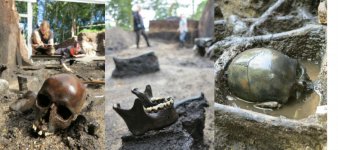
Various skulls from the excavation:
I think it's fascinating that this battle is pretty close to the cimbri, both in time and place.
The article:
Basically, we do not know what happened on a battlefield in East Jutland just over 2,000 years ago, but one thing is certain: it was violent.
In a new study, archaeologists gather our preliminary knowledge of one of the most spectacular excavations on Danish soil, Alken Enge, and it is a horrific reading.
A mass burial in the small town of Alken has been shown to cover the bone material from a showdown where 13-year-olds have fought side by side with adult men, where the dead has been left to be ripped into pieces by hungry wolves, and where the bones subsequently has been collected and processed in the most bestial manner.
Most eye-catching is the find of four pelvis bones that has been put on a stick.
"There was a very strange atmosphere about the excavation when we found them. It clearly shows an act that, when you think about it, make one's hair stand up in the back of the neck" says Mads Kähler Holst, director of Moesgaard Museum and first author of the study.
"There was a lot of silence in the excavation that day," excavation leader and co-author Ejvind Hertz adds.
We have no idea what happened
Archaeologists have so far found 2,095 bones and fragments in the peat moss at Alken Enge. However, they have far from excavated the entire area. In the new study, they estimate that there are at least 380, possibly up to a 1,000 people, enshrined in the turbid moss water. People who have lost their life in a battle we currently know very little about.
Carbon analysis shows that all the bones originate from one major event very early in the first century, and historical sources tell us that this was a time of violent upsurge in Europe.
But who these people were, why they went into a battle and where the battle itself took place - we do not know.
"When we come so far north (Scandinavia, ed.), We have unfortunately no Roman written sources to tell us what has happened, so we have no idea, "says Ejvind Hertz, museum inspector at Museum Skanderborg.
Not a clash with the romans
The researchers feel reasonably sure that Alken Enge does not cover a clash between the Romans and the Germanics - a common name for tribal groups in and around Scandinavia - which would otherwise be an obvious thought.
Around year 1 CE, when the bones originated, some violent fighting between the Germans and the Romans took place as the Roman Empire slowly expanded to the north.
But it was also not uncommon for the different Germanic tribes to confront each other, when the Romans weren’t threatening their territories. It was a time of break-ups and people's migrations.
"We feel quite convinced that these people didn’t come from southern Europe, because we would probably be able to see that from the skeletons. On the other hand, they can have lived anywhere from the north of the Alps. We simply have no idea, "says Ejvind Hertz.
Sets the power structures in perspective
Nevertheless, Alken Enge tells a very unique story of power structures in the Iron Age, says an archaeologist who himself has not been involved in the excavation.
Alken Enge is the only place in Europe where we today have the remains of a whole army from the Germanic iron age, and the considerable collection of people show that what we see here is an unprecedented formation of a superpower, Katrine Balsgaard Juul said, a museum inspector at Vejlemuseerne.
"It is a really interesting find, which is not only important in the local area, but for all archaeologists in Europe. We can use it to put all our pits and villages in perspective, "says Katrine Balsgaard Juul, who has read the new study.
"We are always interested in finding out when we go from smaller tribes to a more formal structure - or even a decisive state. Alken shows that at some point in time there has been a form of organization of some very large geographical areas" she adds.
Many villages to one army
In order to set the find at Alken in a little perspective, one can imagine that in the villages of that time there may have been 3 to 5 main houses, says Katrine Balsgaard Juul.
In each of them has lived between 8 and 15 people, including both women and children.
That gives between 24 and 75 people in each village, and if we assume that about half were men or boys, we are down to 10-40 potential soldiers.
Most Alken warriors were between 20 and 40 years, while just under 5 percent were under 20 years. The youngest was 13 years old.
"If we say that at least 380 men died at this battle, how big has it been from the beginning? How many villages are required to procure such an army? One has to imagine that there has been large areas that, after such a battle, have completely lacked young men. A whole generation of men lost. It must have been quite harsh, "says Katrine Balsgaard Juul.
The excavation took place in the years 2012 to 2014 and was conducted in collaboration between archaeologists from Aarhus University, Skanderborg Museum and Moesgaard Museum.
"I doubt they could pass session"
In addition to the ravages of time on the skeletons, the researchers have also become more aware of the damage they have been inflicted. Some during the battle itself, others during a subsequent treatment that may have occurred in connection with sacrifice to the bog. Skulls have been broken, and in a pelvic bone for example, two deep grooves are cut on the inside. "It's hard to imagine that you can get a slash in there during the battle. That's something we almost think has happened afterwards, "says Ejvind Hertz.
Almost none of the men have previously healed fractures. In other words, they have probably never seen a battlefield before.
"We must say that it's quite an unexperienced army, and I doubt they could all pass our modern session. It's a strange, mixed flock, from the very skinny guys to some decently large and muscular types, and from the very young to the relatively old, "says Ejvind Hertz.
The bodies have been lying on the ground for half a year
Archaeologists can see that the dead have been left on the battlefield after the battle. Here they have lain up to a year, before the bones have been collected and transported to the bog by Alken Enge.
During that time, the bodies have probably mostly been transformed into skeletons, and has also become food for the predators of the area.
"These are people who have been killed with incredible violence in a big battle, and they just let them lie for a very long time. I think that's interesting, "says Katrine Balsgaard Juul, who points out that it might have been a war, that has been so extensive that one simply could not handle the dead. That theory is backed up by the fact that Alken Enge seems to be depopulated after the big battle. What used to be fully cultivated farms are being abandoned and taken over by forests. But she also has another explanation:
"It may be the last mockery of a defeated enemy. It is almost the worst one can imagine, that you will not be buried or handled properly when you are dead and thus denied access to afterlife. The ultimate degradation, "she says.
Handling of bones points to religion
Until now, the Germanic's bestial handling of corpses after acts of war, has had almost mythical status.
According to Mads Kähler Holst, the handling of the bones, as well as the fact that they have been transported to such a special place in the landscape, is a very deliberate act.
More precisely, they have been moved to a small landmark at Mossø, Denmark's fourth largest lake, which is located at Alken.
"It helps to emphasize that it is something religious," says Mads Kähler Holst, who was project leader on the excavation. However, the scientists do not dare to make concrete bids on which god or goddess the dead may be sacrificed to. The lack of written sources makes us virtually blind to the god world in the Nordic countries at this time, says Ejvind Hertz, who adds that the Germanics have probably been influenced by Celtic faith.
A 'once in a lifetime' excavation
Although there are still many unanswered questions - or perhaps just for that reason - Alken Enge is in many ways a dream excavation for an archaeologist.
"All archaeologists have a number of things on their 'bucket list'. And dig something like this, which is so rare and has so much regional, national and supranational significance, could be one of them, "says Katrine Balsgaard Juul. Ejvind Hertz agrees: "This excavation is very, very, very unique. It's really 'once in a lifetime' for an archaeologist to be allowed to contribute to such an excavation.'
Four pelvis bones that has been put on a stick:
Various skulls from the excavation: