• Don't want to see ads? Install an adblocker like uBlock Origin or use a Europe-based privacy-friendly browser like Vivaldi or Mullvad.

101 Ancient Eurasian Genomes Available Online

I'd like more data than Genitiker's calls as well, but I don't think that it's a stretch to say that he's probably right about this one. "Sardinian" I2-M26 is indeed called "Sardinian" due to modern frequency and no other reason. We know from other ancient samples, including several Neolithic samples from France, that it was many places in Europe by Remedello. Remedello is easily within range (and Neolithic looking, as Angela points out), and the I2-M26 there could be either native or brought in. I2-M26 is old and widespread enough that either hypothesis works fine. I2a1b, on the other hand, has a northern (even more so than eastern) geographical bias that would make it a bit more surprising in Italy. I2-M223, although less known in ancient samples, seems to be similar to I2a1b, if a little more central.

it was not an affirmation of mine but a "warning" concerning male Y-DNA at this stage of History - the aDNA here is not the only criteria - I have nothing at all against a Y-1a-m-26 but the ancient ones we had found until today were rather western ones, linked to Neolithic (by absorbtion, maybe rather megalitic Neolithic?) - wait and sea: Metals Ages DNA West of Adriatic and Germany is seldom except Iberia...
 
OK - I was just waking up an old dream of mine, for the game - that said, "indistinguishable autosomally" in a very strong word for a not too precise tool of knowledge: I remember the 'block' of Gokhem, Stuttgart and other Neolithic people wihch showed later some trends towards different directions, avowing so some little differences in admixture - male elite mediated hold on land can leave evaporate quickly enough its intruding aDNA according to the weight of the successfull newcomers -
but here I have no certitude nor theory: only remarks - where found you the aDNA reports for the matter? thanks beforehand

Moesan, for now the ones making the calls are posters on various internet sites, so I wouldn't take any of it to the bank quite yet. You can take out "indistinguishable autosomally" and substitute "if reports are correct, all 3 Remedello samples seem to be EEF autosomally". :)

We'll see if there's a devil in the details.
 
^ Check the presentation by Richard Littauer linked above.

He suggests that Tocharian could be originally a Satem language, and that the merge into [k] was caused by neighbouring non-IE languages, which influenced Tocharian. He states that by the time of first texts in Tocharian (so called Tocharian A), it was already a decaying or even a dead language, only used in liturgical texts like Latin in the Middle Ages, or Hebrew in Ashkenazi Jewish communities of Medieval Europe. Littauer also writes (quoting Atkinson 2011) that the "original Tocharian" population was never large, which may explain small amount of Non-Z93 R1a in the area today.
 
Wait, couple of posts back you preached against using Satem/Centum to classify languages and now go ahead with Tocharian as "originally a Satem language" :)
Maybe I am missing smth...
 
Moesan, for now the ones making the calls are posters on various internet sites, so I wouldn't take any of it to the bank quite yet. You can take out "indistinguishable autosomally" and substitute "if reports are correct, all 3 Remedello samples seem to be EEF autosomally". :)

We'll see if there's a devil in the details.

OK, that doesn't change my remark concerning Y-DNA - some more news will come some day - I avow I'm glad : we are living a very exciting time now, and I hope the DNA samples will still grow up - good nigh, I 'll go to rest my "first generation" brain!
 
Wait, couple of posts back you preached against using Satem/Centum to classify languages and now go ahead with Tocharian as "originally a Satem language" :)
Maybe I am missing smth...

That's because you guys apparently keep insisting that the Tarim Mummies weren't Tocharians just because they turned out to be R1a. So if you think that Kentum is inherently linked to R1b, and Satem to R1a, I decided to find an alternative explanation, and - voilà! - I've found it. A Kentumization or a Re-Kentumization could occur in Tocharian.

So if you can't believe that R1a could be Kentum, then maybe you can believe that they were Satem (originally).

Angela said:
quote: "Tocharian language, the second oldest to break off from Proto-Indo European, with a western Europan origin"

And apart from the Kentum character (which could actually be derivative - resulting from [Re-]Kentumization under the influence of local non-IE languages, as Littauer suggests) - what other evidence exists, if any, that Tocharian language was "with a western European origin" ??? And this implies neglecting R1a in Tarim Mummies.

Before Tarim Mummies have turned out to be R1a (which was a few years ago) - if I remember correctly - Eupedia's website was claiming that they were surely Tocharians, that they were most certainly R1b, and that red hair was spread by R1b (because some of them were gingers and were still believed to be R1b at that time).

Now after they've turned out to be R1a, all claims get reversed - "no they weren't Tocharians, no, no." :)
 
I also remember old good times when it was believed that R1b has a Paleolithic LGM continuity from Iberia:

"Of you Eastern Europeans, you are evil steppe invaders, you don't belong, we are true native Europeans!".

Later came Haak with his "massive migration" of R1b, while R1a might actually be local (see Karelia, WHG):

"Oh you Eastern Europeans, you are primitive local hunter-gatherers, we are true PIEs from the steppe!".

:)

Of course I'm only joking. ;o

It's just interesting how at first Western Euros got excited that they are from Iberian LGM refuge, and that - "thankfully Eastern Euros are the steppe newcomers". And now they are excited that they came from the steppe. 8-)

Except that there is R1b from Els Trocs in Iberia. Which, however, was not M269, but an upstream paragroup.

Like R1b from Els Trocs, Karelian R1a is also a rare paragroup, well prior to M198 in the phylogenetic tree.

So before you definitely relocate Eastern Euros to the forest zone "since times immemorial" (as Arvistro has already suggested in this thread - in his statement about "Paleolithic Balts", or something), wait for more samples.
 
That's because you guys apparently keep insisting that the Tarim Mummies weren't Tocharians just because they turned out to be R1a. So if you think that Kentum is inherently linked to R1b, and Satem to R1a, I decided to find an alternative explanation, and - voilà! - I've found it. A Kentumization or a Re-Kentumization could occur in Tocharian.

So if you can't believe that R1a could be Kentum, then maybe you can believe that they were Satem (originally).


And apart from the Kentum character (which could actually be derivative - resulting from [Re-]Kentumization under the influence of local non-IE languages, as Littauer suggests) - what other evidence exists, if any, that Tocharian language was "with a western European origin" ??? And this implies neglecting R1a in Tarim Mummies.

Before Tarim Mummies have turned out to be R1a (which was a few years ago) - if I remember correctly - Eupedia's website was claiming that they were surely Tocharians, that they were most certainly R1b, and that red hair was spread by R1b (because some of them were gingers and were still believed to be R1b at that time).

Now after they've turned out to be R1a, all claims get reversed - "no they weren't Tocharians, no, no." :)

Tomenable, you're aware that was a quote from the paper, not my own conclusion, necessarily, yes? I have no stake in this R1b versus R1a contest; I don't even know my father's yDna line. (Given his ancestral area, U-152 is a good bet, but there's some J2 and G2 up there as well, and in Italy pretty much anything can show up.) Nor am I much interested, to be honest, since I think it's our autosomal composition that makes us who we are. Well, maybe our mtDna to some extent, since there are health implications, but that's it.

My only interest in figuring out the yDna lines in some of these cultures on the steppe is because it's an intellectual puzzle, and also because I always like to get it right. That's it. This attachment of men to their y lines is destined to remain a mystery of the male psyche to me, I'm afraid. :)

As for people lauding one culture over another, maybe part of what's going on is that it's just human nature to want to see one's ancestry in a positive light. There's nothing wrong with that; it's part of our identity after all. There's nothing wrong, that is, so long as it doesn't lead to denigration of someone else's ancestry, and so long as one maintains one's intellectual honesty. I agree with you, though, that a little consistency would be nice. :)
 
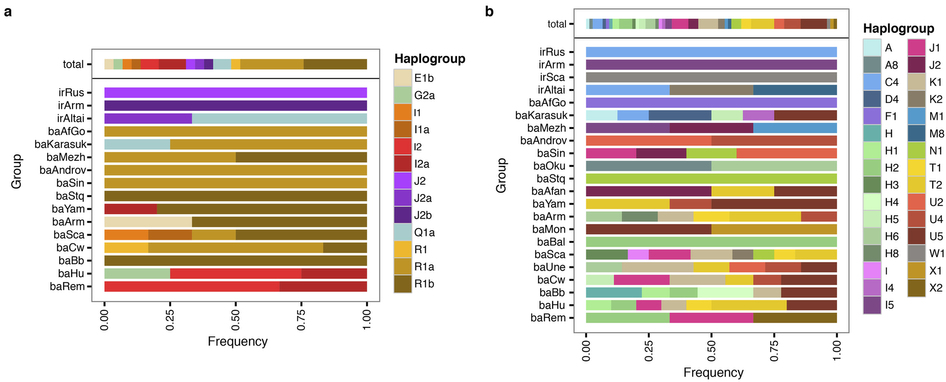
nature14507-sf61rwr50.jpg

Can someone please tell me what baBb is? Also baRem?
 
That's because you guys apparently keep insisting that the Tarim Mummies weren't Tocharians just because they turned out to be R1a. So if you think that Kentum is inherently linked to R1b, and Satem to R1a, I decided to find an alternative explanation, and - voilà! - I've found it. A Kentumization or a Re-Kentumization could occur in Tocharian.

So if you can't believe that R1a could be Kentum, then maybe you can believe that they were Satem (originally).


And apart from the Kentum character (which could actually be derivative - resulting from [Re-]Kentumization under the influence of local non-IE languages, as Littauer suggests) - what other evidence exists, if any, that Tocharian language was "with a western European origin" ??? And this implies neglecting R1a in Tarim Mummies.

Before Tarim Mummies have turned out to be R1a (which was a few years ago) - if I remember correctly - Eupedia's website was claiming that they were surely Tocharians, that they were most certainly R1b, and that red hair was spread by R1b (because some of them were gingers and were still believed to be R1b at that time).

Now after they've turned out to be R1a, all claims get reversed - "no they weren't Tocharians, no, no." :)

you told me the Tarim mummies were not R1a-Z93
can you tell me more?

Tocharian has been discovered by coincidence
I'm sure many more IE languages existed which were never discovered
And many different IE tribes made their way into China, only to be expelled again later

https://en.wikipedia.org/wiki/Yuezhi

they too have been identified as Tocharians, allthough they spoke Bactrian
argueing they might have switched from Tocharian into Bactrian language is IMO far-fetched
there is no proven connection with the Tarim mummies either
IMO they were probably R1a-Z93 (they settled in Bactria and in India)

there was also R1a in Xiongnu :

https://en.wikipedia.org/wiki/Xiongnu

how do you think cattle, horses, bronze and copper entered China?
 
That's because you guys apparently keep insisting that the Tarim Mummies weren't Tocharians just because they turned out to be R1a. So if you think that Kentum is inherently linked to R1b, and Satem to R1a, I decided to find an alternative explanation, and - voilà! - I've found it. A Kentumization or a Re-Kentumization could occur in Tocharian.

So if you can't believe that R1a could be Kentum, then maybe you can believe that they were Satem (originally).
Some consistency is needed. If you quote author who objects Centum/Satem with good reasons, then you should not quote another author who builds on Centum/Satem.

As to Tocharians, I had never argued anything about them on this topic, and probably on other topics either, simply because I know nothing on that subject.

My quote about Satems (or if we disagree to Satem/Centum split, then BSII - Balto-Slavo-Indo-Iranians for lack of better term) was just that new data are surprisingly consistent with Mr Pashka's website www suduva com topic on proto-Balts. About how in Corded Ware and its derived cultures proto-Baltic, Slavic, Indic, Iranic, Germanic (as substrate), Uralic folk interacted in the forest area.
It has some outdated genetic data and it is a bit emotional/pro-Baltic in presenting info, but with all that it seems like being very close to the reality.

This is what he says about Fatyanovo Balts and contacts with Sintashta:
Fatyanovo developed from an early Northern poly-ethnic variant of the Middle Dnieper culture horizont. It is here that pottery displays a unique Fatyanovo Baltic style of mixed Corded Ware and Globular Amphora features and exhibits a trademark "checked" hatched diamond rhombus motif design ornamentation not found with the steppe cultures, thus allowing their contacts with those cultures to be tracked - even into Sintashta and beyond.

He also argues linguistic mythological paralels attested in Sanscrit and Baltic people and Uralic beliefs.

Interesting note. He takes for granted in his website that Globular Amphora Culture was early Centum. And it is Globular Amphora migrations/substrate into Corded that left linguistic Centum-ish tracks into early West Baltic and less noticeable into East Baltic. I wonder if that could turn out right or is seriously outdated :)
 
I'd like more data than Genitiker's calls as well, but I don't think that it's a stretch to say that he's probably right about this one. "Sardinian" I2-M26 is indeed called "Sardinian" due to modern frequency and no other reason. We know from other ancient samples, including several Neolithic samples from France, that it was many places in Europe by Remedello. Remedello is easily within range (and Neolithic looking, as Angela points out), and the I2-M26 there could be either native or brought in. I2-M26 is old and widespread enough that either hypothesis works fine. I2a1b, on the other hand, has a northern (even more so than eastern) geographical bias that would make it a bit more surprising in Italy. I2-M223, although less known in ancient samples, seems to be similar to I2a1b, if a little more central.

IMO the first expansion of I2-M26 went hand in hand with the Cardial expansion and probably more consecutive expansions followed.
There is no link between Cardial and copper working, except maybe Ötzi whose subclade (L91) points toward Sardegna/Sicily, allthough it has been found in Germany too now. L91 is also older than the spread of G2a into Europe so the forefathers of Ötzi might have entered Europe via the Balkans as well.
The Remedello burial rituals were certainly not neolithic at all, they are more IE like.
 
by the way,

Haak et al listed Motola 9 as I2a1
Now some people claim Motola 9 as I2a1a1-L672
Does anybody now where this claim came from?
I'm very skeptical about this
 
I rather skipped over this part of the text in Allentoft's Supplementary Info in my first go round:

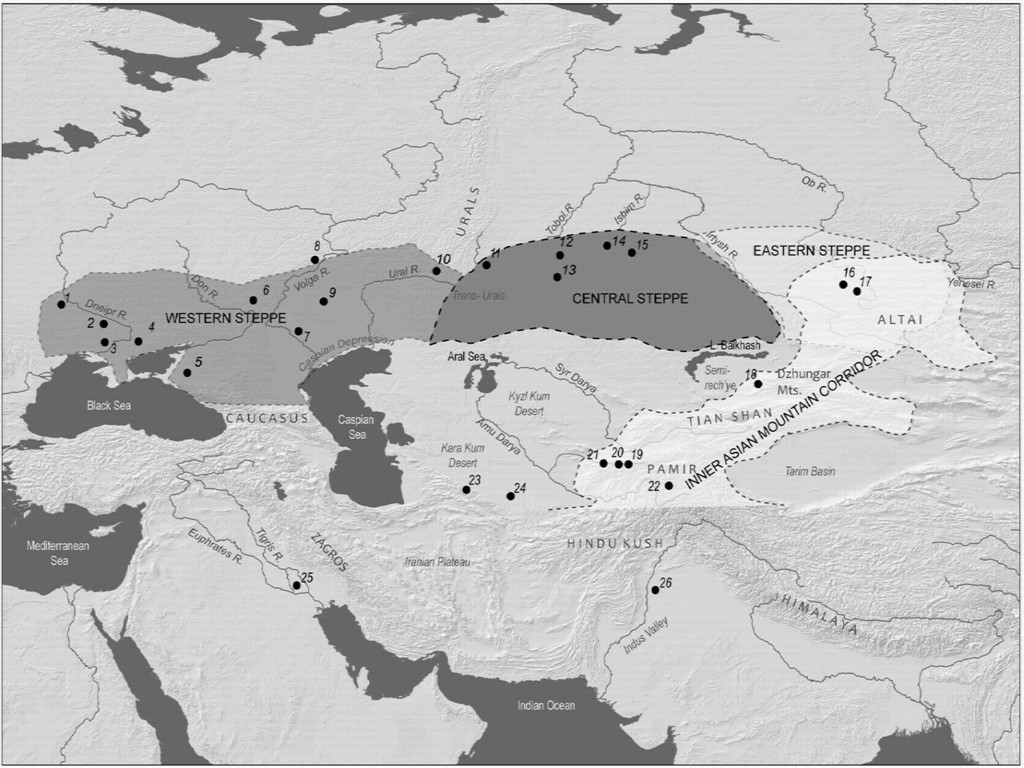
"Despite the general Yamnaya expansion stalling at Ural, some groups must have been looking for more distant grazing grounds, because in the eastern steppe of Western Siberia we find an outlier culture that seems related to early Yamnaya. The archaeological explanations for this phenomenon diverge: traditionally it has been considered the result of a remarkable, long distance migration that took place at an early stage of the pre-Yamnaya (known as the Repin culture) of the western steppe. A two-thousand kilometer trek across the central steppe to the Altai mountains, rich in good grazing and suited to transhumance. The settlers introduced a fully developed kurgan/barrow culture and the pastoral economy known from the western steppe. This migratory route, with a few stations along the way, was maintained and used and later Yamnaya groups continued to use it. This phenomenon led to the formation of the Afanasievo culture near the Altai. An alternative explanation links Afanasievo to the southwest, linking Afanasievo to the southwest, being part of the Inner Asian Corridor from Pamir to Altai-and a southwest Asian/Near Eastern source of pastoralism.It has been proposed that groups from the Afanasievo Culture migrated south to Xinjang and the Tarim basin, bringing with them the Tocharian language, the second oldest to break off from Proto-Indo European, with a western Europan origin, while others would see this being part of the above mentioned interaction zone with the southwest Pamir and Hindu Kush. The later Okunevo Culture was a local south Siberian Early Bronze Age adaptation of Afanasievo influences, and is characterized by stone stelae with expressive art of a shamanistic nature. "

Perhaps some of the particularities of the Afansievo genomes can be better explained by looking at the migration path using the Inner Asian Corridor. It would tie things up nicely if they found some R1b there.

I think Frachetti's analysis deserves another read...it makes sense to me in terms of the chronology and archaeology.

https://www.academia.edu/6106267/Fr...capes_along_the_Inner_Asian_Mountain_Corridor

http://royalsocietypublishing.org/content/royprsb/281/1783/20133382.full.pdf

steppe.jpg

Angela,
this corridor was very important in paleolithic times, through this corridor the first modern humans reached the Altaï mountains and Siberia ; the forefathers of Ust-Ishim (45 ka) probalby came through this corridor , in the Obi-Rakhmat cave near Tashkent blade stone tools (made by modern humans) were found in layers 48800 years old
herding as a subsistence economy existed in Anatolia at least 9000 years ago
8000 years ago first cereal farmers arrived in the Kopet Dag area, and later herders followed
the Kelteminar people arrived 7500 years ago around the Kyzil Kum desert 7500 years ago, but they were HG who adopted stockbreeding later
but is there any solid proof of herding in this corridor during 4th mill BC or earlier?
i checked you Frachetti paper very quick, just reading diagonally, so I may have missed some important details
it is easy to say that the connection between Afanasievo and the Pontic steppe is speculative and then to replace it by an even more speculative theory
as long as there is no solid evidence, the first theory gets my benefit of doubt
 
Bb = bell beaker

BaRem = Remendello culture which is only in North-Italy

http://www.nature.com/nature/journal/v522/n7555/extref/nature14507-s1.pdf

Thats what I suspected. Thank you Sile. So why is it that so many earlier posts in my Iberian blog argued that BB were not R1b but Middle Eastern and now it states they were 100% R1b??? It also shows that they were part of the Yamnaya culture???? Also 25% of Yamnaya are I2a??? Either European Iberians were R1b, or ME cocktail, or I2a or perhaps a mix of all.
 
IMO the first expansion of I2-M26 went hand in hand with the Cardial expansion and probably more consecutive expansions followed.
There is no link between Cardial and copper working, except maybe Ötzi whose subclade (L91) points toward Sardegna/Sicily, allthough it has been found in Germany too now. L91 is also older than the spread of G2a into Europe so the forefathers of Ötzi might have entered Europe via the Balkans as well.
The Remedello burial rituals were certainly not neolithic at all, they are more IE like.

This is no different than the situation for the Baden sample from Gamba et al, is it?

Haak et al showed that the "steppe" ancestry was minimal even though the culture was changing. What was it? 10%?

As to the y-line, I don't know. Maybe it had been in place for a long time, maybe it came from central Europe.

I think the larger point is that, as I've said ad nauseam :), pots don't always mean tons of people. The situation in Hungary and perhaps in the Balkans was very different compared to more north central and northern regions where the steppe people were entering a more empty landscape.

There's this PCA from the paper, for instance...

Allentoft-ancient and modern PCA.jpg
 
Thats what I suspected. Thank you Sile. So why is it that so many earlier posts in my Iberian blog argued that BB were not R1b but Middle Eastern and now it states they were 100% R1b??? It also shows that they were part of the Yamnaya culture???? Also 25% of Yamnaya are I2a??? Either European Iberians were R1b, or ME cocktail, or I2a or perhaps a mix of all.

Less than 25% of Yamnaya Y DNA samples so far are I2a, if you include what Haak found which was all R1b. I2a in Yamnaya is no suprise, because it;s such an old paternal lineage that was dominate in Mesolithic Central-West Europeans. At sompoint it would have found it's way to Russia. Bell beaker was not apart of the Yamnaya culture. Central European(no other region has been tested) Bell Beaker had ancestry from Yamnaya-type people.

We only have DNA from Central European Bell Beaker folk. There's a good chance the Bell beaker folk in Iberia were 100% Neolithic-descended, and therefore no R1b1a2. They would have been mostly I2a and G2a. The "Iberians" are an Iron age ethnic group. You can make theories about their origins and say they derive from earlier Iberians, but there's no prove. We can only speak of them in Iron age sense, and word of their existence in anyother era should be treated as theory. By the Iron age R1b-L11 had probably already mades it's way to the "Iberians".
 
Moesan, for now the ones making the calls are posters on various internet sites, so I wouldn't take any of it to the bank quite yet. You can take out "indistinguishable autosomally" and substitute "if reports are correct, all 3 Remedello samples seem to be EEF autosomally". :)

We'll see if there's a devil in the details.

Everyone should read this quote again.
 
Germanic migrations since when ? It is pretty obvious that Germanic people migrated en masse from Scandinavia to Germany, the Benelux, and to a lower extent also Switzerland, Austria, Bohemia and northern France, then later also to Iceland. So it's not just Britain.

So, there's very good evidence Germanic languages originated specifically in Scandinavia? Not including northern Central Europe, at all? Then why is Scandinavian R1a-Z284 so rare outside of Scandinavia? From what I've read, most continental Germanic R1a is of typical Balto-Slavic clades.

Also, here's a spreadsheet with the site, country, sex, culture, year, and Y DNA(From Geneticker's analysis) of all the Allentoft samples.

https://docs.google.com/spreadsheet...5dCiwrveIy-OGO2qOklwfsayW8/edit?usp=drive_web

So, far Late Neolithic Scandinavians have produced R1a1a1-M417(Including one from CWC and ~2800BC) and "I"(I1?). Bronze age Scandinavians have produced R1b1a2 and I1. In Allentoft's ADMIXTURE Late Neolithic Scandinavians score similar to Corded Ware, and Bronze age Scandinavians score similar to Norwegians(the only Scandinavian reference they had) and Bell Beaker. There could have been some-type of genetic-shift. What's your take on this?
 
Back
Top