-
Don't want to see ads? Install an adblocker like uBlock Origin or use a Europe-based privacy-friendly browser like Vivaldi or Mullvad.
You are using an out of date browser. It may not display this or other websites correctly.
You should upgrade or use an alternative browser.
You should upgrade or use an alternative browser.
MBA to Classical/Early Roman era Mainland Greeks PCA
- Thread starter Jovialis
- Start date
-
- Tags
- ancient greece

Vitruvius
Well-known member
- Messages
- 647
- Reaction score
- 1,201
- Points
- 91
- Ethnic group
- Italian
- Y-DNA haplogroup
- I1
- mtDNA haplogroup
- H5a1
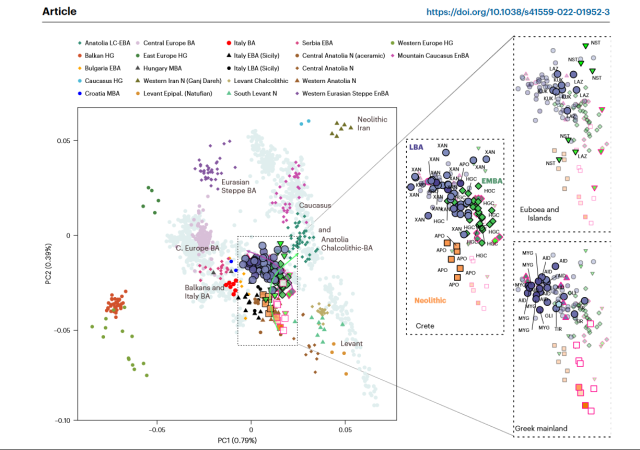
This seems to line up with what Skourtanioti et al. reported; Anatolian dominant influence in the islands and Balkan influence in the mainland during the Bronze age; the Mycenaean population was being pulled both ways. It would appear that as time went on the Anatolian influence increased and dominated Tenea and presumably at least the Peloponnesian peninsula by the Roman period.
Attachments
Vitruvius
Well-known member
- Messages
- 647
- Reaction score
- 1,201
- Points
- 91
- Ethnic group
- Italian
- Y-DNA haplogroup
- I1
- mtDNA haplogroup
- H5a1
A few thoughts:
The north macedonia samples are from paeonia, not historic Greek Macedonia. Paeonians are likely good analogues for what actual Macedonians and other closely related northern Greeks resembled autosomally, however, so I think this assumptive label is reasonable. I also think it's unlikely Logkas is a one off outlier and also see it as representative of a larger existing norm of N. Greek ancestry.
In my opinion the Ebla_EMBA is the only area that should be labelled "Anatolian-Levantine". An even better description might be Armenian/Anatolian/Levantine and this and nearby border regions of southeast Anatolia are about the greatest extent you'll see of a backflow of Levantine dna into the peninsula.
What is labelled "Anatolian" on the western edge of the peninsula comes from areas that had been very thoroughly Hellenized in the Greek dark ages, so it would make sense to include this into the broader "Greco-Anatolian" label. All of these people both on the islands and in the western coast of the peninsula itself considered themselves proper Greeks, but all retained large amounts of Anatolian BA proper blood.
Kalehoyuk/Central Anatolia was not levantine influenced in the ancient era. It simply falls further east on the preexisting Neolithic Anatolian/Neolithic Armenian cline and is probably a better proxy for BA Anatolia prior to its Greek presence. I think Kalehoyuk is a good candidate for the "Anatolian" label for that reason. To be clear, Neolithic Armenia was also not genetically identical to IA Armenia, which had since received steppe influence that Neolithic Armenia was lacking . The C4 cluster is probably mostly Anatolian proper with a few minor outliers resembling areas like Ebla and the south eastern edges of Cilicia.
S. Greek I would eliminate entirely or just cluster with Greco-Anatolian. It is a moving average that appears to be losing EEF ancestry over time.
Last edited:
Dianatomia
Regular Member
- Messages
- 436
- Reaction score
- 174
- Points
- 43
- Ethnic group
- Greek
- Y-DNA haplogroup
- J2a
Just note, the Logkas sample was found inland. A mountainous area isolated from the Sea. This might be a factor since Cycladic and Cretan sea fairing civilisations had a very long time to put their genetic mark on all coastal areas of the Aegean. As such, Paeonian and Logkas could be a good proxy for inland Greek tribes. Not North Greek tribes overall.A few thoughts:
The north macedonia samples are from paeonia, not historic Greek Macedonia. Paeonians are likely good analogues for what actual Macedonians and other closely related northern Greeks resembled autosomally, however, so I think this assumptive label is reasonable. I also think it's unlikely Logkas is a one off outlier and also see it as representative of a larger existing norm of N. Greek ancestry.
In my opinion the Ebla_EMBA is the only area that should be labelled "Anatolian-Levantine". An even better description might be Armenian/Anatolian/Levantine and this and nearby border regions of southeast Anatolia are about the greatest extent you'll see of a backflow of Levantine dna into the peninsula.
What is labelled "Anatolian" on the western edge of the peninsula comes from areas that had been very thoroughly Hellenized in the Greek dark ages, so it would make sense to include this into the broader "Greco-Anatolian" label. All of these people both on the islands and in the western coast of the peninsula itself considered themselves proper Greeks, but all retained large amounts of Anatolian BA proper blood.
Kalehoyuk/Central Anatolia was not levantine influenced in the ancient era. It simply falls further east on the preexisting Neolithic Anatolian/Neolithic Armenian cline and is probably a better proxy for BA Anatolia prior to its Greek presence. I think Kalehoyuk is a good candidate for the "Anatolian" label for that reason. To be clear, Neolithic Armenia was also not genetically identical to IA Armenia, which had since received steppe influence that Neolithic Armenia was lacking . The C4 cluster is probably mostly Anatolian proper with a few minor outliers resembling areas like Ebla and the south eastern edges of Cilicia.
S. Greek I would eliminate entirely or just cluster with Greco-Anatolian. It is a moving average that appears to be losing EEF ancestry over time.
Vitruvius
Well-known member
- Messages
- 647
- Reaction score
- 1,201
- Points
- 91
- Ethnic group
- Italian
- Y-DNA haplogroup
- I1
- mtDNA haplogroup
- H5a1
Just note, the Logkas sample was found inland. A mountainous area isolated from the Sea. This might be a factor since Cycladic and Cretan sea fairing civilisations had a very long time to put their genetic mark on all coastal areas of the Aegean. As such, Paeonian and Logkas could be a good proxy for inland Greek tribes. Not North Greek tribes overall.
Interesting take, but do we have evidence to support the idea that northern Greek coastal settlements will be closer to the Crete/dodecanese genetic structure? I'm not saying you're necessarily wrong, but this is simply new information to me.
bigsnake49
Regular Member
- Messages
- 1,880
- Reaction score
- 471
- Points
- 83
- Ethnic group
- Thracian
- Y-DNA haplogroup
- R-PF7558 (LDNA)
- mtDNA haplogroup
- U5a1b1d1 (LDNA)
It would be really informative if we get pure Ancient Macedonian DNA and compare it with let's say other Epirotan tribes like the Molossians.
I am 100% mainland Greek, 50% from Peloponnesus and 50% from central Greece. I plot very near the dead center of all Greeks. Couple of years ago I ran my simulated G25 vs Greek samples from MBA all the way to Himera iirc. There was a clear trend that the closer we got to today timewise the closer were the distances to my own. I have little doubt mainland has been getting periodic “steppe” (meaning populations with more steppe than Greeks) influx from MBA all the way to Middle Ages. At some point research has to try and explain what happened between LBA (before the collapse) and classical Greece. The people switched from burying to cremating and E-V13 got introduced (or so it seems, since it so far is absent in Mycenaeans). This can’t be a coincidence.

davef
Hornet
I must’ve missed out on some real interesting stuff while I was away all these years.
Looks like Minoan or mycenaen types aka Anatolian farmer heavy existed beyond Greece into Italy, comes as 100 percent no suprise.
So the blue palace of Nestor square seems to plot well within the Levant cluster, was this a levantine guest who lived or worked at the palace?
Looks like Minoan or mycenaen types aka Anatolian farmer heavy existed beyond Greece into Italy, comes as 100 percent no suprise.
So the blue palace of Nestor square seems to plot well within the Levant cluster, was this a levantine guest who lived or worked at the palace?

Jovialis
Advisor
- Messages
- 9,903
- Reaction score
- 6,810
- Points
- 113
- Ethnic group
- Italian
- Y-DNA haplogroup
- R1b-PF7566>Y227216
- mtDNA haplogroup
- H6a1b7
Hi davef, long time no see!I must’ve missed out on some real interesting stuff while I was away all these years.
Looks like Minoan or mycenaen types aka Anatolian farmer heavy existed beyond Greece into Italy, comes as 100 percent no suprise.
So the blue palace of Nestor square seems to plot well within the Levant cluster, was this a levantine guest who lived or worked at the palace?
That sample is actually from Halikarnassos, off the coast of Anatolia in the Aegean (the sample symbols are different here)
davef
Hornet
thanks!! Glad you’re here! I gotta read more on this,seems there were lots of new Greek studies I missed out on when I was gone. Anyway this place was really cleaned up, has a new UI and less crazy agendas going around (from what I can see).Hi davef, long time no see!
That sample is actually from Halikarnassos, off the coast of Anatolia in the Aegean (the sample symbols are different here)
View attachment 19443
Jovialis
Advisor
- Messages
- 9,903
- Reaction score
- 6,810
- Points
- 113
- Ethnic group
- Italian
- Y-DNA haplogroup
- R1b-PF7566>Y227216
- mtDNA haplogroup
- H6a1b7
Most of the garbage has migrated to X.thanks!! Glad you’re here! I gotta read more on this,seems there were lots of new Greek studies I missed out on when I was gone. Anyway this place was really cleaned up, has a new UI and less crazy agendas going around (from what I can see).
davef
Hornet
lucky for me I only go on discord, rarely other social media. And the discord servers I go on are more tech centric, not anthro bc too many racists and antisemites dwell at places like those, sadly.Most of the garbage has migrated to X.
Last edited:
Jovialis
Advisor
- Messages
- 9,903
- Reaction score
- 6,810
- Points
- 113
- Ethnic group
- Italian
- Y-DNA haplogroup
- R1b-PF7566>Y227216
- mtDNA haplogroup
- H6a1b7
This website is literally the only "social media" I have, if it even qualifies.lucky for me I only go on discord, rarely other social media. And the discord servers I go on are more tech centric, not anthro bc too many racists and antisemites dwell at places like those, sadly.
davef
Hornet
Holy crap, I have no info but I'm itching to see those. Then again I can't really expect them to be that much diff from the ones we saw. I saw the griffin man, loved the jewel he was buried with-i think it showed him plunging his sword into his enemy. Have to say, I was blown away by how well made that was back then, the muscles looked super detailed and realisticI heard there are 50-55 new mycaenean like samples from Akbari 2026 study if anyone has any additional information about this please share it with us

Juan.delajara
Regular Member
- Messages
- 102
- Reaction score
- 95
- Points
- 28
- Ethnic group
- Mostly Southern European-mediterranean
- Y-DNA haplogroup
- J2-S10971
One of them should be the Mycenaean J-L70 from the Peloponnese.I heard there are 50-55 new mycaenean like samples from Akbari 2026 study if anyone has any additional information about this please share it with us
Jovialis
Advisor
- Messages
- 9,903
- Reaction score
- 6,810
- Points
- 113
- Ethnic group
- Italian
- Y-DNA haplogroup
- R1b-PF7566>Y227216
- mtDNA haplogroup
- H6a1b7
The official files are available for it, but they didn't label the samples. If we can figure out the sample IDs I can analyze them in Admixtools2 and smartpcaI heard there are 50-55 new mycaenean like samples from Akbari 2026 study if anyone has any additional information about this please share it with us
davef
Hornet
Would like to know where these 50-55 bodies were found, Greece or somewhere else? Mycenaen-types seemed to live everywhere around that time in southern Europe, doubt you’d find them in Spain or south France but def Italy, Albania etc.
It would be neat if they made it to Spain or France! Who knows what happened back then, people moved around.
It would be neat if they made it to Spain or France! Who knows what happened back then, people moved around.