

Tautalus
Regular Member
- Messages
- 580
- Reaction score
- 1,482
- Points
- 93
- Ethnic group
- Portuguese
- Y-DNA haplogroup
- I2-M223 / I-FTB15368
- mtDNA haplogroup
- H6a1b2y
Abstract
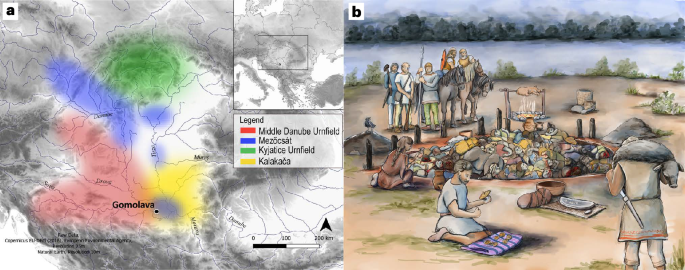
Narratives about the motivations and conditions for mass violence as a persistent feature of conflict throughout human history have evolved in complexity and materiality. Victims of these events are key for understanding the evolution and transformative power of violent behaviour as it developed from simple intergroup conflict to more strategic mass violence. Here we present the results of a bioarchaeological study of 77 and biomolecular analysis of 25 individuals from a ninth-century BCE mass grave from Gomolava in the Carpathian Basin, Southeast Europe. The site is located at the interface of complex sociospatial relations, divergent cultural traditions and values, and competing ideologies of landscape use. We show that excessive lethal violence enacted mostly on women and children suggests a selective demographic bias. The people buried together shared few, even distant, genetic relationships, and so their killing presents striking evidence for an episode of cross-regional conflict and an underlying aggressive shift in power, violence and gender relations in the region. Gomolava provides evidence consistent with deliberate annihilation of select sections of a regional population as a motivation for mass violence behaviour in later prehistoric Europe. It also shines new light on the socioeconomic agency and importance of women and young individuals in later European prehistory.
Ancestry of the Gomolava individuals

Haplogroups
Narratives about the motivations and conditions for mass violence as a persistent feature of conflict throughout human history have evolved in complexity and materiality. Victims of these events are key for understanding the evolution and transformative power of violent behaviour as it developed from simple intergroup conflict to more strategic mass violence. Here we present the results of a bioarchaeological study of 77 and biomolecular analysis of 25 individuals from a ninth-century BCE mass grave from Gomolava in the Carpathian Basin, Southeast Europe. The site is located at the interface of complex sociospatial relations, divergent cultural traditions and values, and competing ideologies of landscape use. We show that excessive lethal violence enacted mostly on women and children suggests a selective demographic bias. The people buried together shared few, even distant, genetic relationships, and so their killing presents striking evidence for an episode of cross-regional conflict and an underlying aggressive shift in power, violence and gender relations in the region. Gomolava provides evidence consistent with deliberate annihilation of select sections of a regional population as a motivation for mass violence behaviour in later prehistoric Europe. It also shines new light on the socioeconomic agency and importance of women and young individuals in later European prehistory.
A large mass grave from the Early Iron Age indicates selective violence towards women and children in the Carpathian Basin - Nature Human Behaviour
In this analysis of biomolecular and archaeological data from a ninth-century BCE mass grave in the Carpathian Basin, Fibiger et al. find evidence for the targeted killing of mostly unrelated women and children, challenging views of prehistoric violence.www.nature.com
Ancestry of the Gomolava individuals
Haplogroups
| Sample Name | Individual | Haplogroup | Sex | Y-Chr Hg | Y-Chr Hg_marker | Y-Chr Major clade |
| TFS001 | Sk8 | H1at | XX | |||
| TFS002 | Sk18 | N1a1a1a | XX | |||
| TFS003 | Sk24 | T2b19 | XX | |||
| TFS004 | Sk26 | H63 | XY | R-BY251 | BY251 | R1b |
| TFS005 | Sk32 | H23 | XX | |||
| TFS006 | Sk33 | H1at | XX | |||
| TFS007 | Sk36 | T2e+152 | XX | |||
| TFS008 | Sk41 | H5a2 | XX | |||
| TFS009 | Sk42 | K1a5b | XX | |||
| TFS010 | Sk46 | H1 | XX | |||
| TFS011 | Sk53 | T2b | XX | |||
| TFS012 | Sk60 | T2b+152 | XX | |||
| TFS013 | Sk61 | H | XY | R-BY20217*(xY132099,Y170300,FT407478) | Y150900 | R1b |
| TFS014 | Sk70 | H26c | XX | |||
| TFS015 | Sk72 | U5b1c2 | XY | R-Y19423 | Y21291 | R1b |
| TFS016 | Sk74 | U2e1b | XX | |||
| TFS017 | Sk4 | T2b | XX | |||
| TFS018 | Sk14 | H1at | XX | |||
| TFS019 | Sk16 | H | XX | |||
| TFS020 | Sk22 | H5a | XX | |||
| TFS021 | Sk23 | H11a | XX | |||
| TFS022 | Sk50 | H5a6 | XX | |||
| TFS023 | Sk51 | H35 | Not Assigned | |||
| TFS024 | Sk52 | T2b+152 | XX | |||
| TFS025 | Sk54 | K1a4a1a2 | XX | |||
| TFS026 | Sk56 | U5a1b | XY | R-CTS1450*(xY18959) | Y5590;Y5591 | R1b |
| TFS027 | Sk69 | H63 | XX | |||
Last edited: