• Don't want to see ads? Install an adblocker like uBlock Origin or use a Europe-based privacy-friendly browser like Vivaldi or Mullvad.

Interesting FST outputs (aDNA Target vs Moderns)

Not that big of a revelation imo, Lazaridis 2017 showed Albanians (as well as Bulgarians to a lesser extent) pretty close to Mycenaean samples, on par with some Italians basically, only second to Italians and Greeks. Same for Minoan samples (but with larger distances for all).
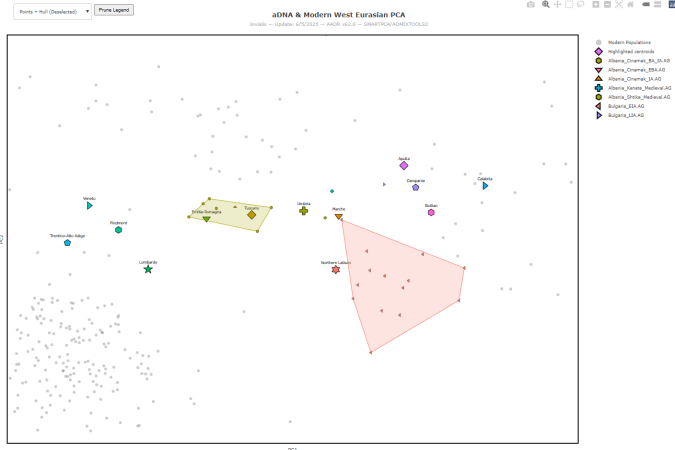
Up until the middle ages it seems Bulgarians were very Ancient Greek-like, until they were enriched with Slavic DNA.

Albanians on the other hand were North Italian-like, but medieval samples show them between Central/South Italians, up until Slavic enrichment.

1771615695933.png
 

Attachments

  • 1771615531812.png
    1771615531812.png
    83.4 KB · Views: 117
Last edited:
Up until the middle ages it seems Bulgarians were very Ancient Greek-like, until they were enriched with Slavic DNA.

Albanians on the other hand were North Italian-like, but medieval samples show them between Central/South Italians, up until Slavic enrichment.

View attachment 19260

If I understand correctly...

1) Albanians would plot around North Italians before the Eastern-Mediterranean (Levantine/Middle-Eastern) influx into the Balkans during the Roman Empire.
2) After the influx of Eastern-Meds, they plotted more between Central-Southern Italian like.
3) Slavic admixture during Ottoman time have placed them in their current PCA position.

Is this correct? It is interesting that I had my father's results ran through qpadm by someone and the model passed when looking only at the combo between the medieval Albanian samples even though we don't have a haplogroup commonly associated with people from the Balkans (J2a-Z2177). When looking at G25, he interestingly doesn't plot amongst Albanians but with Tuscany/Marche Italy (i'm not sure if that is considered north or central).
 
If I understand correctly...

1) Albanians would plot around North Italians before the Eastern-Mediterranean (Levantine/Middle-Eastern) influx into the Balkans during the Roman Empire.
2) After the influx of Eastern-Meds, they plotted more between Central-Southern Italian like.
3) Slavic admixture during Ottoman time have placed them in their current PCA position.

Is this correct? It is interesting that I had my father's results ran through qpadm by someone and the model passed when looking only at the combo between the medieval Albanian samples even though we don't have a haplogroup commonly associated with people from the Balkans (J2a-Z2177). When looking at G25, he interestingly doesn't plot amongst Albanians but with Tuscany/Marche Italy (i'm not sure if that is considered north or central).
I’m skeptical that Roman-period migrants from the eastern Mediterranean produced a transformational shift. For the southern Balkans and Italy, it seems plausible that much of this affinity could be explained by regional Aegean–Balkan dynamics (e.g., Thracian and Aegean-related inputs) rather than invoking large-scale Anatolian/Levantine influx as the default explanation.
 
Last edited:
I’m skeptical that Roman-period migrants from the eastern Mediterranean produced a transformational shift. For the southern Balkans and Italy, it seems plausible that much of this affinity could be explained by regional Aegean–Balkan dynamics (e.g., Thracian and Aegean-related inputs) rather than invoking large-scale Anatolian/Levantine influx as the default explanation.
1771691899752.png
 
Do you have the genetic distances for Iron Age Romans and Etruscans?
 
Are modern North Italians and Tuscans nearer to Central Mediterranean C6 or to IA Etruscans?
 
Back
Top