
• Don't want to see ads? Install an adblocker like uBlock Origin or use a Europe-based privacy-friendly browser like Vivaldi or Mullvad.

J2b2-L283 (proto-illyrian)

Sounds good. I like that everytime we get into these debates, all it takes is a couple of weeks for new samples to settle it. We should do it more often, good omen for new publications.
Indeed, with the new data is sounds even better. But I'm fairly sure you don't see why, isn't it ? Let me explain it to you !

In fact, the sample(s) you speak about (don't forget the Greek one, he is also very interesting per-se) change very little things to my best fitting model :
Caucasus --> Usatovo (~3600 BCE) ... which was already a given.
Usatovo --> Eneolitic Tuscany (~3500-3100 BCE), for a group of "Z615-" L283-carriers.
This movements where likely related with a westward diffusion of Arsenical Copper technology.

The main change is now that the Z615 carrier most likely stayed in-situ around Usatovo.
The R-Z2106 expansion provides the needed mecanism to erase most of the Usatovian J-L283 diversity.
A diversity cariage of ~few centuries is acceptable for the Tuscan injection (that's why I always placed this injection in a range of 3500-3000 BCE).
Which implies that J-L283 population likely stayed very compact during the 3600-3100 BCE range (== no wide dispersion around that time).
Acceptable "co-travellers" on the R1b side around that time would be R-Z2118 and R-CTS699.

Such modification is no big deal per-se. In the 3000-2500 BCE range J-Z597 wasn't very active ... the place where he waited before merging with BB-population was poorly constrained (due to the lack of J-Z615 or J-Z597 compact diversity signal).

We have now amazing proof that the absorbtion by BB-related populations occured ~4400 BCE around south-eastern Europe instead of South-eastern Alps (no big deal in terms of geographical accuracy for the concerned epoch).
You failed to notice that the paper you speak about basically proves again that Cetina is a BB-related syncretic culture. Attesting that J-L283 got "influenced"/"absorbed" by BBs as I always claimed (proving me right once again ...).

Do you realize ? The cultural mecanism and involved cultures (North Caucasus/Maykop, Usatovo, Eneolitic Tuscany) are unchanged for my model, just details (about peculiar subclades exact path) are updated. Which bascially means that the model is right, and just need to be "tuned" for peculiar individual path of each subclade.
We will still find J-Z622s in Eneolithic Tuscany (when deeply sampled). Do you think otherwise ?

Someone fairly smart said :
J-Z597 is a clade that got absorbed by BBs ... not originating from BBs ... This is the whole concept of "being absorbed" or "being influenced".
Here again, Cetina being a syncretic culture involving BBs is not an idea of mine, but is coming from serious published papers.

Where exactly J-Z597 got absorbed ? This is a potentially interesting question, ~South-eastern Alps is the more likely to me (but there is some open space about the exact location, because J-Z597 didn't have any compact diversity signal).

See, the data you think are "settling the question" are in fact just fitting in the amount of freedom that existed in my current model ...
Before this sample, it was "more likely" for J-Z615 to have migrated westward with his cousins ... apparently he didn't.
A "Most likely" outcome is not always the outcome that occurs, if so it won't be "most likely" but a "given".

Looking at Fig.3 of the paper you speak about ... the merging of J-Z597 population with BBs related population likely occured in south-eastern-Europe (Look how deep BB-realted population went in South-eastern-Europe during the 3000-2000 BCE range).
For what we know, J-Z597 might have been collected by BBs even nearby Moldova before ultimately expanding in Western-Balkans.
This scenario would help to explains why J-Z597 is absent from the Yamnayan footprint, because it failed to expand with them (the lineage was "passive" since Usatovo culture) ... J-Z597 likely never participated to Yamnayan movements (it also explains the lack of related statistical signal about Yamnayan movements for J-L283), and simply got collected by expanding BBs and then finally found a new-breath inside the Cetina syncretic culture.
We are far, very far, from the claims by some peoples on this topic that Cetina was unrelated to BBs.

Maybe you sought this finding support your claim that Tyrrhenian J-L283s migrated ~1800 BCE from western-Balkans ?
In fact it didn't, to support such "creative idea" you would need to find a clade with ~[2500-1800] BCE TMRCA clading with Z615- Tyrrhenian subclades.

So here we go again, data appearing are proving me right again and again ... where do we find consistenly "early" J-L283 ? On the "Arsenical Copper metallurgy" diffusion footprint ! And when did J-L283 expanded ? Just when Arsenical Copper diffused !

Thanks to new data we can refine the details of the model ... but the mecanism is definitely looking as the good one : Arsenical Copper diffusion in the Maykop influence sphere, which is followed by the absorbtion by BB-related populations and re-expansion within the Cetina syncretic culture.
 
Ghurier, it appears your intellectual faculties may reside on the more modest end of the spectrum.
If you want ... any argument ? Because like that, it sounds like an unsubstanciated claim.

Regarding my intellectual faculties ... google my name if you want to have a glimpse !

I'm very open to discuss ideas if you can propose something a bit more elaborated than an insult.
If you can identify an inconsistency in the model I propose, you are more than welcome to share it !

Yet, no-one managed to take it done !
The mecanism :
1- Arsenical Copper diffusion (3600-3100 BCE phase)
2- BB absorption (~2400 BCE)
3- Cetina expansion (2400-1800 BCE phase)
Provides a very good fit on both diversity and ancient samples ... I have yet to see a model able to compete for J-L283.
 
Ghurier, I must decline your offer, as I find your assertions lacking in scientific merit. I have no desire to expend my time engaging with such unsubstantiated notions. Thank you, but no.
Thank you for your return, can you provide me your qualifications justifying that you pose as being able to "evaluate" the "scientific merit" of a claim ?

Up to now, you failed to produce any relevant contribution, and you just dodged a request to elaborate on your claim ... which is very un-scientific. Rethoric reach a "wall" very quickly in a scientific discussion !

I therefore express doubt of your abilities to evaluate the quality of a scientific work.
I never saw a referee refusing a paper without providing a justification ... As I never refused a paper without providing a justification to the authors.

I'm forced to conclude that you are only providing an emotional response, to a topic that you don't properly understand.
Thank you anyway for your participation.
As a kind advice, I would recommend you to avoid insulting other peoples, not everybody react as peacefully as me, particularly in the real world.
 
I've already explained why I prefer not to engage further on this matter. My initial remark was merely an observation of your demeanor. As for your work in astrophysics, I find it lacks rigor and originality; it appears to favor redundant modeling over genuinely advancing our understanding of celestial phenomena. Such contributions clutter the discourse rather than enrich it.
Your comments are still very vague ... not a very good indication.
Still, I have to congratulate you, in roughly 15 minutes you managed to review my 100+ papers (including 26 first-author/coresponding-author publications).
Sadly, you failed to identify that my topic of study wasn't "celestial phenomena" but was "the evolution history of the universe".
Sounds like a bad start if you fail to identify the research topic in the first place ;) .

Can you share your own "work" with us ?
I want to evaluate the quality of your scientific production, if any, to see how relevant are your "opinions".
Indeed, up to now you only shared opinions, not a single reasoning, not a single argument.
Up to now, you behave like a "poser".

That said, I would have comments and I would need details about the following claims you made :

1) How do you evaluate a "lack of rigor" ? Sounds like an emotional evalution to me.
What is your background in statistics, modelling of astrophysical probe, and data analysis to be able to claim that my work in this field "lack of rigor" ? Did you noticed that a significant part of my work consisted in devellopping statistical tools and new methodologies ?

2) Lack of originality ? Did you have a degree in astrophisics ? Without that, I don't know how you can evaluate such a thing.
Being able to understand the relevance of a work requires a deep understanding of the topic. Maybe you want to amuse us with ideas you have to propose to bring some "originality" in the field ?

3) Redundant modelling ? The variety of astrophysical process and cosmological probe I used is in fact very diverse. I'm probably among the very few in the world to have been able to provide modelling and data analysis for such broad type of LSS-related data with tailored high quality methodologies.

Let be honest, your rethoric tactics is something I used to see a lot from poorly educated peoples back in my studying days and after that during my teaching days.
You dismiss the work by others, without clear critics (just some vague random comments that you are totally unable to justify, because you don't understand what you speak about).
You might fool uneducated peoples, but the vacuity of your claim is very apparent, and definitely damage your credibility.

Thus, as an advice, you may want to either be able to defend your claim with a good argumentation, or you might prefer to stay quiet.
Yet, the way you behave (starting with an insult and afterward handwaving with arrogance) is only damaging one thing : your own credibility.

Good luck kid.
 
Hello,

I've just received my Big Y results, please let me know how I can contribute further. On FamilyTreeDNA the terminal subclade is J-BY178234, my kit is 978518. On YFull my terminal subclade J-Y155546, my kit is YF133761. Not sure why these are different? Thanks.
 
Hello,

I've just received my Big Y results, please let me know how I can contribute further. On FamilyTreeDNA the terminal subclade is J-BY178234, my kit is 978518. On YFull my terminal subclade J-Y155546, my kit is YF133761. Not sure why these are different? Thanks.

Hi cousin. Best reach out to Hunter Provyn at https://phylogeographer.com/about-me/ (end of the page has his email).
 
Hello,

I've just received my Big Y results, please let me know how I can contribute further. On FamilyTreeDNA the terminal subclade is J-BY178234, my kit is 978518. On YFull my terminal subclade J-Y155546, my kit is YF133761. Not sure why these are different? Thanks.
You have the same subclade with two different Laberia individuals, one of the main heartlands of Albanians
 
Hello,

I've just received my Big Y results, please let me know how I can contribute further. On FamilyTreeDNA the terminal subclade is J-BY178234, my kit is 978518. On YFull my terminal subclade J-Y155546, my kit is YF133761. Not sure why these are different? Thanks.
You need to pay for the BAM file upgrade in FamilyTreeDNA then you can to the free upgrade of VCF->BAM in your orders page in YFull. Right now on YFull they are using a estimate based on an existing BAM upload there. You could very well have a new subclade downstream once you do that, not 100% though.
 

Old news, but worth posting. From the preprint “Ancient genomics support deep divergence between Eastern and Western Mediterranean Indo-European languages”, the following ancient J2b L283 samples were sequenced:

-2 J2b L283 Yamnaya samples from a kurgan in Constantinovca, Moldova 🇲🇩 on the border with Ukraine. They appear to possibly be twins and are under the Z597 branch. Dated to about 2500 BCE. Late Yamnaya, possibly Catacomb related.

-1 J2b L283 Mycenaean sample from Kirrha, Greece 🇬🇷. Dated to about 1600 BCE. This sample was assigned to the Z600 branch of J2b L283.

-1 J2b L283 sample from Narde, Italy 🇮🇹 near the top of the Adriatic. Dated to about 900 BCE (Grave 59). Assigned to the PH1602 branch of J2b L283.

Yamnaya:

IMG_1227.jpeg


Mycenaean:

IMG_1228.jpeg


Italian…not sure of archaeological context:

IMG_1343.jpeg
 
Last edited:
Do we have their autosomal DNA? I've read the moldavian sample was 83% steppe.
 

Old news, but worth posting. From the preprint “Ancient genomics support deep divergence between Eastern and Western Mediterranean Indo-European languages”, the following ancient J2b L283 samples were sequenced:

-2 J2b L283 Yamnaya samples from a kurgan in Constantinovca, Moldova 🇲🇩 on the border with Ukraine. They appear to possibly be twins and are under the Z597 branch. Dated to about 2500 BCE. Late Yamnaya, possibly Catacomb related.

-1 J2b L283 Mycenaean sample from Kirrha, Greece 🇬🇷. Dated to about 1600 BCE. This sample was assigned to the Z600 branch of J2b L283.

-1 J2b L283 sample from Narde, Italy 🇮🇹 near the top of the Adriatic. Dated to about 900 BCE (Grave 59). Assigned to the PH1602 branch of J2b L283.
Yamnaya:

View attachment 17685

Mycenaean:

View attachment 17686

Italian…not sure of archaeological context:

View attachment 17687

The Narde necropolis at Frattesina I believe is still considered to belong to the Final Bronze Age Protovillanovan culture (not to be confused with the Iron Age Villanovan culture, although the latter is descended from the former). 900 BCE would actually be early Iron Age.
 
Do we have their autosomal DNA? I've read the moldavian sample was 83% steppe.

Sample I10206 from Crihana Veche, Moldova is 84% Core Yamnaya and uses IBD, or Identity By Descent, analysis to make this determination. The other 16% should be something like Trypillian ancestry.

Samples CGG_2_103750 and 103753 (also Moldova, from Constantinovca) are modeled as 100% Yamnaya. They are under the Z597 branch. The paper containing those samples is still in preprint and has not yet reached final publication.
 
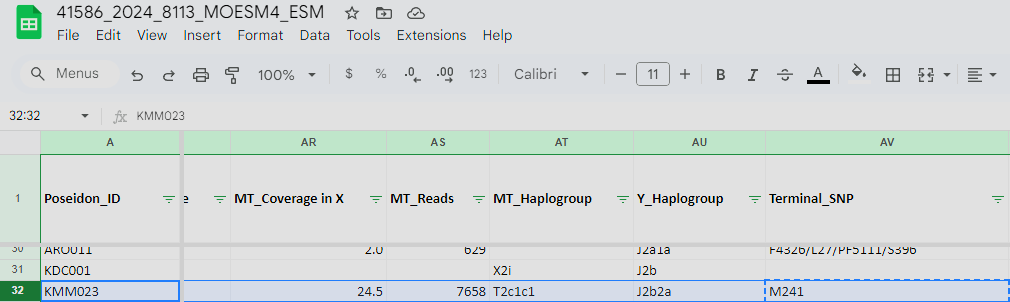
I haven't see any discussion regarding sample KMM023. Cant we assume it's most likely J-L283?

russia_stavropol_latemaykop_eba:kmm023-KMM023​

Territory: Russia - Komsomolec 1-Marfa
Molecular Sex: XY
Date Estimate: 3231.5 BCE
Predicted Y-DNA: J2b2a
Predicted mtDNA: T2c1c1

Ancient Model from Davidski:
Kura-Araxes_ARM_Kaps: 63.18 %
TUR_Barcin_N: 13.04 %
IRN_Ganj_Dareh_N: 10.11 %
Yamnaya_RUS_Samara: 7.30 %
TUR_Tepecik_Ciftlik_N: 3.19 %
Levant_PPNB: 2.27 %
WHG: 0.60 %
BRA_LapaDoSanto_9600BP: 0.32 %
MAR_Taforalt: 0.00 %

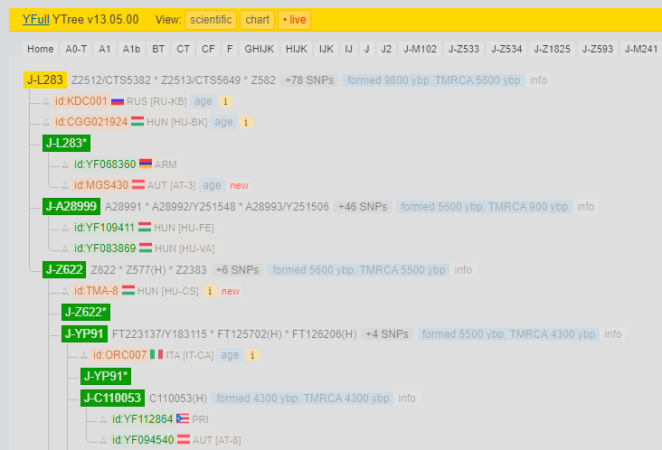
Also there's a new basal J-L283 Ancient DNA sample found in Austria on the YFull Tree.
 

Attachments

  • Screenshot 2025-08-21 185654.png
    Screenshot 2025-08-21 185654.png
    64.2 KB · Views: 208
Last edited:
I haven't see any discussion regarding sample KMM023. Cant we can assume it's most likely J-L283?

russia_stavropol_latemaykop_eba:kmm023-KMM023​

Territory: Russia - Komsomolec 1-Marfa
Molecular Sex: XY
Date Estimate: 3231.5 BCE
Predicted Y-DNA: J2b2a
Predicted mtDNA: T2c1c1

Ancient Model from Davidski:
Kura-Araxes_ARM_Kaps: 63.18 %
TUR_Barcin_N: 13.04 %
IRN_Ganj_Dareh_N: 10.11 %
Yamnaya_RUS_Samara: 7.30 %
TUR_Tepecik_Ciftlik_N: 3.19 %
Levant_PPNB: 2.27 %
WHG: 0.60 %
BRA_LapaDoSanto_9600BP: 0.32 %
MAR_Taforalt: 0.00 %

Also there's a new basal J-L283 Ancient DNA sample found in Austria on the YFull Tree.

KMM023 will be under this branch of J2b Z593, so definitely not under J2b L283:


The Austrian sample looks to be J2b L283*, so negative for downstream assignments at this time. Might represent a rare branch that moved into the Balkans with the Yamnaya.

The ZO1002 sample (early/pre Yamnaya) from Zolotarevka has also finally been added to the LIVE version of the YFull YTree.

 
KMM023 will be under this branch of J2b Z593, so definitely not under J2b L283:


The Austrian sample looks to be J2b L283*, so negative for downstream assignments at this time. Might represent a rare branch that moved into the Balkans with the Yamnaya.

The ZO1002 sample (early/pre Yamnaya) from Zolotarevka has also finally been added to the LIVE version of the YFull YTree.

In the study it says that the terminal SNP of KMM023 was J-M241 not J-Z593. But I just found a comment from Trojet on Genarchivist where he said "KMM023 is negative at J-L283. I'll check to see if he may be J-Z593>Y167175."

I don't know what he concluded its terminal clade to be, but I suppose its confirmed not to be J-L283 so forget I mentioned it lol.
 

Attachments

  • Screenshot 2025-08-21 225100.png
    Screenshot 2025-08-21 225100.png
    38.5 KB · Views: 168
Last edited:
I haven't see any discussion regarding sample KMM023. Cant we can assume it's most likely J-L283?

russia_stavropol_latemaykop_eba:kmm023-KMM023​

Territory: Russia - Komsomolec 1-Marfa
Molecular Sex: XY
Date Estimate: 3231.5 BCE
Predicted Y-DNA: J2b2a
Predicted mtDNA: T2c1c1

Ancient Model from Davidski:
Kura-Araxes_ARM_Kaps: 63.18 %
TUR_Barcin_N: 13.04 %
IRN_Ganj_Dareh_N: 10.11 %
Yamnaya_RUS_Samara: 7.30 %
TUR_Tepecik_Ciftlik_N: 3.19 %
Levant_PPNB: 2.27 %
WHG: 0.60 %
BRA_LapaDoSanto_9600BP: 0.32 %
MAR_Taforalt: 0.00 %

Also there's a new basal J-L283 Ancient DNA sample found in Austria on the YFull Tree.

KMM023 will be under this branch of J2b Z593, so definitely not under J2b L283:


The Austrian sample looks to be J2b L283*, so negative for downstream assignments at this time. Might represent a rare branch that moved into the Balkans with the Yamnaya.

The ZO1002 sample (early/pre Yamnaya) from Zolotarevka has also finally been added to the LIVE version of the YFull YTree.

In the study it says that the terminal SNP of KMM023 was J-M241 not J-Z593. But I just found a comment from Trojet on Genarchivist where he said "KMM023 is negative at J-L283. I'll check to see if he may be J-Z593>Y167175."

I don't know what he concluded its terminal clade to be, but I suppose its confirmed not to be J-L283 so forget I mentioned it lol.

No worries. It looks like J2b L283 was probably out there on the Pontic Caspian Steppe for quite some time, perhaps as early as 5000 BCE or even earlier. There is a site in the NE Caucasus (Dagestan) called Chokh that dates back to the Neolithic and played an important role in the development of pastoralism there. At the same time, it’s hypothesized that nomadic pastoralism could have expanded out on to the Pontic Caspian Steppe via a movement of nomadic pastoralists up the east side of the Caspian Sea and from there to the lower Volga. It’s thought that the pastoralists who went up the east side of the Caspian Sea originated in northern Iran. They would have “picked up” excess TTK or “Tutkaul” ancestry during this movement. The Core Yamnaya had a fair amount of TTK ancestry and I think the ZO1002 sample (3900 BCE) had around 20 % TTK ancestry. So, up the west Caspian via Chokh or the East Caspian via these TTK folk look like two intriguing possibilities.
 
Strabo the historian claims these vindelici where illyrian, but he claimed many alpine tribes where ..............noricum (east austria ) was illyrian, Port of Vienna (not Vienna ) was a illyrian city as per current Unesco archeological digs

One of 4 pages of Illyrian names found in Noricum

I think there is a confusion between pure halstatt celts and mixed populace in the east alps area......like Veneti dressed celtic but spoke none celtic language, could be same with some Illyrian tribes in Noricum, like the Carni tribe

My research has also led me to the same source. I found the following: "it appears that "Raetia et Vindelicia" was also inhabited by a number of non-Raetic tribes. The Breuni and Genauni are classified as Illyrian by Strabo"

My paternal ancestry derives from a Rhaeto-Romance language so I was curious if there might be a connection. I suspect Rhaetian mixing with Illyrian and Celtic tribes within the Alpine region are what account for much of the confusing J-L283 spread. However, I don't really see anyone consider the Raeti tribes very much on here.
 
Last edited:
KMM023 will be under this branch of J2b Z593, so definitely not under J2b L283:


The Austrian sample looks to be J2b L283*, so negative for downstream assignments at this time. Might represent a rare branch that moved into the Balkans with the Yamnaya.

The ZO1002 sample (early/pre Yamnaya) from Zolotarevka has also finally been added to the LIVE version of the YFull YTree.


No worries. It looks like J2b L283 was probably out there on the Pontic Caspian Steppe for quite some time, perhaps as early as 5000 BCE or even earlier. There is a site in the NE Caucasus (Dagestan) called Chokh that dates back to the Neolithic and played an important role in the development of pastoralism there. At the same time, it’s hypothesized that nomadic pastoralism could have expanded out on to the Pontic Caspian Steppe via a movement of nomadic pastoralists up the east side of the Caspian Sea and from there to the lower Volga. It’s thought that the pastoralists who went up the east side of the Caspian Sea originated in northern Iran. They would have “picked up” excess TTK or “Tutkaul” ancestry during this movement. The Core Yamnaya had a fair amount of TTK ancestry and I think the ZO1002 sample (3900 BCE) had around 20 % TTK ancestry. So, up the west Caspian via Chokh or the East Caspian via these TTK folk look like two intriguing possibilities.
My knowledge is lacking as I have not heard of TTK/Tutkaul. I'll have to do some research on it. Here is supposedly Davidski's model of ZO1002. I assume this TTK population your speaking of is being absorbed by the Kura Araxes/IRN in this model.

russia_stavropol_latesteppe_eneolithic_eba_o:zo1002-ZO1002​

Ancient Model from Davidski:
Kura-Araxes_ARM_Kaps: 51.39 %
Yamnaya_RUS_Samara: 33.10 %
IRN_Ganj_Dareh_N: 6.82 %
WHG: 3.57 %
TUR_Barcin_N: 2.10 %
ETH_4500BP: 1.84 %
IRN_Shahr_I_Sokhta_BA2_I8728: 1.09 %
BRA_LapaDoSanto_9600BP: 0.11 %
 
Last edited:
I haven't see any discussion regarding sample KMM023. Cant we can assume it's most likely J-L283?

russia_stavropol_latemaykop_eba:kmm023-KMM023​

Territory: Russia - Komsomolec 1-Marfa
Molecular Sex: XY
Date Estimate: 3231.5 BCE
Predicted Y-DNA: J2b2a
Predicted mtDNA: T2c1c1

Ancient Model from Davidski:
Kura-Araxes_ARM_Kaps: 63.18 %
TUR_Barcin_N: 13.04 %
IRN_Ganj_Dareh_N: 10.11 %
Yamnaya_RUS_Samara: 7.30 %
TUR_Tepecik_Ciftlik_N: 3.19 %
Levant_PPNB: 2.27 %
WHG: 0.60 %
BRA_LapaDoSanto_9600BP: 0.32 %
MAR_Taforalt: 0.00 %

Also there's a new basal J-L283 Ancient DNA sample found in Austria on the YFull Tree.

KMM023 will be under this branch of J2b Z593, so definitely not under J2b L283:


The Austrian sample looks to be J2b L283*, so negative for downstream assignments at this time. Might represent a rare branch that moved into the Balkans with the Yamnaya.

The ZO1002 sample (early/pre Yamnaya) from Zolotarevka has also finally been added to the LIVE version of the YFull YTree.

In the study it says that the terminal SNP of KMM023 was J-M241 not J-Z593. But I just found a comment from Trojet on Genarchivist where he said "KMM023 is negative at J-L283. I'll check to see if he may be J-Z593>Y167175."

I don't know what he concluded its terminal clade to be, but I suppose its confirmed not to be J-L283 so forget I mentioned it lol.

No worries. It looks like J2b L283 was probably out there on the Pontic Caspian Steppe for quite some time, perhaps as early as 5000 BCE or even earlier. There is a site in the NE Caucasus (Dagestan) called Chokh that dates back to the Neolithic and played an important role in the development of pastoralism there. At the same time, it’s hypothesized that nomadic pastoralism could have expanded out on to the Pontic Caspian Steppe via a movement of nomadic pastoralists up the east side of the Caspian Sea and from there to the lower Volga. It’s thought that the pastoralists who went up the east side of the Caspian Sea originated in northern Iran. They would have “picked up” excess TTK or “Tutkaul” ancestry during this movement. The Core Yamnaya had a fair amount of TTK ancestry and I think the ZO1002 sample (3900 BCE) had around 20 % TTK ancestry. So, up the west Caspian via Chokh or the East Caspian via these TTK folk look like two intriguing possibilities.
Your forgetting the third option of them going east and looping around the Caspian sea lol.


My knowledge is lacking as I have not heard of TTK/Tutkaul. I'll have to do some research on it. Here is supposedly Davidski's model of ZO1002. I assume this TTK population your speaking of is being absorbed by the Kura Araxes/IRN in this model.

russia_stavropol_latesteppe_eneolithic_eba_o:zo1002-ZO1002​

Ancient Model from Davidski:
Kura-Araxes_ARM_Kaps: 51.39 %
Yamnaya_RUS_Samara: 33.10 %
IRN_Ganj_Dareh_N: 6.82 %
WHG: 3.57 %
TUR_Barcin_N: 2.10 %
ETH_4500BP: 1.84 %
IRN_Shahr_I_Sokhta_BA2_I8728: 1.09 %
BRA_LapaDoSanto_9600BP: 0.11 %

TTK ancestry would come from the Tutkaul site in Tajikistan and dates to about 6200 BCE…so much older than Kura Araxes. TTK is connected to ANE (Ancestral North Eurasian) and even Iran_N ancestry from what I can tell. These early pastoralist groups were specifically tied to sheep and goats that look like they may have come from northern Iran near the south Caspian. I think bones from this type of livestock started showing up towards the lower Volga around 5000 BCE.

IMG_1690.jpeg
 
Last edited:
Back
Top