• Don't want to see ads? Install an adblocker like uBlock Origin or use a Europe-based privacy-friendly browser like Vivaldi or Mullvad.

Language trees support hybrid model for origin of Indo-European languages

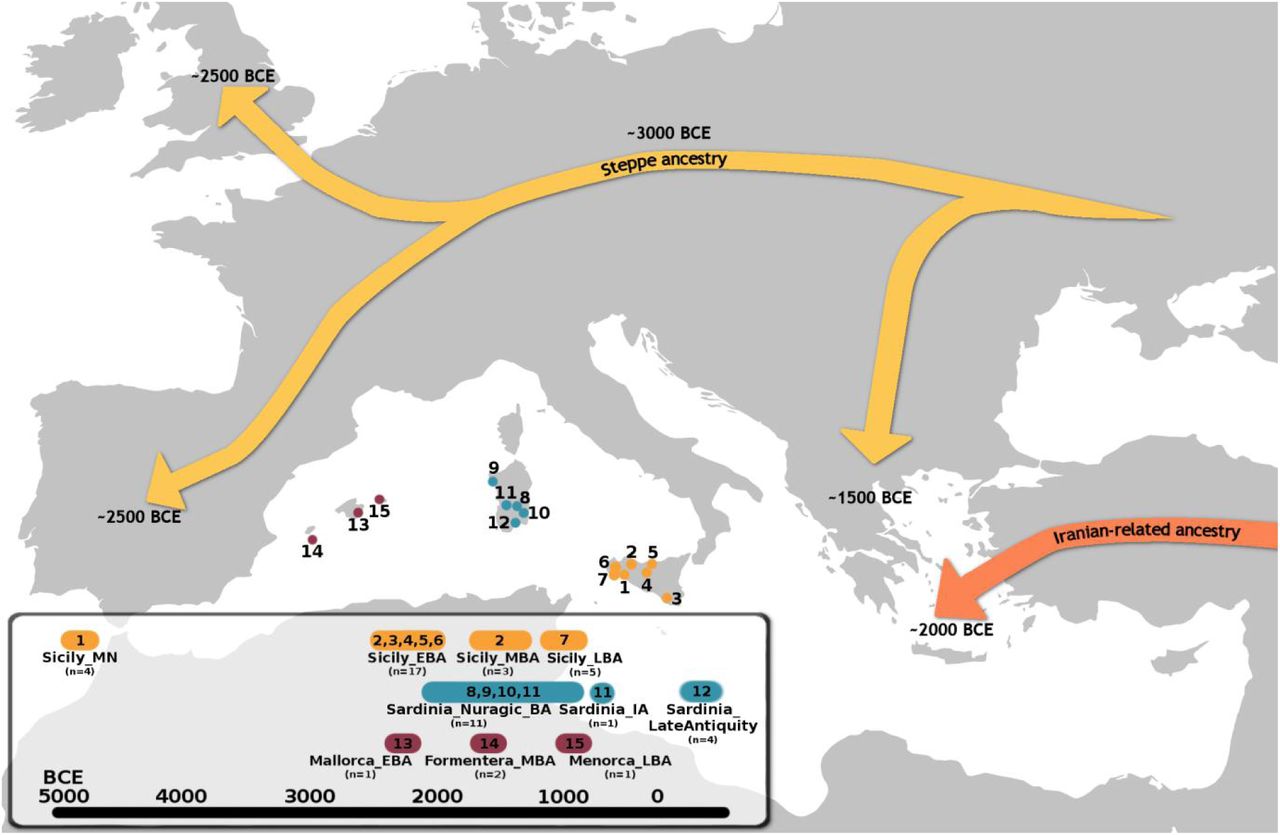
The orange arrow (Fig. 1) points to Crete, where the Minoan culture emerged around 2,000 BCE. Four out of five males belonging to Minoans, Mycenaeans, and southwestern Anatolians belonged to haplogroup J (Lazaridis et al. 2017). Earlier populations from Greece and western Anatolia were dominated by Y-chromosome haplogroup G2 that was prevalent in Anatolian and European farmers. Mycenaeans can be modelled as a mixture of Minoans and Bronze Age steppe populations (~13–18% admixture with a ‘northern’ steppe population in mainland Greece). Haplogroup R1b was presumably introduced to mainland Greece by Mycenaeans.


https://www.biorxiv.org/content/10.1101/584714v1.full

Minoan culture dates back to 2,800 BC, not 2,000 BC.

https://slideplayer.com/slide/7525768/

slide_2.jpg
 
F1.large.jpg

It was Iranian-related ancestry which came to Greece about 2,000 BC, wasn't it?
It was around 3000BC, not 2000BC, it was either CHG or Iran Neo, there is a possibility it was linked with what was the Minoan language and most likely has nothing to do with IE.

Also as other’s say, “Mycenaeans” weren’t a group that moved into Greece. It is the byproduct of the merge of steppe IE speaking people with local Aegean populations. Saying “Mycenaeans moved into Greece in 2000Bc” is like saying “Mexicans moved into Mexico in 1520AD”.
 
I wouldn't say a crystal clear gene flow from the steppe. There is only one "real" R1b-PF7562 so far and very negligible steppe ancestry. Anyway, for now the northern model for Proto-Greek is more realistic, I agree.

It is crystal clear. The Logkas girls were more or less 50% steppe/50% Aegean in autosomal terms. You can’t get a better smoking gun than that. Bronze Age Greeks further south had way less but this is just a matter of diffusion of the original steppe element that made it to Peloponnesus etc. During Bronze Age we still have samples from southern Greece that lack the steppe element but by Iron Age

1.every sample has steppe
2. The amount of steppe said samples have appears to be higher than during Bronze Age (it is obvious in all calculators)

…indicates that there had been a constant steppe influx further south. Without this extra influx, the diffusion of the original amount would have made everyone having steppe regardless, but the average across everyone in the Iron Age would have been lower than the steppe element found in the admixed Bronze Age Mycenaeans. The same amount of sugar that made half a bucket of lemonade sweet, will make the full bucket less sweet. The full bucket is sweeter, more sugar was added. It is that simple.

About the paper, we now have ancient dna. Instead of trying to constantly reinvent the wheel perhaps we should try putting the puzzle together using all pieces.
 
I wouldn't say a crystal clear gene flow from the steppe. There is only one "real" R1b-PF7562 so far and very negligible steppe ancestry. Anyway, for now the northern model for Proto-Greek is more realistic, I agree.

The steppe derived gene flow is probably the only crystal clear thing about that era.
Ofc that doesn't automatically mean it's the bearer of Protogreek
 
It is crystal clear. The Logkas girls were more or less 50% steppe/50% Aegean in autosomal terms. You can’t get a better smoking gun than that. Bronze Age Greeks further south had way less but this is just a matter of diffusion of the original steppe element that made it to Peloponnesus etc. During Bronze Age we still have samples from southern Greece that lack the steppe element but by Iron Age

1.every sample has steppe
2. The amount of steppe said samples have appears to be higher than during Bronze Age (it is obvious in all calculators)

…indicates that there had been a constant steppe influx further south. Without this extra influx, the diffusion of the original amount would have made everyone having steppe regardless, but the average across everyone in the Iron Age would have been lower than the steppe element found in the admixed Bronze Age Mycenaeans. The same amount of sugar that made half a bucket of lemonade sweet, will make the full bucket less sweet. The full bucket is sweeter, more sugar was added. It is that simple.

About the paper, we now have ancient dna. Instead of trying to constantly reinvent the wheel perhaps we should try putting the puzzle together using all pieces.

I forgot about the logkas samples. You’re right it was like 50% steppe but I was thinking about the Bronze Age and the Y-DNA it wasn’t a huge turnover like in Great Britain or Central Europe. Anyway, I already said that the most plausible explanation is the steppe origin for Greek.
 
That image is from this genetic study: The spread of steppe and Iranian-related ancestry in the islands of the western Mediterranean, as you see they are geneticists who use these terms. These terms don't matter, it is important thing is that these studies don't talk about people of modern countries.

The main Y-DNA haplogroup seems to be J2, the oldest samples of J2a and J2b have been found in Iran, however J2b has already a low frequency in this country, so it can't be related to modern Iranians.

J2 is supposed to be 32 thousands years old. There should be specific clades moving from Iran.

I am not very familiar with the phylogeny but most clades which survive at least might not be from Iran. Time will tell.

I was one of those that very early defended the role of J2a haplogroup for proto-Greek (but realistically we are talking about specific clades). I also believed certain G2a and I2a clades could have existed in the proto-Greek homeland (although I find it rather pointless to try to identify them).

I also was one of the few that said that there may be no E-V13 and R1b-Z2103 among the so called Mycenaeans at least, not that I had considered impossible for them to have existed. The theoretical possibilities are always more than those we recognize.

Either way, personally I favor a Neolthic model for the expansion of IE and an early split between Anatolian and non-Anatolian, either in Anatolia itself or in SE Europe. This would not mean that all groups with similar genetic profile were Indo-European. They very well could have been para-Indo-European. Then 'nuclear IE' should have been somewhere in SE Europe by a group with ancestry we conventionally label ANF. Two clines are formed early, an ANF-WHG cline and an ANF-Steppe-Eneolithic cline. I currently believe both were important for the dispersion of IE. Greek may be from the latter theoretically.

This view is consistent with the data, if we avoid circular arguments. More data will help.
 
The idea that the ethnogenesis of the ancient Mycenaeans cannot totally disregard either the northern model, with people arriving from the Balkans, or the eastern one with more confused influxes of peoples from the Anatolian-Caucasian area continues to haunt me in the back of my skull. Each of these models has strengths and weaknesses, but considered in a correct chronological sequence they don't necessarily clash.


The northern model corroborates the more traditional (or known) image we have of the archaic Greek world from a cultural and social point of view, better justifies the introgression of haplogroups and part of the steppe autosomal DNA in the make-up of the population and goes to crown the formation and stabilization of the Mycenaean language in the proper sense. But perhaps all this was only the final series of a much longer fiction.


In the prequel the eastern model of Lazaridis should perhaps be called into question. Instead, this certainly manages to justify better than the previous one the overwhelming number of Caucasus-Iranian haplogroups in the Aegean population and obviously the bulk of the basic Anatolian-Neolithic autosomal, gradually corrected by an increasing quota of CHG DNA. Regardless of how things objectively went, I believe it is correct to necessarily take into account this substratum ("Minoan" or more generally pre-Mycenaean), which in any case incubated much of what we call "Mycenaean" and influenced it to various title (if only for the domination of the Cretan thalassocracy in the whole region)
.
Therefore, if the basic idea - of this study and of the previous one by Lazaridis last year - which in practice also supports the existence of an archaic Indo-European Caucasian nucleus not tributary of the steppes is confirmed as valid, we should perhaps begin to consider the 'Indo-Europeanization of Mycenaean Greece operating on two fronts, like a pincer that squeezes the Aegean and its coasts precisely from the north and east.
Obviously, if we work with traditional concepts, including those of a rigid genetic and linguistic distinction between Indo-European Mycenaeans on the one hand and non-Indo-European Minoans on the other, the operation can be difficult. However, if we assume that this separation was much more nuanced and gradual, with some intermediate links to consider, perhaps there could be some surprises.


In concrete terms, I would hope that some expert would take up and examine better the hypotheses put forward decades ago by some linguists - I am referring to authors such as Georgiev in the 1950s or more recently Finkelberg - who, analyzing the texts of Linear A, suspected that behind that language was an Indo-European or Indo-European-influenced idiom. Precisely Finkelberg at the beginning of 2000 saw in the Cretan Minoan a relative of the Luvian or one of its predecessors, and in any case and in the last analysis something reconnectable to the Anatolian Indo-European group.
In my opinion they are old proposals which in the light of these latest genetic and glottochronological investigations appear less science-fiction or extravagant than one thinks

https://www.academia.edu/24273902/The_Language_of_Linear_A_Greek_Semitic_or_Anatolian
 
Paul Heggarty has co-written several books with Colin Renfrew and tries to retrieve Renfrew's thesis.

For me it is absolutely incorrect to make believe that the spread of the ancestor of the Indo-European language starting from the South Caucasus due to CHG during the Neolithic is the same thing as the farming that spread ANF/EEF. Renfrew's theory is based on the Neolithic revolution and had nothing to do with CHG and the South Caucasus. Now one of his collaborators is trying to make us believe that Refrenw was right too.

There are also other aspects of this paper that are very perplexing.
 
It was around 3000BC, not 2000BC, it was either CHG or Iran Neo, there is a possibility it was linked with what was the Minoan language and most likely has nothing to do with IE.

It is meangless to say CHG/Iranian ancestry was the source of IE people in Anatolia and non-IE people in Greece, Greek culture in Greece could be old too.
 
Paul Heggarty has co-written several books with Colin Renfrew and tries to retrieve Renfrew's thesis.

For me it is absolutely incorrect to make believe that the spread of the ancestor of the Indo-European language starting from the South Caucasus due to CHG during the Neolithic is the same thing as the farming that spread ANF/EEF. Renfrew's theory is based on the Neolithic revolution and had nothing to do with CHG and the South Caucasus. Now one of his collaborators is trying to make us believe that Refrenw was right too.

There are also other aspects of this paper that are very perplexing.

it took Renfrew very long to admit he was wrong on the neolithic origin of IE
 
It is meangless to say CHG/Iranian ancestry was the source of IE people in Anatolia and non-IE people in Greece, Greek culture in Greece could be old too.

Let's admit that it is true that CHG can be associated with the oldest ancestor of Indo-European but it is obvious that languages evolve continuously, so much so that in a very few thousand years we have very different IE linguistic families. Can a Frenchman and an Iranian understand each other if each speaks his own language? Can a Norwegian and a Greek understand each other if each speaks his own language? No. So it is obvious that when CHG merges with EHG the language that will have prevailed will have been very different from the original and more distant one spoken in time by CHG only.

Non-IE people in Greece who were they made up of? A mix of EEF, CHG and Iran_N? Really difficult to figure out which component their language could come from, as it could very well have been a mix of everything.
 
Pax Augusta;670032........ There are also other aspects of this paper that are very perplexing.[/QUOTE said:
One of the perplexing aspect of this paper is that it passed the peer-reviewed process.
 
It is meangless to say CHG/Iranian ancestry was the source of IE people in Anatolia and non-IE people in Greece, Greek culture in Greece could be old too.

It is not meaningless because there is actually a linguistic case against these CHG like people that entered Greece around 3000BC (and gave rise to Minoan civilization) being IE. Their language is still indecipherable. It used a script called Linear A and we can’t read it. Bronze Age Greeks that came in contact with these people took their script, modified it slightly (we call it Linear B) yet we can read their language and we can tell beyond any doubt it is an early form of Greek and naturally, IE. The odds that Minoans stem from IE Anatolians is minuscule. We have deciphered Anatolian cuneiform texts and we know they are related to IE. We have deciphered Linear Mycenaean texts and we know they are IE. If Linear Minoan texts are linked to Indo-Anatolian like Hittite then why can’t we read them? The parsimonious explanation is that they aren’t IE related.
I said before we don’t need to reinvent the wheel and that linguists need to take genetics into consideration. In this case it is geneticists that need to take linguistics into consideration. Minoans being CHG/Iran Neo doesn’t tell us much in a vacuum.
 
...........................
 
From Eupedia Haplogroup R1b (Y-Dna)

“It is now known that kurgan-type burials only date from the 4th millenium BCE and almost certainly originated south of the Caucasus. The genetic diversity of R1b being greater around eastern Anatolia, it is hard to deny that R1b evolved there before entering the steppe world.”

This hypothesis proposes that R1b (P297) could have evolved in northern eastern Anatolia/South Caucasus before it crossed into the Pontic-Caspian steppe. It is uncertain whether this migration occurred before, during, or after the Neolithic period. If they spent thousand(s) years in the South Caucasus, they might have been left with a predominant CHG admixture, which they then carried to the steppes. If we couple this with this new theory about the origin of IE languages, what role did R1b play in the development of PIE in the South Caucasus and its spread to the steppes ? The key role ?

iV8B1Uw.jpg


qWPPEb0.jpg
 
It is not meaningless because there is actually a linguistic case against these CHG like people that entered Greece around 3000BC (and gave rise to Minoan civilization) being IE. Their language is still indecipherable. It used a script called Linear A and we can’t read it. Bronze Age Greeks that came in contact with these people took their script, modified it slightly (we call it Linear B) yet we can read their language and we can tell beyond any doubt it is an early form of Greek and naturally, IE. The odds that Minoans stem from IE Anatolians is minuscule. We have deciphered Anatolian cuneiform texts and we know they are related to IE. We have deciphered Linear Mycenaean texts and we know they are IE. If Linear Minoan texts are linked to Indo-Anatolian like Hittite then why can’t we read them? The parsimonious explanation is that they aren’t IE related.
I said before we don’t need to reinvent the wheel and that linguists need to take genetics into consideration. In this case it is geneticists that need to take linguistics into consideration. Minoans being CHG/Iran Neo doesn’t tell us much in a vacuum.

It is the nature of the texts that make decipherement difficult along with the fact that we don't know if the signs had the exact same values as Linear B. If we had texts that were long e.g. like hymns or poetry and knew the values of the signs we would be able to decipher it.

Also the so called Minoans are not 'CHG/Iran Neo', they are mostly ANF derived, over 80% (?)- I don't remember exactly.
 

The R1b migration map you propose is significantly outdated.
For instance, having V88 passing by the levant is a fairly strange idea in 2023.

Indeed, v88 is now well known to be from European Paleolithic (WHG) and likely entered north africa crossing the Mediteranean through Sardinia when pushed/absorbed by neolithic groups.

R1b is a post-glacial recovery and have been spread on the WHG/ANE cline. If some subclades might have find a way to southern Caucasus early, it seems hard for R-M269 to have been somewhere else than north of the caucasus during the neolithic.
Like for the R1b --> R1a transition for the spread of IE-languages, in such southern caucasus model, R-M269 probably inherited this languages from some other populations.
 
Back
Top