• Don't want to see ads? Install an adblocker like uBlock Origin or use a Europe-based privacy-friendly browser like Vivaldi or Mullvad.

101 Ancient Eurasian Genomes Available Online

Less than 25% of Yamnaya Y DNA samples so far are I2a, if you include what Haak found which was all R1b. I2a in Yamnaya is no suprise, because it;s such an old paternal lineage that was dominate in Mesolithic Central-West Europeans. At sompoint it would have found it's way to Russia. Bell beaker was not apart of the Yamnaya culture. Central European(no other region has been tested) Bell Beaker had ancestry from Yamnaya-type people.

We only have DNA from Central European Bell Beaker folk. There's a good chance the Bell beaker folk in Iberia were 100% Neolithic-descended, and therefore no R1b1a2. They would have been mostly I2a and G2a. The "Iberians" are an Iron age ethnic group. You can make theories about their origins and say they derive from earlier Iberians, but there's no prove. We can only speak of them in Iron age sense, and word of their existence in anyother era should be treated as theory. By the Iron age R1b-L11 had probably already mades it's way to the "Iberians".

Then why does it show in the areas were the Iberians lived 60-80% R1b???? Has it ever occurred to you that if Iberians were not R1b, then how did it all that massive R1b DNA get there??? They did not have jets or cars then. Your opinions is all guesses and poor ones at that. The Iberian peninsula has more R1b than France, Germany, and England. This clearly shows that the Iberians (both Celtic and Iberian) are a homogeneous population.

How do you know they were Iron Age people??? You treat the "Iberians" as if they were not important. Yet they occupied almost half the Iberian peninsula and the Celts the other. That's larger than France. So it is obvious that R1b had something to do with the Iberians.
 
Last edited:
Less than 25% of Yamnaya Y DNA samples so far are I2a, if you include what Haak found which was all R1b. I2a in Yamnaya is no suprise, because it;s such an old paternal lineage that was dominate in Mesolithic Central-West Europeans. At sompoint it would have found it's way to Russia. Bell beaker was not apart of the Yamnaya culture. Central European(no other region has been tested) Bell Beaker had ancestry from Yamnaya-type people.

some people are saying the I2 in the steppe came from the west
 
So, there's very good evidence Germanic languages originated specifically in Scandinavia? Not including northern Central Europe, at all? Then why is Scandinavian R1a-Z284 so rare outside of Scandinavia? From what I've read, most continental Germanic R1a is of typical Balto-Slavic clades.

Also, here's a spreadsheet with the site, country, sex, culture, year, and Y DNA(From Geneticker's analysis) of all the Allentoft samples.

https://docs.google.com/spreadsheet...5dCiwrveIy-OGO2qOklwfsayW8/edit?usp=drive_web

So, far Late Neolithic Scandinavians have produced R1a1a1-M417(Including one from CWC and ~2800BC) and "I"(I1?). Bronze age Scandinavians have produced R1b1a2 and I1. In Allentoft's ADMIXTURE Late Neolithic Scandinavians score similar to Corded Ware, and Bronze age Scandinavians score similar to Norwegians(the only Scandinavian reference they had) and Bell Beaker. There could have been some-type of genetic-shift. What's your take on this?

who's chart is this ?

why is early Neolithic ydna missing from it , is it not important or does it ruin peoples theories/fantasies?
 
some people are saying the I2 in the steppe came from the west

they probably did, in pre-neolithic times or at the onset of the neolithic invasion into Europe
others probably were there, even before that
no western Yamnaya dna samples yet, nor cuccuteni samples
 
who's chart is this ?

why is early Neolithic ydna missing from it , is it not important or does it ruin peoples theories/fantasies?

These are only the samples from Allentoft. It's my spreadhseet.
 
Then why does it show in the areas were the Iberians lived 60-80% R1b???? Has it ever occurred to you that if Iberians were not R1b then how did it all that massive R1b DNA get there??? They did not have jets or cars then. Your opinion is all guesses and poor ones at that. The Iberian peninsula has more R1b than France, Germany, and England. This clearly shows that the Iberians are a homogeneous population.

How do you know they were Iron Age people??? You treat the "Iberians" as if they were not important. Yet they occupied almost half the Iberian peninsula and the Celts the other. That's larger than France. So it is obvious that R1b had something to do with the Iberians.

Y DNA is just a paternal lineage which are prone to founder effects. R1b-L11 in West Europe is estimated to be 6,000 years or less old. One man who probably lived 6,000YBP, is the common ancestors of ~50% West European paternal lineages. It's a founder effect, and isn't representative of overall genetic makeup. Over 50% of Finns have an East Asian/Siberian paternal lineage, but less than 10% of their ancestry is East Asian/Siberian. Y DNA percentages usually tell very little about overall ancestry.

The Iberian language is probably from people who didn't have R1b1a2. R1b-L11 was obviously brought to Iberia from the east(originally Russia/Ukraine). Ancient DNA speaks for itself. If Iron age Iberians had R1b, which they probably did, it still came originally from the east.

I say Iberians are an Iron age people, because that's the only time period we have prove they existed. Iberian is a language. Their language is what defines them. Their language could descend from Neolithic Iberians, or at least earlier than the Iron age. But we have no prove. It's all theory.
 
So, far Late Neolithic Scandinavians have produced R1a1a1-M417(Including one from CWC and ~2800BC) and "I"(I1?). Bronze age Scandinavians have produced R1b1a2 and I1. In Allentoft's ADMIXTURE Late Neolithic Scandinavians score similar to Corded Ware, and Bronze age Scandinavians score similar to Norwegians(the only Scandinavian reference they had) and Bell Beaker. There could have been some-type of genetic-shift. What's your take on this?

As I have speculated before in my "Mesolithic-Neolithic vs. Eneolithic-Bronze Age European DNA", R1a came to Scandinavia with Corded Ware culture (Battle Axe = Corded Ware, it's the same), while R1b came later to Scandinavia, with Bell Beaker culture.

Link to my thread: http://www.eupedia.com/forum/thread...thic-Early-Iron-Age-Y-DNA-landscape-of-Europe

Allentoft's study confirms my assumption.

ronze age Scandinavians have produced R1b1a2 and I1.

In my opinion I1 came to Scandinavia before both R1a and R1b.

I1 most certainly came to Scandinavia with Funnelbeaker culture, who were Neolithic farmers.

Why do I think so? Because Funnelbeaker people were direct descendants of earlier LBK culture (also farmers).

And the oldest sample of I1 to date, was found in Hungary in a burial of LBK Transdanubian.

Late Neolithic

In this link:

https://docs.google.com/spreadsheet...dCiwrveIy-OGO2qOklwfsayW8/edit#gid=2120948378

Sample designated as "Late Neolithic" is from roughly the same period as samples described as "Corded Ware" and "Battle Axe". In fact the Copper Age (Chalcolithic) is often referred to as "Eneolithic" or "Late Neolithic" (the latter name is rather erroneous).

And Battle Axe was just another name for Corded Ware, or one of its branches.

==============================

So I hold to my previous assumpton that the sequence of migrations into Scandinavia was as follows:

- I1 came with Funnelbeaker farmers
- R1a came with Corded Ware culture
- R1b came with Bell Beaker culture

In this chronological order (though R1b could enter only very shortly after R1a, or maybe at the same time).
 
The thing is that Corded Ware culture expanded deeper into Scandinavia (as far as western Norway).

By contrast Bell Beaker culture initially stayed mostly in Denmark, generally more in the south.

==============================

LBK Transdanubia samples from Hungary contained not only I1, but also other haplogroups. However, they later spread into different directions from that Transdanubian homeland, and different lineages could spread in different directions.

https://en.wikipedia.org/wiki/Linear_Pottery_culture

https://en.wikipedia.org/wiki/Funnelbeaker_culture

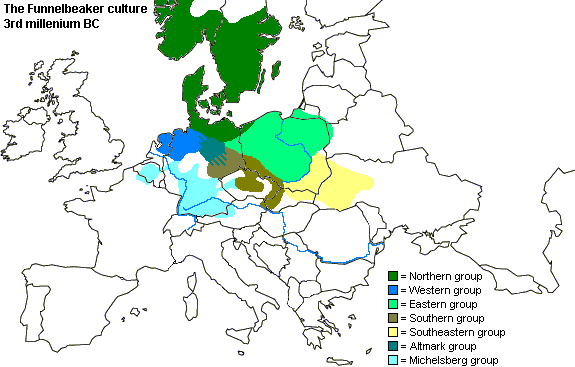
Northern group of the Funnelbeaker culture (dark green) - they could be mostly I1 due to a founder effect:

funnelbeakerculture.gif


Funnelbeaker farmers expanded into areas inhabited by Pitted Ware hunter-gatherers, who were not I1.

We have samples of Y-DNA from Kongemose culture and from Pitted Ware culture - they were all I2a1 and I2c:

http://en.wikipedia.org/wiki/Kongemose_culture

http://en.wikipedia.org/wiki/Pitted_Ware_culture

===============================================

Stone Age Hunter-Gatherer DNA from Scandinavia:

Sweden_DNA.png


Sweden_mt_DNA.png


Another source gives slightly different frequencies for modern haplogroups though:

For U2 - 0,8% (not 0,3)
For U4 - 3,0% (not 2,9)
For U5 - 13,2% (not 12,1)
For K - 7,5% (not 6,4)
For U - 3,3% (not 2,8)
For T2 - 4,3% (not 4,0)

This adds in total 3,6% more to the combined frequency of Hunter-Gatherer haplogroups.

If we apply this alternaive data, then we get 63,2% totally new post-HG branches (instead of 66,8%).
 
As I have speculated before in my "Mesolithic-Neolithic vs. Eneolithic-Bronze Age European DNA", R1a came to Scandinavia with Corded Ware culture (Battle Axe = Corded Ware, it's the same), while R1b came later to Scandinavia, with Bell Beaker culture.

Link to my thread: http://www.eupedia.com/forum/thread...thic-Early-Iron-Age-Y-DNA-landscape-of-Europe

Allentoft's study confirms my assumption.


In my opinion I1 came to Scandinavia before both R1a and R1b.

I1 most certainly came to Scandinavia with Funnelbeaker culture, who were Neolithic farmers.

Why do I think so? Because Funnelbeaker people were direct descendants of earlier LBK culture (also farmers).

And the oldest sample of I1 to date, was found in Hungary in a burial of LBK Transdanubian.
.
Exactly my thoughts too.
 
By "post-Neolithic" that second graph means "post-Pitted Ware hunter-gatherer".

Funnelbeaker farmer immigration is already included in "Other mtDNA" (dark grey).

Of course they could also bring in some of lineages which were already present among hunters.

So the replacement of hunter-gatherer lineages was at least 60% and perhaps greater than 2/3.

====================

Edit:

I think that there already exists some study with samples of Funnelbeaker mtDNA from Scandinavia.
 
That's because you guys apparently keep insisting that the Tarim Mummies weren't Tocharians just because they turned out to be R1a. So if you think that Kentum is inherently linked to R1b, and Satem to R1a, I decided to find an alternative explanation, and - voilà! - I've found it. A Kentumization or a Re-Kentumization could occur in Tocharian.

So if you can't believe that R1a could be Kentum, then maybe you can believe that they were Satem (originally).


And apart from the Kentum character (which could actually be derivative - resulting from [Re-]Kentumization under the influence of local non-IE languages, as Littauer suggests) - what other evidence exists, if any, that Tocharian language was "with a western European origin" ??? And this implies neglecting R1a in Tarim Mummies.

Before Tarim Mummies have turned out to be R1a (which was a few years ago) - if I remember correctly - Eupedia's website was claiming that they were surely Tocharians, that they were most certainly R1b, and that red hair was spread by R1b (because some of them were gingers and were still believed to be R1b at that time).

-

Now after they've turned out to be R1a, all claims get reversed - "no they weren't Tocharians, no, no." :)


I'm sorry no offense in my post, but a re-kentumization after satemization seems to me very weird, according to my lingiuistic experience! linguistic is not electricity nor ahything close to mechanics only - without historical examples wa cannot elaborate theories like it -
seemingly, if I rely upon some surveys, the ancestors of first inhabitants oF Tarim Basin (supposedly got southwards from Afanasyavo) were different from subsequent populations in the same place; I-Eans all of them, but from a different subgroup (the last: Indo6iranians?).
Just my point without considering it as Bible!
 
Then why does it show in the areas were the Iberians lived 60-80% R1b???? Has it ever occurred to you that if Iberians were not R1b, then how did it all that massive R1b DNA get there??? They did not have jets or cars then. Your opinions is all guesses and poor ones at that. The Iberian peninsula has more R1b than France, Germany, and England. This clearly shows that the Iberians (both Celtic and Iberian) are a homogeneous population.

How do you know they were Iron Age people??? You treat the "Iberians" as if they were not important. Yet they occupied almost half the Iberian peninsula and the Celts the other. That's larger than France. So it is obvious that R1b had something to do with the Iberians.

You ought to look again at your %s: Iberian Peninsula doesn't show higher %s of Y-R1b than overall France (except Basque country; common to both), at fist. and soemtimes ago in History Celtic languages occupied larger territories than genuine Iberians.
 
Exactly my thoughts too.

my point is that different subclades of Y-I1 moved to Scandinavia, and a lot of them later than Y-R1a (most of R1a: 2900/2500 BC?). It's hard to link Y-I1 to a time or to a culture only.
I suppose at some time even if issued from different clans, some Y-R1b-U106 and Y-I1 were neighbors south the Baltic, as Y-R1a were.. it's true that if we imagine I-Eans were pure male clans we are obliged to consider Y-I1 came before or after but... hard to become this well represented ligneage in Scandinavia of today.
concerning Tricher-Funnelbeaker culture I think it was a melting pot of diverse influences, and different from place to place. Megaltihers of Atlantic (from where in remote times?), southeast Europeans (LBK) and maybe some Steppes precursors... it's not a bunch of mt-DNA's (present situation) which could learn us too much things.
 
Any thoughts or known genetics for Globular Amphora Culture?

Only mtDNA is available, IIRC.
 
This is autosomal DNA, right?:

Similarity of Corded Ware mostly from Poland + Germany (baCW) and Unetice from Poland + Czech Rep. (baUne) to modern populations:

"Supplementary Figure 2. Example of principal component analysis of individuals subsampled to 10,000 SNPs. Arrows indicate the shift in position for each ancient individual compared to the full dataset."

It is a real shame that Poles were not even included in compared modern populations, given that most of the samples are from Poland.

Anyway - it turns out that modern Croats (cro), Bulgarians (bul), Czechs (cze) and Hungarians (hun) are very similar:

Autosomal.png


I also gathered some info on mtDNA haplogroups:

Lithuania:

RISE 598 LBA Turlojiske remains 1755 - H2a2

Poland:

RISE 1 Corded Oblaczkowo burial E8-A - K1b1a1
RISE 109 Unetice Wojkowice grave 1044 - U4
RISE 139 Unetice Chociwel grave 20/2011 - U2e1f1
RISE 145 Unetice Polwica grave 1603 - H6a1b
RISE 150 Unetice Przeclawice grave 02 - U5a1b1
RISE 154 Unetuce Szczepankowice grave 3 - K1a4a1
RISE 431 Corded/proto-Unetice Leki Male barrow 4 skeleton 2 - T2e

Germany:

RISE 434 Corded Tiefbrunn burial 1/3 - U4
RISE 435 Corded Tiefbrunn burial 2/3 - J1b1a1
RISE 436 Corded Tiefbrunn burial 3/3 - U5b1c2
RISE 446 Corded Bergrheinfeld burial 13 m - J1c1b

Czech Rep.:

RISE 577 Unetice Velke Prilepy F0565, gr. 238 - T2b
RISE 586 Unetice Moravska Nova Ves F0597, gr. 6 - K1b1a
 
BTW - those two willow-green arrows (r505 and r395) are Sintashta and Andronovo respectively. :) The one located above (r395) - almost exactly between Unetice samples from Poland-Czechia and Corded Ware samples from Poland-Germany - is Sintashta.

So Corded Ware, Unetice, modern Croats, modern Czechs, modern Bulgarians, and Proto-Indo-Iranians - were all very similar. :)

Too bad, that modern Poles were not included in the comparison. They would appear somewhere in the vicinity as well.

Czechs are more towards the upper-right corner compared to Croats - they are similar to baSca, or Nordic Bronze Age (violet arrow r98).

So Czechs and Hungarians are Nordic-shifted (shifted towards baSca, or the Nordic Bronze Age) compared to Croats.

By contrast, Ukrainians, Belarusians, Lithuanians, Estonians are shifted to the lower-right end - towards Finns, Mordvins and Russians (you can't see all of the chart, but if I showed more of it towards the lower-right corner, you would see Russians, Finns, Mordvins there).

Bulgarians are more shifted to the left - towards Greeks and Albanians - when compared to Croats.

So where do you think would Poles appear?

Certainly they don't have as much Finno-Ugric admixture as Ukrainians-Belarusians-Lithuanians-Estonians-Russians and not as much Nordic (baSca / Nordic Bronze Age) admixture as Czechs and Hungarians. Certainly also not as much Greek-Albanian as Bulgarians. :)

Poles would appear to the lower-left of Czechs, to the upper-left of Ukrainians-Belarusians and to the right of Bulgarians.

Probably below Croats, maybe to the lower-right of Croats, below Hungarians, quite close to these ancient Polish-Czech-German samples.
 
This is autosomal DNA, right?:

Similarity of Corded Ware mostly from Poland + Germany (baCW) and Unetice from Poland + Czech Rep. (baUne) to modern populations:

"Supplementary Figure 2. Example of principal component analysis of individuals subsampled to 10,000 SNPs. Arrows indicate the shift in position for each ancient individual compared to the full dataset."

It is a real shame that Poles were not even included in compared modern populations, given that most of the samples are from Poland.

Anyway - it turns out that modern Croats (cro), Bulgarians (bul), Czechs (cze) and Hungarians (hun) are very similar:

Autosomal.png


I also gathered some info on mtDNA haplogroups:

Lithuania:

RISE 598 LBA Turlojiske remains 1755 - H2a2

Poland:

RISE 1 Corded Oblaczkowo burial E8-A - K1b1a1
RISE 109 Unetice Wojkowice grave 1044 - U4
RISE 139 Unetice Chociwel grave 20/2011 - U2e1f1
RISE 145 Unetice Polwica grave 1603 - H6a1b
RISE 150 Unetice Przeclawice grave 02 - U5a1b1
RISE 154 Unetuce Szczepankowice grave 3 - K1a4a1
RISE 431 Corded/proto-Unetice Leki Male barrow 4 skeleton 2 - T2e

Germany:

RISE 434 Corded Tiefbrunn burial 1/3 - U4
RISE 435 Corded Tiefbrunn burial 2/3 - J1b1a1
RISE 436 Corded Tiefbrunn burial 3/3 - U5b1c2
RISE 446 Corded Bergrheinfeld burial 13 m - J1c1b

Czech Rep.:

RISE 577 Unetice Velke Prilepy F0565, gr. 238 - T2b
RISE 586 Unetice Moravska Nova Ves F0597, gr. 6 - K1b1a

So, 75% of R1a1 of CW are germans.............do you have a subclade for these?..........all I see is M417
 
Back
Top