• Don't want to see ads? Install an adblocker like uBlock Origin or use a Europe-based privacy-friendly browser like Vivaldi or Mullvad.

If hg. IJ folks were Cro-magnon who were R* folks?

The study didn't really test a large number of people though. Only 25 Kurds were tested.
Kurdish aDNA is well know. I believe new results doesn't change Kurdish aDNA, right?

The closest relatives to Kurds are Persians, Ossetians and than folks in the Caucasus if we can believe aDNA of course.

Ossetians were Alanians, Persians were ancient Persians, while Kurds were ancient Medes, so this whole picture makes sense to me. Persians, Alanians and Medes were brothers to each other.
 
Kurdish aDNA is well know. I believe new results doesn't change Kurdish aDNA, right?

The closest relatives to Kurds are Persians, Ossetians and than folks in the Caucasus if we can believe aDNA of course.

Ossetians were Alanians, Persians were ancient Persians, while Kurds were ancient Medes, so this whole picture makes sense to me. Persians, Alanians and Medes were brothers to each other.

No, I mean maybe more Kurds have R1a1 than the test suggests, since they only tested 25 Kurds.
 
So there you have your answer. Mutation responsible for blue eyes (in Europeans) is benign and heritable, while ocular albinism is a medical condition (you don't like this definition but still :))
So you know for sure which form of mutation he has? Maybe he had Swedish father? How come you're so sure?


https://en.wikipedia.org/wiki/Ocular_albinism
"Also known as Forsius-Eriksson syndrome[8][9] or "Åland Island eye disease", mostly only affects males, though females are often carriers and can sometimes be symptomatic; it is frequently linked with protanopic dichromacy (a form of color blindness) and with night blindness (nyctalopia)."

Are freckles on skin a medical condition too? After all, they are frequently linked with skin cancer.

Kardu, I don't mind if we're wrong, that we are learning through debate, or sometimes a shouting match. What can't settle with me is how sure you are of many things with still limited and almost rudimentary knowledge we poses (we as humans) in these fields.
 
No, I mean maybe more Kurds have R1a1 than the test suggests, since they only tested 25 Kurds.
Of course, it must be so. Because on every aDNA map Kurds and Iranians cluster together.

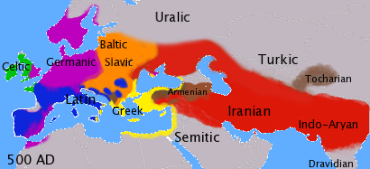
Two Y-DNA haplogroups are supposed to be connected with Iranic peoples: J2 and R1a1.
R1 is more closely linked to Iranians, while R1b is linked to Europeans


http://en.wikipedia.org/wiki/Iranian_peoples

IE1500BP.png


Also mtDNA haplogoup U7 is closely linked to Iranic folks:

"Many European populations lack Haplogroup U7, but its frequency climbs over 4% in the Near East and up to 5% in Pakistan, reaching nearly 10% level in Iranians."

http://en.wikipedia.org/wiki/Haplogroup_U_(mtDNA)#Haplogroup_U7
 
So you know for sure which form of mutation he has? Maybe he had Swedish father? How come you're so sure?


Are freckles on skin a medical condition too? After all, they are frequently linked with skin cancer.

Kardu, I don't mind if we're wrong, that we are learning through debate, or sometimes a shouting match. What can't settle with me is how sure you are of many things with still limited and almost rudimentary knowledge we poses (we as humans) in these fields.

If you check the original discussion above you'll see that I replied on Alan's claim that blue eyes can occur naturally in various parts of the world...
Sure that child on that photo might have a Swedish/European parent, it can be Photoshopped or he most probably has ocular albinism...
 
Talking about colors, blue eyes and blonde hair are very very rare in Kurdistan, while red hair and green eyes are very common in the inland of Kurdistan/Zagros Mountains. So blonde hair and blue eyes are definitely NOT from West Asia!
 
Kurdish aDNA is well know. I believe new results doesn't change Kurdish aDNA, right?

The closest relatives to Kurds are Persians, Ossetians and than folks in the Caucasus if we can believe aDNA of course.

Ossetians were Alanians, Persians were ancient Persians, while Kurds were ancient Medes, so this whole picture makes sense to me. Persians, Alanians and Medes were brothers to each other.

You are mixing linguistics with genetics/ethnic origins.
Ossetians are as much Alans as modern Turks are Oghuz or modern Hungarians - Magyars...
 
You are mixing linguistics withgenetics/ethnic origins.
Ossetians are as much Alans as modern Turks are Oghuz or modern Hungarians -Magyars...
I do understand your feelings as a Georgian and I'm not here to encourage separatism in your country. But South Ossetians are genetically very close to Persians and Kurds.

Btw, I was born in Tbilisi (USSR) and I like Georgians much more than Ossetians or Persians (I don't like Persians at all)!

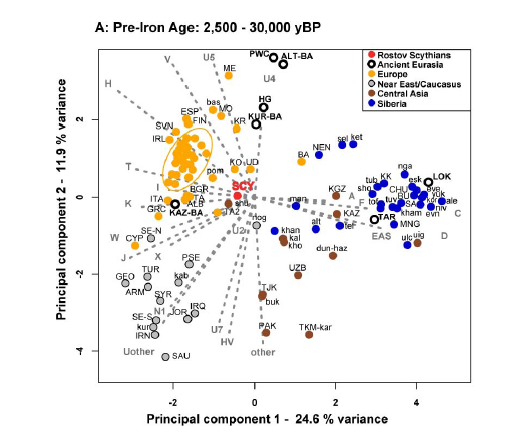
As you can see even on this map South Ossetians (SE-S), Kurds (KUR) and Iranians (IRN) are clustered together.

preironage.png


http://dienekes.blogspot.nl/2012/11/mitochondrial-dna-in-ancient-human.html
 
So, both genetically and linguistically West Iranian nations are very close to each other. Like 3000 years ago; Alanians, Persians and Medes were close to each other! We didn't change that much in the last 3000 years!

IE1500BP.png
 
Y-chromosome variation in Tajiks and Iranians

http://informahealthcare.com/doi/abs/10.3109/03014460.2012.747628


https://fbcdn-sphotos-c-a.akamaihd.net/hphotos-ak-snc7/424863_3823408110088_1311194968_n.jpg

It's interesting to observe that in Persian sample R1a1 is 20.8%, in Tajiks - 30% while among Kurds - 0%

?just recently there was a study (grugni. et al. 2012) which found 20% R1a in Kurds and only some 10% among Persians overall.


May I ask where the samples were token? I suspect its from a group of very isolated Kurds.

Could you please give more informations about it? Could you list the frequency of Haplogroups found in the three groups and from where these samples were taken?
 
Kurdish aDNA is well know. I believe new results doesn't change Kurdish aDNA, right?

The closest relatives to Kurds are Persians, Ossetians and than folks in the Caucasus if we can believe aDNA of course.

Ossetians were Alanians, Persians were ancient Persians, while Kurds were ancient Medes, so this whole picture makes sense to me. Persians, Alanians and Medes were brothers to each other.

The study says, based on aDNA Kurds are considerably different from Persians and Tajiks, this is not really new news. Kurds might be slightly closer to Iranians compared to other groups in the Near East but they are almost equally distinct to them too.


The only weird thing is the frequency of Haplogroup R1a* among this sample. Giving that just recently a study found 20% R1a among Kurds and only some ~10% among Persian speakers. I would like to know where the samples were taken from.

Since I have never seen a study on Kurds with less than ~11% r1a.
 
But I think it's true that we Kurds have less R1a and more J2a than our Iranic cousins in Central Asia.
 
And Tajiks are actually descendants of the Persians mixed with East Eurasian (Mongoloid) tribes.
 
Of course, it must be so. Because on every aDNA map Kurds and Iranians cluster together.

Two Y-DNA haplogroups are supposed to be connected with Iranic peoples: J2 and R1a1.
R1 is more closely linked to Iranians, while R1b is linked to Europeans


http://en.wikipedia.org/wiki/Iranian_peoples

IE1500BP.png


Also mtDNA haplogoup U7 is closely linked to Iranic folks:

"Many European populations lack Haplogroup U7, but its frequency climbs over 4% in the Near East and up to 5% in Pakistan, reaching nearly 10% level in Iranians."

http://en.wikipedia.org/wiki/Haplogroup_U_(mtDNA)#Haplogroup_U7


This is wrong, and how do you come up with R1, this has nothing to do with the thematic. R1b is clustered under R1* too.

R1b is as much "European" as R1a is. you are confusing things. On aDNA maps Kurds do not cluster "together" with Iranians. I dont know what together even means to you. Kurds generally are distinct and have their own cluster which is positioned, by McDonald and Dienekes somewhere in between Iranian, Turkish Georgian and Armenian but slightly leaning to the Iranian cluster if you compare these groups.
 
But I think it's true that we Kurds have less R1a and more J2a than our Iranic cousins in Central Asia.

Less than Tajiks? Yes we have less R1a and more R1b, J2a compared to Tajiks and other Central Asians. But its new to me that we have less than Iranians and even close to 0% according to this study.
 
R1b is as much "European" as R1a is. you are confusing too many things. On aDNA maps Kurds do not cluster "together" with Iranians. I dont know what together even means to you. Kurds generally are distinct and have their own cluster which is positioned, by McDonald and Dienekes somewhere in between Iranian, Turkish Georgian and Armenian but slightly leaning to the Iranian cluster if you compare these groups.
I'm not confusing anyting, I got that from wiki.

Also, of course we Kurds are separated from other groups and form our own genepool and nation, but in general we're closer to Iranians than to other groups. We have some common roots with Persians...
 
Less than Tajiks? Yes we have less R1a and more R1b, J2a compared to Tajiks and other Central Asians. But its new to me that we have less than Iranians and even close to 0% according to this study.
I know. But only 25 samples from Eastern Kurdistan were tested. And it's the first study ever where Kurds lack of R1a.
ALL other studies on Kurds show that R1a together with J2a is the biggest or the second common haplogroup among Kurds. Sometimes J2a is the most common and sometimes is R1a the most common. But according to eupedia I2 and R1b are also very common in Kurdistan.

Btw, the most common haplogroups among Armenians are R1b & J2a and among Assyrians R1b & J1. So J2a has nothing do to with and Semites and their homeland where original Assyrians are from. Original URHEIMAT of proto-Semites was almost Y-DNA hg. J2a free!
 
I'm not confusing anyting, I got that from wiki.

Also, of course we Kurds are separated from other groups and form our own genepool and nation, but in general we're closer to Iranians than to other groups. We have some common roots with Persians...

Thats what I said but you said we cluster together with Iranians which is just not true.

As I said we are distinct to these groups but if you ask which group is closest to us it would be the Iranians which leans more towards us compared to the other groups.

Its like this, lets take a scale from 1-10

Than Armenians would be close as a 7
Georgians as close as a 8
Turks as close as a 8
and Iranians as close as a 9
 
Thats what I said but you said we cluster together with Iranians which is just not true.

As I said we are distinct to these groups but if you ask which group is closest to us it would be the Iranians which leans more towards us compared to the other groups.

Its like this, lets take a scale from 1-10

Than Armenians would be close as a 7
Georgians as close as a 8
Turks as close as a 8
and Iranians as close as a 9
Yes.

The most interesting thing is that Kurds in West (Ottoman occupied) Kurdistan are still closer to Persians than to Turks, Kurds in South and Southwest Kurdistan (former Syria & Iraq) are still closer to Persians than to Arabs from Arabia and Kurds in Eastern (Persian occupied) Kurdistan are closer to other Kurds than to Persians!

This is the only true fact that matters to me. All Kurds from all parts of Kurdistan are the same! :grin:
 

I do understand your feelings as a Georgian and I'm not here to encourage separatism in your country. But South Ossetians are genetically very close to Persians and Kurds.

Btw, I was born in Tbilisi (USSR) and I like Georgians much more than Ossetians or Persians (I don't like Persians at all)!

As you can see even on this map South Ossetians (SE-S), Kurds (KUR) and Iranians (IRN) are clustered together.

preironage.png


http://dienekes.blogspot.nl/2012/11/mitochondrial-dna-in-ancient-human.html
This has nothing to do with separatism and politics. I actually have a very nice daily contact with the admins of Ossetian project and other knowledgeable people from their group.
What I mean is that just because of linguistic data you mistakenly call Ossetians Alans which is not correct. Again are modern Hungarians Magyars? Or modern Turks - Oghuz?
 
Back
Top