• Don't want to see ads? Install an adblocker like uBlock Origin or use a Europe-based privacy-friendly browser like Vivaldi or Mullvad.

Dacian Language

I know that relation exists from mythology...
but I am not really familiar with writings of ancient Greek historians...
when I quote something it is because on internet it is easy to search through books...

ok Celts expand to west dinaric and reach and enter Greece until Aetolia,
Cadmus and Illyrus send them back to monte negro .
creation of illyria ancient Greek generation where the distinguish of celtus places them were noric are found later


their lost, opened the land for liburni etc to inhabit area
that time celts Norici are from N italy to Slovenia to Pannonian area,
later another group the gauls entered in balkans and lose and move to dacia and from there to minor asia

follow greek and strabo
celts 2 times enter the balcans,

and were pushed north to danub
there is celtic blood in balkans more than some think or counter
but as serbian = celtic is deniable neither celtic = serbian
you can not put a name of a slavic intruder to an older pre-intruder or settler, it is unholy
it is like call you ottoman before libertion of Balkans
would you like that?
as serb in 1800 someone to call you ottoman?
Serbian unification is after 600 and is given baltic-slavic colour and culture
that means all the celtic thracian roman and greek are lost as a nation, (not as relics)

that is why Greeks get mad when they hear skopje,

Like i did when hear Dagne without a shame to continue that pan-slavism and name the bugari intruders or traitors as Macedonians,
it is unholy,
 
what Macedonian???????????????
so you come to the Greek -Dona -ona wich means area of same things, same nation people,
Chalki-dona (chalki nation area)
or greek chiken house male Ornith-ona
or area of grapes - ampell-ona
it was about word "gradina"

-din is celtic ending, not Greek


IN MAKEDONIAN THE Word IS -DONA
COMPARE THE MYG-DONA PEOPLE ΜΥΓΔΟΝΕΣ A THRACIAN TRIBE
COMPARE THE MAKEDONIAN CITY CHALKI-DONA
celtic?


now about glava
lets see

Kunos kephalai, Κυνος κεφαλαι known for the battle of romans with Makedonians,
in ancient Makedonian language is Kunos Kevalai κυνος κεβαλαι

in slavic is kuce glava !!!!!!

Κεφαλαι means central area
κeφαλοχωρι means the center village

there can not be a better example

Μακεδονια read it in your language
Dagne is wrong "glava" = head..it is a word, not a suffix...
it may appear (rarely) in the end of word e.g. as part of coin name as in "Triglav" (tri = 3, Triglav is mountain in Slovenia and one of Slavic deities)

you are right
the Greek -Ona -Dona
the North -Dava
the -au
and the Hettit -awa


Nesili language

ahhiy-awa
Milay-awa
Arz-awa
Zalp -uwa

compare it with Wars-awa etc

well, yes, I claim long time on this forum, that Hittite is linked to pre-Balto-Slavic... and Lech (Poles) to Lycia


ok Celts expand to west dinaric and reach and enter Greece until Aetolia,
Cadmus and Illyrus send them back to monte negro .
creation of illyria ancient Greek generation where the distinguish of celtus places them were noric are found later

their lost, opened the land for liburni etc to inhabit area
that time celts Norici are from N italy to Slovenia to Pannonian area,
Russian primary chronicle states that Noricans are also of Slavic origin...

After the flood, the sons of Noah (Shem, Ham, and Japheth) divided the earth among them. To the lot of Shem fell the Orient, and his share extended lengthwise as far as India and breadthwise (i.e., from east to south) as far as Rhinocurura, including Persia and Bactria, as well as Syria, Media (which lies beside the Euphrates River), Babylon, Cordyna, Assyria, Mesopotamia, Arabia the Ancient, Elymais, India,Arabia the Mighty, Coelesyria, Commagene, and all Phoenicia. To the lot of Ham fell the southern region, comprising Egypt, Ethiopia facing toward India, the other Ethiopia out of which the red Ethiopian river flows to the eastward, the Thebaid, Libya as far as Cyrene, Marmar is, Syrtis, and other Libya, Numidia, Massyris, and Maurentania over against Cadiz. Among the regions of the Orient, Ham also received Cilicia, Pamphylia, Mysia,
Lycaonia, Phrygia, Camalia, Lycia, Caria, Lydia, the rest of Moesia, Troas, Aeolia, Bithynia, and ancient Phrygia. He likewise acquired the islands of Sardinia, Crete, and Cyprus, and the river Gihon, called the Nile.
To the lot of Japheth fell the northern and the western sections, including Media, Albania, Armenia (both little and great), Cappadocia, Paphlagonia, Galatia, Colchis, Bosporus, Maeotis, Dervis, Sarmatia, Tauria, Scythia, Thrace, Macedonia, Dalmatia, Molossia, Thessaly, Locris, Pellene (which is also called the Peloponnese), Arcadia, Epirus, Illyria, the Slavs, Lychnitis and Adriaca, from which the Adriatic Sea is named. He received also the islands of Britain, Sicily, Euboea, Rhodes, Chios, Lesbos, Cythera, Zacynthus, Cephallenia, Ithaca, and Corcyra, as well as a portion of the land of Asia called Ionia, the river Tigris flowing between the Medes and Babylon and the territory to the north extending as far as the Pontus and including the Danube, the Dniester, and the Carpathian Mountains, which are called Hungarian, and thence even to the
Dnipro [Dnieper]. He likewise acquired dominion over other rivers, among them the Desna, the Pripet', the Dvina, the Volkhov, and the Volga, which flows eastward into the portion of Shem.
In the share of Japheth lies Rus', Chud, and all the gentiles: Merya, Muroma, Ves', Mordva, Chud beyond the portages, Perm', Pechera, Yam', Ugra, Litva, Zimegola, Kors', Let'gola, and Liv'. The Lyakhs, the Prussians, and Chud border on the Varangian Sea. The Varangians dwell on the shores of that same sea, and extend to the eastward as far as the portion of Shem. They likewise live to the west beside this sea as far as the land of the English and the French. For the following nations also are a part of the race of Japheth: the Varangians, the Swedes, the Normans, the Gotlanders, the Rus', the English, the Spaniards, the Italians, the Romans, the Germans, the French, the Venetians, the Genoese, and so on. Their homes are situated in the
northwest, and adjoin the Hamitic tribes.
Thus Shem, Ham, and Japheth divided the earth among them, and after casting lots, so that none might encroach upon his brother’s share, they lived each in his appointed portion. There was but one spoken language, and as mankind multiplied throughout the earth, they planned, in the days of Yoktan and Peleg, to build a tower as high as heaven itself. Thus they gathered together in the plain of Shinar to build the tower and the city of Babylon round about it. But they wrought upon the tower for forty years, and it was unfinished. Then the Lord God descended to look upon the city and the tower, and said, “This race is one, and their tongue is one.” So the
Lord confused the tongues, and after dividing the people into seventy-two races, he scattered them over the whole world. After the confusion of the tongues, God overthrew the tower with a great wind, and the ruin of it lies between Assur and Babylon. In height and in breadth it is 5400 and 33 cubits, and the ruin was preserved for many years. After the destruction of the tower and the division of the nations, the sons of Shem occupied the eastern regions, and sons of Ham those of the south, and the sons of Japheth the western and the northern lands. Among these seventy-two nations, the Slavic race is derived from the line of Japheth, since they are the Noricians, who are identical with the Slavs.
http://en.wikipedia.org/wiki/Primary_Chronicle
http://www.utoronto.ca/elul/English/218/PVL-selections.pdf

later another group the gauls entered in balkans and lose and move to dacia and from there to minor asia

follow greek and strabo
celts 2 times enter the balcans,

and were pushed north to danub
there is celtic blood in balkans more than some think or counter
but as serbian = celtic is deniable neither celtic = serbian
you can not put a name of a slavic intruder to an older pre-intruder or settler, it is unholy
no offence, but based on ancient DNA, E-V13 and J2 people are intruders in Europe compared to I2a and R1a people...

it is like call you ottoman before libertion of Balkans
would you like that?
as serb in 1800 someone to call you ottoman?
Serbian unification is after 600 and is given baltic-slavic colour and culture
that means all the celtic thracian roman and greek are lost as a nation, (not as relics)

tribal names Serbs, Sherdana, Serdi/Scordisci/Sarbans/Kurds/Sardinians are in my opinion of same origin....
other versions include Zeruiani/Serians/ white Syrians/Cimmerians/Serres...

I do not say all those people = modern Serbs
I say that there is continuity of tribal names and genetics (I2)...
and when I speak of past I speak of proto-Serbs and not of Serbs...


that is why Greeks get mad when they hear skopje,
the reason Greeks are so obsessed with Slavic Macedonians state name is that you fear of teritorial pretensions.... there is no proof or clue that ancient Macedonians (except perhaps for their royal family) were originally of hellenic origin...

it is unholy,
Greeks as most Europeans are rather recent arrival to Europe...
it is questionable even whether Illiad and Odysey are about helenic or about pre-helenic people....

as far as we know Homer may as well be encoded nationality of poet (Gomer, thus Cimmerian/Serian) and not personal name....

Roberto Salinas Price, mexican linguist (known for claim that Troy was not in Asia minor but probably in Bosnia on Neretva river), based his conclusions also on observation that Homer's work looks largely as translated to Greek from some proto-Slavic like language..... on his web sites he explains part of reconstruction...

http://www.homer.com.mx/index.html

I am curious to hear your opinion about reconstruction he makes... but on some new topic...
 
so, in coin "tvrđava" it is clear loan from Dacian
if Lithuanian is Dacian derived, why 'tvirtovė' in Lithuanian and not e.g. "tvirtdava"?

I think you'll agree that the word tvrđava consists of stem tvrd, suffix -av, and ending -a, right?

The stem of the word tverd/t is common for balto-slavic languages (Polish, Russian, Ukrainian, South Slavic, Lithuanian, etc) and in many languages the word "fortress" is derived with a stem "tverd/t", rigth ?

You see, with this overall picture one cannot really claim that Serbian tvrdava was loaned from Dacian dava ... which misses three letters of the stem word tvrd/t that are kept in all other words of this etymology ...
 
are you nuts?

all name toponyms and low class speach is a dialect of Aeolian?
search pella katadesmos,
the reason you Serbs name macedonia that area is to avoid a battle with Bulgarians,
cause macedonians although serbs in gennetic follow Bulgarian culture,
you left north from nis and kossovo and behind again you left a tribe which do not know were it belong and create a fake nation inheritage.

since Makedonians are slavs and enter the 6 th century (I wonder who say that)
or if ancient thracians were pure Balto- slavic then why you try to connect serbs with Celtic,
so Makedonians were thracian = slavic but serbs = celtic so celtic = slavic ?

tomorrow Bulgarians = Balkars = Turks so Turks are slavic !!!! :grin:

And maybe syrria and damascus is Serb to,
 
Greeks as most Europeans are rather recent arrival to Europe...
it is questionable even whether Illiad and Odysey are about helenic or about pre-helenic people....

as far as we know Homer may as well be encoded nationality of poet (Gomer, thus Cimmerian/Serian) and not personal name....

Roberto Salinas Price, mexican linguist (known for claim that Troy was not in Asia minor but probably in Bosnia on Neretva river), based his conclusions also on observation that Homer's work looks largely as translated to Greek from some proto-Slavic like language..... on his web sites he explains part of reconstruction...

Oh come come how yes no... Relax, Slavic peoples and Serbians in particular can be proud of many heroic deeds, but the cradle of European civilisation is Greece. I am afraid it sound banal but it is true ...
And Homer wasn’t Slavic, no hopes for that I am afraid, too…
 
I think you'll agree that the word tvrđava consists of stem tvrd, suffix -av, and ending -a, right?

The stem of the word tverd/t is common for balto-slavic languages (Polish, Russian, Ukrainian, South Slavic, Lithuanian, etc) and in many languages the word "fortress" is derived with a stem "tverd/t", rigth ?

You see, with this overall picture one cannot really claim that Serbian tvrdava was loaned from Dacian dava ... which misses three letters of the stem word tvrd/t that are kept in all other word of this etymology ...

nope, you didnot read my posts carefully....

tvrd+dina = tvrdina ... = strong + celtic ending for town, fortified settlement
tvrd+ava is tvrdava which is quite different from tvrđava

but tvrd + dava = strong + dacian ending for town/fortified settlement
can give tvrđava

those 2 examples in fact suggest that proto-Balto-Slavs may have lived in unfortified villages around Dacian and Celtic fortified settlements/ towns..... so, the word for fortified settlements is imported and joined with word for strong to give word for fortress...


Oh come come how yes no... Relax, Slavic peoples and Serbians in particular can be proud of many heroic deeds, but the cradle of European civilisation is Greece. I am afraid it sound banal but it is true ...
And Homer wasn’t Slavic, no hopes for that I am afraid, too…
oh, there is no doubt about that...
I always emphasize that ancient Greek civilization is foundation of European one...
however, haplogroups dominant in Greeks are genetically much more recent arrivals to Europe than I2a and R1a people... so, when Iapetoc speaks of intruders he should watch his tongue...


all name toponyms and low class speach is a dialect of Aeolian?
search pella katadesmos,
but what year you talk about?

the reason you Serbs name macedonia that area is to avoid a battle with Bulgarians,
cause macedonians although serbs in gennetic follow Bulgarian culture,
you left north from nis and kossovo and behind again you left a tribe which do not know were it belong and create a fake nation inheritage.
nope, Serbs called Macedonia south or old Serbia...
Tito introduced Macedonians as nation, same as he made nation of Monenegers who before him considered themselves elite Serbs, and of Bosnia muslims

since Makedonians are slavs and enter the 6 th century (I wonder who say that)
or if ancient thracians were pure Balto- slavic then why you try to connect serbs with Celtic,
so Makedonians were thracian = slavic but serbs = celtic so celtic = slavic ?
there are two components in genetics of Slavs: R1a and I2a...
I think R1a were originally people like Scythians, Thracians, while I2a were Celtic people - Cimmerians( = Serians = Zeruiani ) /Gomer whose state comprised Scythian/Thracian elements ... I2a2 is highest in Serbs, Croats, Galicia in Ukraine, in Bohemia
Bohemia = land of Celtic Boii, and Galicia being term used for lands of Celts
so why wouldn't Serbs and Croats origin from Scordisci/Serdi and Helvetti?
that fits very well with what Russian primary chronicle suggests about Danubian Slavs moving north when pushed by Vlakhs (roman empire)...

also Seneca says that in Europe Serians live along Danube and rule over scattered Scythians... now note how big is spread of Serians according to Seneca. ..Europe, Serica (northwest China), arc from China to India, Red sea, Caspian highlands...
Bavarian geographer says that state of Zeruiani was so big that all Slavs come from it....
clearly Zeruiani = Serians.... but who are they?

Scythians, Cimmerians and Sarmatians are only 3 big tribes that strech both to Europe and asia
Seneca says Serians rule over Scythians and live unguarded from Sarmatians... this lives Cimmerians as only candidate for Serians...

look at Thraco-Cimmerians findings.... btw. note that Thraco comes from Greek authors thinking that Cimmerians are same as Thracians... and note that The findings are not in south Thrace....but in area along Danube which is in Thrace in area of Triballi (note that byzantine sources occasionally use name Triballi for modern Serbs)
...
Thraco-Cimmerian.png


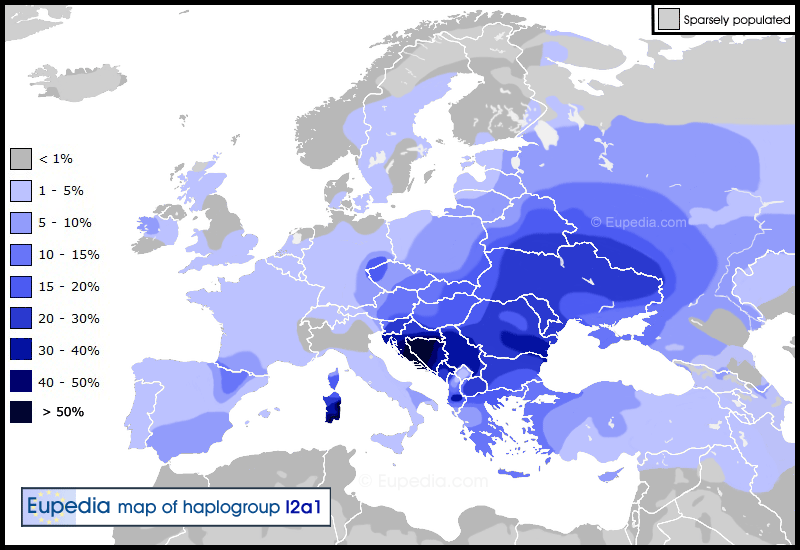
that is I2a spread before west part of it moved towards south to Dalmatia in 6th century... (also earlier as Pannonians)

Haplogroup_I2a.gif


but Cimmerian are original Celts according to Josephus...
Cimmerians = Gomer is practically widely accepted...
and according to Hebrew world Gomer = ancestor of Germanic people
Cappadocia is settled by Cimmerians, hence name Gamir, but in Strabo's time white Syrians live there
and today I2a2 Kurds... so we have clear link Cimmerians-white Syrians-I2a2
now, let's focus on tribal name Gomer... according to Roman historians it is exonym used to denote true Celts

I2a hotspots -Serbs, Croats, Galicia (word derived from Gals = Celts), Bohemia (Celtic Boii)... I2a spread - along Danube...


tomorrow Bulgarians = Balkars = Turks so Turks are slavic !!!! :grin:
I do not think Bulgars were originally turkic actually...
I think they origin from thracians that migrated to north along Black sea shores when pressed by roman empire spread....same as Scordisci/Serdi in my opinion migrated along Danube to Bohemia to come back as white Serbs in 6th century....

you yourself made relation to Vulkan/Hefest...

And maybe syrria and damascus is Serb to,
it is not Serb, but origin of name is related to spread of I2 Serians state that according to Seneca did also reach Red sea...


Oh come come how yes no... Relax, Slavic peoples and Serbians in particular can be proud of many heroic deeds, but the cradle of European civilisation is Greece. I am afraid it sound banal but it is true ...
And Homer wasn’t Slavic, no hopes for that I am afraid, too…

I do not claim that...
renown linguist from neutral country proposes that...
I just say well it is possible...
 
nope, you didnot read my posts carefully....

tvrd+dina = tvrdina ... = strong + celtic ending for town, fortified settlement
tvrd+ava is tvrdava which is quite different from tvrđava

but tvrd + dava = strong + dacian ending for town/fortified settlement
can give tvrđava

those 2 examples in fact suggest that proto-Balto-Slavs may have lived in unfortified villages around Dacian and Celtic fortified settlements/ towns..... so, the word for fortified settlements is imported and joined with word for strong to give word for fortress...


oh, there is no doubt about that...
I always emphasize that ancient Greek civilization is foundation of European one...
however, haplogroups dominant in Greeks are genetically much more recent arrivals to Europe than I2a and R1a people... so, when Iapetoc speaks of intruders he should watch his tongue...


but what year you talk about?


nope, Serbs called Macedonia south or old Serbia...
Tito introduced Macedonians as nation, same as he made nation of Monenegers who before him considered themselves elite Serbs, and of Bosnia muslims


there are two components in genetics of Slavs: R1a and I2a...
I think R1a were originally people like Scythians, Thracians, while I2a were Celtic people - Cimmerians( = Serians = Zeruiani ) /Gomer whose state comprised Scythian/Thracian elements ... I2a2 is highest in Serbs, Croats, Galicia in Ukraine, in Bohemia
Bohemia = land of Celtic Boii, and Galicia being term used for lands of Celts
so why wouldn't Serbs and Croats origin from Scordisci/Serdi and Helvetti?
that fits very well with what Russian primary chronicle suggests about Danubian Slavs moving north when pushed by Vlakhs (roman empire)...

also Seneca says that in Europe Serians live along Danube and rule over scattered Scythians... now note how big is spread of Serians according to Seneca. ..Europe, Serica (northwest China), arc from China to India, Red sea, Caspian highlands...
Bavarian geographer says that state of Zeruiani was so big that all Slavs come from it....
clearly Zeruiani = Serians.... but who are they?

Scythians, Cimmerians and Sarmatians are only 3 big tribes that strech both to Europe and asia
Seneca says Serians rule over Scythians and live unguarded from Sarmatians... this lives Cimmerians as only candidate for Serians...

look at Thraco-Cimmerians findings.... btw. note that Thraco comes from Greek authors thinking that Cimmerians are same as Thracians... and note that The findings are not in south Thrace....but in area along Danube which is in Thrace in area of Triballi (note that byzantine sources occasionally use name Triballi for modern Serbs)
...
Thraco-Cimmerian.png


that is I2a spread before west part of it moved towards south to Dalmatia in 6th century... (also earlier as Pannonians)

Haplogroup_I2a.gif


but Cimmerian are original Celts according to Josephus...
Cimmerians = Gomer is practically widely accepted...
and according to Hebrew world Gomer = ancestor of Germanic people
Cappadocia is settled by Cimmerians, hence name Gamir, but in Strabo's time white Syrians live there
and today I2a2 Kurds... so we have clear link Cimmerians-white Syrians-I2a2
now, let's focus on tribal name Gomer... according to Roman historians it is exonym used to denote true Celts

I2a hotspots -Serbs, Croats, Galicia (word derived from Gals = Celts), Bohemia (Celtic Boii)... I2a spread - along Danube...


I do not think Bulgars were originally turkic actually...
I think they origin from thracians that migrated to north along Black sea shores when pressed by roman empire spread....same as Scordisci/Serdi in my opinion migrated along Danube to Bohemia to come back as white Serbs in 6th century....

you yourself made relation to Vulkan/Hefest...


it is not Serb, but origin of name is related to spread of I2 Serians state that according to Seneca did also reach Red sea...


I do not claim that...
renown linguist from neutral country proposes that...
I just say well it is possible...


you are nuts,

Homeric is written not in slavic not even in Thracian but in Proto Greek
that language is Greco-Persian not even hittite
from that language split the IE Greek the doric and the Aeolian
later that language became unite with Athenean latin-semitic and create greek

Makedonian even at low class speak aeolian epirotan not even word from south slavic or Serbian,

Besides if you at least new a littlle thracian or Greek the suddenly you will understand
Dorieis Trichakes
Bryges Thriikes
city center Trikke

in fact even translated you can not understand hommer
and 4% are guess cause we have lost language,
Homeric is only 20% of modern greek language due to romans and Byzantines,
who f up the language

Besides since you like to play it Celtic and Thracian give the names of primary God and the Orphic religion
I quess you never asked who were the gods of ancient Thracians
cause you stay behind the BIG Slavic family and play it god and now claim that Anatolians were Slavic,

Yes Serbi came from africa to arabia and Sheba kingdom then moved Syria to minor asia by sharpedon then moved to Europe to Scordus mountain, then moved east to caucas to Serbi area then return to Bella serbia and finaly moved to serbia that is today, but before the take a holiday trip to boii
your theory,

Grats

Besides when you talk about intruders you better watch out

G is the oldest in Europe
J2a enters Europe before 8 000 years
so take a look of times and then tell me who is older

No Further expand cause i have to insult if I continue

Simply tell me the names of Thracian gods
and why triballi is no more in use.

besides we are are home erectus or cro magnon?


If slavic is anatolian and hittite
then the order goes like this

Hittite 2000 BC
lycaonians ????
enter balkans and became thracians ok means 1300 BC at least
thracians expand north meet the scythians and the baltic and became slavic
and the returned back to balkans???

is that you are saying?
sambazios is about 900-800 Bc when brygians moved east

older name for Makedonia is Ematheia
I wonder does it means something to you or in Fyroms language?
also Pieria , Pierii is the tribe that makedonians fight
cause it means in another language
 
Last edited:
that implies that Illyrian is somewhat incorporated in (south?) Slavic, because this is very often used suffix in nouns and is used to designate location....
if it was passed via placenames from Illyrians than it wouldnot exist as widely used suffix that designates location.... (read my previous post on this topic)

no, you are wrong, it implies that since illyrian is older than slavic, then the slavs accepted/used/took these illyrian words into the slavic vocabulary. in the Balkan area, because you cannot find these in the MAIN slavic area of Russia
 
only historic contact with Turkey is on that map you show of Poland-Lithuania... which was Balto-Slavic state in which Slavic Poles, Ukrainians and Belarus went under name of Poland... Poles just mean field people.. so any Slavic people can accept that as tribal identity... while real tribal name of Poles is Lech/Lechia (Lyakhs in Russian primary chronicle).... in fact origin may be the same as of Lycians in Asia minor who were also known as Lukka sea peoples... but that originally could have meant mountain people...

words are imported either by conquest or trough trade...
there was no substantial trade between Otoman empire and Poland...
and Poland was never under Ottoman empire...

and if word spread in times of Poland-Lithuania coin state, it would probably exist in Lithuanian as well...

it is very possible that the word comes from Ottomans.... but it also might have been around in Balkan, east Europe and Anatolia before them as well... something to think about is when boots were invented and when Polish people have started using them.... could it be as late as Poland-Lithuania state (1569–1795)?

this map is the years between 1580 - 1610
venice lost cyprus to the ottomans in 1574
Venice regained Dalmatia in 1624
Venice reunited its lands between terafirma ( veneto mainland) and istria ( except trieste) after the war against Austria ( gorizia war of 1614-1617)

So, in the use of it as per the discussion, it is irrelevant, because since Wallachia was a vassal state of the ottomans for centuries via its southern border, wallachia was in contact with the poles or lituatians from the north. Wallachia was the area where lingiustic words/vocabulary where exchanged between the ottomans and the poles/slavs
 
Sory dagne

your thread became again a fighting arena

to return to thread
from ancient times we know a small diference among thracians and dacians
thracian was more towards iranian persian and anatolian while Dacian?

if I accept that dacian is baltic or slavic or germanic etc
and thracian is also slavic baltic germanic
that means romanian is out of discuss and brygian out of discuss
and skudet case means that persians were also slavic
so we make the whole IE just a slavic language
and since slavic = celtic in another tread wow the case goes far,

i believe in a para slavic (that term i learn from taranis, althouth it is a greek word)
or a pre slavic,
or thracians moved north meat the baltic and return south as slavic

as you see all my debates and argue have at least a weak or a strong basis,

in fact I believe that cyrill slavonization is stronger than some of us think or imagine

the nesuli language could help us more in linguistic.

in fact my always question is Brygian
in brygian we find many modern greek ,
many changed today slavic
and enough simmilar to persian iranian

so if Brygians = celtic or germanic or thracian or slavic the situation ballance

by the language of Brygians we find a language that is connected with greek and Iranian but in tottaly different sounds and isotones with south slavic
that means that indeed modern slavic is imported in balkans

the echinos pomaks language has enough greek and slavic but sounds like Greek and follows another grammar than bulgarians
the written thracian words by greeks prove a slavic influence but not that high cause we find many persian and unknown words and some non IE connected with turkish and latin but a small %
the possibilty of thracians = Celtic hmmm I dont know
I believe in pre-slavic or in a para slavic language or towards germanic
but the reconstruction is made after balto-slavic sounds and not thracian or romanian sounds


by the way Lithuania alter name is Lietuva ?
what does it mean?
or after for?
 
ok Celts expand to west dinaric and reach and enter Greece until Aetolia,
Cadmus and Illyrus send them back to monte negro .
creation of illyria ancient Greek generation where the distinguish of celtus places them were noric are found later


their lost, opened the land for liburni etc to inhabit area
that time celts Norici are from N italy to Slovenia to Pannonian area,
later another group the gauls entered in balkans and lose and move to dacia and from there to minor asia

follow greek and strabo
celts 2 times enter the balcans,

and were pushed north to danub
there is celtic blood in balkans more than some think or counter
but as serbian = celtic is deniable neither celtic = serbian
you can not put a name of a slavic intruder to an older pre-intruder or settler, it is unholy
it is like call you ottoman before libertion of Balkans
would you like that?
as serb in 1800 someone to call you ottoman?
Serbian unification is after 600 and is given baltic-slavic colour and culture
that means all the celtic thracian roman and greek are lost as a nation, (not as relics)

that is why Greeks get mad when they hear skopje,

Like i did when hear Dagne without a shame to continue that pan-slavism and name the bugari intruders or traitors as Macedonians,
it is unholy,

You say norici as a linguistic meaning?. because Noricum was where the celtic and illyric languages mixed.
The true illyrian linguistc area was south of the neretva river, going north it was called "proto-dalmatic" which ceased at the liburni and lopsi trbes, these became "proto-venetic". So, in reference to your word norici, historians are still in discussion if the celtic language actually mixed with the "pure" illyric or the slang illyric called venetic
 
Russian primary chronicle states that Noricans are also of Slavic origin...

LOL, russian history must start in 400AD then


no offence, but based on ancient DNA, E-V13 and J2 people are intruders in Europe compared to I2a and R1a people...

No, offence but I2 was before I2a and I2a was same time as E-v13 and J2. Where do you get your bias information from?

the reason Greeks are so obsessed with Slavic Macedonians state name is that you fear of teritorial pretensions.... there is no proof or clue that ancient Macedonians (except perhaps for their royal family) were originally of hellenic origin...

When both greeks and slavs realise that the ancient macedonians no longer exist is when something will be sorted out. They must realise these ancient macedonians ( who are neither greek or slavic ) have disappeared like the ancient illyrians and thracians
 
Sory dagne

your thread became again a fighting arena

When both greeks and slavs realise that the ancient macedonians no longer exist is when something will be sorted out. They must realise these ancient macedonians ( who are neither greek or slavic ) have disappeared like the ancient illyrians and thracians

Quoted for truth, the both of you.

Now, regarding the Norici: from what little is known, they were a Celtic-speaking people akin to the Gauls and the Galatians. There are also very short inscriptions from the region (written in a variety of the Etruscan alphabet) which back this up.

ptuj.2.gif


Furthermore:

- Ptolemy records Celtic town names on the territory of the Norici (for example, "Gobanodurum", "Gesodurum").
- Pliny claims that "Norici" is an other name for "Taurisci"
- Strabo (in book VII, chapter 2.2) states that the Taurisci are Galatians.
 
hahahaha

IE language

Homeric υετος uetos that u is short and mostly to iu you
the land is υετις -δος uetida
ορ υετις -tinthos uetiθα
most proper the first due to (')

In thracian form (as the greek written of thracian grammary)
that is υετουδα uet-ouda
ok it is IE
but uva -uda (ουδα) not d but th
hmm vowel sounds equal !!!!

just for the record of Homer's
ty
 
no, you are wrong, it implies that since illyrian is older than slavic, then the slavs accepted/used/took these illyrian words into the slavic vocabulary. in the Balkan area, because you cannot find these in the MAIN slavic area of Russia

english: construction site
serbian:gradilište
Czech: staveniště
Slovak: staveniska
macedonian:gradilišteto

english: purgatory
serbian: čistilište
russian: chistilishche
macedonian:čistilišteto
bulgarian: chistilishte

I am lazy to search for more words, but suffix exists for sure in Czech....
how can it be in Czech and Serbian, but not in Slovene, Russian... if there was no movement of people from Balkan to Czech republic area as I suggested with Scordisci migrating back to Bohemia under pressure of roman empire and moving back as Serbs later...
 
english: construction site
serbian:gradilište
Czech: staveniště
Slovak: staveniska
macedonian:gradilišteto

english: purgatory
serbian: čistilište
russian: chistilishche
macedonian:čistilišteto
bulgarian: chistilishte

I am lazy to search for more words, but suffix exists for sure in Czech....
how can it be in Czech and Serbian, but not in Slovene, Russian... if there was no movement of people from Balkan to Czech republic area as I suggested with Scordisci migrating back to Bohemia under pressure of roman empire and moving back as Serbs later...

:confused2::confused2::confused2::confused2: whats this mean in regard sto my reference
 
Back
Top