Haplogroup E1b1b (Y-DNA)
The main paternal lineage in North Africa.

|

One Family ProjectThe One Family One World Project is a partnership between Living DNA and Eupedia initiated in 2017. The project aims to map the regional genetic variations of the world with a great level of detail and accuracy in order to improve our understanding of both recent and ancient migrations and see how humans are all connected with one another as one big family. Genetic variations within Nordic & Baltic countriesScandinavian people are less homogeneous genetically than is generally believed. Various studies have shown that the frequency of Y-DNA haplogroups (ancestral paternal lineages) varied considerably between regions and similar patterns are reflected between Scandinavian dialects. Historical and cultural contextLooking at whole genomes, the Danes are genetically intermediary between Swedes and Frisians or North Germans. Within Denmark itself, there is reason to believe that Jutlanders are not identical to Zealanders. Historically Danish Zealand and Swedish Scania formed a single entity. Comparing northern and southern Jutlanders will also shed light on the source population of the Jutes and Angles who migrated to England in the 5th century. In ancient times, Sweden was home to two other distinct tribes: the Goths in what became Götaland and the Swedes in Svealand. The mountainous Dalarna region between Sweden and Norway developed its own dialect after centuries of isolation. It is also the southermost region where Sami is spoken. Iceland and the Faroe Islands were discovered and settled by Vikings of mainly Norwegian origin. However these Norsemen also brought slaves from Scotland and Ireland, and as a result the proportion of Scottish and Irish lineages is considerable, representing maybe 25% of male lineages and 50% of female lineages. The Vikings brought back slaves from Britain and Ireland to Western Norway, where the incidence of British and Irish paternal lineages is now makes up over 10% of the population. The northern half of Norway and Sweden shows a gradient of admixture between the Scandinavian and Sami populations. The Sami are divided in three cultural groups and nine dialects, including three dialects and one cultural group in the Kola peninsula in Russia. The second cultural group corresponds to the North Lapland and Finnish Lapland on the map. The last one ranges from Northern Norway to Dalarna. Five Sami dialects are spoken, including the southern Sami dialect spoken in Trøndelag and Jämtland. Linguistically, Finland is divided between the eastern Savonian dialect and several western dialects. The Swedes have historically settled in large numbers along the western and southern coasts of Finland and Swedish is still spoken today, especially in western Ostrobothnia (displayed under its Swedish name, Österbotten, on the map). The Finnish Lapland is a merger of two Uralic populations, the Finns and Sami. Estonian is a Finnic language that split from Finnish a bit over 1,000 years ago. It has a northern dialect and a southern dialect, which were used to separate the country in two potentially slightly distinct genetic regions. Livonian, a close relative of Estonian, was a language spoken until recently (the last native speaker died in 2013) in Latvia on both sides of the Gulf of Riga. This indicates that the region of Livonia may be home to a population that is a genetic blend of Finnic and Baltic people. The two other historical regions of Latvia are Curonia, where the Old Curonian and Semigallian language was once spoken, and Latgalia, a region which still has its own distinctive dialect. Lithuania is quite homogeneous, but can nevertheless be split in two. The Samogitian dialect spoken in West Lithuania is sometimes considered a separate language. Southwest Lithuania was historically home to the Skalvians, a Baltic tribe related to the Prussians. ObjectiveThe aim of the project is to confirm whether the proposed genetic boundaries are correct, and redefine them if necessary based on the actual genetic data collected from participants in each region. Proposed genetic regions of Nordic and Baltic EuropeOur preliminary research indicates at least 31 areas of Nordic and Baltic countries may have distinct genetic differences. 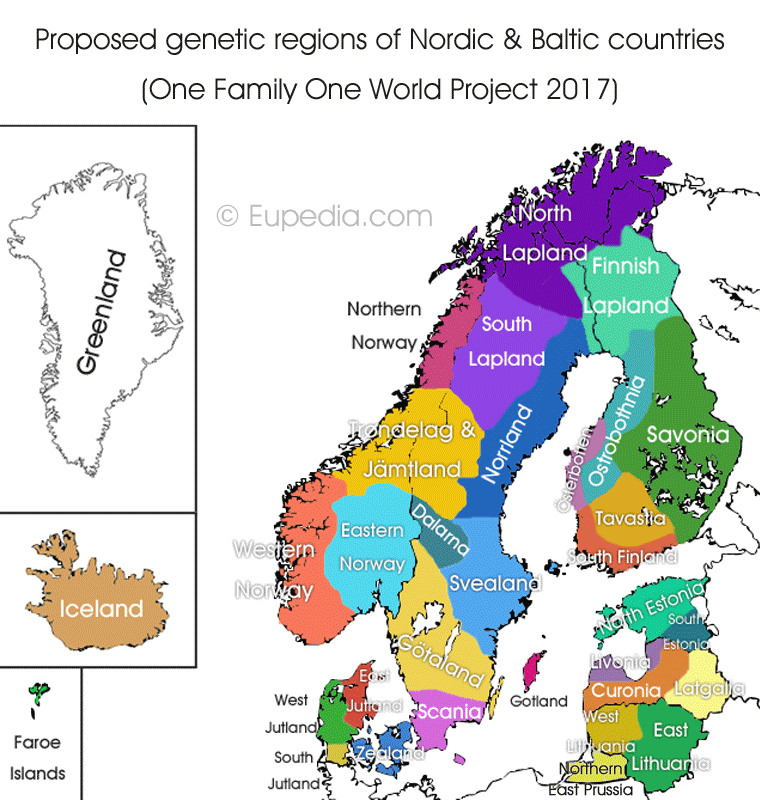
How do I qualify?The One Family project is open to everyone worldwide and has two parts.
If you have already tested with Living DNA, all you need to do to join the project is log into your account, click on the Research tab and choose to participate in our global ancestry research project, if you haven't already done it. If you already tested your DNA with another company (23andMe, AncestryDNA, MyHeritage, or FTDNA's Family Finder), you can join the project here for free. After submitting the form with your family information, you will receive an email to confirm the creation of your Living DNA account and will be asked to upload your genome there for free. If you have not yet tested your DNA with one of the above companies, then you will need to order a Living DNA test to take part. The data provided as part of the project is kept strictly private and confidential under Living DNA’s ISO:27001 certification for information security. Please read Living DNA's Privacy Policy for more information. Haplogroup E1b1b (Y-DNA)
The main paternal lineage in North Africa. Haplogroup I2 (Y-DNA)
The main paternal lineage of Mesolithic Europeans. Haplogroup R1a (Y-DNA)
The dominant paternal lineage in Northeast Europe. Haplogroup H (mtDNA)
The largest European maternal lineage. Neanderthal facts & myths
How much did we inherit from Neanderthals ? Haplogroup G2a (Y-DNA)
The main paternal lineage of Neolithic farmers. Haplogroup J1 (Y-DNA)
The dominant Arabic paternal lineage. Haplogroup R1b (Y-DNA)
The dominant paternal lineage in Western Europe. MtDNA by country
Frequencies by regions in Europe and the Near East. The origins of red hair
Where is it more common? Where did it come from? Haplogroup I1 (Y-DNA)
The original paternal lineage of Nordic Europe. Haplogroup J2 (Y-DNA)
The Greco-Anatolian paternal lineage. Y-DNA Maps
Maps of the main paternal lineage in Europe. Facts about DNA
Fun tutorial about the basics of genetics. Medical DNA
SNP's linked with traits and medical conditions. |
Copyright © 2004-2025 Eupedia.com All Rights Reserved.
|